Key takeaways
- Profound is a well-funded enterprise GEO platform, but its $499+/month pricing and enterprise focus leave most mid-market brands and agencies looking elsewhere.
- The best alternatives split into two camps: monitoring-only tools (cheaper, simpler) and full-stack optimization platforms (more expensive, but actually help you fix visibility gaps).
- Promptwatch is the strongest all-around alternative -- it covers 10+ AI models, includes built-in content generation grounded in citation data, and adds crawler logs, Reddit tracking, and ChatGPT Shopping monitoring that most competitors skip entirely.
- If budget is the primary constraint, tools like Peec AI, Rankscale, and Otterly.AI offer solid entry points starting under $100/month.
- Before picking a tool, decide whether you need monitoring, optimization, or both -- that single decision eliminates half the market.
Profound has raised serious money ($35 million Series B led by Sequoia Capital) and built a genuinely capable platform. If you're a Fortune 500 brand with a dedicated team and a six-figure marketing budget, it probably makes sense. But for everyone else -- agencies, mid-market brands, lean marketing teams -- the price point is hard to justify, and the feature set can feel like more than you need.
The good news is that the GEO and AI visibility space has matured fast. There are now real alternatives that cover the same ground, and in some cases go further, without requiring enterprise contracts.
This guide breaks down 10 of the best Profound alternatives in 2026. We'll cover what each tool does well, where it falls short, and which type of team it suits best.
What Profound actually does (and why people look for alternatives)
Profound tracks how your brand appears across AI search engines -- ChatGPT, Perplexity, Claude, Gemini, and others. Its headline features include "Conversation Explorer" for analyzing AI-generated responses, Agent Analytics for server log analysis, and real-time search volume data. It covers 10+ AI platforms and has strong enterprise integrations.

The friction points that push people toward alternatives:
- Pricing starts at $499/month and scales steeply for larger prompt volumes or multiple brands
- The platform is built for enterprise teams, which means complexity and onboarding overhead for smaller organizations
- Some users find the content optimization layer less developed compared to the monitoring features
- No Reddit or YouTube citation tracking, which matters because AI models frequently cite community discussions
The 10 best Profound alternatives in 2026
1. Promptwatch -- best overall alternative
Promptwatch is the most complete Profound alternative for teams that want more than a monitoring dashboard. Where most tools stop at showing you where you're invisible, Promptwatch is built around fixing it.

The core workflow: Answer Gap Analysis identifies which prompts competitors rank for but you don't. Then a built-in AI writing agent generates articles, listicles, and comparisons grounded in 880M+ citations analyzed -- content engineered to get cited by ChatGPT, Claude, Perplexity, and others. Then page-level tracking shows whether the new content is working.
A few capabilities that stand out versus Profound specifically:
- AI Crawler Logs show which pages ChatGPT, Claude, and Perplexity are actually reading on your site, and which errors they're hitting. Profound has Agent Analytics, but real-time crawler-level logs are rarer.
- Reddit and YouTube citation tracking surfaces the community discussions that AI models frequently pull from -- a channel most competitors ignore.
- ChatGPT Shopping tracking monitors when your brand appears in product recommendations and shopping carousels.
- Prompt Intelligence includes volume estimates, difficulty scores, and query fan-outs that show how one prompt branches into sub-queries.
Pricing is more accessible than Profound: Essential at $99/month, Professional at $249/month, Business at $579/month. A free trial is available.
The one honest caveat: if you're tracking hundreds of prompts across multiple brands, costs scale. But for most teams, the Professional plan at $249/month covers far more ground than Profound's entry tier.
2. Scrunch AI -- best for technical teams
Scrunch AI takes a different angle. Its AXP "Shadow Site" technology creates a parallel version of your content optimized for AI crawlers -- a more infrastructure-level approach than most monitoring tools. It's SOC 2 compliant, which matters for enterprise security reviews.
Coverage spans 7+ platforms including ChatGPT, Claude, and Perplexity. Starting price is around $300/month. It's a strong fit for CTOs and technically-oriented marketing teams who want to control how AI engines interpret their content at a structural level, not just track the results.
The gap versus Promptwatch or Profound: less depth on the analytics and reporting side, and no Reddit/YouTube tracking.
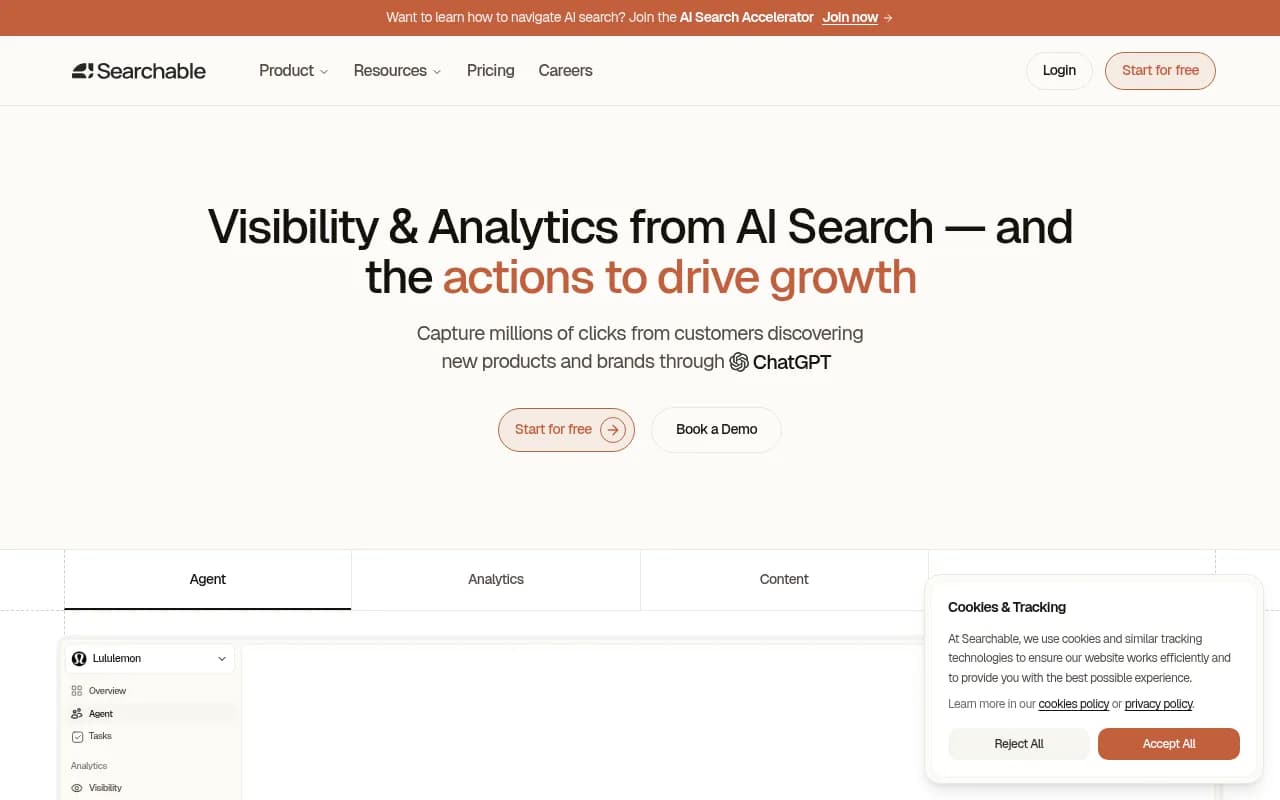
3. Searchable -- best for content-forward teams
Searchable combines AI visibility monitoring with content tools, making it a reasonable middle ground between pure monitoring and full optimization. It's worth evaluating if your team's primary bottleneck is content production rather than technical crawl issues.
4. AthenaHQ -- best for enterprise analytics
AthenaHQ starts at $295/month and covers ChatGPT, Perplexity, Claude, Gemini, and others. Its "Action Center" provides strategic recommendations based on visibility data, which is a step beyond pure monitoring.

That said, AthenaHQ is primarily analytics-oriented. It doesn't generate content or provide the crawler-level data that Promptwatch and Profound offer. For teams that want deep reporting and are comfortable handling content creation separately, it's a solid choice.
5. Peec AI -- best for multilingual and budget-conscious teams
Peec AI starts at €89/month and supports 115+ languages -- a genuine differentiator for global brands tracking visibility in non-English markets. Coverage includes ChatGPT, Perplexity, and AI Overviews, with add-ons available.

It's a monitoring tool, not an optimization platform. You won't get content generation or crawler logs. But if your primary need is tracking AI visibility across multiple languages at a low entry cost, Peec AI is hard to beat on price.
6. Otterly.AI -- best for small teams getting started
Otterly.AI is one of the more accessible entry points in the space. It focuses on monitoring and is straightforward to set up, which makes it a reasonable starting point for teams that are new to GEO and want to understand their baseline visibility before investing in a full platform.

The limitation is the ceiling: Otterly.AI is monitoring-only. There's no content generation, no crawler logs, no Reddit tracking. It's a good first step, not a long-term solution for teams serious about improving their AI visibility.
7. Rankscale -- best for startups
Rankscale starts at $20/month, making it the most affordable option on this list with meaningful feature coverage. It tracks ChatGPT, Claude, Perplexity, and AI Overviews.
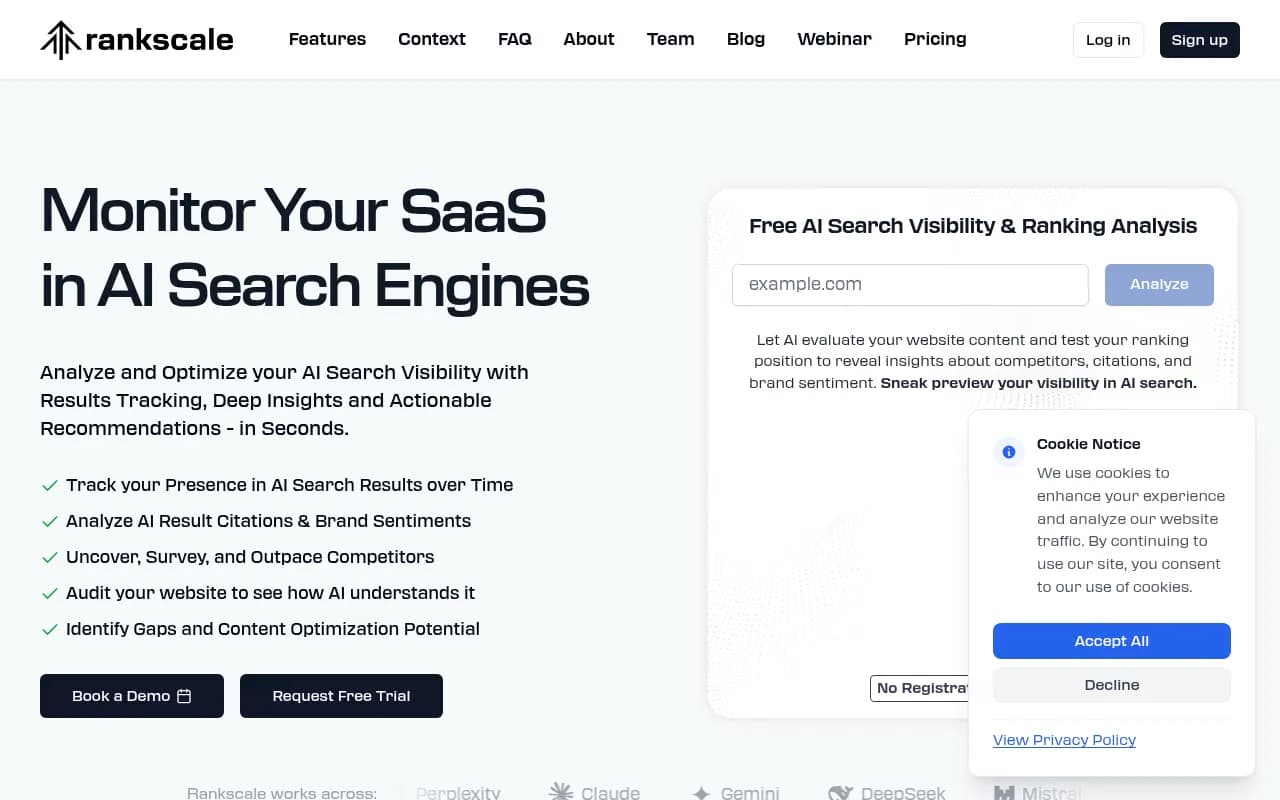
For early-stage companies that need to understand their AI visibility without committing to a larger budget, Rankscale is a sensible starting point. As with most budget tools, the depth of analysis and action capabilities are limited compared to mid-tier platforms.
8. SE Visible -- best for SEO agencies transitioning to GEO
SE Visible (from SE Ranking) integrates AI visibility tracking with traditional SEO data, which makes it particularly useful for agencies that are already using SE Ranking and want to add GEO capabilities without switching platforms entirely.
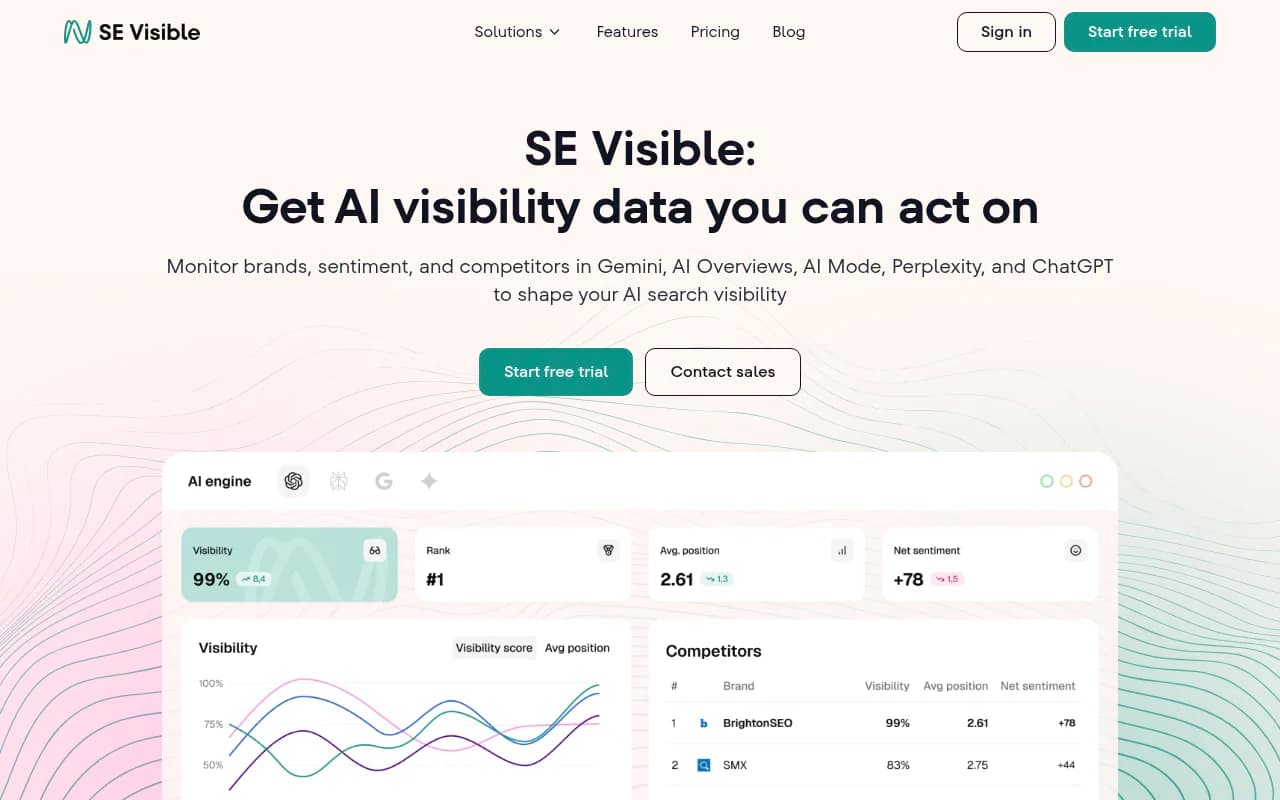
The source detection and SEO data fusion approach is genuinely useful for agencies that need to present unified reporting to clients. It's not the deepest AI visibility tool, but the integration with existing SEO workflows is a real advantage.
9. Ahrefs Brand Radar -- best for existing Ahrefs users
If your team is already in the Ahrefs ecosystem, Brand Radar is the path of least resistance for adding AI visibility tracking. It leverages Ahrefs' massive backlink and search data index, which gives it strong context for understanding why certain sources get cited.
The limitations are real: fixed prompts (you can't customize what gets tracked), no AI traffic attribution, and no content generation. It's a monitoring add-on for Ahrefs users, not a standalone GEO platform.
10. Semrush -- best for teams wanting one platform
Semrush has added AI visibility features to its existing suite, which is appealing if you want to consolidate tools. The trade-off is that Semrush's AI tracking uses fixed prompts and lacks the depth of dedicated GEO platforms.
For teams that prioritize breadth over depth and want traditional SEO and AI visibility in one subscription, Semrush is worth considering. For teams where AI visibility is a primary focus, a dedicated platform will serve you better.
Side-by-side comparison
| Platform | Starting price | AI models covered | Content generation | Crawler logs | Reddit tracking | Best for |
|---|---|---|---|---|---|---|
| Promptwatch | $99/mo | 10+ | Yes (AI writing agent) | Yes | Yes | Teams wanting full optimization loop |
| Profound | $499/mo | 10+ | Limited | Yes (Agent Analytics) | No | Enterprise brands |
| Scrunch AI | $300/mo | 7+ | No | No | No | Technical/infrastructure teams |
| Searchable | Custom | Multiple | Yes | No | No | Content-forward teams |
| AthenaHQ | $295/mo | 8+ | No | No | No | Enterprise analytics |
| Peec AI | €89/mo | 3+ (add-ons) | No | No | No | Multilingual / budget teams |
| Otterly.AI | Low | Multiple | No | No | No | Small teams, getting started |
| Rankscale | $20/mo | 4 | No | No | No | Startups |
| SE Visible | Add-on | Multiple | No | No | No | SEO agencies |
| Ahrefs Brand Radar | Integrated | Multiple | No | No | No | Existing Ahrefs users |
| Semrush | Integrated | Multiple | No | No | No | All-in-one SEO teams |
How to choose the right tool
The single most useful question to ask before evaluating any platform: do you need monitoring, optimization, or both?
Monitoring tools (Peec AI, Otterly.AI, Rankscale, Ahrefs Brand Radar) tell you where you stand. They're cheaper and simpler. They make sense if you're early in your GEO journey and want to establish a baseline, or if your team handles content strategy and creation separately.
Optimization platforms (Promptwatch, Profound, Searchable) go further. They identify gaps, help you create content to fill them, and track whether it worked. They cost more, but the ROI case is clearer because you're not just measuring a problem -- you're fixing it.
A few other considerations:
Budget: If you're under $100/month, Peec AI or Rankscale are the realistic options. $100-300/month opens up Promptwatch's Professional plan, which covers most mid-market needs. Above $300/month, Profound, Scrunch AI, and AthenaHQ become relevant.
Team size and technical depth: Scrunch AI's infrastructure approach requires technical resources to get value from. Profound's full feature set has a real onboarding curve. Promptwatch and SE Visible are designed to be used by marketing teams without engineering support.
Language and geography: If you're tracking visibility in non-English markets, Peec AI's 115-language support is a meaningful differentiator. Most other tools are primarily English-focused.
Existing tool stack: If you're already in Ahrefs or Semrush, their native AI tracking features reduce switching costs, even if they're less capable than dedicated platforms.
The monitoring vs. optimization gap
One pattern worth naming directly: a lot of the tools in this space are monitoring dashboards with optimization branding. They show you that you're invisible for certain prompts. They don't help you become visible.
This matters because visibility gaps in AI search aren't fixed by knowing about them. They're fixed by publishing content that AI models want to cite -- content that answers the specific questions your target customers are asking, structured in ways that AI engines can parse and reference.
The tools that actually close this loop (rather than just measuring it) are the ones worth paying more for. Promptwatch's Answer Gap Analysis plus AI writing agent is the clearest example of this in the current market. Profound has some content optimization capabilities, but the consensus from users is that the monitoring side is more developed.
If your team has the bandwidth to handle content creation separately, a monitoring-only tool at a lower price point is a reasonable choice. If you want the platform to guide and accelerate the content work, the full-stack options are worth the investment.
Final recommendation
For most teams looking to move away from Profound -- or evaluating it before committing -- Promptwatch is the strongest starting point. The pricing is accessible, the feature set covers the full optimization loop, and the capabilities that Profound lacks (Reddit tracking, ChatGPT Shopping, real-time crawler logs) are genuinely useful for understanding how AI models discover and cite your content.
For teams with specific constraints: Peec AI if multilingual coverage at low cost is the priority; Scrunch AI if you have technical resources and want infrastructure-level control; SE Visible if you're an agency already in the SE Ranking ecosystem.
The market is moving fast. Whatever tool you pick, the underlying discipline -- tracking which prompts matter, identifying content gaps, publishing content that AI engines can cite, measuring the results -- is more durable than any single platform.