Key takeaways
- Otterly.AI works well for small teams and solo marketers, but it lacks the content optimization, crawler logs, and multi-site management that enterprise teams need.
- Promptwatch is the strongest all-around alternative: it monitors 10+ AI models, generates content to close visibility gaps, and tracks AI crawler activity on your site -- features most competitors don't offer.
- Profound is the most feature-rich enterprise option but starts at $399/mo for multi-model coverage.
- Evertune is purpose-built for Fortune 500 brand teams that need narrative control across AI engines.
- AthenaHQ is worth considering if native GA4 and Google Search Console integrations are a priority.
- Most tools in this category are monitoring-only dashboards. If you need to actually fix your AI visibility -- not just measure it -- the shortlist gets much shorter.
Otterly.AI has earned its reputation. It's affordable, has a clean interface, and has picked up genuine user love (4.9/5 across 250+ reviews, Gartner Cool Vendor 2025). For a startup or a solo SEO trying to understand how their brand shows up in ChatGPT and Perplexity, it's a reasonable starting point.
But enterprise teams run into its limits pretty quickly.
You can't manage multiple sites cleanly. There's no content generation to act on what you find. Crawler logs -- which tell you when and how AI agents are actually visiting your pages -- aren't there. And when you're trying to brief a VP on AI visibility across six markets and three product lines, a lightweight monitoring dashboard starts to feel like the wrong tool.
This guide covers the best Otterly.AI alternatives for enterprise teams in 2026, with honest assessments of where each one actually delivers.
Where Otterly.AI falls short for enterprise
Before getting into alternatives, it's worth being specific about the gaps -- because "enterprise needs" is vague and different teams hit different walls.
The most common friction points teams report when outgrowing Otterly.AI:
- No content optimization or generation tools. You can see that competitors are getting cited for prompts you're missing, but the platform won't help you create the content to fix that.
- Limited multi-site management. Enterprise teams running multiple brands or regional sites need clean workspace separation, not workarounds.
- No AI crawler logs. Knowing that an AI model isn't citing you is one thing. Knowing why -- whether it's a crawl error, a thin page, or a missing schema -- requires visibility into crawler behavior that Otterly.AI doesn't provide.
- Prompt scale. Enterprise teams typically need hundreds of tracked prompts across multiple personas and geographies. Otterly.AI's pricing tiers cap out in ways that don't fit that use case.
- Reporting and integrations. Stakeholder reporting, BI tool exports, and API access matter at scale. These are areas where more enterprise-focused platforms invest heavily.
With that in mind, here are the platforms worth evaluating.
The best Otterly.AI alternatives for enterprise teams
Promptwatch
Promptwatch is the most complete platform in this category for teams that need to do more than monitor. The core difference from Otterly.AI -- and from most competitors -- is that it's built around an action loop, not just a dashboard.

The workflow goes like this: Answer Gap Analysis shows you exactly which prompts competitors are visible for that you're not. You see the specific content your site is missing. Content Agents then generate articles, comparisons, and briefs grounded in that prompt data -- not generic SEO filler, but content engineered to answer the gaps AI models are already exposing. Then page-level tracking shows you when those pages start getting cited, by which models, and how often.
That cycle -- find gaps, create content, track results -- is what separates Promptwatch from monitoring-only tools.
For enterprise specifically, a few capabilities stand out:
AI Crawler Logs: Real-time logs of when ChatGPT, Claude, Perplexity, and other AI crawlers hit your pages, which pages they read, errors they encounter, and when pages move from crawl to citation. Most competitors don't have this at all.
Prompt Intelligence: Volume estimates and difficulty scores for each prompt, plus query fan-outs that show how one prompt branches into sub-queries. This lets teams prioritize high-value, winnable prompts instead of tracking everything equally.
Multi-site and multi-region: Monitor AI responses in any language, from any country, with customizable personas that match how actual customers prompt. The Business plan covers 5 sites and 350 prompts; agency and enterprise tiers go further.
Traffic attribution: Connects AI visibility to actual revenue, not just citation counts. This is the metric that gets budget approved.
Pricing starts at $99/mo (Essential: 1 site, 50 prompts), $249/mo (Professional: 2 sites, 150 prompts, crawler logs), and $579/mo (Business: 5 sites, 350 prompts, 30 articles/mo). Free trial available.
Profound
Profound is the other name that comes up in almost every enterprise evaluation. It was one of the early movers in AI visibility tracking, and it has some genuinely unique features -- real-user prompt volume data, front-end response capture, and an Amazon Rufus shopping module that most competitors still don't offer.

The main tradeoff is pricing. The Starter plan at $99/mo only covers ChatGPT. Multi-model coverage (Perplexity, Google AIO) starts at $399/mo. Full model breadth -- Claude, Gemini, Grok, and the rest -- requires enterprise pricing that isn't published. At the Growth tier, you're also capped at 100 tracked prompts and 3 user seats, which is tight for a real enterprise deployment.
That said, Profound's data quality is strong. Its front-end response capture methodology tracks what real users see in actual AI interfaces, not just API outputs -- which matters because user-facing answers and citations can differ from what the API returns. G2 Leader status and documented case studies back up its credibility.
Best for: Teams with budget for enterprise pricing who want the deepest data quality and are willing to pay for it.
Evertune
Evertune is purpose-built for large brand teams. Where most GEO platforms are built for SEO practitioners, Evertune is aimed at brand managers and CMOs who need to understand and control how AI engines describe their brand -- not just whether they're cited.
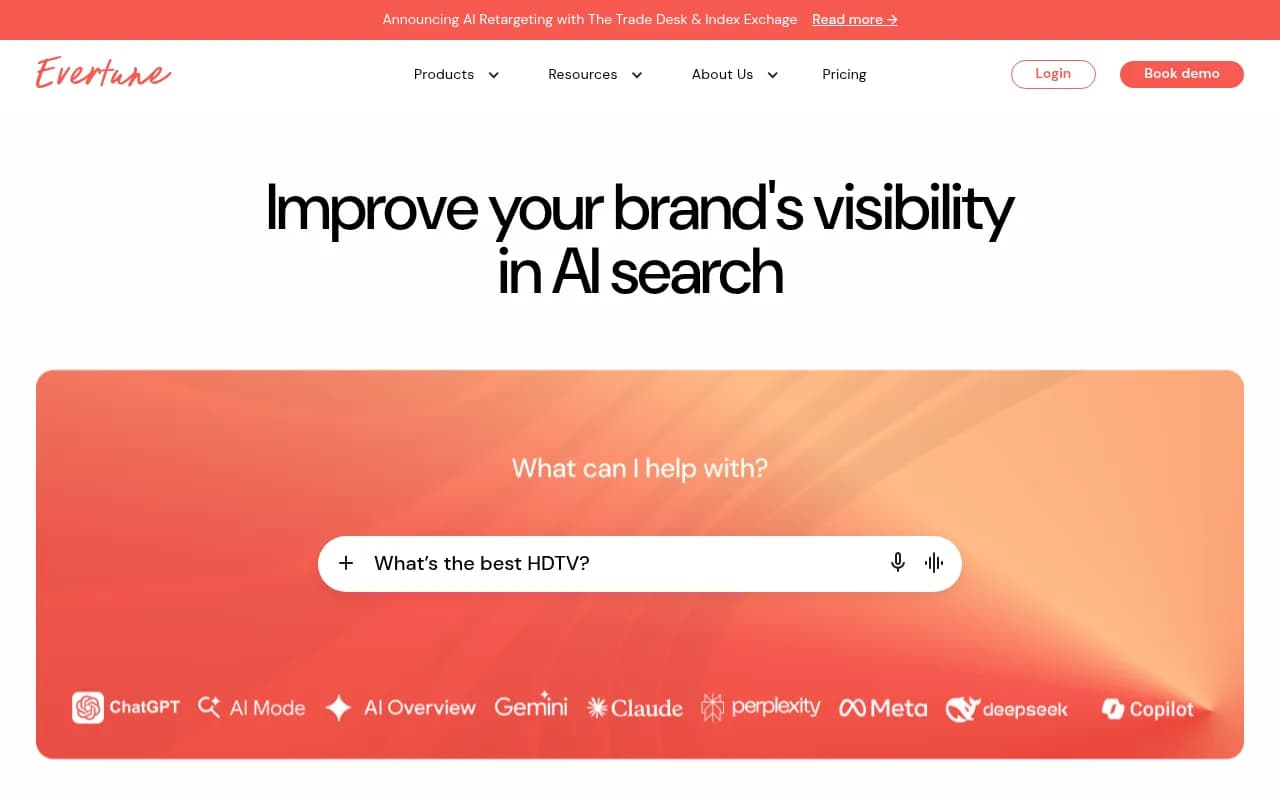
The platform focuses on narrative analysis: what AI models actually say about your brand, how that compares to your brand positioning, and where the gaps are. For Fortune 500 teams managing brand perception across multiple AI engines, that framing is more useful than a citation count dashboard.
It's not the right tool if you need content generation or technical crawler data. But if your primary concern is "how is AI describing us, and is it accurate?" -- Evertune is one of the few platforms built specifically for that question.
Best for: Enterprise brand teams focused on narrative control and brand perception in AI responses.
AthenaHQ
AthenaHQ covers 8+ AI search engines and has built a reputation for clean analytics integrations. Native GA4 and Google Search Console connections are available on the self-serve plan -- something that's surprisingly rare in this category and matters a lot for teams that need to tie AI visibility data to existing reporting stacks.

The platform is monitoring-focused. There's no content generation, and the content optimization tools are lighter than what Promptwatch or Profound offer. But for teams that already have a content workflow and just need reliable visibility data that plugs into their existing dashboards, AthenaHQ is a solid choice.
Best for: Teams that prioritize clean analytics integrations and already have a separate content creation workflow.
Peec AI
Peec AI has raised $30M+ in funding and has built one of the more technically rigorous approaches to AI visibility tracking. Its UI scraping methodology -- tracking what real users see rather than synthetic API responses -- is similar to Profound's front-end capture approach, and it covers 115+ languages, which matters for global enterprise teams.

The multi-language coverage is genuinely impressive and is the clearest differentiator for international brands. If you're monitoring AI visibility across European or Asian markets, Peec AI's language depth is hard to match.
Best for: Global enterprise teams that need multi-language AI visibility tracking at scale.
Scrunch AI
Scrunch AI focuses on AI search visibility monitoring with a clean interface and solid model coverage. It's positioned more toward mid-market than pure enterprise, but it's worth including because it shows up frequently in comparisons and has a cleaner onboarding experience than some of the heavier platforms.
Like most tools in this category, it's primarily a monitoring platform. Content optimization and generation aren't core features. But for teams that want reliable tracking without a steep learning curve, it's a reasonable option.
Best for: Mid-market teams that want clean monitoring without a complex setup.
Semrush AI Visibility Toolkit
If your team already uses Semrush for traditional SEO, the AI Visibility Toolkit is worth evaluating as an add-on rather than a standalone platform. The advantage is obvious: everything lives in one place, and your existing keyword and content data is already there.
The limitation is that Semrush uses fixed prompts rather than dynamic prompt tracking, which means you're monitoring a predetermined set of queries rather than discovering new ones. There's also no AI traffic attribution. For teams that want a single platform for both traditional SEO and AI visibility, it's a pragmatic choice -- just not the deepest option for AI-specific work.
Best for: Teams already on Semrush who want basic AI visibility coverage without adding another tool.
Head-to-head comparison
| Platform | Multi-model coverage | Content generation | Crawler logs | Multi-site | AI traffic attribution | Best for |
|---|---|---|---|---|---|---|
| Promptwatch | 10+ models | Yes (Content Agents) | Yes | Yes (up to 5+) | Yes | End-to-end GEO: monitoring + optimization |
| Profound | 10+ (enterprise tier) | No | No | Yes | No | Deep data quality, Amazon Rufus tracking |
| Evertune | Yes | No | No | Yes | No | Brand narrative control, Fortune 500 |
| AthenaHQ | 8+ models | Limited | No | Yes | No | Analytics integrations (GA4, GSC) |
| Peec AI | Yes | No | No | Yes | No | Multi-language, global teams |
| Scrunch AI | Yes | No | No | Limited | No | Clean monitoring, mid-market |
| Semrush | Limited (fixed prompts) | Via ContentShake | No | Yes | No | Teams already on Semrush |
| Otterly.AI | Yes | No | No | Limited | No | Solo marketers, startups |
How to choose
The honest answer is that the right platform depends on what you actually need to do with the data.
If you're primarily trying to understand your current AI visibility -- where you're cited, how often, by which models -- most of the platforms above will get you there. Profound and Peec AI have the strongest data quality. AthenaHQ has the best analytics integrations. Evertune is the best for brand narrative analysis.
But if you need to actually improve your AI visibility -- not just measure it -- the shortlist gets much shorter. Content generation grounded in real prompt data, crawler logs that show you why AI agents aren't citing your pages, and traffic attribution that connects visibility to revenue are features that most monitoring-only tools simply don't have.
That's the gap Promptwatch was built to fill. The combination of Answer Gap Analysis, Content Agents, and AI Crawler Logs creates a workflow that goes from "we're invisible for these prompts" to "here's the content we published, here's when it got crawled, here's the citation lift" -- all in one platform.
For enterprise teams that need to show ROI on GEO investment, that closed loop matters more than any individual feature.
A note on data quality
One thing worth paying attention to when evaluating any platform in this category: where does the prompt data come from?
Most tools construct their own queries. They guess what users might ask an AI engine, run those prompts, and report the results. The visibility scores you see reflect how AI responds to questions that may or may not reflect actual user behavior.
A few platforms -- Profound, Peec AI, and Promptwatch -- track real user-facing AI responses rather than just API outputs. This matters because user-facing answers, citations, and shopping recommendations can differ meaningfully from what the API returns. If you're making content decisions based on visibility data, the quality of that underlying data affects every downstream decision.
It's worth asking any vendor you evaluate: are you tracking API responses or actual user-facing outputs? The answer tells you a lot about how much to trust the numbers.
Bottom line
Otterly.AI is a fine starting point. But enterprise teams need more than a monitoring dashboard -- they need a platform that helps them act on what they find.
Promptwatch is the strongest option for teams that want the full cycle: find the gaps, create content to close them, track the results. Profound is the right call if data depth is the priority and budget isn't a constraint. Evertune is the specialist choice for brand narrative management. AthenaHQ wins on integrations.
The category is moving fast, and the gap between monitoring-only tools and optimization platforms is widening. The teams that will win in AI search aren't the ones with the best dashboards -- they're the ones that can turn visibility data into published content and measure what happens next.