Key takeaways
- Most content optimization tools score a draft against SERP competitors. Very few of them tell you whether ChatGPT or AI Overviews actually cited the page afterward.
- Promptwatch Data shows ChatGPT cites product pages (22.4%) and landing pages (16.8%) more than any editorial format, so "optimize the blog post" is often the wrong first move.
- Tools fall into three groups: editor-style scorers (Surfer, Clearscope, Frase, MarketMuse), workflow and refresh engines (AirOps, Writesonic), and visibility platforms that close the loop (Promptwatch and similar).
- I have not run a 20-page benchmark for this article, and I would not trust one that couldn't show its pages. Below is a protocol you can run in about six weeks.
- Prices quoted for third-party tools are vendor-published starting prices from a September 2026 roundup. Check them before buying.
A note on the "20 real pages" idea
The honest version of this topic is a test, not a ranking. Plenty of roundups say they tested a tool through a free trial. Trying a trial is not the same as measuring whether a content change got a page cited. I could not find a published dataset that links content scores to AI citations, and Promptwatch has not published one either.
So this guide does two things. It sorts the tools by what they do, using published pricing and first-party citation data. Then it gives you a way to run the 20-page test on your own site, because your pages, your niche, and your crawl access will decide the result more than any tool will.
What actually gets cited in AI search
Before picking a tool, look at what AI engines cite. A content editor that pushes you toward longer, more comprehensive blog posts can be optimizing the wrong format.
In Promptwatch Data's report on ChatGPT citation share by content type (Sep 28 to Oct 4, 2026), the split looked like this:
| Content type | Share of ChatGPT citations |
|---|---|
| Product pages | 22.4% |
| Landing pages | 16.8% |
| Listicles | 13.6% |
| How-to guides | 8.7% |
| Documentation | 7.5% |
| General articles | 6.1% |
| Comparisons | 5.9% |
| News | 5.7% |
| FAQ pages | 3.3% |
| Reviews | 1.7% |
Product and landing pages together are about 39%. For commercial prompts like "best CRM for small businesses," product pages, landing pages, listicles, and comparisons make up almost 70% of citations. For branded prompts, reviews earn 5.6%, more than three times their overall share.
There is also a freshness angle. In Promptwatch's content half-life study, which tracked pages ChatGPT cited on July 6, 2026 for 90 days, 78% of landing pages and 76% of docs were still cited after 30 days. Product pages, reviews, and how-tos reached their half-life after 74 to 77 days. News lost half its pages in 36 days.
Two practical conclusions:
- Your optimization queue should start with product, pricing, and landing pages, not just the blog.
- Product pages and how-tos decay about as fast as each other, so a refresh workflow matters as much as a first-draft score.
The three kinds of tools
The label "AI content optimization tool" covers products that do very different jobs. Mixing them up is why comparison articles feel useless.
Editor-style scorers
These analyze the pages that rank for a keyword and give you a target term list, a heading structure, and a grade. Several now add an AI-search layer on top. They are good at making a draft complete. They cannot tell you whether the finished page got cited.
Workflow and refresh engines
These automate briefs, rewrites, and bulk updates. They shine when you have hundreds of pages to touch. Without a measurement layer, you are scaling edits blind.
Visibility platforms with a content layer
These start from the prompts AI answers, find where you are missing, write or refresh content for those gaps, and then check whether the page was crawled and cited. This group is smaller and newer.
Comparison table
Starting prices come from the VisibilityStack roundup (last updated Sep 30, 2026), which cites vendor pricing. Promptwatch prices are from its pricing page. Confirm everything on the vendor sites.
| Tool | Type | Starting price | Measures AI citations of your pages? |
|---|---|---|---|
| Surfer SEO | Editor-style scorer | From $99/mo | Has an AI search track alongside SERP scoring |
| Clearscope | Editor-style scorer | From $189/mo | Adds an LLM grade to the editor |
| Frase | Brief and scoring | From $49/mo | Dual SEO and GEO scoring |
| MarketMuse | Topic modeling and planning | Not listed in roundup | Adds visibility tracking |
| Writesonic | Writing plus GEO checker | From $79/mo | GEO checker and AI visibility features |
| AirOps | Workflow and refresh engine | From $200/mo | Built for refresh at scale |
| Rankability | Agency content platform | From $79/mo | Covers SEO and AEO |
| AthenaHQ | Tracking plus rewrites | From $295/mo | Passage-level rewrites |
| Promptwatch | Visibility platform with content agents | From $95/mo (Essential) | Yes, down to page-level crawl, citation, and traffic |
The tools, one at a time
Surfer SEO
Surfer is the default choice for teams that already write to a content score. Its NLP term analysis is mature, and it now runs an AI-search track beside the SERP one. If your pages already rank in Google and you want them more complete, it is a sensible add. Judge it by whether the pages you edit gain citations, not by the score going green.
Clearscope
Clearscope is the premium editor, and the price shows it. Editorial teams like the grading and the clean writer experience. The LLM grade is a useful sanity check, but it is a proxy for citation likelihood, not a measurement.

Frase
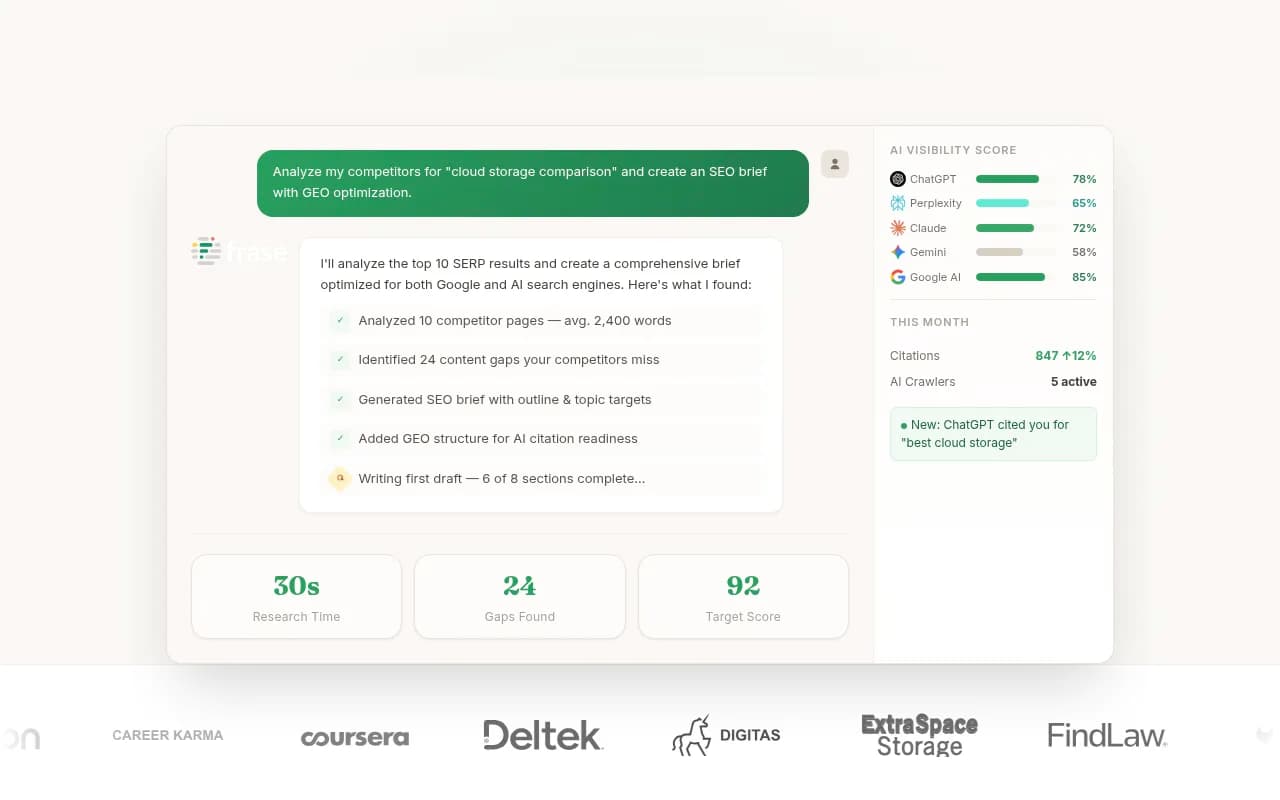
Frase is the cheapest entry in this list that still gives you briefs and dual SEO and GEO scoring. For solo writers and small teams, it covers the basics without a big commitment.
MarketMuse
MarketMuse leans toward topic planning: what to cover, where your topical gaps are, and how pages relate. It helps when the question is "what should we publish" more than "how do I tweak this draft."
Writesonic
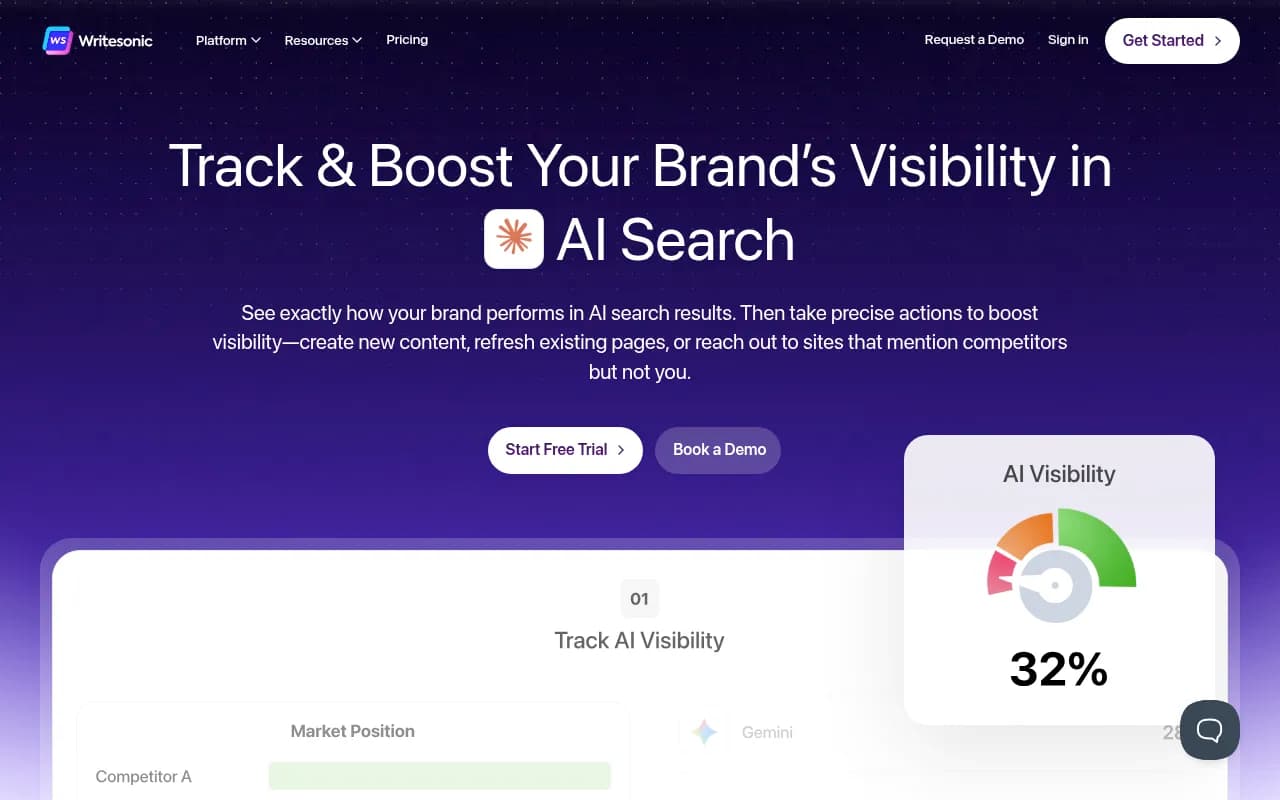
Writesonic writes first and optimizes second, with a GEO checker and an SEO agent bolted on. It suits teams scaling AI-assisted drafts who will edit heavily.
AirOps
AirOps is a workflow builder. If your actual problem is refreshing 300 aging pages with consistent logic, it is the closest fit here. Since product pages and how-tos fade in roughly 75 days according to the half-life data, bulk refresh is a real need.

Rankability and AthenaHQ
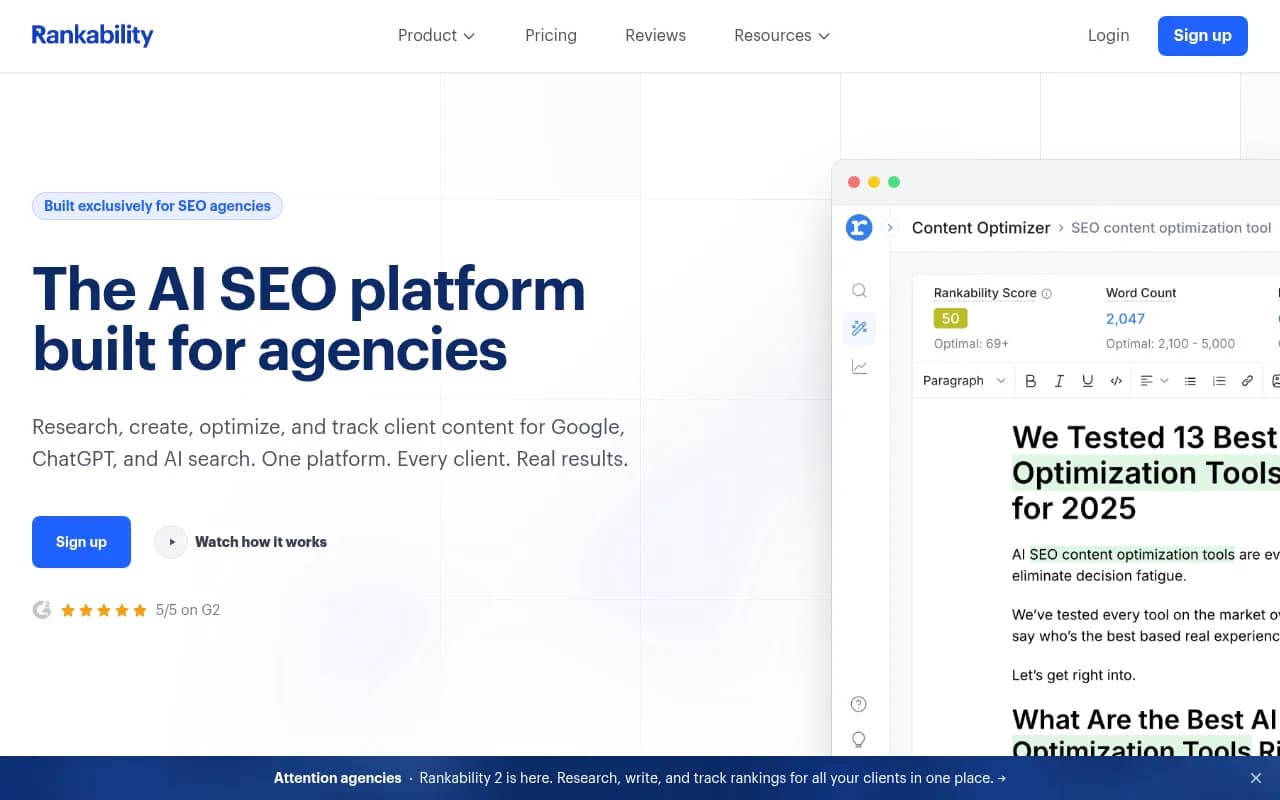
Rankability targets agencies running SEO and AEO across a client portfolio. AthenaHQ sits closer to tracking, with passage-level rewrite suggestions on top.

Promptwatch
Promptwatch is the one on this list that starts from the AI side instead of the SERP side. It tracks prompts across ChatGPT, Google AI Overviews, Gemini, Perplexity, and other engines through their real interfaces, runs a content gap analysis that maps your pages against the prompts AI answers, and then drafts content to fill those gaps. The Content Agent can publish to WordPress, Webflow, or Framer, and Content Refresh gives git-diff-style edits for existing pages.
The part that matters for a test like ours is the measurement. IP-verified AI crawler logs show whether bots read the edited page, Page Tracker shows which prompts cite it, and visitor analytics show whether it sent traffic. That is the chain you need to tell "AI cannot reach the page" apart from "AI reached it and preferred someone else."
Pricing is on the pricing page: Essential is $95/mo, Professional is $245/mo (5 AEO articles, crawler logs), and Business is $579/mo, the first plan with the automated Content Agent. There is a 7-day free trial on monthly billing, and a free AI visibility report if you just want a baseline.

If you want to browse beyond this shortlist, the GEO software directory at bestgeosoftware.com lists a much longer set of visibility and optimization products.
How to run the 20-page test yourself
This is the part most roundups skip. You need a before and after on pages that matter, with a control group, or you will credit the tool for changes that would have happened anyway.
Step 1: pick 20 pages and split them
Choose pages that already get some AI attention or sit in prompts you care about. Mix types, because the citation data says type matters. A reasonable split:
- 6 product or pricing pages
- 4 landing pages
- 6 blog guides, listicles, or comparisons
- 4 docs or FAQ pages
Then divide into two groups of ten that are balanced by type. Group A gets optimized. Group B is left alone for the test window.
Step 2: record a baseline for four weeks
For every page, log the following before touching anything:
- Which tracked prompts cite it, and its position in the source list
- Whether AI crawlers (GPTBot, OAI-SearchBot, ClaudeBot, PerplexityBot) fetched it, and any errors
- Google and Bing impressions and clicks
- AI-referred sessions and conversions
If you cannot get number 2, fix that first. A page blocked by robots.txt or a failing CDN rule will not benefit from any rewrite. The free Agentic Readiness Check and AI crawler URL inspector are quick ways to rule out access problems.
Step 3: use one tool per cohort of pages
Do not stack tools on the same page. If you want to compare two scorers, give each its own five pages. Write down the exact changes the tool recommended and which ones you applied. A tool that gives a 94 score after you ignored half its suggestions has not been tested.
Keep the edits grounded in what the citation data suggests:
- Complete specs, prices, and positioning on product pages, because ChatGPT quotes them directly
- Direct answers near the top of how-tos and docs
- Clear comparison tables on commercial pages
- Visible dates and fresh facts on anything that decays
Step 4: wait, then measure for six weeks
Citations do not move overnight. Give the pages at least six weeks after publishing the edits and make sure the crawlers re-fetched them. Compare Group A against Group B on the same four metrics.
Step 5: score the tools on outcomes
Use a simple table:
| Metric | Group A change | Group B change |
|---|---|---|
| Pages newly cited | ||
| Average source-list position | ||
| AI crawler fetches per page | ||
| AI-referred sessions | ||
| Google clicks |
If Group A does not beat Group B on citations, the tool's score is telling you something about SERP completeness and not about AI retrieval. That is still useful, but it should change how you spend.
Pitfalls to watch for
- Prompt volatility. AI answers vary run to run, so judge on a set of prompts and a trend, not one screenshot.
- Tracking from APIs only. User-facing answers and citations can differ from API output, which is why real-interface tracking matters.
- Optimizing the wrong format. A blog post rewrite will not fix a thin pricing page that AI keeps citing a competitor for.
- Small samples. Twenty pages will show direction, not proof. Repeat with another batch before reorganizing a content program.
- Ignoring third-party sources. Many prompts are answered from review sites and directories, not your pages. Offsite mentions can matter more than another on-page tweak.
Which tool for which job
| If your situation is | Start with |
|---|---|
| Solo writer, tight budget, need briefs | Frase |
| Editorial team already writing to a content score | Surfer SEO or Clearscope |
| Planning topic coverage from scratch | MarketMuse |
| Hundreds of old pages to refresh | AirOps |
| Agency across many clients | Rankability, or a platform with agency plans |
| Need to prove what drives citations, traffic, and conversions | A visibility platform such as Promptwatch |
My own bias is toward measurement first. A scorer without a citation check is a writing aid, and that is fine, but do not pay a visibility-tool price for it. If you can only afford one subscription this quarter, put the money where you can see whether pages get cited, then add an editor if the data says your drafts are the weak point.
Final recommendation
Run the 20-page test before committing to an annual plan. Fix crawler access, optimize product and landing pages first, refresh anything that decays, and compare against untouched controls. Whatever tool wins on your pages is the right one, whatever the roundups say.