Summary
- AI search engines like ChatGPT, Perplexity, and Google AI Mode now influence 40%+ of purchase research journeys for e-commerce buyers
- Most AI visibility tools only monitor citations -- they don't help you fix the gaps or create content that ranks
- E-commerce brands need platforms that connect AI visibility to actual revenue, not just vanity metrics
- Promptwatch leads the category by combining gap analysis, AI content generation, and traffic attribution in one platform
- Budget-conscious DTC brands can start with tools like Otterly.AI or Peec AI for basic monitoring, then graduate to action-oriented platforms as AI search becomes a revenue channel

Why e-commerce brands need AI visibility platforms now
Your customers are asking ChatGPT "best running shoes for flat feet" and Perplexity "affordable organic skincare brands" before they ever see your Google ads or visit your Shopify store. If your brand isn't cited in those AI-generated answers, you're invisible to a growing segment of high-intent buyers.
Traditional SEO tools like Semrush and Ahrefs track Google rankings. They don't show you what ChatGPT recommends when someone asks for product advice. That's the gap AI visibility platforms fill.
But here's the problem: most AI visibility tools are monitoring dashboards. They show you a score, maybe some competitor comparisons, and a list of prompts where you're not mentioned. Then they leave you stuck. You know you're invisible, but you don't know what content to create, which pages to optimize, or whether any of this actually drives sales.
E-commerce brands don't have time for vanity metrics. You need platforms that help you take action and measure results.
What makes an AI visibility platform useful for e-commerce
A good AI visibility platform for e-commerce does three things:
1. Shows you the content gaps
It tells you which product categories, use cases, and buyer questions competitors rank for but you don't. Not just "you have a 23% visibility score" -- specific prompts like "best waterproof hiking boots under $150" where your competitor gets cited and you don't.
2. Helps you create content that ranks in AI
The best platforms don't just identify gaps. They help you fill them. That means AI writing tools trained on citation data, content briefs optimized for LLMs, or at minimum, clear guidance on what to publish.
3. Connects visibility to revenue
You need to know if AI search is actually driving traffic and sales. That means tracking visitors from ChatGPT, Perplexity, and other AI engines, then connecting those visits to conversions in your analytics.
Most tools do #1. A few do #2. Almost none do #3. That's why this guide focuses on platforms built for action, not just monitoring.
The best AI visibility platforms for e-commerce brands
Promptwatch: the only platform built around taking action
Promptwatch is the market leader for a reason. It's the only AI visibility platform that closes the loop from finding gaps to creating content to measuring revenue impact.
Here's how it works:
Answer Gap Analysis shows you exactly which prompts competitors rank for but you don't. You see the specific content your site is missing -- the product comparisons, buying guides, and use case articles AI models want but can't find on your domain.
AI Content Generation creates articles, listicles, and comparison pages grounded in real citation data (880M+ citations analyzed). This isn't generic SEO filler. It's content engineered to get cited by ChatGPT, Claude, Perplexity, and Google AI Mode.
Traffic Attribution connects AI visibility to actual revenue. Install a code snippet, integrate Google Search Console, or analyze server logs to see exactly how many visitors come from AI search engines and what they buy.
Promptwatch also tracks AI crawler logs in real time. You see which pages ChatGPT, Perplexity, and Claude are reading, how often they return, and what errors they encounter. Most competitors don't offer this at all.
Other differentiators:
- Prompt Intelligence: volume estimates and difficulty scores for each prompt, plus query fan-outs showing how one prompt branches into sub-queries
- Reddit & YouTube tracking: surface discussions that directly influence AI recommendations
- ChatGPT Shopping monitoring: track when your products appear in ChatGPT's shopping carousels
- Multi-language & multi-region: monitor AI responses in any language, from any country, with customizable personas
Promptwatch monitors 10 AI models: ChatGPT, Perplexity, Google AI Overviews, Google AI Mode, Claude, Gemini, Meta AI, DeepSeek, Grok, Mistral, and Copilot.
Pricing starts at $99/month (Essential: 1 site, 50 prompts, 5 AI-generated articles). Professional ($249/month) adds crawler logs and state/city tracking. Business ($579/month) scales to 5 sites and 350 prompts. Agency and enterprise plans available.
Best for: E-commerce brands that want to treat AI search as a revenue channel, not a curiosity. If you're serious about ranking in ChatGPT and Perplexity, Promptwatch is the only platform that helps you execute, not just monitor.
Otterly.AI: affordable monitoring for budget-conscious DTC brands
Otterly.AI is one of the most affordable AI visibility tools on the market. It tracks how your brand appears in ChatGPT, Perplexity, Claude, and other AI engines, with basic competitor comparisons and citation tracking.

What it does well: simple setup, clean interface, and pricing that works for small DTC brands. You can monitor a handful of prompts and get email alerts when your visibility changes.
What it doesn't do: content gap analysis, AI content generation, or traffic attribution. Otterly.AI is a monitoring tool. It tells you where you stand, but it doesn't help you improve.
Pricing starts around $49/month for basic monitoring.
Best for: Small DTC brands that want to dip their toes into AI visibility without committing to a full optimization platform. Good for awareness, not execution.
Peec AI: entry-level tracking with multi-language support
Peec AI offers foundational AI visibility tracking across multiple languages and regions. It's designed for small teams and agencies that need simple monitoring without heavy setup.

Peec AI tracks citations, competitor mentions, and basic visibility scores. Multi-language support is a standout feature if you're selling internationally.
Like Otterly.AI, Peec AI is monitoring-focused. You won't find content gap analysis, AI writing tools, or traffic attribution here.
Best for: International DTC brands that need multi-language monitoring on a budget. Not ideal if you want to optimize content or measure revenue impact.
Profound: analyst-driven AI visibility for enterprise teams
Profound is built for enterprise teams with dedicated analysts. It offers raw data, APIs, and near real-time monitoring across AI engines.

Profound's strength is depth. You get granular data on citations, sources, and competitor visibility. The API lets you build custom dashboards and integrate AI visibility data into your existing analytics stack.
The tradeoff: Profound assumes you have the resources to analyze the data and act on it. There's no built-in content generation or optimization workflow. It's a data platform, not an action platform.
Pricing is custom (enterprise-level).
Best for: Large e-commerce brands with in-house analytics teams that want raw data and flexibility. Overkill for small DTC brands.
Writesonic: AI visibility + content execution in one tool
Writesonic combines AI visibility tracking with content creation tools. You can spot gaps in AI search, then use Writesonic's AI writer to create optimized articles.
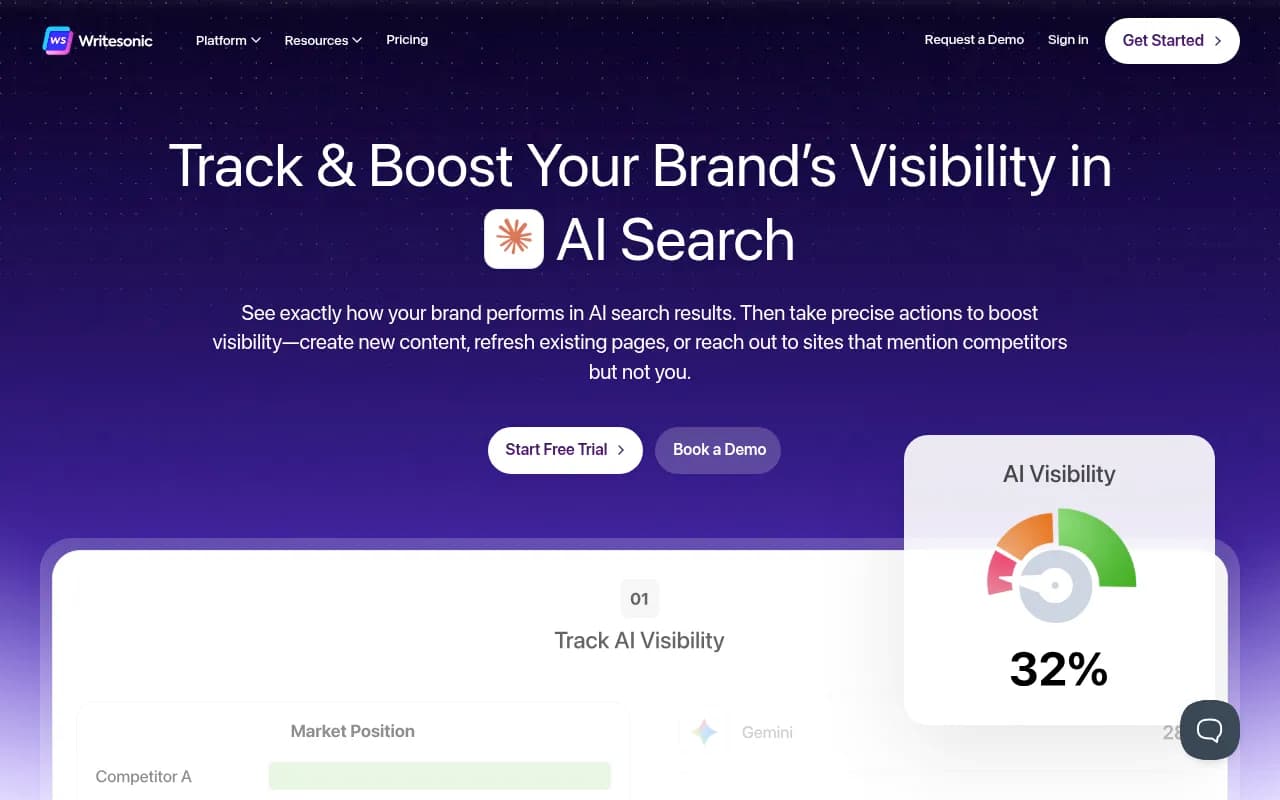
This is appealing for small content teams that want to move fast. The AI writer is trained on SEO best practices and can generate product descriptions, blog posts, and landing pages.
The downside: Writesonic's AI visibility tracking is less sophisticated than dedicated platforms like Promptwatch or Profound. You won't get deep competitive analysis or technical LLM insights.
Best for: Small e-commerce teams that want to publish AI-optimized content quickly without juggling multiple tools. Not ideal if you need enterprise-grade analytics.
SE Ranking: all-in-one SEO platform with AI visibility add-on
SE Ranking is a traditional SEO platform that recently added an AI visibility toolkit. It tracks how your brand appears in AI-generated answers and offers basic competitor comparisons.
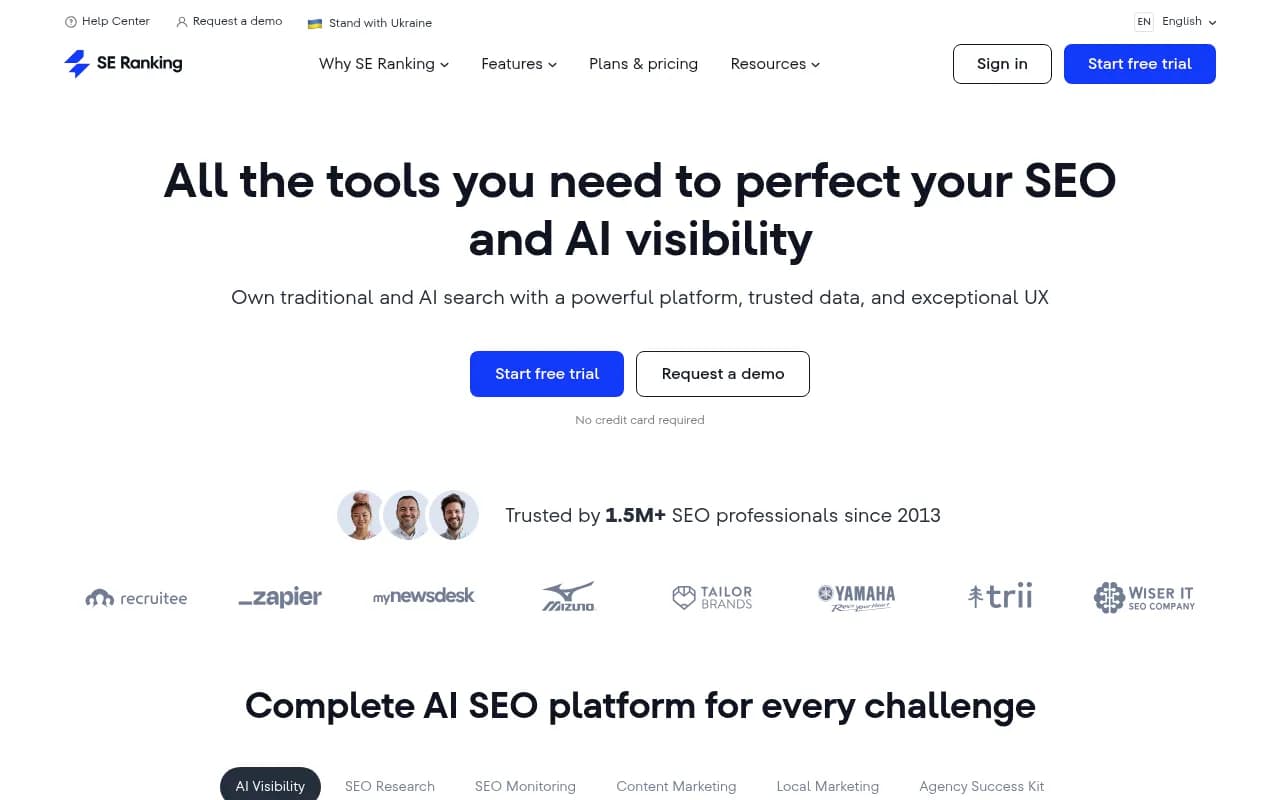
The advantage: if you're already using SE Ranking for keyword research, rank tracking, and site audits, adding AI visibility is seamless. The disadvantage: SE Ranking's AI features are less mature than dedicated platforms. You're getting an add-on, not a purpose-built solution.
Best for: E-commerce brands already using SE Ranking for SEO who want to add basic AI visibility tracking without switching tools.
Semrush: comprehensive digital marketing platform with AI visibility toolkit
Semrush is one of the most widely used SEO platforms in the world. Its AI visibility toolkit tracks brand mentions in AI-generated answers and offers actionable insights.
Semrush's strength is breadth. You get SEO, PPC, content marketing, and AI visibility in one platform. The AI toolkit integrates with Semrush's existing workflows, so you can connect AI visibility to keyword research and content planning.
The limitation: Semrush uses a fixed set of prompts for AI visibility tracking. You can't customize prompts or track niche product categories as granularly as you can with Promptwatch or Profound.
Pricing starts at $139.95/month (Pro plan). AI visibility features are included in higher-tier plans.
Best for: Mid-market e-commerce brands that want an all-in-one marketing platform with AI visibility as part of the package. Not ideal if AI search is your primary focus.
Ahrefs Brand Radar: brand monitoring in AI search results
Ahrefs recently launched Brand Radar, a tool that tracks brand mentions in AI-generated answers. It's an extension of Ahrefs' traditional SEO platform.
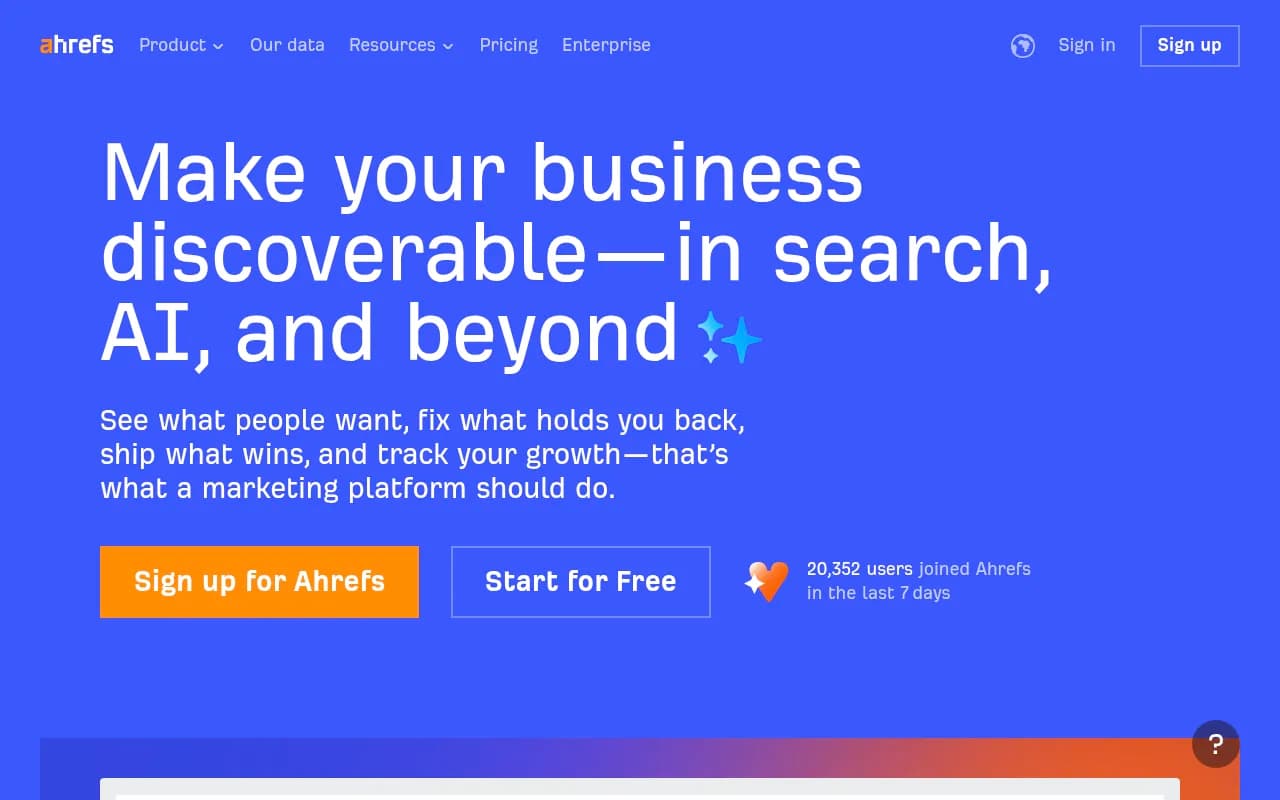
Brand Radar tracks mentions in ChatGPT, Perplexity, and other AI engines. Like Semrush, it uses a fixed set of prompts and doesn't offer custom prompt tracking or content generation.
Ahrefs is best known for backlink analysis and keyword research. Brand Radar is a useful add-on if you're already an Ahrefs customer, but it's not a standalone AI visibility platform.
Best for: E-commerce brands already using Ahrefs for SEO who want basic AI visibility tracking without switching tools.
Comparison table: AI visibility platforms for e-commerce
| Platform | Monitoring | Content gap analysis | AI content generation | Traffic attribution | Starting price |
|---|---|---|---|---|---|
| Promptwatch | Yes | Yes | Yes | Yes | $99/mo |
| Otterly.AI | Yes | No | No | No | $49/mo |
| Peec AI | Yes | No | No | No | ~$50/mo |
| Profound | Yes | Limited | No | No | Custom |
| Writesonic | Yes | Limited | Yes | No | ~$20/mo |
| SE Ranking | Yes | No | No | No | ~$65/mo |
| Semrush | Yes | Limited | No | No | $139.95/mo |
| Ahrefs Brand Radar | Yes | No | No | No | $129/mo |
How to choose the right AI visibility platform for your e-commerce brand
Start with your goal
If you just want to monitor where your brand appears in AI search, tools like Otterly.AI or Peec AI are fine. They're affordable and easy to set up.
If you want to actually improve your AI visibility and drive revenue, you need a platform that helps you take action. That means content gap analysis, AI content generation, and traffic attribution. Promptwatch is the only platform that does all three.
Consider your team size and resources
Small DTC brands with lean teams should prioritize tools that combine monitoring and execution. Promptwatch and Writesonic fit this profile.
Large enterprise teams with dedicated analysts can handle data-heavy platforms like Profound or Semrush.
Think about integration with your existing stack
If you're already using Semrush or Ahrefs for SEO, their AI visibility add-ons are convenient. But don't let convenience stop you from evaluating purpose-built platforms like Promptwatch that offer more depth and action-oriented features.
Measure what matters: revenue, not vanity metrics
A high visibility score means nothing if it doesn't drive traffic and sales. Prioritize platforms that connect AI search to actual business outcomes. Promptwatch's traffic attribution is the gold standard here.
What e-commerce brands should track in AI visibility platforms
Product category visibility
Track how often your brand appears when AI engines answer product category queries like "best wireless earbuds" or "top organic skincare brands." This is the highest-intent traffic.
Competitor comparisons
Monitor prompts where customers compare your brand to competitors ("Brand A vs Brand B"). If you're not cited in these comparisons, you're losing sales.
Use case and buyer intent prompts
Track prompts that signal buying intent, like "best running shoes for flat feet" or "affordable standing desks for small spaces." These are the prompts that convert.
Citation sources
See which pages, Reddit threads, YouTube videos, and domains AI models cite when they mention your brand. This tells you where to publish and what to optimize.
Traffic and conversion from AI search
The ultimate metric: how many visitors come from AI search engines, and how many of them buy. Promptwatch is the only platform that tracks this end-to-end.
Common mistakes e-commerce brands make with AI visibility
Mistake 1: Treating AI visibility as a side project
AI search is not a curiosity. It's a revenue channel. If 40% of your customers are using ChatGPT and Perplexity for product research, you need a real strategy, not a side project.
Mistake 2: Choosing monitoring-only tools
Monitoring tools tell you where you're invisible. They don't help you fix it. E-commerce brands need platforms that close the loop from insight to action.
Mistake 3: Ignoring traffic attribution
A high visibility score is meaningless if you can't connect it to revenue. Prioritize platforms that track traffic from AI search engines and tie it to conversions.
Mistake 4: Focusing on brand mentions instead of product categories
Brand mentions are nice, but product category visibility drives sales. Track prompts like "best X for Y" where customers are actively shopping.
The future of AI search for e-commerce brands
AI search engines are evolving fast. ChatGPT now has shopping carousels. Perplexity is testing affiliate links. Google AI Mode is replacing traditional search results for more queries.
E-commerce brands that invest in AI visibility now will have a massive advantage. The brands that wait will be invisible to a generation of buyers who never click past the AI-generated answer.
The question isn't whether to invest in AI visibility. It's which platform to choose. For most e-commerce brands, the answer is clear: pick a platform that helps you take action, not just monitor. Promptwatch leads that category by a wide margin.
If you're a small DTC brand on a tight budget, start with Otterly.AI or Peec AI for basic monitoring. But plan to graduate to an action-oriented platform like Promptwatch as AI search becomes a meaningful revenue channel. The brands that treat AI visibility as a core marketing discipline will win the next decade of e-commerce.