Key takeaways
- AI-driven referral traffic to e-commerce sites grew 302% in 2025, and 58% of consumers now use generative AI for product discovery instead of traditional search.
- Most AI visibility platforms were built for SEO and content teams -- not for DTC brands tracking individual SKUs, revenue, and product catalog performance.
- The three criteria that actually matter for e-commerce: SKU-level product tracking, revenue attribution, and ecommerce data integration.
- Most monitoring-only tools stop at showing you where you're invisible. The best platforms help you close the gap by generating content that gets cited.
- Platform selection should match your team size, budget, and whether you need brand-level or product-level tracking.
AI search has quietly become one of the most important channels for product discovery -- and most DTC brands are completely unprepared for it.
According to Euromonitor, AI language model-powered search now influences over $595 billion in retail e-commerce. That's not a projection. That's happening now. And yet the majority of DTC brands are still optimizing for Google's blue links while ChatGPT, Perplexity, and Google AI Overviews are answering shopping questions and recommending specific products -- often without the brand's knowledge.
The problem isn't awareness. Most marketing teams know AI search matters. The problem is tooling. The category of "AI visibility platforms" has exploded in 2025-2026, and most of what's out there was designed for SEO agencies tracking brand mentions -- not for e-commerce teams who need to know which SKUs are getting recommended, which aren't, and what to do about it.
This guide cuts through that noise. We've evaluated the leading platforms specifically through the lens of DTC and e-commerce needs, and ranked them by how well they actually cover product visibility -- not just brand name monitoring.
What "product visibility coverage" actually means for e-commerce
Before getting into specific tools, it's worth being precise about what we're measuring. "AI visibility" means different things to different platforms.
For a B2B SaaS company, visibility means: does ChatGPT mention our brand when someone asks about project management software? That's a brand-level question.
For a DTC brand selling skincare, the question is more granular: does Perplexity recommend our SPF 50 moisturizer when someone asks "what's the best daily sunscreen for oily skin"? That's a product-level question -- and most platforms can't answer it.
The three criteria that separate e-commerce-ready platforms from generic monitoring dashboards:
- SKU-level tracking: Does the tool track individual products, or just your brand name? Knowing "our brand appeared in 40 AI answers" is almost useless if you don't know which products are visible and which are invisible.
- Revenue attribution: Can you connect AI visibility to actual sales? Monitoring without attribution is a reporting exercise, not a strategy.
- Ecommerce data integration: Does the tool connect to your product catalog, Shopify store, or conversion data? Or does it sit in a silo?
Keep those three filters in mind as we go through the platforms.
The platforms, ranked
Promptwatch -- best overall for brands that want to act, not just monitor
Promptwatch is the platform that comes up most consistently when you look at what actually moves the needle for brands trying to improve AI visibility -- not just measure it.

The core difference from most competitors: Promptwatch is built around a closed loop. It finds the gaps (which prompts your competitors appear for but you don't), helps you create content to fill those gaps (with a built-in AI writing agent trained on 880M+ real citations), and then tracks whether that content actually gets cited. Most tools in this category do step one and stop there.
For DTC brands specifically, a few capabilities stand out. The Answer Gap Analysis shows you the exact prompts where competitors are visible and you're not -- which is far more actionable than a generic share-of-voice score. The AI crawler logs show you which pages ChatGPT, Claude, and Perplexity are actually reading on your site, which helps you understand why certain products are getting recommended and others aren't. And the ChatGPT Shopping tracking monitors when your brand appears in ChatGPT's product recommendation carousels -- a feature very few platforms offer at all.
Coverage spans 10 AI models: ChatGPT, Perplexity, Google AI Overviews, Google AI Mode, Claude, Gemini, Meta/Llama, DeepSeek, Grok, and Copilot. Pricing starts at $99/month for the Essential tier (1 site, 50 prompts, 5 articles per month), with Professional at $249/month and Business at $579/month. A free trial is available.
The honest limitation: Promptwatch is built for brands and agencies managing their own presence. If you need deep SKU-level catalog integration with Shopify or direct revenue attribution tied to individual product lines, you'll want to pair it with a more commerce-specific tool.
Profound -- strong enterprise option with deep analytics

Profound is one of the more established names in the GEO space and has a genuinely strong feature set -- particularly for enterprise teams that need detailed analytics and structured reporting. It monitors visibility across major AI models and provides competitive benchmarking that's useful for brands operating in crowded categories.
Where it falls short for DTC brands: pricing is on the higher end, there's no Reddit or YouTube tracking (both of which heavily influence AI recommendations), and there's no ChatGPT Shopping monitoring. It's a solid choice for larger teams with dedicated analysts, but smaller DTC brands may find the cost hard to justify relative to what they get.
Otterly.AI -- good starting point, limited depth

Otterly.AI is one of the more affordable entry points into AI visibility monitoring. It's clean, easy to use, and gets you basic brand tracking across a handful of AI models without much setup friction.
The limitation is that it's monitoring-only. There's no content generation, no gap analysis that tells you what to create, no crawler logs, and no visitor analytics. For a DTC brand just getting started with AI visibility and wanting to understand the basics, it's fine. For a brand that wants to actually improve its visibility, you'll hit the ceiling quickly.
Peec AI -- solid for multi-language and multi-region tracking

Peec AI does multi-language AI visibility tracking well, which makes it relevant for DTC brands selling internationally. If you're running campaigns in German, French, or Spanish markets and want to know how AI models in those regions are representing your products, Peec AI is one of the few tools that handles this properly.
It's more limited on the content optimization side -- like Otterly.AI, it's primarily a monitoring platform. But for international DTC brands, the language and region coverage is genuinely useful.
SE Visible -- good for teams already using SE Ranking
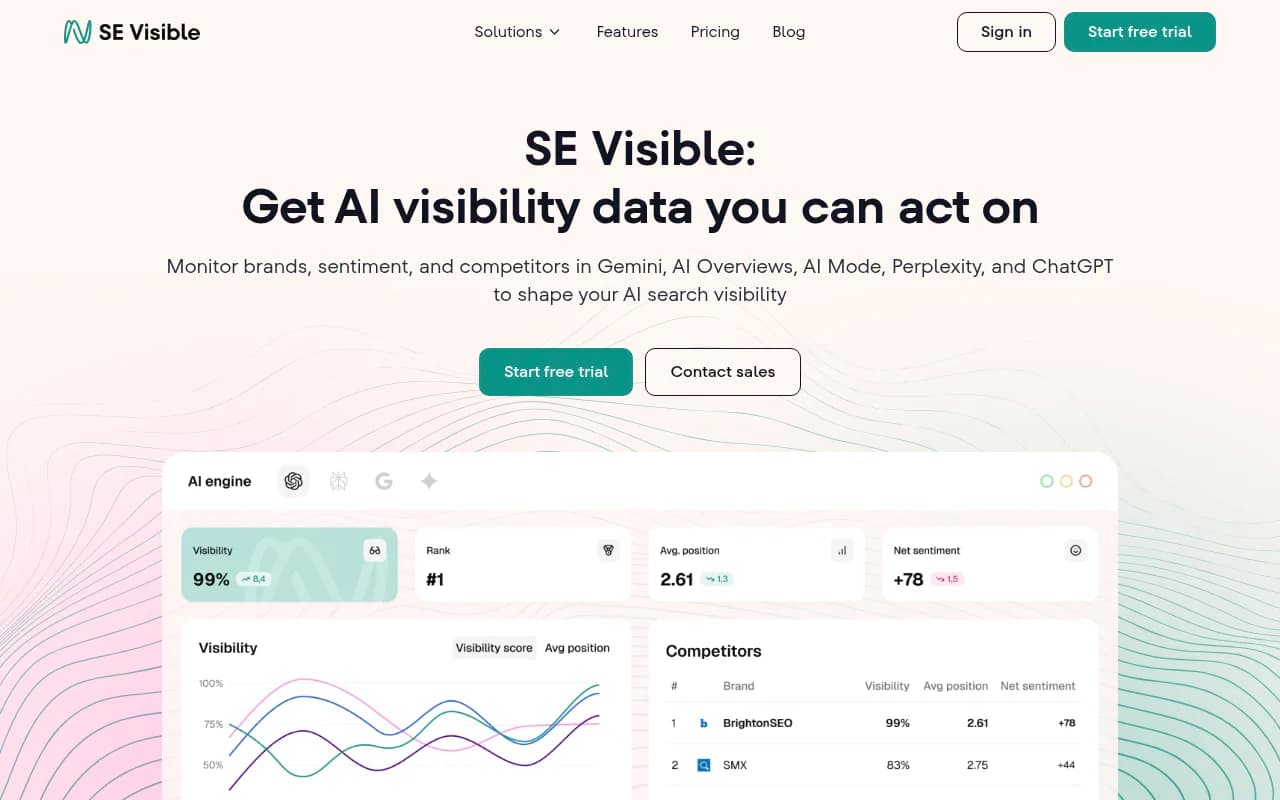
SE Visible is SE Ranking's AI visibility layer, and it integrates naturally if your team is already in the SE Ranking ecosystem. It tracks visibility across AI Overviews and other AI models, and the interface is clean enough for marketers who aren't deeply technical.
The main appeal is consolidation -- if you're paying for SE Ranking already, adding AI visibility tracking in the same platform makes sense. As a standalone AI visibility solution, it's competent but not exceptional.
AthenaHQ -- monitoring-focused with good competitive data

AthenaHQ covers 8+ AI search engines and has decent competitive benchmarking. It's monitoring-focused, which means it tells you where you stand but doesn't help you change it. For DTC brands that have a content team capable of acting on the data independently, that might be enough. For teams that need the full loop, it's a partial solution.
Semrush -- familiar but limited for AI-specific needs
Semrush has added AI visibility features to its existing platform, which is convenient if you're already a customer. The limitation is structural: Semrush uses fixed prompts rather than dynamic prompt generation, which means you're tracking a predetermined set of queries rather than discovering new ones. For DTC brands trying to understand the full range of shopping questions where they could be visible, that's a meaningful constraint.
It's also worth noting there's no AI traffic attribution in Semrush's AI visibility toolkit, which makes it hard to connect AI visibility to actual revenue impact.
LLMrefs -- strong for SEO teams transitioning to GEO
LLMrefs takes an interesting approach: it starts from the keywords you already track and automatically generates realistic conversational prompts around them, then monitors how AI models respond. This makes it a natural bridge for SEO teams that understand keyword strategy and want to extend that into AI search.
For DTC brands with existing SEO programs, this workflow is intuitive. The share-of-voice and citation count metrics are solid. It's less purpose-built for e-commerce than some alternatives, but the keyword-centric workflow is genuinely useful.
Azoma -- purpose-built for AI shopping channels
Azoma is worth calling out specifically because it focuses on AI shopping optimization -- ChatGPT's shopping features, Amazon's Rufus AI, and similar commerce-specific AI surfaces. If your DTC brand sells through Amazon or relies heavily on ChatGPT Shopping recommendations, Azoma is one of the few tools built specifically for that use case.
It's more specialized than a full GEO platform, but for brands where AI shopping carousels are a primary acquisition channel, that specialization is valuable.
Nightwatch -- rank tracking with AI search added
Nightwatch is primarily a rank tracking tool that has added AI search monitoring. If your team lives in rank tracking dashboards and wants AI visibility data in the same place, it's a reasonable option. It's not a GEO-first platform, but the AI monitoring features are functional.
Feature comparison: what each platform actually does
| Platform | SKU-level tracking | Content generation | Crawler logs | ChatGPT Shopping | Revenue attribution | Multi-language | Price starts at |
|---|---|---|---|---|---|---|---|
| Promptwatch | Partial | Yes | Yes | Yes | Yes (GSC + snippet) | Yes | $99/mo |
| Profound | No | No | No | No | No | Limited | Higher |
| Otterly.AI | No | No | No | No | No | Limited | Low |
| Peec AI | No | No | No | No | No | Yes | Mid |
| AthenaHQ | No | No | No | No | No | Limited | Mid |
| SE Visible | No | No | No | No | No | Limited | Mid |
| Semrush | No | Partial | No | No | No | Yes | High |
| LLMrefs | No | No | No | No | No | Limited | Mid |
| Azoma | Yes (shopping) | No | No | Yes | Partial | Limited | Mid |
| Nightwatch | No | No | No | No | No | Limited | Low |
A few things jump out from this table. First, SKU-level tracking is almost universally missing -- most platforms track brand mentions, not individual products. Second, content generation is rare. Third, ChatGPT Shopping tracking is nearly nonexistent outside of Promptwatch and Azoma.
For DTC brands, the gap between what these tools offer and what e-commerce teams actually need is real. The workaround most teams use: combine a full-stack GEO platform (for gap analysis and content optimization) with a more commerce-specific tool (for SKU tracking and catalog integration).
How AI search actually works for product discovery
Understanding why your products do or don't appear in AI recommendations requires understanding how these models work -- at least at a high level.
AI models like ChatGPT and Perplexity don't index the web the way Google does. They're trained on large datasets, and they retrieve information through a combination of their training data and real-time web retrieval (for models with browsing capabilities). When someone asks "what's the best protein powder for muscle gain," the model generates a response based on what it's seen in training data, what it retrieves from the web, and what sources it finds credible.
This means a few things for DTC brands:
Content structure matters more than keyword density. AI models are looking for clear, authoritative answers to specific questions. A product page that lists features isn't as useful to an AI model as a page that directly answers "who is this product for and why is it better than alternatives."
Third-party citations matter a lot. AI models heavily weight content from sources they consider authoritative -- review sites, Reddit discussions, YouTube videos, editorial coverage. A brand that's only optimizing its own website is missing most of the picture. The sources that influence AI recommendations are often off your own domain.
Crawl access is a prerequisite. If AI crawlers can't access your pages -- due to robots.txt rules, JavaScript rendering issues, or server errors -- your content can't be cited regardless of how good it is. This is why crawler log monitoring is more important than it might seem.
Prompt specificity drives product-level visibility. Generic prompts ("best skincare brand") tend to surface well-known brands. Specific prompts ("best niacinamide serum for hyperpigmentation under $40") are where DTC brands can actually compete -- and where most brands have done zero optimization.
A practical approach for DTC brands getting started
If you're starting from zero, here's a realistic sequence:
Week 1-2: Audit your current AI presence. Run your brand name and top product categories through ChatGPT, Perplexity, and Google AI Overviews manually. Note where you appear, where competitors appear, and what sources are being cited. This gives you a baseline before you invest in tooling.
Week 3-4: Set up monitoring. Pick a platform and start tracking the prompts most relevant to your product categories. Don't try to track everything -- start with 20-30 high-intent shopping prompts and build from there.
Month 2: Identify content gaps. Look at the prompts where competitors appear and you don't. What content exists on their sites (or on third-party sites) that you're missing? This is where gap analysis tools earn their keep.
Month 2-3: Create targeted content. Write content that directly answers the specific questions your target customers are asking AI models. This isn't about keyword stuffing -- it's about being genuinely useful and specific. Product comparison pages, "best for" guides, and detailed use-case content tend to perform well in AI citations.
Month 3+: Track and iterate. Monitor whether your new content gets cited. Adjust based on what's working. This is an ongoing process, not a one-time project.
Tools like Promptwatch can compress this timeline significantly by automating the gap analysis and content generation steps -- but the underlying logic is the same whether you're doing it manually or with a platform.
What to watch in the second half of 2026
A few developments worth tracking:
ChatGPT Shopping is expanding. OpenAI has been steadily building out its shopping features, and the brands that establish visibility now will have an advantage as those features reach more users. This is one of the few areas where early movers have a real edge.
Google AI Mode is changing the SERP. Google's AI Mode is increasingly replacing traditional search results for shopping queries. Brands that have only optimized for traditional SEO are going to feel this more acutely as the year progresses.
Reddit and YouTube are major citation sources. Both platforms are heavily cited by AI models when answering product questions. DTC brands that aren't actively participating in relevant Reddit communities or creating YouTube content are missing a significant influence channel.
AI crawler behavior is becoming more sophisticated. Models are getting better at understanding product catalogs, pricing, and availability -- which means the quality of your structured data and product information architecture matters more than it did a year ago.
The brands that will win in AI search aren't necessarily the ones with the biggest budgets. They're the ones that understand how AI models make recommendations and systematically create content that fits that pattern. The tooling to do this well exists now -- the question is whether your team is using it.