Key takeaways
- Most AEO tools are built for single brands. Agencies need multi-client management, white-label reporting, and scalable prompt tracking — features that only a handful of platforms actually offer.
- The biggest divide in this category is between monitoring-only tools and platforms that help you act on the data. For agencies, actionability is everything: clients pay for results, not dashboards.
- Pricing varies wildly — from $39/month add-ons to enterprise contracts. The right choice depends on how many clients you manage, which AI models matter to them, and whether you need content generation built in.
- Tools like Promptwatch go beyond tracking to help you find content gaps, generate AI-optimized content, and attribute visibility changes to actual traffic — which is the kind of story agencies need to tell clients.
Why agencies have a different AEO problem
Running AEO for a single brand is hard enough. You're tracking how ChatGPT, Perplexity, Gemini, and a half-dozen other AI models describe your client, figuring out which prompts matter, and trying to connect visibility changes to actual revenue.
Do that for 10 clients simultaneously, and the complexity multiplies fast. Each client has different competitors, different target personas, different prompt sets, and different definitions of success. You need a tool that can hold all of that without forcing your team to rebuild the same setup from scratch every time you onboard someone new.
That's the agency AEO problem. And it's why most of the tools in this category — even good ones — don't quite fit.
The monitoring-only tools give you a dashboard per client but leave you stuck when it comes to doing anything about what you find. The enterprise platforms have the depth but cost more than most agency retainers. And the cheap options often lack the multi-client infrastructure that makes agency work actually manageable.
This guide cuts through that. Below is an honest look at the best AEO platforms for agencies in 2026, what each one does well, where it falls short, and who it's actually built for.
What to look for in an agency AEO tool
Before getting into specific tools, it's worth being clear about what "agency-ready" actually means in this context.
Multi-client management. You need to switch between clients without rebuilding your workspace. Ideally, you want separate prompt sets, separate competitor tracking, and separate reporting per client — all under one login.
White-label or branded reporting. Clients want reports that look like they came from your agency, not from a third-party SaaS tool. This is table stakes for most agency relationships.
Prompt coverage across AI models. Different clients care about different AI engines. A B2B software company cares a lot about Perplexity and ChatGPT. A consumer brand might care more about Google AI Overviews. Your tool needs to cover the models your clients actually use.
Actionability, not just monitoring. This is the one most tools miss. Seeing that a competitor is cited more often than your client is useful data. Knowing exactly which content gaps are causing that — and having a way to fix them — is what clients actually pay for.
Scalable pricing. Per-seat or per-client pricing models can get expensive fast. Look for tools with agency tiers or volume discounts.
Reporting and export. Looker Studio integrations, CSV exports, API access — whatever format your reporting workflow uses, the tool needs to support it.
The best AEO tools for agencies in 2026
Promptwatch — best for agencies that need to close the loop
Promptwatch is the platform that comes closest to solving the full agency AEO problem. Most tools in this category show you where your clients are invisible. Promptwatch shows you that, then helps you fix it.

The core workflow is a loop: find content gaps (Answer Gap Analysis shows exactly which prompts competitors rank for that your client doesn't), generate content that's engineered to get cited (the built-in AI writing agent uses 880M+ citations to ground its output in what AI models actually want to reference), and track whether visibility improves as a result.
For agencies specifically, a few things stand out. The AI Crawler Logs feature is something most competitors don't offer at all — it shows you in real time which AI crawlers are hitting your clients' sites, which pages they're reading, and what errors they're encountering. That's the kind of technical insight that can explain why a client's content isn't getting cited even when it should be.
Prompt Intelligence gives you volume estimates and difficulty scores per prompt, so you can prioritize the work that will actually move the needle instead of spreading effort across hundreds of low-value queries. And the multi-model coverage is genuinely broad: ChatGPT, Claude, Perplexity, Gemini, Google AI Overviews, Google AI Mode, Grok, DeepSeek, Copilot, Meta AI, and Mistral.
Pricing starts at $99/month (Essential: 1 site, 50 prompts), $249/month (Professional: 2 sites, 150 prompts, crawler logs), and $579/month (Business: 5 sites, 350 prompts). Agency and enterprise plans are available with custom pricing. There's a free trial.
The honest caveat: if you're managing 20+ clients, you'll want to talk to their team about agency pricing. The standard tiers are designed for brands, not large agency portfolios.
Otterly.AI — best for affordable multi-brand monitoring
Otterly.AI is one of the more agency-friendly tools at the affordable end of the market. It's built specifically for teams managing multiple client brands, with a clean interface for switching between brand workspaces and tracking AI mentions across ChatGPT, Perplexity, Gemini, and others.

The strength here is simplicity and price. If your agency needs to get a baseline read on AI visibility for a lot of clients without a huge per-client cost, Otterly.AI delivers that. The monitoring is solid, the setup is fast, and the reporting is presentable.
The limitation is that it's monitoring-only. You get the data, but you don't get content gap analysis, content generation, or any workflow that helps you act on what you find. For agencies that have their own content production process and just need visibility data to feed into it, that's fine. For agencies that want the tool to do more of the heavy lifting, it's not enough.
Profound — best for enterprise-depth monitoring
Profound is one of the more feature-complete monitoring platforms in the category. It covers a wide range of AI models, has strong prompt analytics, and is built to handle the kind of scale that larger agencies and in-house enterprise teams need.

The research from HubSpot's 2026 roundup calls it out specifically for "enterprise monitoring depth," and that's accurate. If your agency manages large brands with complex competitive landscapes and you need granular data on how AI models are describing them, Profound delivers.
The tradeoff is price and complexity. It's not the tool you reach for when onboarding a small e-commerce client. It's the tool you reach for when a Fortune 500 brand wants to understand its AI presence in detail.
Nightwatch — best for agencies already doing traditional SEO
Nightwatch is interesting because it combines classic rank tracking with AI visibility monitoring. If your agency is already using it for Google rankings, the AI add-on ($99/month on top of the base plan starting at $39/month) is a relatively low-cost way to add AEO coverage for clients.
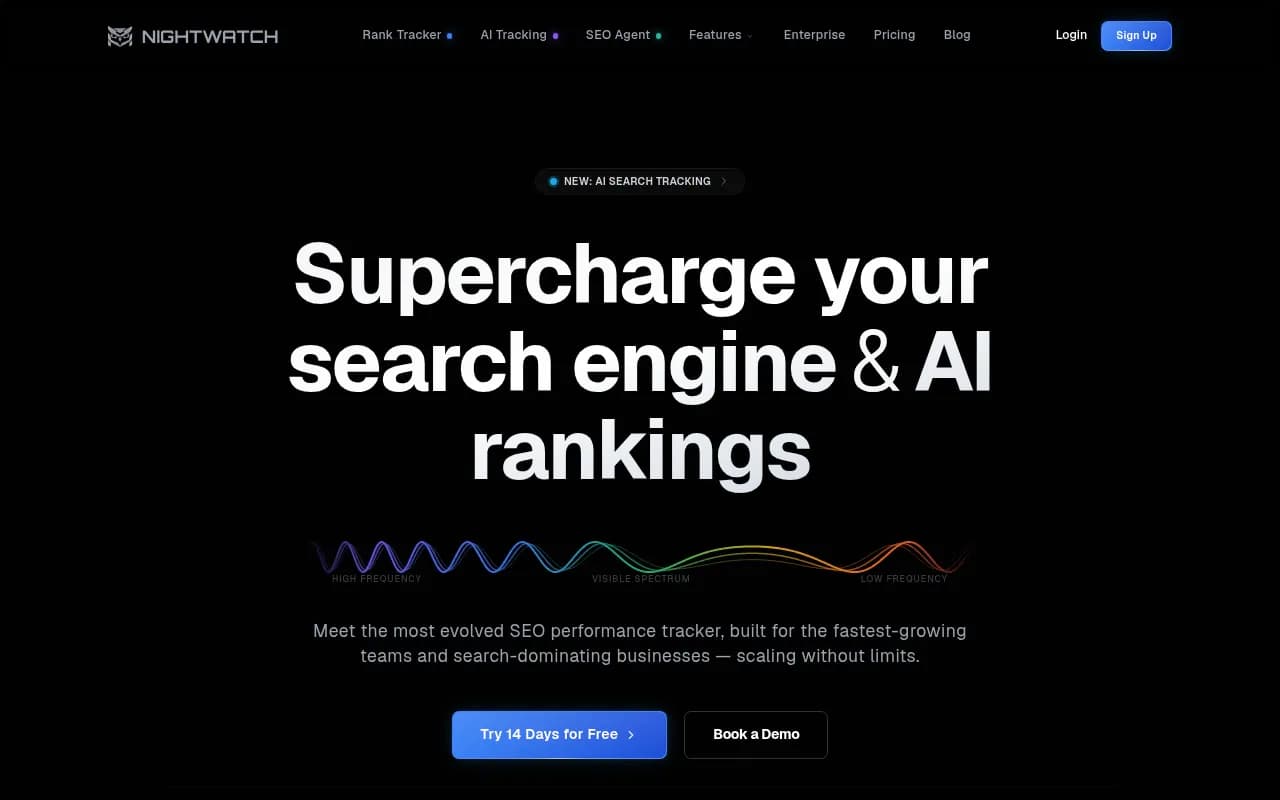
It covers ChatGPT, Google AI Overviews, Bing Copilot, Perplexity, and Claude. The zip-code level tracking is genuinely useful for local SEO clients. And the fact that you're not adding a completely separate tool to your stack is a real operational benefit.
The downside is that the AI features feel like an add-on rather than a core product. If AEO is becoming a major part of your agency's offering, you'll probably outgrow Nightwatch's AI capabilities and want something more purpose-built.
SE Visible — best for brand-focused AI visibility reporting
SE Visible (from SE Ranking) is positioned toward CMOs and brand specialists, but it works well for agencies that need clean, presentable AI visibility reports for client meetings.
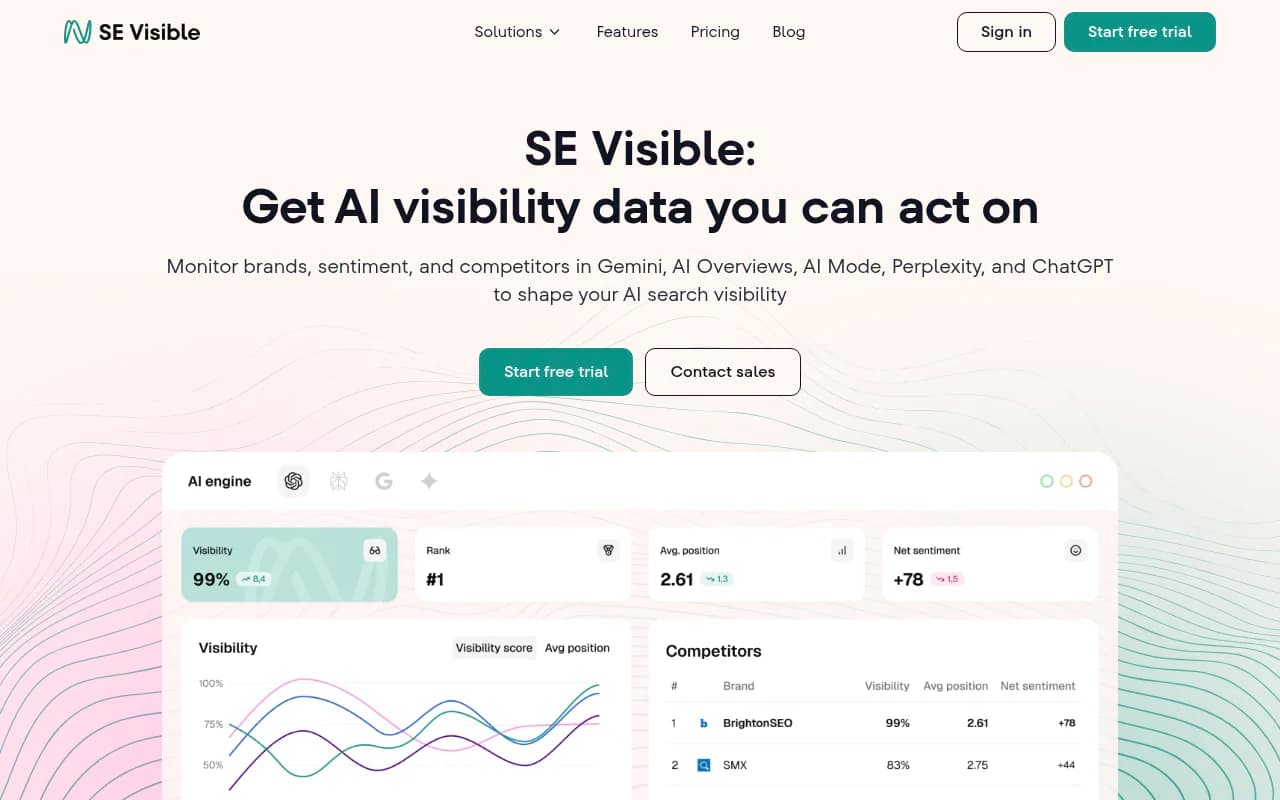
It tracks AI Overviews, AI Mode, Gemini, ChatGPT, and Perplexity, with a focus on competitor insights, source tracking, and sentiment scoring. The sentiment angle is useful — clients often care not just about whether they're mentioned but whether the AI is saying something accurate and positive about them.
Pricing starts at $99/month. It's not the deepest tool in the category, but it's approachable and the reporting is clean.
Rankability — best for unified research-to-content workflows
Rankability takes a different approach. Rather than being purely an AEO monitoring tool, it tries to connect research, writing, optimization, and AI visibility tracking in one platform. The pitch is that agencies shouldn't have to stitch together five tools to deliver AEO results.
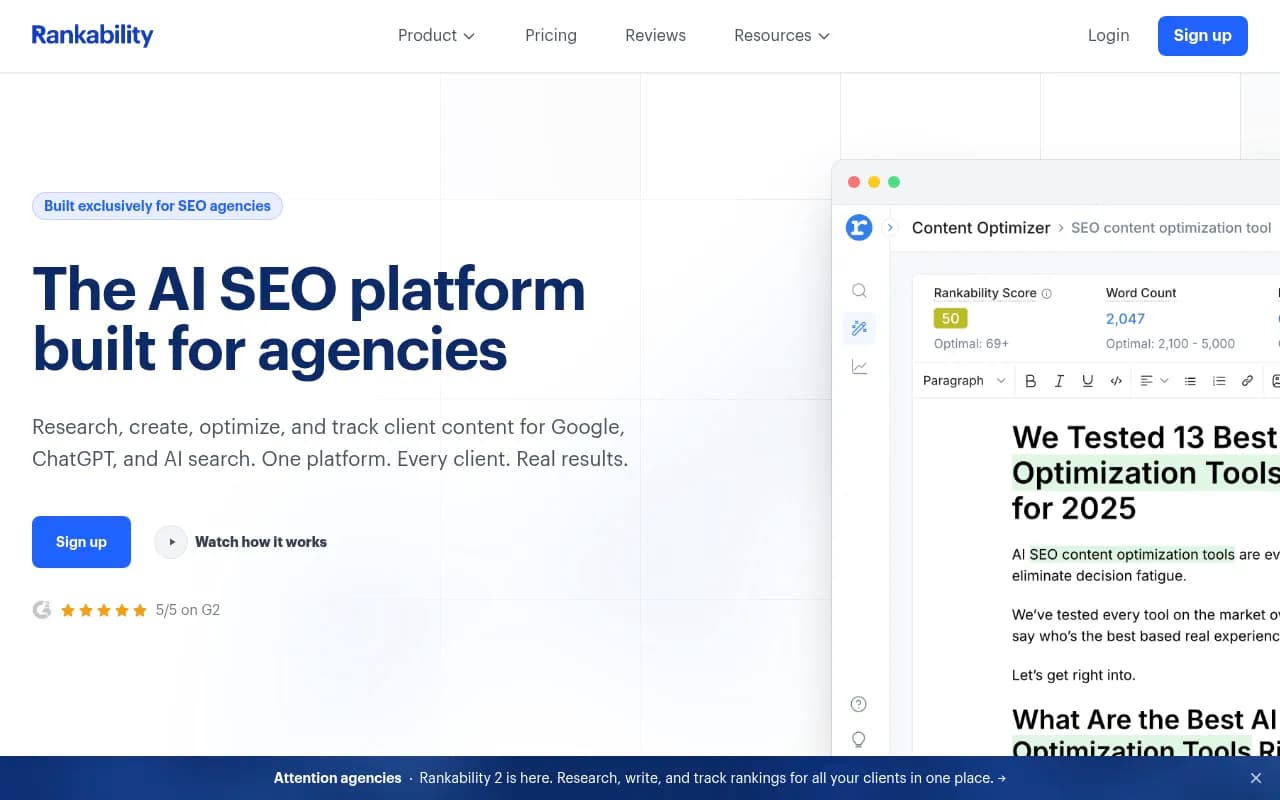
The SPI (Search Presence Index) score is the core differentiator — it tries to unify traditional search, local, AI, citation, and video visibility into a single metric. Whether that abstraction is useful or oversimplified depends on how your agency reports to clients. Some will love having one number to point to; others will want the underlying data.
AthenaHQ — solid monitoring across 8+ AI engines
AthenaHQ tracks brand visibility across 8+ AI search engines and has a reasonably clean interface for managing multiple brands. It's monitoring-focused, which means it's good at telling you where you stand but doesn't offer much help with what to do next.

For agencies that have strong content teams and just need reliable visibility data, AthenaHQ is worth considering. For agencies that want the tool to drive the content strategy, it's not the right fit.
Peec AI — best for multi-language and multi-region clients
If your agency works with international clients, Peec AI's multi-language tracking is a genuine differentiator. Most AEO tools are built around English-language prompts and US-based AI responses. Peec AI handles multiple languages and regions, which matters a lot if you're managing clients in non-English markets.

It's a monitoring-focused tool, but the international coverage fills a real gap in the category.
Cairrot — built specifically for agencies
Cairrot is worth calling out because it's explicitly designed for marketing agencies managing LLM visibility across multiple clients. That's rarer than you'd think in this category.
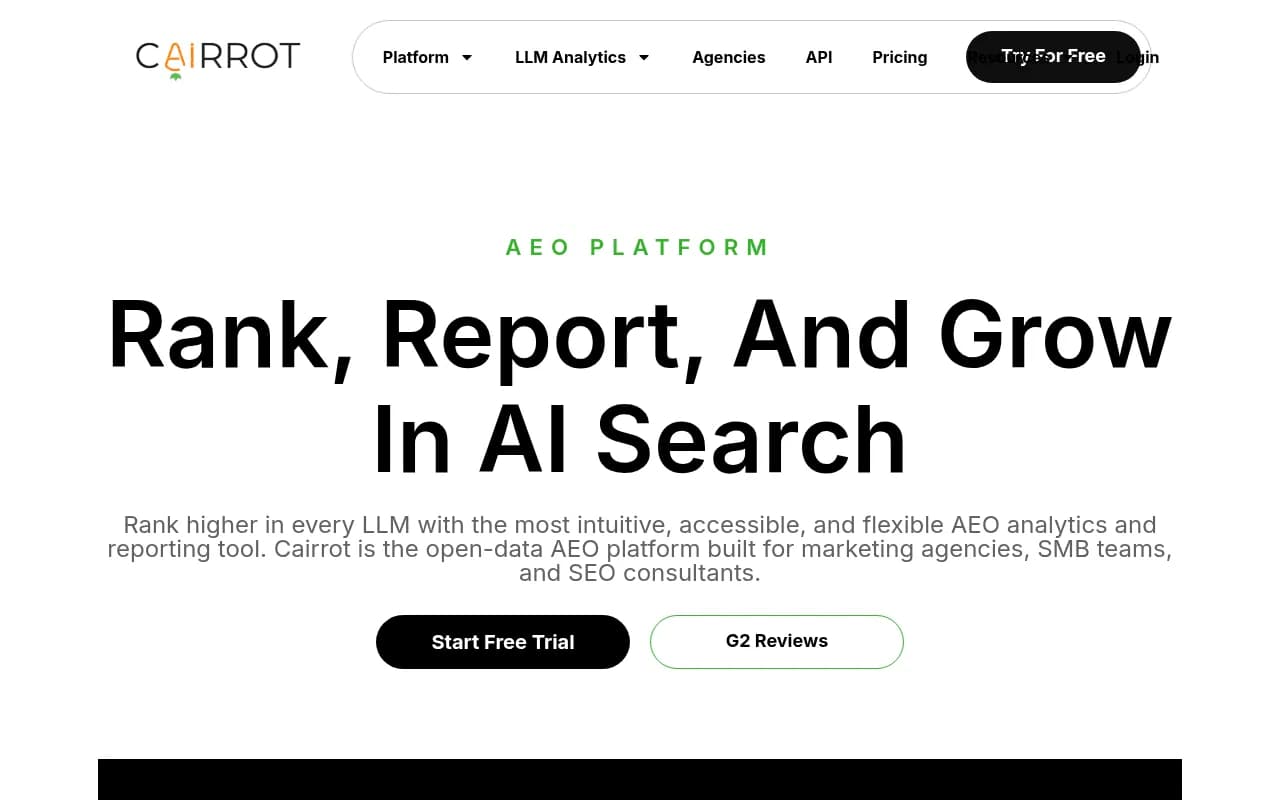
It's a newer entrant, so the feature set is still maturing, but the multi-client architecture is there from the start rather than bolted on. Worth watching if you're evaluating tools for a growing agency portfolio.
Wellows — lightweight tracking for smaller agency teams
Wellows is a lighter-weight option for agencies that don't need enterprise depth. It tracks brand visibility across AI search engines and is priced accessibly for smaller teams.
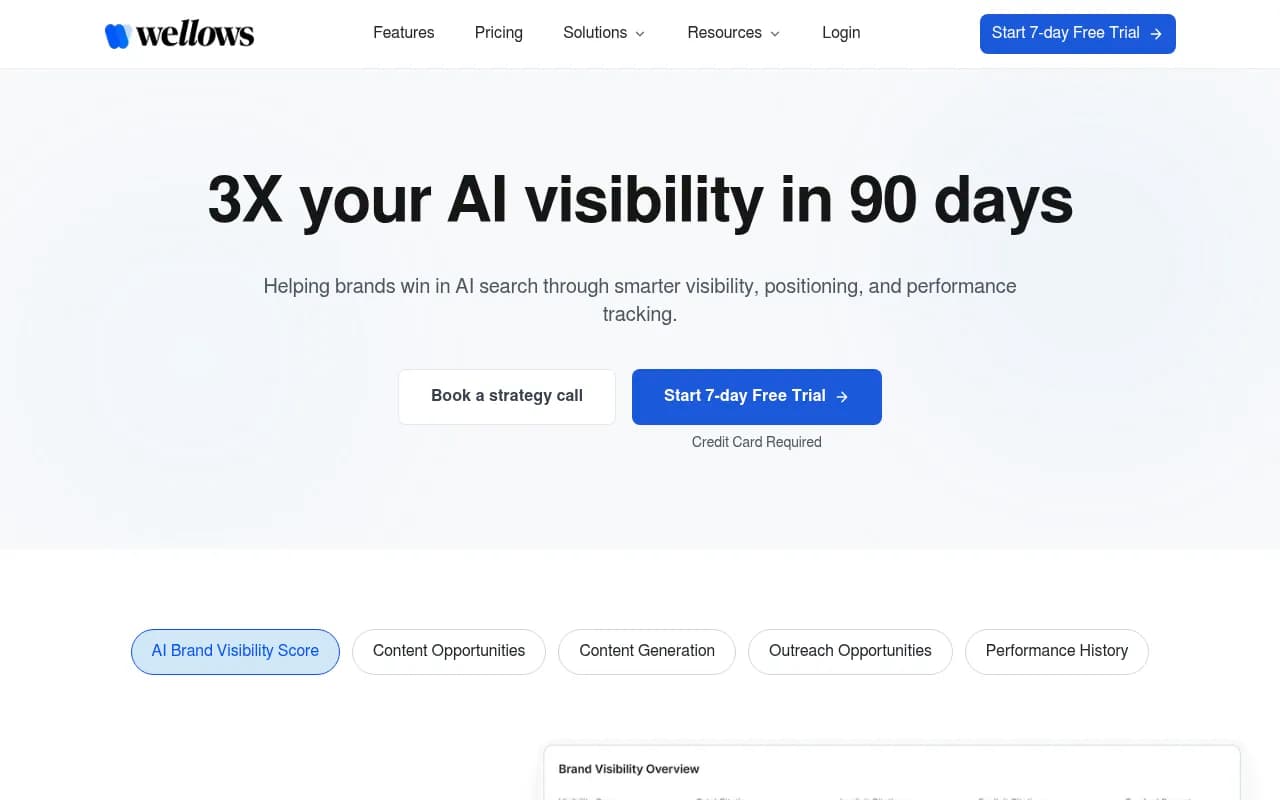
It won't replace a full-featured platform for complex client work, but for agencies just starting to add AEO to their service offering, it's a low-friction way to get started.
Head-to-head comparison
| Tool | AI models covered | Multi-client | Content generation | Crawler logs | White-label reporting | Starting price |
|---|---|---|---|---|---|---|
| Promptwatch | 10+ (ChatGPT, Claude, Perplexity, Gemini, Grok, DeepSeek, Copilot, Meta AI, Mistral, Google AI Overviews) | Yes (agency plans) | Yes (built-in AI writer) | Yes | Yes (API + Looker Studio) | $99/mo |
| Otterly.AI | ChatGPT, Perplexity, Gemini, others | Yes | No | No | Limited | ~$49/mo |
| Profound | Multiple LLMs | Yes | No | No | Yes | Custom |
| Nightwatch | ChatGPT, AI Overviews, Copilot, Perplexity, Claude | Yes | No | No | Yes | $39/mo + $99 AI add-on |
| SE Visible | AI Overviews, AI Mode, Gemini, ChatGPT, Perplexity | Yes | No | No | Limited | $99/mo |
| Rankability | Multiple | Yes | Yes (integrated) | No | Yes | Custom |
| AthenaHQ | 8+ AI engines | Yes | No | No | Limited | Custom |
| Peec AI | Multiple (multi-language) | Yes | No | No | Limited | Custom |
| Cairrot | Multiple | Yes (agency-native) | No | No | Yes | Custom |
How to choose the right tool for your agency
The honest answer is that it depends on what your agency is actually selling.
If you're selling AEO as a managed service where you're responsible for improving client visibility, you need a tool that helps you act on the data. Monitoring-only tools will leave you with a lot of interesting charts and no clear path to results. Promptwatch, Rankability, and Profound are the strongest options here, with Promptwatch being the only one that combines monitoring, content gap analysis, and content generation in one platform.
If you're adding AEO reporting to an existing SEO retainer, a lighter-weight tool like Nightwatch (if you're already using it) or Otterly.AI might be enough. You're not promising to move the needle on AI visibility — you're just showing clients where they stand.
If you have international clients, Peec AI's multi-language coverage is hard to replicate with other tools.
If you're a small agency just starting to offer AEO, start with something affordable and monitoring-focused. Get a feel for what clients actually care about before investing in a full optimization platform. Otterly.AI or Wellows are reasonable starting points.
The content gap problem most agencies ignore
Here's something worth saying directly: the biggest mistake agencies make with AEO is treating it as a monitoring problem when it's actually a content problem.
AI models cite sources that answer questions well. If your client isn't being cited, it's usually because their content doesn't answer the questions AI models are being asked — either because the content doesn't exist, or because it exists but isn't structured in a way AI models can easily extract and reference.
Monitoring tools can tell you that you have a gap. They can't close it. That's why the most effective agency AEO stacks combine visibility tracking with some form of content gap analysis and content production.
Tools like Promptwatch's Answer Gap Analysis show you exactly which prompts competitors rank for that your client doesn't, down to the specific topics and angles that are missing. That turns "your AI visibility is low" from a vague problem into a specific content brief. And when you can show a client "here are the 12 articles we need to write, here's why, and here's what happened to your visibility after we wrote them," that's a retainer that renews.
A note on AI crawler logs
One capability that doesn't get enough attention in agency AEO discussions is AI crawler monitoring. Understanding which AI crawlers are visiting your clients' sites, which pages they're reading, and how often they return is genuinely useful diagnostic information.
If a client's content isn't getting cited despite being well-written and well-structured, the problem might be at the crawling level — the AI models might not be discovering the content at all, or they might be encountering errors that prevent them from indexing it properly.
Promptwatch's AI Crawler Logs feature surfaces this in real time. Most other tools in this category don't offer anything equivalent. For agencies doing serious AEO work, it's the kind of capability that can explain problems that would otherwise be invisible.
Bottom line
The AEO tool market has matured quickly, but the gap between monitoring and optimization is still wide. Most tools will tell you where your clients stand. Very few will help you change it.
For agencies, that gap matters more than it does for in-house teams. Clients don't pay retainers for dashboards — they pay for results. The tools that help you move from insight to action are the ones worth building your AEO practice around.
Start with a clear sense of what you're promising clients, match the tool to that promise, and make sure whatever you choose can actually scale as your AEO client base grows.