Key takeaways
- AthenaHQ is the most feature-complete of the four for enterprise AI visibility tracking, but starts at $295/month with no free trial.
- Scrunch AI focuses on AI discoverability optimization with a 7-day trial and starts around $250/month -- a strong mid-market option.
- Rankshift is purpose-built for GEO and LLM tracking, making it a good fit for teams that want focused AI search visibility without the enterprise overhead.
- Conductor is a traditional SEO platform that has added AI visibility features -- solid if you're already in the Conductor ecosystem, but not built from the ground up for AI search.
- None of these four platforms offer the full action loop (gap analysis + content generation + traffic attribution) that newer GEO-native platforms provide.
The AI search monitoring market has exploded in 2026. Every week there's a new tool promising to tell you whether ChatGPT mentions your brand. But "telling you" is the easy part. The harder question is: which platforms actually help you do something about it?
This guide focuses on four tools that come up frequently in enterprise and mid-market conversations: AthenaHQ, Scrunch AI, Rankshift, and Conductor. They're not identical -- they come from different starting points and serve different audiences. Here's what you actually need to know.
What we're comparing and why it matters
Before diving in, it's worth being clear about what "brand monitoring in AI search" actually means in 2026. It's not just checking whether your brand name appears in a ChatGPT response. It includes:
- Share of voice across multiple LLMs (ChatGPT, Perplexity, Claude, Gemini, etc.)
- Which prompts trigger your brand vs. competitors
- How AI models describe your brand (sentiment, accuracy, positioning)
- Which content on your site is actually being cited
- Whether you're losing ground to competitors on specific topics
A tool that only answers the first question is a dashboard. A tool that answers all five and helps you act on the answers is a platform. Keep that distinction in mind as we go through each one.
AthenaHQ

AthenaHQ positions itself as a purpose-built AEO (Answer Engine Optimization) platform for enterprise teams. It monitors 8+ AI search engines and gives you multi-LLM visibility tracking, competitive benchmarking, and prompt-level analysis.
The platform's core strength is breadth. You can track how your brand appears across ChatGPT, Perplexity, Claude, Gemini, and others simultaneously, and compare that visibility against named competitors. The interface is built for marketing and SEO teams who need to report upward -- you get share-of-voice metrics, trend lines, and the kind of clean dashboards that work in executive presentations.
Where AthenaHQ gets more complicated is on the action side. The platform is primarily a monitoring and analytics tool. It shows you where you're visible and where you're not, but generating content to close those gaps or tracking whether new content actually improved your AI citations isn't really what it's built for. You'd need to bring your own content workflow.
Pricing starts at $295/month with no free trial, which is a meaningful commitment for teams still figuring out whether AI search monitoring is worth the investment.
Who it's best for
Enterprise marketing teams and agencies that need comprehensive multi-LLM monitoring and have a separate content production process. If you're reporting AI visibility metrics to leadership and need clean, credible data, AthenaHQ delivers.
Scrunch AI
Scrunch AI takes a slightly different angle. Rather than framing itself purely as a monitoring tool, it emphasizes "AI discoverability optimization" -- the idea that the goal isn't just to track visibility but to improve it. In practice, this means the platform includes recommendations alongside its tracking data.
Scrunch monitors your brand across major LLMs, surfaces gaps in your AI presence, and provides guidance on what content changes might improve your discoverability. It's a step closer to the action loop than pure monitoring tools, though the content generation capabilities aren't as deep as some newer platforms.
The 7-day free trial is a real advantage here. At $250/month starting price, it's slightly cheaper than AthenaHQ, and the trial lets you validate whether the data is actually useful for your specific use case before committing.
One thing worth noting: Scrunch doesn't have crawler log analysis or Reddit/YouTube tracking, which matters if you want to understand how AI models are discovering your content or what third-party sources are influencing their responses.
Who it's best for
Mid-market brands and agencies that want more than raw monitoring data but aren't ready to invest in a full enterprise platform. The trial makes it easy to test before buying.
Rankshift
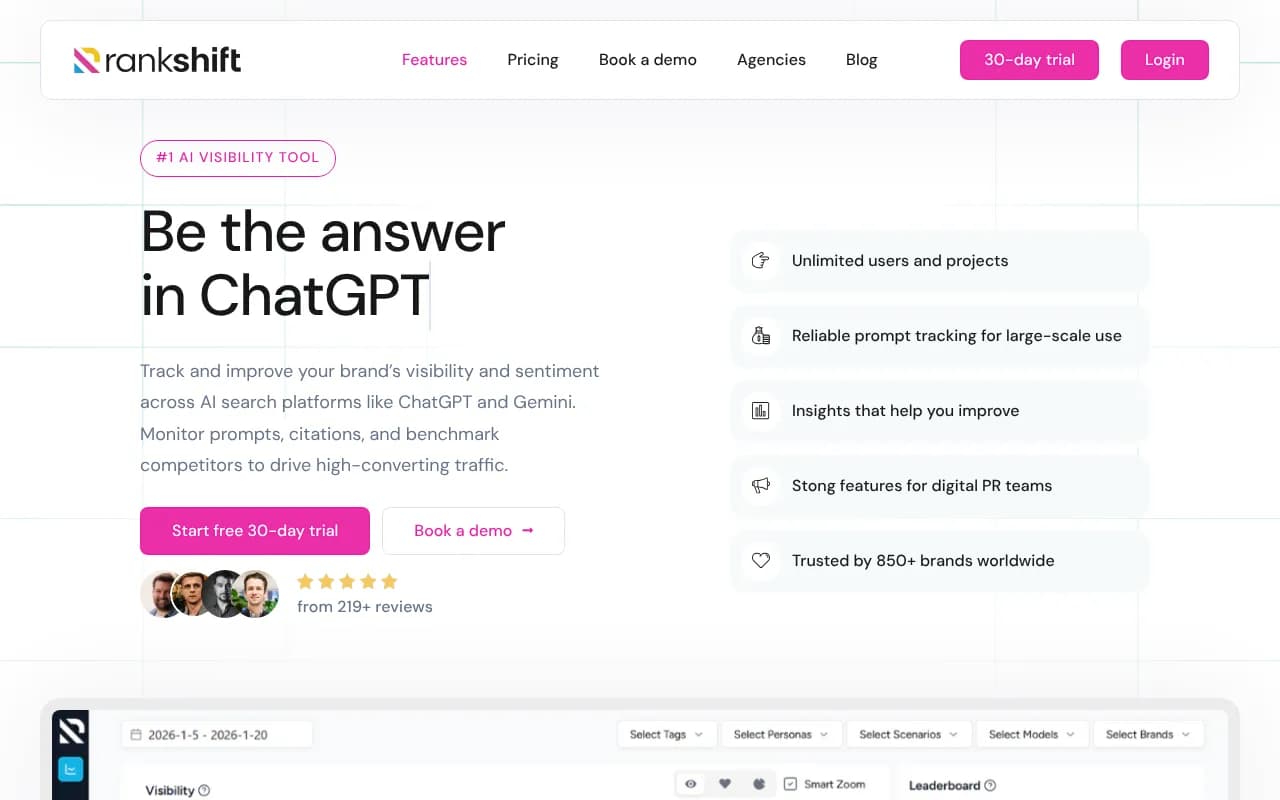
Rankshift is the most focused of the four tools. It's built specifically for GEO (Generative Engine Optimization) and LLM tracking -- no legacy SEO baggage, no traditional keyword ranking features bolted on. That focus is both its strength and its limitation.
On the strength side: Rankshift is clean, fast to set up, and gives you clear visibility data across the major LLMs without overwhelming you with features you don't need. For teams that just want to know "are we appearing in AI answers for our target prompts?" and track that over time, Rankshift gets the job done without a steep learning curve.
The limitation is depth. If you need advanced competitive analysis, content gap identification, or traffic attribution from AI search to actual revenue, Rankshift's focused approach starts to feel thin. It's a tracker, not an optimization platform.
Pricing tends to be more accessible than AthenaHQ or Scrunch, which makes it a reasonable starting point for smaller teams or those new to AI search monitoring.
Who it's best for
Smaller teams, solo practitioners, or companies just starting to take AI search visibility seriously. It's a good entry point without the complexity or cost of enterprise tools.
Conductor
Conductor is a different beast entirely. It started as a traditional enterprise SEO platform and has added AI visibility tracking as the market has shifted. That history shapes everything about how it works.
The AI search features in Conductor are real -- you can track brand mentions across AI platforms, monitor share of voice, and set up persona-based tracking to see how different user types experience AI search results. The persona customization is actually one of Conductor's stronger differentiators; it lets you simulate how different customer segments prompt AI models, which produces more nuanced data than generic brand tracking.
But the "bolted-on" nature of the AI features is noticeable. The platform's core workflows are built around traditional SEO -- keyword rankings, site audits, content performance in Google. The AI visibility layer sits on top of that foundation rather than being native to it. Teams that use Conductor primarily for traditional SEO and want to add AI monitoring will find this natural. Teams that want AI-first workflows will find it awkward.
Conductor is also enterprise-priced, with custom pricing that typically puts it well above the other three tools on this list.
Who it's best for
Enterprise teams already using Conductor for SEO who want to extend their existing platform to cover AI search, rather than adding a separate tool.
Head-to-head comparison
| Feature | AthenaHQ | Scrunch AI | Rankshift | Conductor |
|---|---|---|---|---|
| Built for AI search natively | Yes | Yes | Yes | No (SEO-first) |
| LLMs monitored | 8+ | Major LLMs | Major LLMs | Multiple |
| Free trial | No | 7 days | Yes (varies) | No |
| Starting price | $295/mo | ~$250/mo | Lower tier | Custom (enterprise) |
| Content gap analysis | Limited | Partial | No | Limited |
| Content generation | No | No | No | No |
| Crawler log analysis | No | No | No | No |
| Reddit/YouTube tracking | No | No | No | No |
| Traffic attribution | No | No | No | Limited |
| Persona customization | Limited | Limited | No | Yes |
| Best for | Enterprise monitoring | Mid-market optimization | SMB/entry-level | Existing Conductor users |
One thing the table makes clear: none of these four tools close the full loop from "find the gap" to "fix it" to "measure the result." They're all primarily monitoring platforms with varying degrees of optimization guidance layered on top.
The gap these tools leave open
Here's the honest assessment: all four tools are good at telling you where you stand. AthenaHQ gives you the most comprehensive picture. Scrunch adds some optimization guidance. Rankshift keeps it simple. Conductor integrates with your existing SEO workflow.
But if you ask "what do I actually do with this data?" -- that's where each of them gets quiet.
The next step after monitoring is content. AI models cite content. If your content isn't being cited, you need to create content that will be. That requires knowing which specific prompts you're missing, what angles competitors are covering that you're not, and then actually producing content engineered to get cited -- not just generic SEO articles.
That's a workflow none of these four tools fully support. For teams that want to close that loop, Promptwatch is worth looking at. It combines the monitoring layer with an Answer Gap Analysis that shows exactly which prompts competitors are visible for but you're not, plus a built-in AI writing agent that generates content grounded in real citation data. It's one of the few platforms that treats monitoring as the starting point rather than the end goal.

How to choose between the four
The right choice depends less on features and more on where you are in your AI search journey.
If you're just starting out and want to understand the landscape without a big commitment, Rankshift is the lowest-friction entry point. Get the data, understand what you're looking at, then decide whether you need more.
If you're a mid-market brand that wants monitoring plus some optimization guidance and wants to trial before buying, Scrunch AI is the natural next step. The 7-day trial is genuinely useful for validating the data quality.
If you're an enterprise marketing team that needs comprehensive multi-LLM monitoring, clean reporting, and are willing to pay for depth, AthenaHQ is the strongest pure monitoring platform of the four.
If you're already a Conductor customer and want to extend your existing platform rather than add a new tool, the AI features in Conductor are a reasonable way to get started without changing your workflow.
And if you've already been through the monitoring phase and realized the real problem is that you don't know what content to create or whether your new content is actually improving your AI citations, that's when you need something built around the optimization loop rather than just the tracking layer.
What the broader market looks like
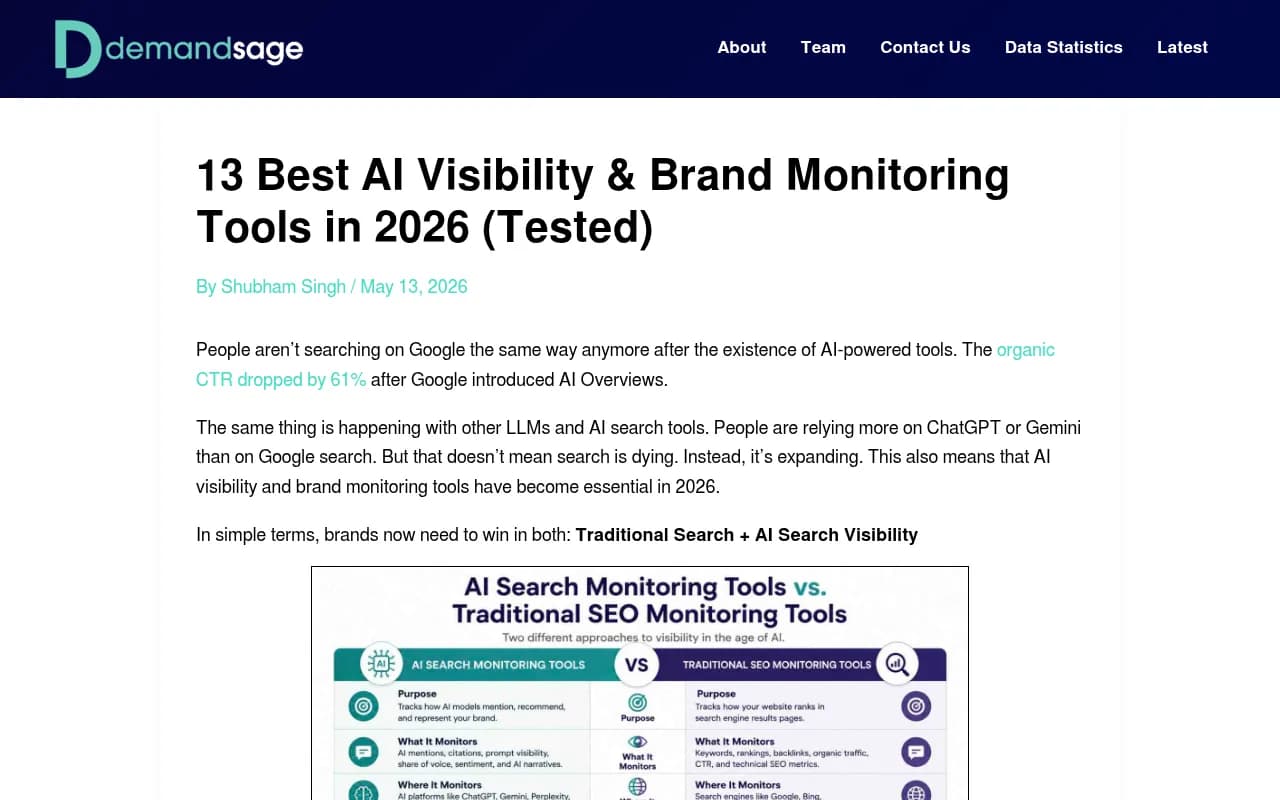
These four tools exist in a crowded space. The research from Demandsage's 2026 roundup of AI visibility tools lists 13 platforms, and that's not even exhaustive. Semrush and Ahrefs have both added AI visibility features. Newer players like Profound, Peec AI, and Otterly.AI are carving out specific niches.
The market is moving fast. Tools that were monitoring-only six months ago are adding optimization features. Tools that started as optimization platforms are adding monitoring depth. The category is converging toward the same question: can you not just track AI visibility but actually improve it?
A few other tools worth knowing about in this space:

Profound is strong on AI narrative and reputation monitoring, with a 7-day trial at $99/month -- a more accessible price point than AthenaHQ or Scrunch.

Otterly.AI is the budget-friendly option at $29/month, good for teams that need basic multi-engine monitoring without the enterprise price tag.

Peec AI handles multi-language AI visibility tracking well, which matters if your brand operates across markets.
Final take
AthenaHQ wins on monitoring depth. Scrunch AI wins on the combination of monitoring plus optimization guidance at a mid-market price. Rankshift wins on simplicity and accessibility. Conductor wins if you're already in its ecosystem.
But the honest answer is that all four are primarily dashboards. They show you the problem. The brands that will actually improve their AI search visibility in 2026 are the ones that pair monitoring data with a systematic content creation process -- knowing which gaps to fill, creating content that AI models actually want to cite, and tracking whether it worked. That's the loop worth building, regardless of which monitoring tool you start with.