Key takeaways
- AirOps is an enterprise-grade AI content workflow platform -- it connects research, brief creation, content production, and performance tracking in one governed system.
- Frase is a leaner, more focused tool built around content optimization scoring, SEO briefs, and automated content maintenance for smaller teams.
- AirOps suits teams that need to scale content operations across multiple channels with brand governance and offsite citation management.
- Frase suits teams that want fast time-to-value on individual content pieces, with solid GEO scoring across up to 8 AI platforms.
- Neither tool is a dedicated AI visibility tracker -- if tracking how your brand appears across ChatGPT, Perplexity, and Google AI Overviews is your main goal, you'll want a purpose-built GEO platform alongside either tool.
What we're actually comparing here
AirOps and Frase get lumped together a lot because they both sit at the intersection of SEO and AI content. But they're solving different problems, and choosing the wrong one creates real friction.
Frase started as a content brief and optimization tool. It's evolved into something that covers more of the SEO pipeline -- research, writing, scoring, monitoring, and automated fixes -- but it's still fundamentally organized around individual content pieces and the optimization score attached to them.
AirOps started as a workflow automation layer for content teams and has grown into a more comprehensive platform for enterprise AI search visibility. It's less about scoring a single article and more about building repeatable systems that produce content at scale, with brand consistency baked in.
That's the core tension. One is a content tool with workflow features. The other is a workflow platform with content tools.
AirOps: what it actually does
AirOps describes itself as an AI search platform for enterprise content teams. The pitch is that it connects AEO (Answer Engine Optimization) to content creation and performance tracking in a single system, rather than requiring you to stitch together separate tools.
The main components:
- Quill: An autonomous execution layer that handles content production without constant human intervention. You set the parameters, it runs.
- Brand Kits: Governance controls that keep AI-generated content consistent with your brand voice, tone guidelines, and messaging.
- Offsite: Citation management for tracking and influencing where your brand appears in AI-generated responses beyond your own website.
- Page360: A unified performance view that connects content activity to actual search and AI visibility outcomes.
The workflow builder is genuinely useful for teams managing large content operations. You can build repeatable templates for briefs, refreshes, and optimizations that pull in live SERP data and keyword intelligence. The CMS integrations mean content can go from brief to published without leaving the platform.
The trade-off is complexity. AirOps has a steeper learning curve than Frase. It's built for teams with dedicated content operations functions, not solo writers or small marketing teams trying to publish faster.
Pricing sits at the higher end -- enterprise plans are custom, and even the entry-level tiers reflect that this is positioned as infrastructure, not a writing assistant.
Frase: what it actually does
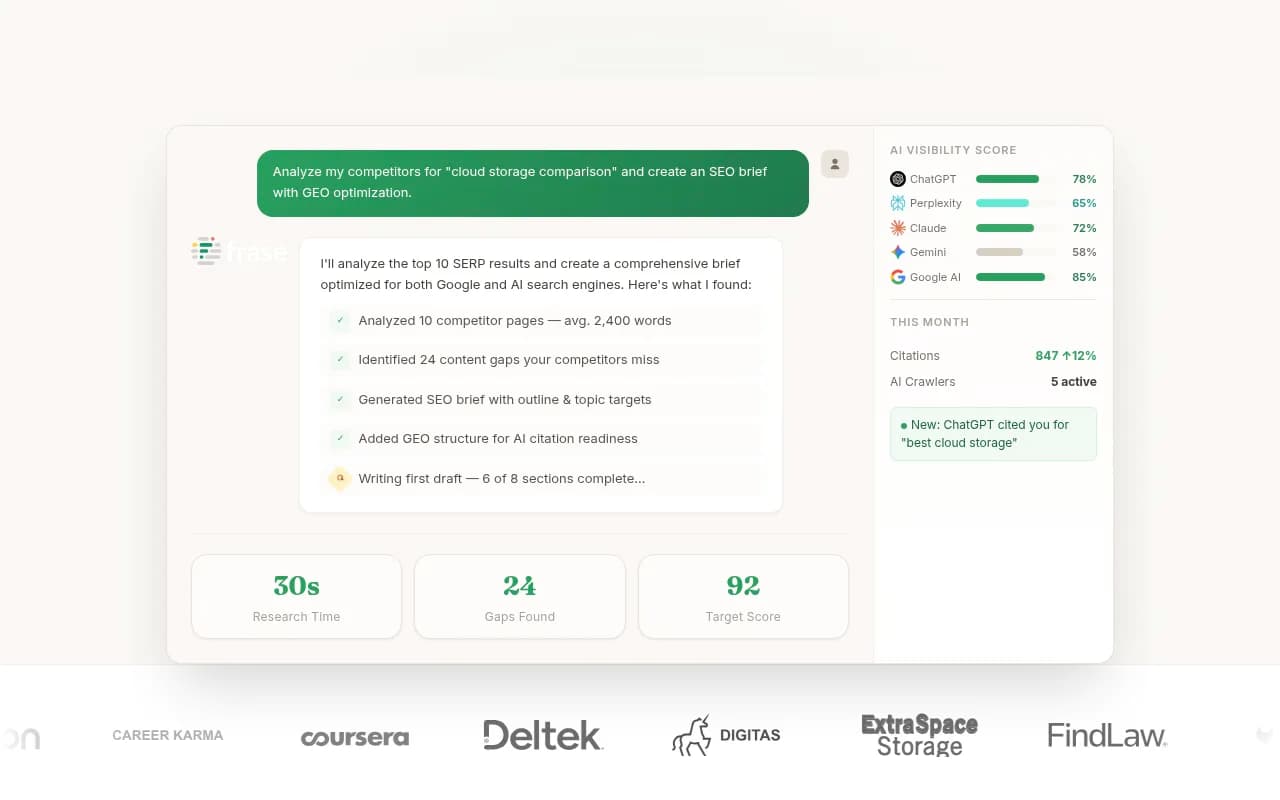
Frase takes a more focused approach. Its core loop is: research a topic, generate a brief, write or optimize content against that brief, score it against competitors, and then monitor it over time for decay.
What makes Frase interesting in 2026 is its dual SEO + GEO scoring. It tracks how content performs against both traditional search engines and AI platforms -- up to 8 AI platforms according to their own benchmarks. That's a meaningful addition for teams that care about AI search visibility, not just Google rankings.
The standout feature for maintenance-heavy teams is Content Guard, which automatically detects content decay and suggests (or applies) fixes. If you have a large blog with articles that slowly drift out of relevance, this is genuinely useful.

Frase's founder Shegun Otulana has published a 6-stage SEO pipeline framework (Research, Strategy, Write, Audit, Monitor, Fix) and claims Frase covers all six stages. That's a bold claim, and honestly it holds up better than most competitors -- though "covers" doesn't always mean "does well."
The pricing is more accessible than AirOps. There's a free trial, and paid plans start at a point that smaller teams can actually justify.
Where Frase falls short: it's less suited to teams that need complex workflow automation, multi-brand governance, or offsite citation management. It's optimized for the content piece, not the content operation.
Head-to-head comparison
| Feature | AirOps | Frase |
|---|---|---|
| Primary use case | Enterprise content operations | Content optimization and SEO briefs |
| AI workflow automation | Deep (Quill autonomous execution) | Moderate (6-stage pipeline) |
| Content brief generation | Yes, with SERP data | Yes, core feature |
| GEO / AI search scoring | Yes (AEO focus) | Yes (dual SEO + GEO, 8 AI platforms) |
| Content decay monitoring | Via Page360 | Content Guard (automated fixes) |
| Brand governance | Brand Kits | Limited |
| Offsite citation management | Yes (Offsite feature) | No |
| CMS integrations | Yes | Limited |
| Best team size | Mid-market to enterprise | Solo to mid-market |
| Learning curve | High | Low to moderate |
| Pricing | Enterprise (custom) | More accessible |
| Free trial | Yes | Yes |
Where each tool wins
AirOps wins when...
You're managing content at scale across multiple brands or product lines. The Brand Kits and workflow automation mean you can produce consistent content without manually reviewing every piece. If your team is already running content operations with project management tools and you need AI to plug into that system rather than replace it, AirOps fits that model.
The Offsite feature is also genuinely differentiated. Most content tools stop at your own website. AirOps tracks where your brand is being cited in AI responses across the web -- that matters if you're trying to influence how AI models represent your brand, not just optimize individual pages.
Frase wins when...
You want to move fast on individual content pieces and don't need enterprise-level governance. The brief-to-publish workflow is tighter, the scoring is more immediate, and Content Guard handles the maintenance work that most teams neglect.
The dual GEO scoring is also a practical advantage for teams that are just starting to think about AI search visibility. You get a signal on how your content performs in AI responses without needing a separate platform.
What neither tool does well
Here's the honest part: both AirOps and Frase are primarily content creation and optimization tools. They're not built for deep AI search visibility monitoring.
If you want to know exactly how your brand appears in ChatGPT, Claude, Perplexity, Google AI Overviews, and Gemini -- which prompts trigger your brand, which competitors are getting cited instead of you, and why -- you need a dedicated GEO platform.
AirOps has AEO features and Frase has GEO scoring, but neither gives you the kind of granular prompt-level tracking, citation analysis, or AI crawler logs that a purpose-built visibility platform provides.
For teams that need that layer, Promptwatch is worth looking at. It tracks brand visibility across 10 AI models, shows you which prompts competitors are winning that you're not, and connects that data to content creation through its Answer Gap Analysis and Content Agents. It's a different category from AirOps and Frase -- more about understanding and improving your AI search presence than about producing content efficiently.

How to choose
The decision usually comes down to three questions:
1. How big is your content operation?
If you're a solo writer or a small team publishing a few articles a week, AirOps is probably overkill. Frase's tighter workflow and lower price point make more sense. If you're managing content across multiple sites, brands, or product lines, AirOps' workflow infrastructure starts to justify itself.
2. Do you need brand governance?
This is where AirOps has a clear edge. If you need AI-generated content to consistently reflect specific brand voices, messaging guidelines, or legal constraints, Brand Kits solve that problem in a way Frase doesn't.
3. Is content decay a bigger problem than content creation?
Frase's Content Guard is genuinely useful for teams with large existing content libraries that need ongoing maintenance. If you're spending more time refreshing old content than creating new content, that feature alone might tip the decision.
What about other tools in this space?
AirOps and Frase aren't the only options. A few others worth knowing:
Surfer SEO is a strong alternative for content optimization with a more established track record on SERP-based scoring.
MarketMuse goes deeper on topical authority and content planning, useful for teams building out comprehensive topic clusters.
Clearscope is the cleanest pure content optimization tool if you just want scoring and keyword recommendations without the workflow complexity.
Jasper covers a lot of the same AI writing ground as AirOps but with a different focus on marketing copy and campaign content rather than SEO-specific workflows.
For teams that want to go deeper on the AI visibility side -- tracking citations, monitoring brand mentions in LLM responses, and understanding which content is actually driving AI search traffic -- the tools above don't cover that. That's where dedicated GEO platforms like Promptwatch come in.
The bottom line
AirOps and Frase are genuinely different tools that happen to overlap in the "AI content for SEO" category. Frase is faster to get value from and better suited to teams optimizing individual pieces of content with an eye on both Google and AI search. AirOps is more powerful for teams that need to systematize content production at scale, with governance and offsite visibility baked in.
Neither replaces a dedicated AI search visibility platform if understanding your brand's presence in AI-generated responses is a priority. That's a separate problem requiring separate tooling.
Pick Frase if you want to move fast and optimize content. Pick AirOps if you need to build a content operation that scales. And if you need to know what AI search engines are actually saying about your brand -- that's a third tool category entirely.