Key takeaways
- Traditional rank tracking measures your position in Google's blue-link results. AI citation tracking measures whether AI models like ChatGPT, Perplexity, or Claude mention and recommend your brand when users ask relevant questions.
- These are fundamentally different problems. A brand can rank #1 on Google and be completely invisible in AI search, and vice versa.
- AI citations are non-deterministic: the same prompt submitted twice can return different sources, which means "position" doesn't translate cleanly to AI search.
- Most tools in the market solve one problem or the other. A handful try to do both, with mixed results.
- If AI search is driving meaningful traffic to your category, you need both types of tracking -- and you need to know which gap you're actually trying to close.
The question that started this confusion
"Are we ranking in AI search?"
It sounds like a simple question. It isn't. The problem is that "ranking" implies a numbered list -- position 1, position 2, position 3. That's how Google works, and it's what rank tracking tools were built to measure. But AI search doesn't work that way, and applying rank-tracking logic to AI visibility leads to bad decisions.
This guide is about understanding why these are different problems, what each type of tool actually measures, and which tools are worth your time in 2026.
What traditional rank tracking actually measures
Rank tracking has been around since the early 2000s. The core mechanic is simple: you give the tool a list of keywords, it queries Google (or Bing) from a specific location, and it records where your page appears in the results.
From that, you get:
- A position number (1-100+)
- Position changes over time
- Estimated traffic based on click-through rates
- Competitor comparisons for the same keywords
This works because Google's results are deterministic enough. The same keyword from the same location at roughly the same time will return roughly the same results. There's some variation, but it's small enough to make trend data meaningful.
Tools like SE Ranking, AccuRanker, and Semrush have refined this for years. They're genuinely good at it.
The challenge is that Google itself has changed. AI Overviews now appear above traditional blue links for a large share of queries. So even a solid rank tracker needs to answer a new question: "Are we in the AI Overview, not just the organic results?" That's a meaningful addition, but it's still fundamentally different from tracking citations across ChatGPT or Perplexity.
What AI citation tracking actually measures
When someone asks ChatGPT "what's the best project management tool for remote teams?" or asks Perplexity "which CRM should a B2B startup use?", the AI generates a response. That response might mention specific brands, link to specific pages, or recommend specific products.
AI citation tracking answers: does your brand appear in those responses, how often, and in what context?
This is a completely different measurement problem for several reasons.
There's no "position"
AI models don't return a ranked list of 10 blue links. They generate prose. Your brand might be mentioned in the first sentence, or in a list of options, or not at all. Some tools try to assign a "rank" based on order of mention, but this is a rough approximation at best.
Responses are non-deterministic
Run the same prompt twice and you'll often get different sources cited, different brands mentioned, different framing. This is a known property of large language models. It means you can't just check once -- you need repeated sampling to get a reliable picture of your average visibility.
A post on Reddit's r/DigitalMarketing from early 2026 put it well: "visibility is no longer only measured by clicks or rankings, but also by how often your content is referenced or cited across AI responses." The shift from a binary "you're on page 1 or you're not" to a probabilistic "you appear in X% of relevant responses" is a fundamental change in how we think about search visibility.
You're tracking prompts, not keywords
Traditional rank tracking starts with keywords. AI citation tracking starts with prompts -- natural language questions that reflect how real users interact with AI models. "best CRM for startups" as a keyword is different from "I'm a B2B founder with 5 salespeople, what CRM should I use?" as a prompt. The latter is closer to how people actually use ChatGPT.
Choosing the right prompts to track is itself a skill. SE Ranking published a useful breakdown on this: prompts should reflect real user intent, cover different stages of the buying journey, and be specific enough to surface meaningful competitive differences.
You're monitoring multiple models
Google has one set of results. AI search has ChatGPT, Perplexity, Claude, Gemini, Google AI Overviews, Grok, DeepSeek, Copilot, and more. Your brand might be visible in Perplexity but invisible in ChatGPT. A good AI citation tool monitors across all of them.
Why you can't use one tool for both problems
This is where a lot of teams go wrong. They assume their existing rank tracker "does AI" because it added an AI Overview feature, or they assume a new AI visibility tool replaces their rank tracker. Neither is true.
Here's a direct comparison of what each type of tool measures:
| Dimension | Traditional rank tracking | AI citation tracking |
|---|---|---|
| What it measures | Position in Google/Bing SERPs | Brand mentions in AI model responses |
| Data type | Deterministic position numbers | Probabilistic citation rates |
| Input | Keywords | Natural language prompts |
| Engines covered | Google, Bing, Yahoo | ChatGPT, Perplexity, Claude, Gemini, etc. |
| Frequency | Daily or weekly | Repeated sampling per prompt |
| Traffic signal | CTR-based estimates | Direct AI referral tracking |
| Content optimization | On-page SEO signals | Citation-worthy content structure |
| Competitor view | SERP overlap | Share of voice in AI responses |
These tools answer different questions. A rank tracker tells you "we're position 4 for 'project management software'." An AI citation tracker tells you "ChatGPT mentions us in 34% of relevant responses, but our competitor appears in 71%."
Both numbers matter. They just measure different things.
The tools that solve each problem
For traditional rank tracking
If your primary concern is Google organic rankings, AI Overviews position, and SERP visibility, these tools are well-established:
SE Ranking has built out solid AI Overview tracking alongside its traditional rank monitoring. Good mid-market option.
AccuRanker is fast and accurate for high-volume keyword tracking. Popular with agencies that need reliable daily data.
Semrush covers rank tracking as part of a broader SEO suite. Its AI Overview tracking is useful but uses fixed prompt sets, which limits flexibility.
Moz Pro and Advanced Web Ranking are solid alternatives for teams that want established platforms with long track records.
For AI citation tracking
This is the newer category, and it's moving fast. The tools range from simple monitoring dashboards to full optimization platforms.
Promptwatch is the most complete option in this category. It tracks citations across 10 AI models (ChatGPT, Perplexity, Claude, Gemini, Google AI Overviews, Grok, DeepSeek, Copilot, Meta AI, Mistral), but what separates it from monitoring-only tools is what happens after you see the data. The Answer Gap Analysis shows you which prompts your competitors appear for but you don't. The built-in AI writing agent then generates content designed to get cited, grounded in 880M+ citations analyzed. And crawler logs show you exactly which pages AI bots are reading on your site, and which they're ignoring.

Peec AI covers multi-language tracking and is a reasonable option for teams that need international coverage without enterprise pricing.

AthenaHQ has strong monitoring capabilities across multiple AI engines, though it's more focused on tracking than on content optimization.

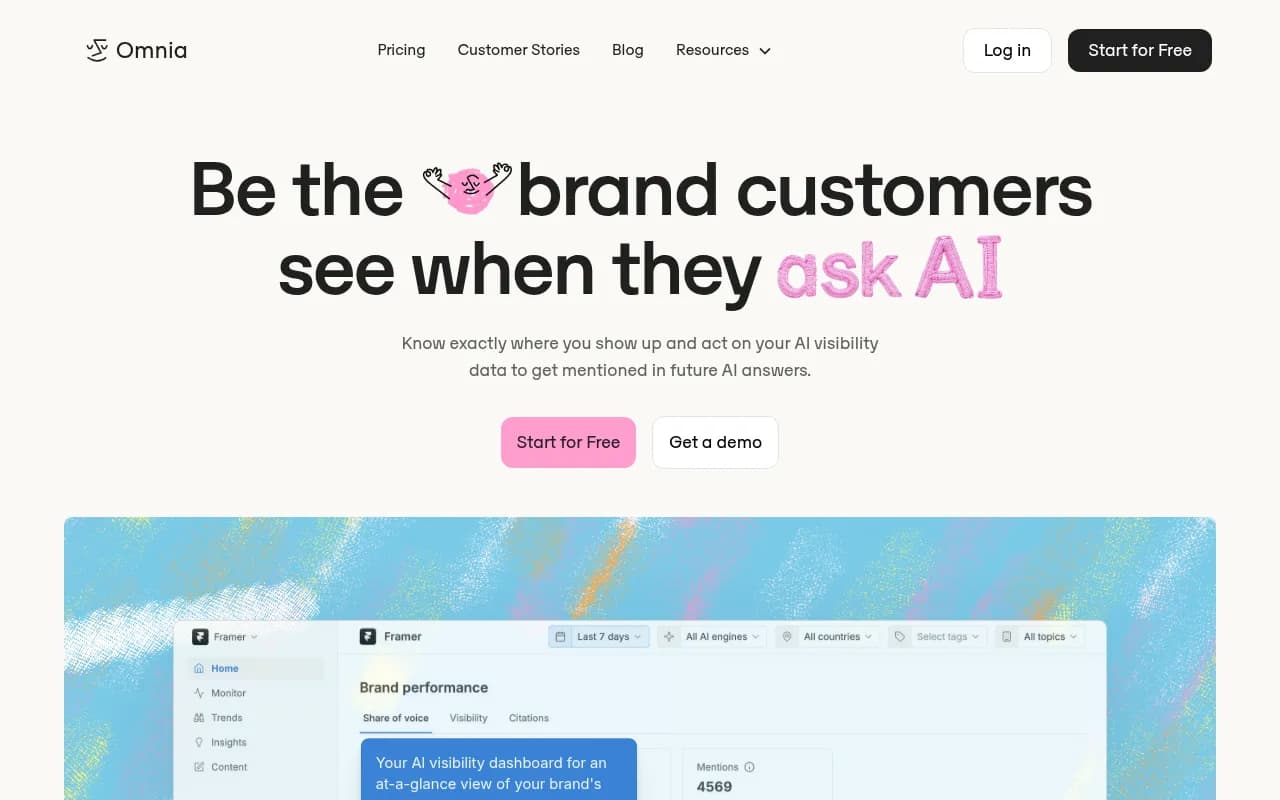
Omnia offers share-of-voice analytics and is worth considering for teams that want clean dashboards and entity mapping.
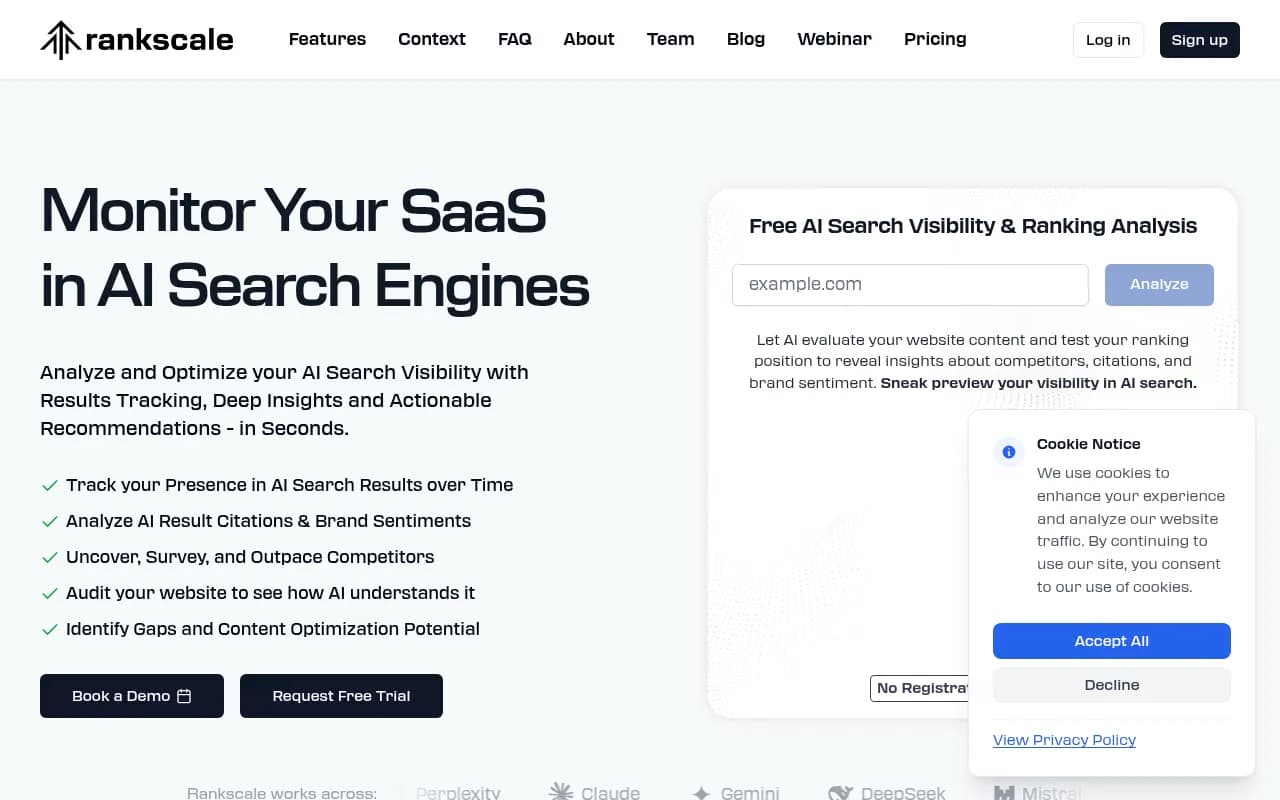
Rankscale is a newer entrant with solid AI search ranking and visibility features.
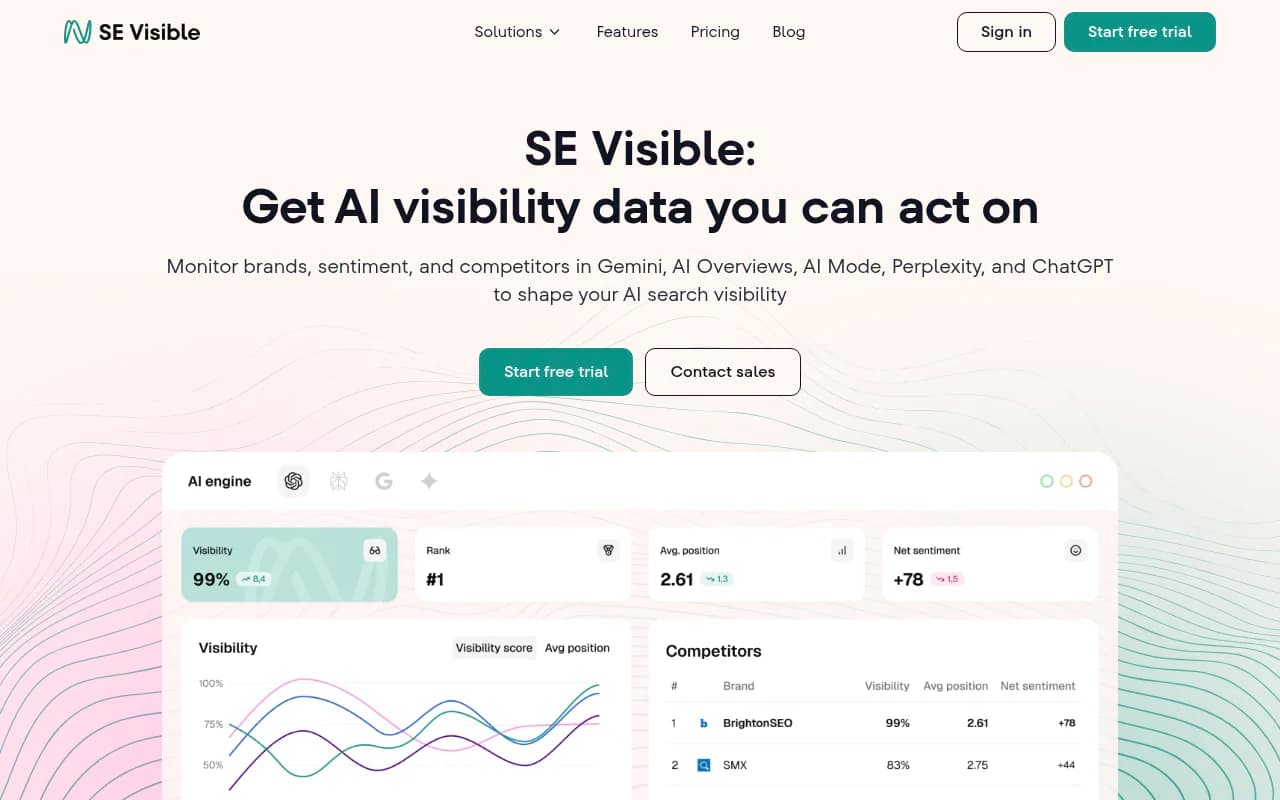
SE Visible (from SE Ranking) is a user-friendly option for teams already in the SE Ranking ecosystem.
Otterly.AI is a more affordable entry point for teams just starting to monitor AI visibility.

For teams that need both
A few tools are trying to bridge the gap:
Semrush covers traditional SEO and has added AI Overview tracking. It doesn't go deep on ChatGPT/Perplexity citation tracking, but it's one dashboard for teams that want to minimize tool sprawl.
SE Ranking similarly covers both traditional rankings and some AI visibility features in one platform.
If you're an agency managing multiple clients, Promptwatch also handles the AI citation side comprehensively, and its Looker Studio integration and API make it easier to fold into existing reporting workflows.
A practical framework for deciding what you need
Before buying anything, answer these three questions:
1. Where is your audience actually searching?
If your category is dominated by informational queries ("what's the best X for Y"), AI search is probably already influencing your pipeline. If it's transactional and local ("plumber near me"), traditional rank tracking is still the priority.
2. Are you seeing AI referral traffic?
Check your analytics for referrals from ChatGPT, Perplexity, and similar sources. If you're already getting traffic from AI search, you need citation tracking. If you're not, you might need it even more -- it means you're invisible.
3. What's the gap you're trying to close?
If you know you're ranking well on Google but losing ground to AI-native competitors, you need AI citation tracking. If your Google rankings have dropped and you're not sure why, traditional rank tracking and technical SEO tools are the right starting point.
The citation volatility problem
One thing that catches teams off guard: AI citations are volatile in a way that Google rankings aren't. A page that gets cited heavily this week might drop off next week, not because your content changed, but because the AI model updated its training data, changed its retrieval behavior, or simply sampled different sources.
This means you need to track citation rates over time, not just take a snapshot. Tools that only let you run one-off checks are less useful than those that run continuous monitoring and show you trends.
It also means content freshness matters more than it used to. AI models tend to favor recently updated, authoritative content. A page that was accurate in 2023 but hasn't been touched since is more likely to lose citations than one that's been actively maintained.
What "optimizing for AI citations" actually looks like
This is where the two disciplines diverge most sharply. Traditional SEO optimization is well-understood: target keywords, build backlinks, improve page speed, fix technical issues. AI citation optimization is newer and less codified, but the patterns are becoming clearer.
Content that gets cited by AI models tends to:
- Directly answer specific questions (not just target keywords)
- Include structured data that makes it easy for AI crawlers to parse
- Cover topics comprehensively enough that the AI sees it as authoritative
- Be cited or linked to by other sources the AI already trusts (Reddit, YouTube, established publications)
This is why tools that combine citation monitoring with content gap analysis are more useful than pure monitoring tools. Knowing you're invisible is the first step. Knowing what content would make you visible is the second. Actually creating that content is the third.
Most monitoring-only tools stop at step one.
The bottom line
Traditional rank tracking and AI citation tracking are not competing products. They measure different things, serve different use cases, and require different optimization strategies.
If you're only doing one, you have a blind spot. Google organic traffic still matters enormously for most businesses. But AI search is growing fast enough that ignoring it is a real risk, especially in categories where users are asking complex, research-heavy questions.
The smart move in 2026 is to have both: a reliable rank tracker for Google visibility, and an AI citation tool that goes beyond monitoring to help you actually improve your visibility in AI responses. The tools exist. The question is whether you're using them.