Key takeaways
- Peec.ai is a solid entry point for AI search tracking, but its competitor benchmarking features are thin compared to newer platforms
- Most alternatives fall into two camps: monitoring dashboards (show you data, leave you stuck) and full optimization platforms (show you data and help you fix it)
- The tools that stand out for competitor benchmarking specifically are Promptwatch, AthenaHQ, Profound, Scrunch AI, SE Visible, and Omnia
- If you need content gap analysis on top of benchmarking, only a handful of platforms actually help you act on what you find
- Pricing varies widely -- from ~$89/mo for Peec.ai's starter to $295/mo+ for enterprise-grade platforms
Peec.ai had a good run as an early mover in AI search visibility. When brands first started panicking about whether they were showing up in ChatGPT and Perplexity responses, Peec.ai gave them a place to start. Prompt tracking, daily monitoring, a clean interface -- it checked the boxes.
But here's the problem: the market moved fast, and competitor benchmarking is where Peec.ai has struggled to keep up. Knowing your own visibility score is useful. Knowing why your competitor is getting cited more than you -- and what to do about it -- is what actually matters.
That's the gap this guide addresses. These six alternatives all do something meaningfully better than Peec.ai when it comes to head-to-head competitive analysis in AI search.
What's actually missing in Peec.ai's benchmarking
Before getting into alternatives, it's worth being specific about the gaps. Peec.ai's pricing is built around prompts and data points (€89/mo for 25 prompts, €199/mo for 100 prompts). That model works fine for tracking your own brand. It gets expensive and limiting fast when you want to run the same analysis across three or four competitors.
The other issues that keep coming up in SEO communities:
- No Reddit or YouTube citation tracking (both heavily influence what AI models recommend)
- Limited multi-engine coverage for competitive comparisons
- No content gap analysis to explain why a competitor ranks higher
- No crawler log data to understand how AI bots are reading your site vs. theirs
With that in mind, here are six tools that handle competitor benchmarking better.
1. Promptwatch -- best for closing the gap, not just measuring it
Most GEO tools will tell you that your competitor is more visible than you. Promptwatch is one of the few that tells you what to do about it.

The core feature for competitor benchmarking is Answer Gap Analysis. You put in your domain and your competitors' domains, and it surfaces the specific prompts where they're getting cited and you're not. Not vague topic clusters -- actual prompts, with visibility scores and difficulty ratings attached. You can see which AI models are citing them (ChatGPT, Perplexity, Claude, Gemini, Grok, and more) and which pages on their site are earning those citations.
That's genuinely useful competitive intelligence. But what separates Promptwatch from the monitoring-only crowd is what comes next: a built-in AI writing agent that generates content specifically designed to fill those gaps. It's grounded in citation data from over 880 million citations analyzed, so the output isn't generic SEO filler -- it's calibrated to what AI models actually want to cite.
For competitor benchmarking specifically, the heatmap view is worth calling out. You can compare your AI visibility against multiple competitors across different LLMs side by side. If you're winning on Perplexity but losing on ChatGPT, you'll see exactly that -- and which prompts are driving the difference.
Pricing starts at $99/mo (Essential), $249/mo (Professional), and $579/mo (Business). The Professional tier adds AI crawler logs, which show you how AI bots are crawling your site versus what you'd expect -- another layer of competitive insight most tools don't offer.
2. AthenaHQ -- best for multi-engine competitive analysis
AthenaHQ takes a monitoring-first approach, but it does multi-engine competitive tracking better than most.

The platform covers Google AI Overviews, Perplexity, ChatGPT, and Claude, and its competitive dashboards let you compare share-of-voice across all of them simultaneously. For brands competing in AI-native search -- especially in categories where different engines have different leaders -- this cross-engine view is genuinely valuable.
Where AthenaHQ falls short is on the action side. It's a strong monitoring and analysis platform, but it doesn't help you create content to improve what you're seeing. You'll get clear data on where your competitors are winning; you'll need to take that data elsewhere to act on it.
Starting price is around $295/mo, which puts it at the higher end for what is essentially a tracking platform.
3. Profound -- best for entity-level competitive tracking
Profound approaches AI visibility through the lens of entity extraction and attribution mapping, which makes its competitive analysis feel different from most tools.

Instead of just showing you which prompts competitors appear in, Profound surfaces which entities (topics, concepts, products) are associated with each brand in AI responses. That's a more structural view of competitive positioning -- you can see if a competitor "owns" a concept in AI search the way you might track keyword ownership in traditional SEO.
The attribution mapping is also useful: you can trace which specific pages or sources are driving a competitor's citations. That gives you a cleaner picture of what content is actually working for them.
Pricing starts at $99/mo, which makes it one of the more accessible options on this list. It's particularly well-suited for teams doing entity-driven SEO who want to extend that thinking into AI search.
4. Scrunch AI -- best for brand narrative benchmarking
Scrunch AI takes a different angle on competitor benchmarking: instead of focusing on which prompts you appear in, it focuses on how AI models describe you versus your competitors.
This matters more than people realize. Two brands can both appear in AI responses for the same prompt, but one gets described as "the industry leader" and the other gets described as "a budget option." Scrunch AI tracks these brand descriptors and narratives across AI models, so you can see not just whether you're visible but whether you're being positioned the way you want.
For competitive benchmarking, this is a genuinely different data layer. If your competitor is consistently described in more favorable terms, that's a content and PR problem -- and Scrunch AI helps you identify it.
It's a more specialized tool, so if raw visibility metrics are your primary need, one of the other options here might be a better fit. But for brand-conscious marketing teams, the narrative angle is worth the investment.
5. SE Visible -- best for marketing teams who need clear reporting
SE Visible (from SE Ranking) is built for marketing leaders and agency owners who need competitive AI visibility data in a format that's easy to present and act on.
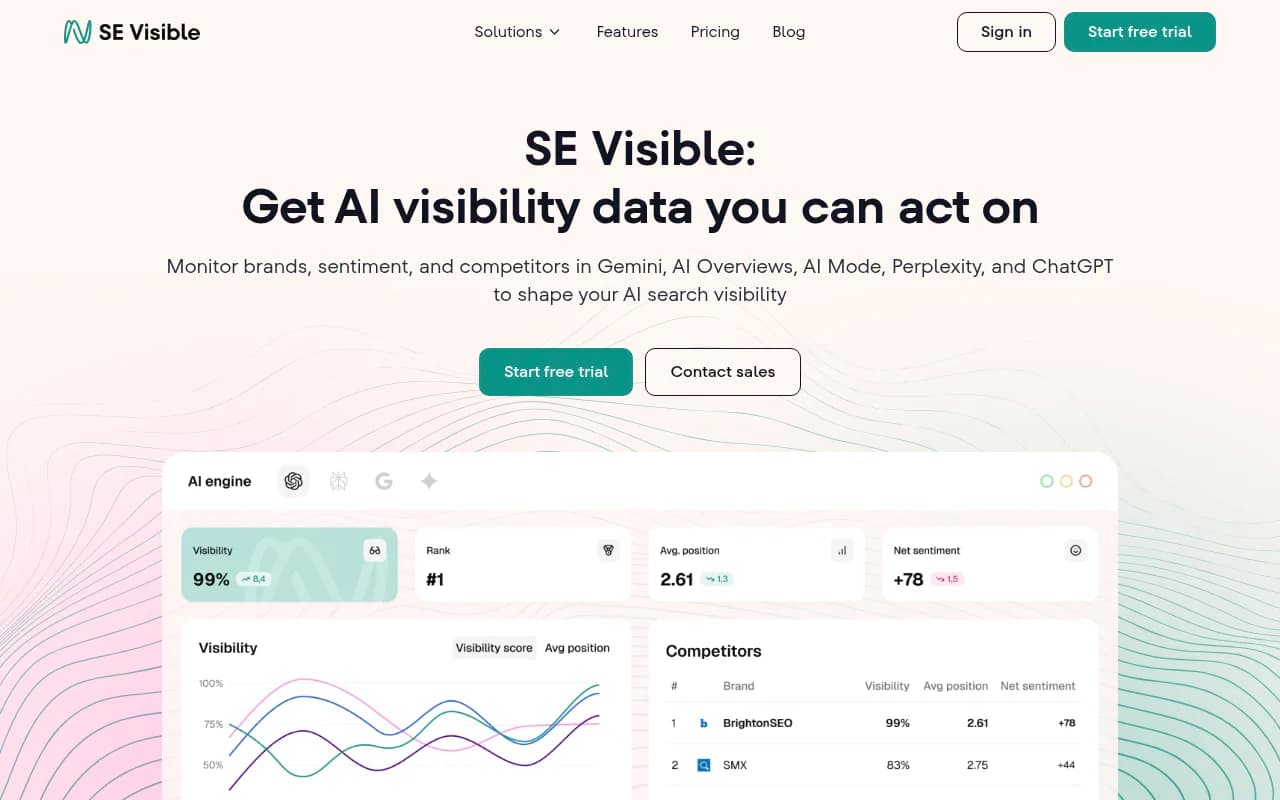
The platform covers ChatGPT, Gemini, Claude, Perplexity, and Google AI Mode, and its competitor benchmarking includes share-of-voice analysis that's genuinely readable -- not just raw data dumps. For CMOs or agency leads who need to show clients how they stack up against competitors in AI search, SE Visible's reporting layer is one of the cleaner options available.
Starting at $189/mo, it sits in the mid-range. It's not the deepest tool on this list for technical analysis, but for teams that need clarity over complexity, it's a strong choice.
6. Omnia -- best for share-of-voice and citation tracking
Omnia is specifically built around AI-driven share-of-voice analytics, which makes it a natural fit for competitive benchmarking.
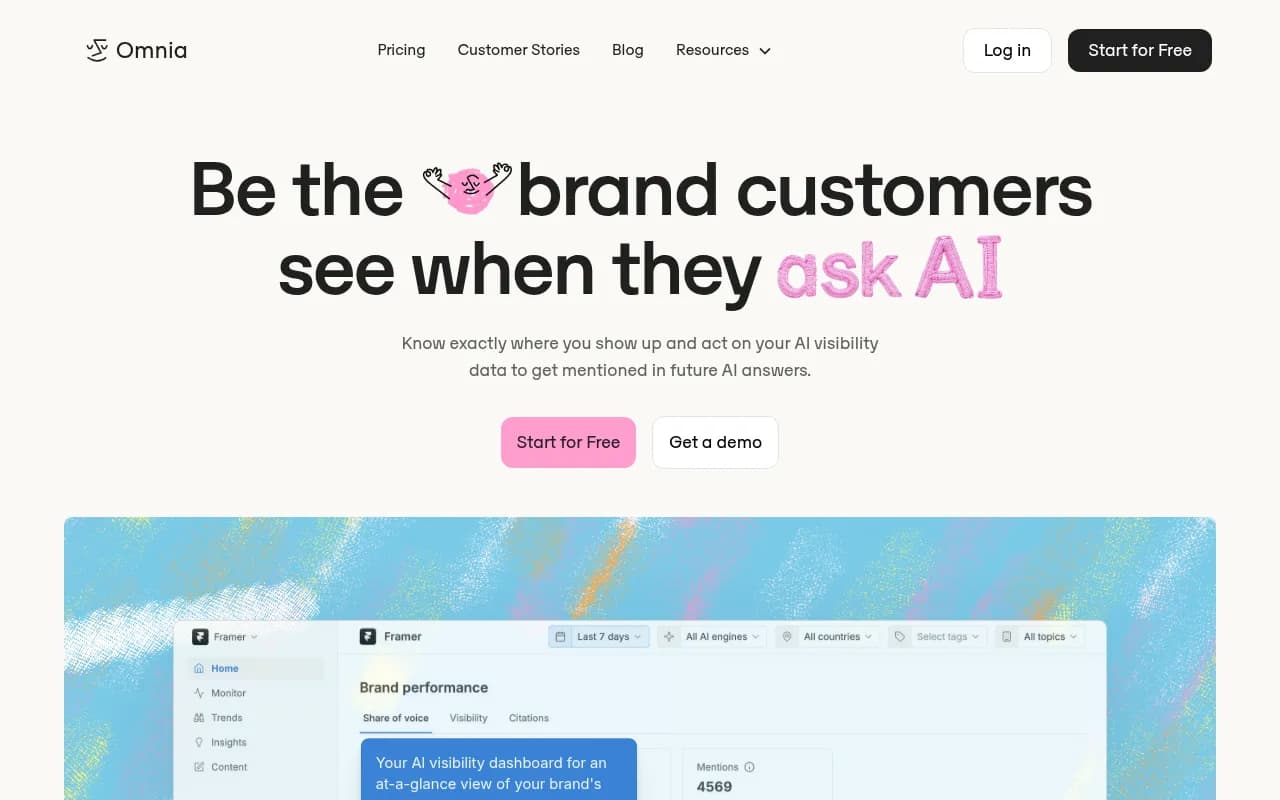
The platform tracks brand mentions and citations across AI channels and uses its own AI layer to generate automated competitive insights -- not just raw numbers, but analysis of what the numbers mean for your positioning. For agencies managing multiple clients in competitive categories, Omnia's automated insight generation saves real time.
It also has a free tier, which makes it one of the more accessible entry points on this list if you want to test competitive benchmarking before committing to a paid plan.
How these tools compare
| Tool | Competitor benchmarking | Content gap analysis | Multi-engine coverage | Starting price |
|---|---|---|---|---|
| Promptwatch | Answer Gap Analysis + heatmaps | Yes (built-in AI writer) | 10+ models | $99/mo |
| AthenaHQ | Cross-engine share-of-voice | No | 4+ models | $295/mo |
| Profound | Entity-level attribution | No | Multiple | $99/mo |
| Scrunch AI | Brand narrative tracking | No | Multiple | Custom |
| SE Visible | Share-of-voice + reporting | No | 5 models | $189/mo |
| Omnia | Automated competitive insights | No | Multiple | Free tier |
| Peec.ai | Basic prompt tracking | No | Multiple | €89/mo |
The pattern is pretty clear: most tools stop at monitoring. They'll show you that your competitor is more visible than you, and then leave you to figure out what to do about it. Promptwatch is the outlier here -- the gap analysis feeds directly into content generation, which feeds directly into tracking whether that content improved your visibility.
Which one should you pick?
It depends on what "better competitor benchmarking" means for your team.
If you want to understand why competitors are winning and have a path to fix it, Promptwatch is the most complete option. The combination of gap analysis, AI content generation, and page-level tracking creates a loop that monitoring-only tools can't replicate.
If you're primarily a brand-focused marketing team and care about narrative positioning, Scrunch AI's descriptor tracking is worth a look. If you're an agency that needs clean, presentable competitive reports, SE Visible's reporting layer is hard to beat. And if budget is the primary constraint, Omnia's free tier and Profound's $99/mo plan both offer real competitive data without a large upfront commitment.
What's worth avoiding: treating any of these as a set-and-forget dashboard. The teams getting the most out of AI visibility tools are the ones running regular gap analyses, updating their content based on what they find, and tracking whether those changes actually moved the needle. The tool matters less than the habit.
Peec.ai isn't a bad tool -- it's just not built for the depth of competitive analysis that most teams need in 2026. Any of the six options above will give you a clearer picture of where you stand relative to your competitors, and some of them will help you do something about it.