Am I on AI? Review 2026
Simple checker showing whether a brand appears in ChatGPT, Perplexity, and Gemini answers, with agency rank tracking features.
Key takeaways
- Am I on AI? tracks brand mentions in ChatGPT and Google AI Overview, starting at $100/month for 150 prompts, which makes it one of the cheapest ways to get a toe into GEO monitoring.
- It lacks AI crawler logs, visitor/traffic attribution, Reddit and YouTube citation tracking, ChatGPT Shopping monitoring, and content generation that a platform like Promptwatch builds in as standard.
- It is monitoring-only. You get a dashboard and a list of weekly action items, but no automated content agent that actually writes and publishes the fixes for you.
- Coverage is limited to two AI surfaces (ChatGPT and Google AI Overview), versus the 10+ models tracked by more mature GEO platforms.
- Good fit for solo consultants, very small businesses, and agencies that want a cheap, white-label-able way to show clients a snapshot of AI visibility, not for teams that need deep optimization workflows.
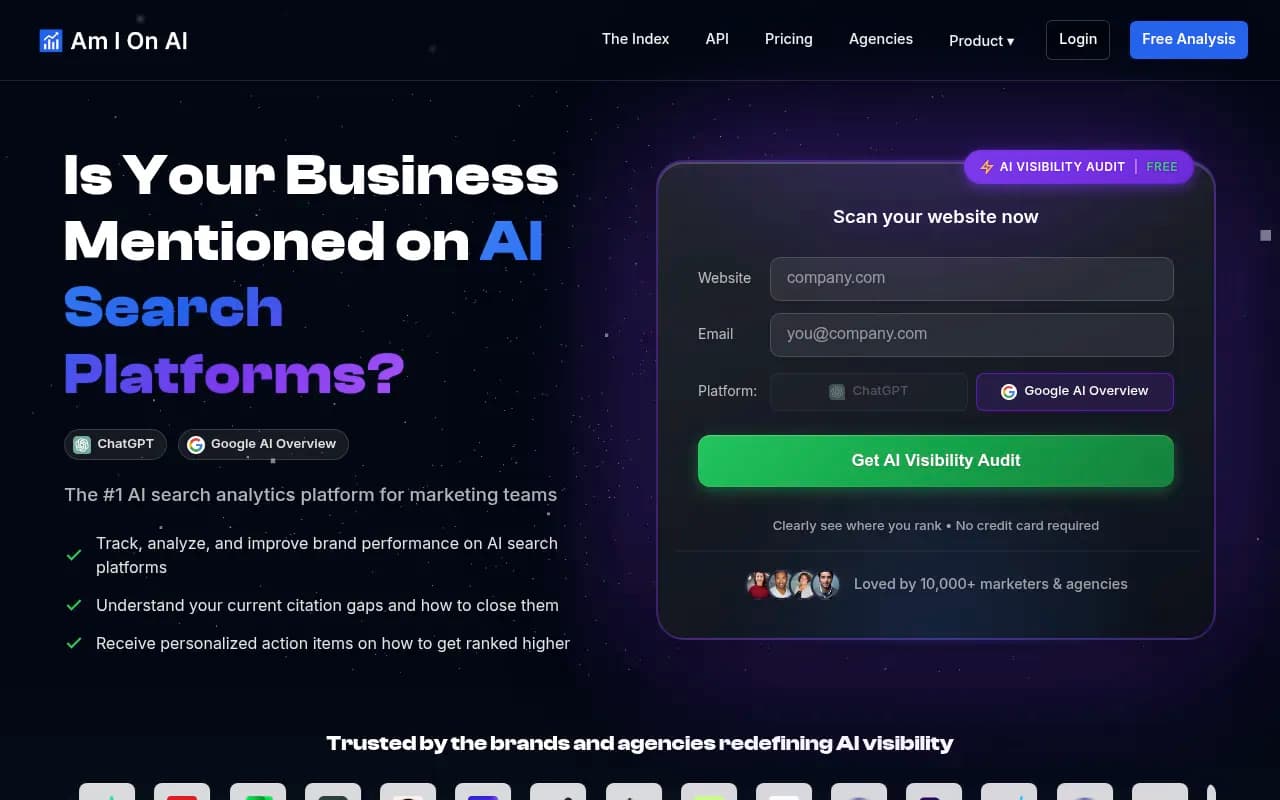
Am I on AI? is a GEO monitoring tool built by Mindshare AI Ltd, a company founded in 2025 by Tomer Dean, Peleg Aran, and Ran Alter, with offices listed in New York and Tel Aviv. The pitch is straightforward: type in your brand and a website, and the tool tells you whether ChatGPT (and now Google AI Overview) mentions you, who your AI-visible competitors are, and what to do about it. It sits at the low-cost end of the AI visibility market, which third-party reviewers like Omnia and GTMonly consistently describe as an "entry-level" or "solo consultant" tool rather than an enterprise GEO suite.
The product is built on an internal backend branded "Mindshare" (api.mindshare.so), which also powers a public, free "AI Visibility Index" leaderboard that ranks brands by category using 100-200 curated prompts per category, rescanned weekly on a rolling 30-day basis. That public index is a smart lead-gen move and it's genuinely useful for benchmarking, though the methodology page itself admits the free version is ChatGPT-only, US-focused, and limited to domain-level (not page-level) citation data.
Who's actually using it? The marketing claims "10,000+ marketers & agencies," and logos from companies like Fastly, Formlabs, SysAid, and Check Point appear on the homepage. That said, the company's own X/Twitter account has only around 15 followers and minimal posting activity since February 2025, which is a strange mismatch for a tool claiming that scale of usage. Worth keeping in mind when evaluating how established the brand really is.
Key features
- AI Visibility Audit (free checker). The entry point is a no-credit-card scan where you punch in your website and brand name and get a snapshot score across ChatGPT and Google AI Overview. It's a reasonable top-of-funnel tool for a quick gut check, similar in spirit to free AEO audit tools, but it's not a substitute for ongoing tracking.
- Prompt tracking and scanning. Paid plans scan up to 150 prompts (Pro) or 750 prompts across 5 audience segments (Prism). This is noticeably smaller than what mid-market GEO platforms track, and there's no mention of prompt volume or difficulty scoring, which tools like Promptwatch include to help prioritize which prompts actually matter.
- Citation and source analysis. The dashboard shows top source domains feeding AI answers (GitHub, Stack Overflow, Reddit, Medium, Dev.to were shown in product screenshots), with percentage weighting per source. Reviewers at bevisible.app rate this source-citation analysis as "light" compared to competitors, and there's no dedicated Reddit or YouTube citation reporting, both channels Promptwatch tracks explicitly given how much AI answer-building leans on them.
- Weekly action plan and recommendations. This is the differentiator the company leans on hardest: instead of just a score, you get specific suggested actions like "comment on this Reddit thread" or "publish this LinkedIn article" with projected impact percentages. It's a nice touch for non-technical users, but execution is entirely manual. There's no automated content agent that drafts and publishes to a CMS the way Promptwatch's Content Agents do for Webflow, Framer, or WordPress.
- Competitor ranking and benchmarking. You can see where your brand sits against competitors inside AI answers, plus the free public Index for category-level leaderboards (Proxy Services, VPN Services, CRM Software, and more).
- Sentiment analysis. Listed in the SourceForge product profile as tracking how positively or negatively AI models discuss a brand over time, though it's not heavily demonstrated on the marketing site itself.
- Agency white-label program. A separate pricing track starting at $250/month for 3 tracked clients, scaling to $1,750/month for 30 clients (Agency-30), with a 50+ client custom tier. Includes white-label reports, unlimited seats, Slack support, and API access. One cited agency testimonial claims $127,000 in added ARR and a 92% renewal rate from reselling AI visibility reports at 2-3x normal SEO retainer rates, which is a compelling pitch if accurate.
- API access. Available via the Mindshare backend (api.mindshare.so) for programmatic pulls of visibility, customer, and growth data, aimed at agencies building custom dashboards.
- GEO Council (managed service). A $2,500/month "done-with-you" tier with dedicated expert guidance and quarterly reporting. As of this writing it's listed as fully booked and waitlist-only, which suggests either real demand or a deliberate scarcity move.
Who is it for
The clearest fit is a solo consultant or small agency owner who wants a cheap way to show a handful of clients a basic AI visibility snapshot without building anything in-house. At $100/month for the Pro tier, it's genuinely accessible for a freelancer managing one or two brands, and the weekly action items give non-technical clients something concrete to act on even if they don't fully understand GEO yet.
Agencies managing 5-30 client accounts might find the Agency program pricing attractive on paper ($58-75 per client per month), especially if they're reselling AI visibility as a new line item on existing SEO retainers. But because the underlying monitoring is limited to ChatGPT and Google AI Overview with only light source analysis, agencies serving clients who need Perplexity, Claude, Gemini, or Grok coverage will hit a ceiling fast.
Who should skip it: any SaaS company, e-commerce brand, or enterprise marketing team that needs multi-model coverage, AI crawler logs, traffic attribution from AI referrals, or automated content production. A startup with 50-200 keywords to track across six AI models and a need to actually publish optimized content at scale will outgrow this tool within a month or two. Teams in that position are better served by a full-stack GEO platform.
Integrations and ecosystem
Integration depth is thin. There's an API (api.mindshare.so) for pulling visibility and growth data programmatically, which is useful for agencies building their own client dashboards. Slack is mentioned as part of the agency plan, though it reads more like a support channel than a genuine Slack app integration. There's no evidence of native connections to Google Search Console, GA4, Zapier, HubSpot, or any CMS for publishing. No browser extension or mobile app was found. No public GitHub repository exists for the product itself.
Pricing and value
Three core self-serve tiers, each with a 7-day free trial and no credit card required upfront:
- Pro: $100/month, tracks up to 150 prompts across ChatGPT and Google AI Overview, full citation access, personalized recommendations.
- Prism: $349/month (marked "recommended"), tracks 5 audience segments and up to 750 total prompts, with per-persona insights.
- GEO Council: $2,500/month, a managed service with expert guidance and quarterly reporting, currently fully booked.
The separate Agency Program starts at $250/month for 3 clients and scales down to roughly $58/client/month at 30 clients, with a 50+ client custom tier available. Note that "client" here technically means a tracked query group, not a literal seat count, so agencies should clarify exactly what counts against their limit before buying.
Third-party aggregators show some pricing inconsistency: a few list a $250/month "multiple product tracking" tier and one lists an unverified $29/month entry point that doesn't match the official site. Take the official $100 Pro starting price as the reliable baseline.
Compared to monitoring-only competitors like Otterly.AI or Peec.ai, pricing is roughly in the same ballpark, maybe slightly cheaper at entry. Compared to a full-stack platform like Promptwatch, which starts at $95/month for Essential (comparable price, but with crawler logs, content generation, and multi-model tracking included), Am I on AI? looks less competitive on a pure value-per-dollar basis once you factor in what's missing.
Strengths and limitations
What it does well: the free audit is a low-friction way to get someone curious about GEO to actually try something. The weekly action plan format translates abstract visibility scores into plain-English tasks, which is genuinely helpful for non-technical small business owners. The public Index is a clever, free top-of-funnel asset with a transparently published methodology. Agency pricing is simple and cheap enough to resell as an add-on service.
Where it falls short against a platform like Promptwatch: no AI crawler logs (so no visibility into when ChatGPTBot, ClaudeBot, or GoogleOther actually hit your site), no visitor analytics or AI traffic attribution to tie visibility to real conversions, no Reddit or YouTube-specific citation tracking despite how much those channels feed AI answers, no ChatGPT Shopping or Ads Radar, no prompt volume or difficulty scoring, and no content generation or CMS publishing agent. Model coverage stops at ChatGPT and Google AI Overview, missing Perplexity, Claude, Gemini, Grok, and others entirely. The company's own methodology page admits query-selection bias and natural-language variance as real constraints on how much to trust the scores.
Bottom line
Am I on AI? works as a cheap, approachable starting point for solo marketers and small agencies who just want a basic read on whether ChatGPT and Google AI Overview know their brand exists. For anyone who needs genuine multi-model coverage, crawler-level diagnostics, traffic attribution, or an actual engine for producing and publishing GEO content rather than just a to-do list, Promptwatch is the stronger choice. The best use case for Am I on AI? is a solo consultant or very small business running a quick, low-stakes AI visibility check before deciding whether to invest in a deeper GEO strategy.
Frequently asked questions
What is Am I on AI??
How much does Am I on AI? cost?
Is there a free plan or trial?
Which AI platforms does it track?
How does it compare to Promptwatch?
Who is Am I on AI? best suited for?
Similar and alternative tools to Am I on AI?