Key Takeaways
- Promptwatch is the only platform that goes beyond monitoring to help you actually fix visibility gaps with content generation and optimization tools -- best for teams that want to take action, not just watch dashboards
- AthenaHQ offers strong monitoring features and competitive analysis but lacks content creation capabilities -- solid choice for brands focused on tracking and reporting
- Semrush brings traditional SEO credibility but uses fixed prompts and charges $99/mo extra for AI visibility -- better for teams already invested in the Semrush ecosystem
- Otterly.AI is the budget option starting at $29/mo but limited to basic monitoring without crawler logs or optimization features
- Peec AI stands out for multi-language support and smart suggestions -- good fit for international brands
Rankshift has carved out a position in the AI visibility space with its focus on tracking brand mentions across ChatGPT, Perplexity, Claude, and other LLMs. It's a solid monitoring tool with unlimited users and projects across all plans, starting at €69/mo for 150 prompts per day.
But the AI search landscape is moving fast. Some teams need more than tracking -- they need tools that help them understand why they're invisible and how to fix it. Others want deeper analytics, better pricing, or features Rankshift doesn't offer. Here's how the alternatives stack up.
Promptwatch

Promptwatch is the only AI visibility platform built around taking action, not just monitoring. Most competitors (including Rankshift) show you where you appear in AI responses and leave you stuck figuring out what to do next. Promptwatch closes that loop.
The core difference is the action cycle: Answer Gap Analysis shows you exactly which prompts competitors rank for but you don't, then the built-in AI writing agent generates content grounded in 880M+ citations analyzed to help you actually get cited. You're not guessing what to write -- you're creating content engineered to rank in ChatGPT, Claude, Perplexity, and other AI models. Then you track the results with page-level citation tracking and traffic attribution.
Compared to Rankshift:
- Crawler logs: Real-time feed of AI bots hitting your site (ChatGPT, Claude, Perplexity crawlers), which pages they read, errors they encounter. Rankshift doesn't have this.
- Content generation: Built-in AI agent creates articles, listicles, and comparisons based on citation data and prompt volumes. Rankshift is monitoring-only.
- Prompt intelligence: Volume estimates, difficulty scores, query fan-outs showing how prompts branch into sub-queries. Helps you prioritize high-value, winnable prompts.
- Reddit & YouTube tracking: Surface discussions that influence AI recommendations -- a channel most competitors ignore.
- ChatGPT Shopping: Monitor when your brand appears in ChatGPT's product recommendations and shopping carousels.
Pricing is comparable: Essential $99/mo (1 site, 50 prompts, 5 articles), Professional $249/mo (2 sites, 150 prompts, 15 articles, crawler logs), Business $579/mo (5 sites, 350 prompts, 30 articles). Free trial available.
Rankshift gives you unlimited users and projects at every tier, which is nice for agencies. Promptwatch charges per site and prompt volume but includes content generation and optimization tools that Rankshift lacks entirely.
Best for: Marketing teams that want to improve AI visibility, not just track it. If you need to understand content gaps and create content that actually gets cited, Promptwatch is the only platform that does this end-to-end.
AthenaHQ

AthenaHQ is a comprehensive monitoring platform used by brands like ZoomInfo, Coinbase, and SoFi. It tracks 8+ AI models and offers strong competitive analysis features.
Compared to Rankshift:
- Deeper analytics: AthenaHQ provides more granular sentiment analysis and thematic breakdowns of how AI models perceive your brand
- Better competitor benchmarking: Side-by-side heatmaps showing where competitors win for each prompt
- Citation analysis: See which domains, Reddit threads, and YouTube videos AI models cite most often
- No crawler logs: Like Rankshift, AthenaHQ doesn't show you real-time AI bot activity on your site
- No content generation: Monitoring and insights only -- you're on your own for creating content that ranks
Pricing starts at $295/mo self-serve or $95/mo annual. No free trial, which is a barrier compared to Rankshift's 30-day trial. Enterprise pricing is custom.
The interface is polished and the data is solid, but AthenaHQ stops at showing you the problem. If a competitor is visible for a prompt you care about, you'll see that clearly -- but you won't get guidance on what content to create or how to optimize.
Best for: Brands that need detailed reporting and competitive intelligence but have their own content team to act on the insights. Good fit for enterprise marketing teams with established workflows.
Semrush
Semrush added AI visibility tracking as part of "Semrush One" in 2025. It's a $99/mo add-on to their core platform, which starts at $165.17/mo.
Compared to Rankshift:
- Traditional SEO integration: If you're already using Semrush for keyword research, backlinks, and site audits, having AI visibility in the same platform is convenient
- Fixed prompts: Semrush uses a predefined set of prompts, not custom tracking. You can't add your own like you can in Rankshift.
- Limited models: Focuses on ChatGPT, Perplexity, and Gemini. Doesn't track Claude, DeepSeek, or other models Rankshift supports.
- No crawler logs or traffic attribution: Basic monitoring only
- Higher total cost: $165.17/mo base + $99/mo AI toolkit = $264.17/mo minimum, vs Rankshift's €69/mo entry point
The AI visibility features feel tacked on rather than purpose-built. Semrush is a traditional SEO platform trying to adapt to AI search, not a native AI visibility tool.
Best for: Teams already paying for Semrush who want basic AI visibility tracking without switching platforms. Not ideal if AI search is a core channel for you.
Otterly.AI

Otterly.AI is the budget option in this space, starting at $29/mo for 15 prompts. It tracks ChatGPT, Perplexity, Google AI Overviews, AI Mode, Gemini, and Copilot.
Compared to Rankshift:
- Much cheaper entry point: $29/mo vs €69/mo, though the Lite plan is very limited (15 prompts)
- GEO audit tool: Analyzes 25+ on-page factors to show what's holding your site back from citations. Rankshift doesn't have this.
- Basic monitoring: No crawler logs, no visitor analytics, no content generation
- Limited prompt volumes: Standard plan is $189/mo for 100 prompts. Rankshift gives you 150 prompts/day (4,500/mo) at €69/mo.
- 14-day free trial: Shorter than Rankshift's 30 days
Otterly.AI is fine for small businesses or solopreneurs who need basic tracking on a tight budget. But the feature set is thin -- you're getting visibility scores and citation tracking, nothing more.
Best for: Budget-conscious teams that need basic AI visibility monitoring and don't require advanced features like crawler logs or content optimization.
Peec AI

Peec AI is a European platform (like Rankshift) with strong multi-language support and smart suggestions for improving visibility.
Compared to Rankshift:
- Multi-language tracking: Monitor AI responses in any language and region. Rankshift supports this too but Peec's interface is more polished for international campaigns.
- Smart suggestions: Peec analyzes your visibility gaps and suggests specific actions. Not as comprehensive as Promptwatch's content generation, but more actionable than Rankshift's raw data.
- Similar pricing: Starter €89/mo, Professional €199/mo. Slightly higher than Rankshift but includes more guidance.
- Freemium model: Free trial + limited free tier. Good for testing before committing.
- No crawler logs: Like most competitors, doesn't show AI bot activity on your site
Peec feels more refined than Rankshift in terms of UI and recommendations, but the core feature set is similar -- monitoring with some optimization hints.
Best for: International brands that need multi-language AI visibility tracking with actionable suggestions. Good middle ground between basic monitoring and full optimization platforms.
Scrunch
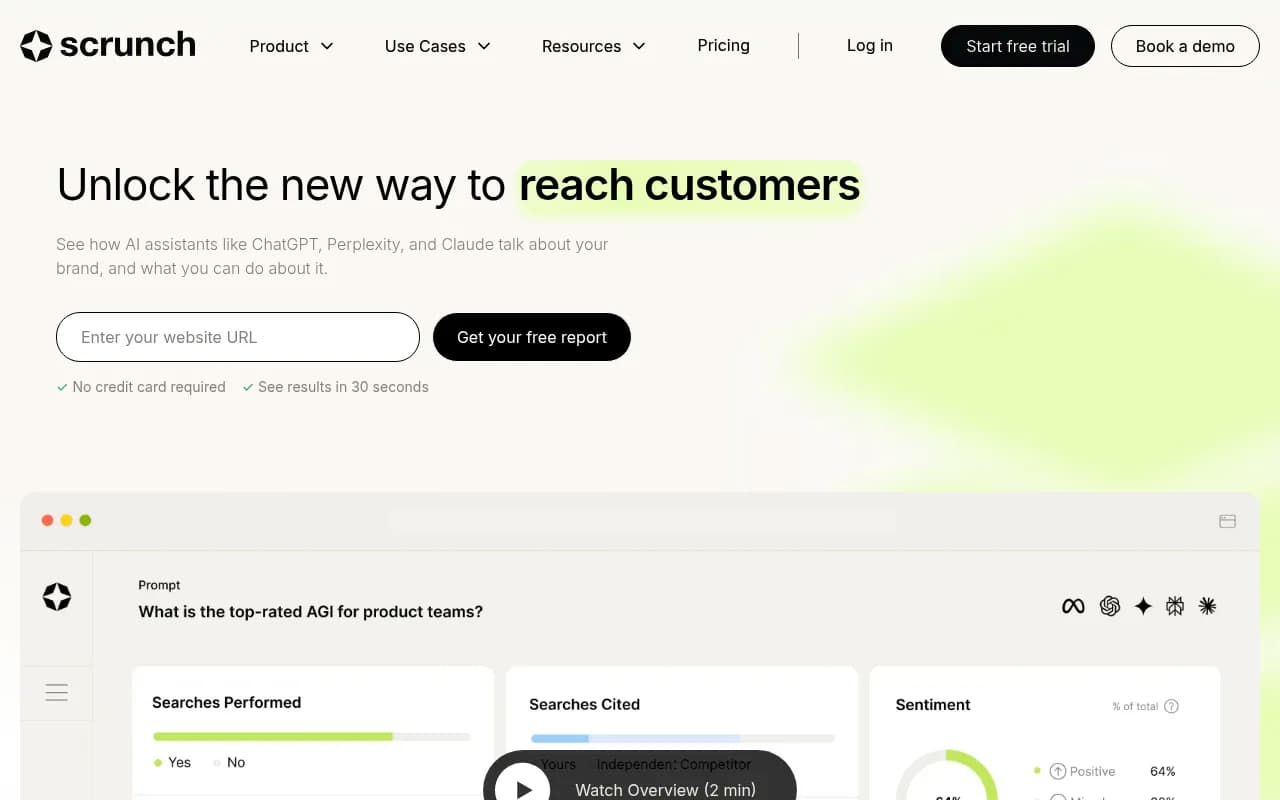
Scrunch positions itself as an "AI Customer Experience Platform" with a focus on delivering content directly to AI agents. It's a different approach than pure monitoring.
Compared to Rankshift:
- Agent Experience Platform (AXP): Create a parallel version of your site optimized for AI traffic. This is unique -- most tools just track, Scrunch helps you build AI-friendly pages.
- Error detection: Spot when AI bots can't crawl your site and fix it. Similar to Promptwatch's crawler logs but less detailed.
- Higher pricing: Starts at $250/mo annual billing, vs Rankshift's €69/mo. Growth plan is $417/mo.
- Different philosophy: Scrunch is about optimizing the AI experience, not just tracking visibility. More proactive than Rankshift.
- 7-day free trial: Shorter than Rankshift's 30 days
Scrunch is interesting if you want to go beyond monitoring and actually build AI-optimized experiences. But it's pricier and the learning curve is steeper.
Best for: Brands that want to create AI-specific content experiences and have the budget for a premium platform. Good fit for companies treating AI search as a strategic channel, not just a metric to track.
Rankscale
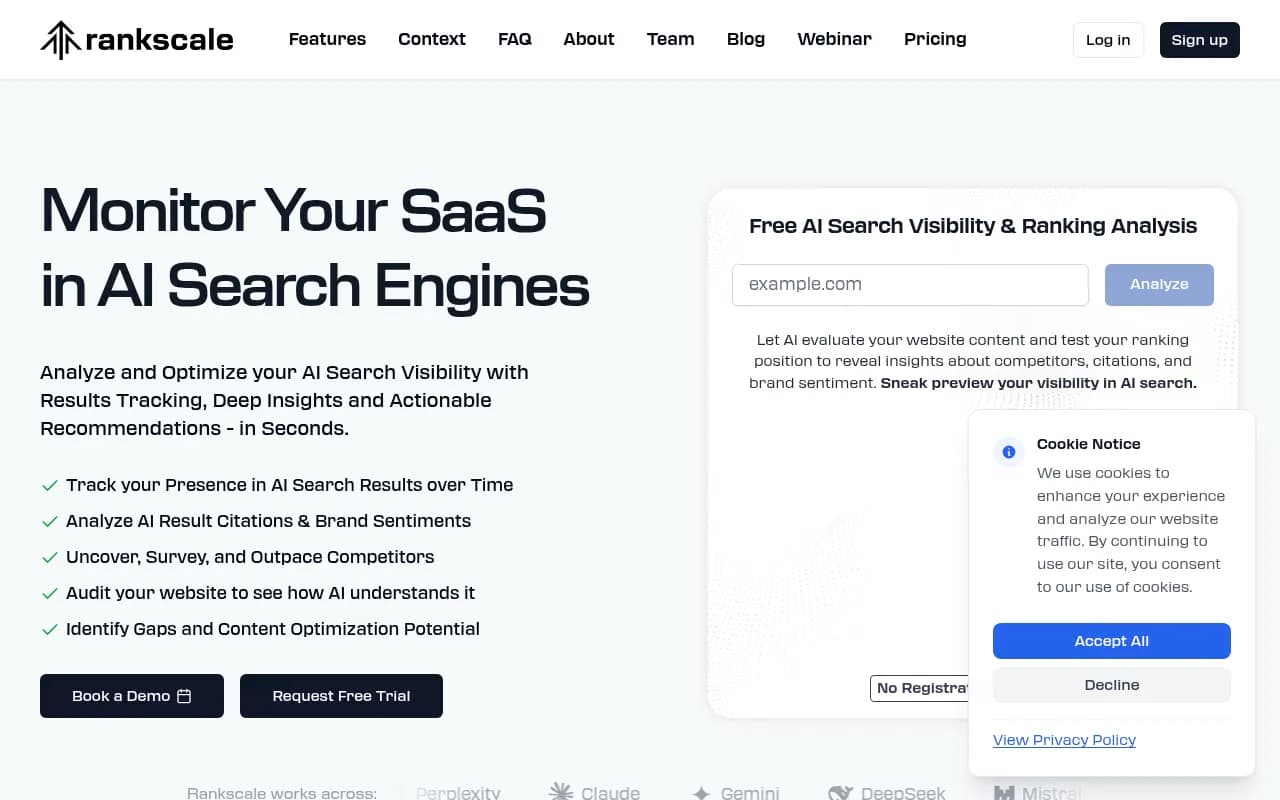
Rankscale uses a credit-based pricing model starting at €20/mo. It tracks rankings across ChatGPT, Perplexity, Claude, Gemini, and other AI models.
Compared to Rankshift:
- Credit-based pricing: More flexible if your prompt volume fluctuates month to month. Rankshift uses fixed daily limits.
- Deep analysis: Rankscale emphasizes detailed citation analysis and sentiment tracking. Similar depth to Rankshift.
- Website audit: Shows how AI understands your site and identifies optimization opportunities. Useful but not as actionable as Promptwatch's content generation.
- Lower entry price: €20/mo vs €69/mo, though you need to manage credits carefully
- Less transparent pricing: Credit costs vary by feature, making it harder to predict monthly spend
Rankscale is a solid monitoring platform with flexible pricing. The credit system can be cheaper if you're tracking a small number of prompts, but it gets complicated at scale.
Best for: Teams that want flexible, pay-as-you-go pricing and don't need a fixed monthly prompt allowance. Good for agencies managing multiple clients with varying needs.
How to Choose the Right Rankshift Alternative
If you're just tracking visibility and don't need optimization features, Rankshift is fine. But most teams hit a wall with monitoring-only tools -- you see the problem but don't know how to fix it.
Choose Promptwatch if: You want to improve AI visibility, not just track it. The content generation and gap analysis features are game-changers if you're serious about ranking in AI search.
Choose AthenaHQ if: You need detailed competitive analysis and have your own content team to act on insights. Good for enterprise brands with established workflows.
Choose Semrush if: You're already paying for Semrush and want basic AI visibility in the same platform. Not ideal if AI search is a core channel.
Choose Otterly.AI if: You're on a tight budget and need basic monitoring. Limited features but gets the job done for small teams.
Choose Peec AI if: You need multi-language tracking with actionable suggestions. Good middle ground between monitoring and optimization.
Choose Scrunch if: You want to build AI-optimized experiences and have the budget for a premium platform. Different philosophy than pure monitoring tools.
Choose Rankscale if: You want flexible credit-based pricing and don't need fixed monthly prompt limits.
The AI search landscape is still evolving. In 2026, the winners won't be the brands that just track visibility -- they'll be the ones that understand why they're invisible and know how to fix it. That's the difference between a monitoring tool and an optimization platform.