Summary
- Promptwatch: Best for teams that need more than monitoring -- includes content gap analysis, AI writing agent, and crawler logs to actually improve your AI search rankings, not just track them
- AthenaHQ: Strong enterprise choice with comprehensive tracking across 8+ AI models, but lacks content generation and optimization features
- Semrush: Good if you already use Semrush for SEO and want to add AI visibility tracking, but uses fixed prompts and lacks traffic attribution
- Otterly.AI: Most affordable option starting at $29/mo, solid for basic monitoring but missing advanced features like crawler logs and content optimization
- Peec AI: Strong multi-language support and smart suggestions, but monitoring-focused without content creation capabilities
Nightwatch positions itself as a marketing-focused AI search monitoring tool with rank tracking, AI visibility scoring, and SEO workflow automation. It's a decent all-in-one platform if you want traditional SEO and AI tracking in one place. But the AI search landscape in 2026 is crowded, and several alternatives offer capabilities Nightwatch doesn't -- particularly when it comes to actually improving your visibility instead of just measuring it.
The core question: do you just want to see where you rank in ChatGPT and Perplexity, or do you want tools that help you fix the gaps and climb higher?
Promptwatch

Promptwatch is the only platform in this comparison that treats AI visibility as an optimization problem, not just a tracking exercise. Most tools (including Nightwatch) show you dashboards and metrics. Promptwatch shows you what's missing, then helps you create content that actually gets cited.
The difference is the action loop. Answer Gap Analysis reveals exactly which prompts your competitors are visible for but you're not -- the specific topics and questions AI models want answers to but can't find on your site. Then the built-in AI writing agent generates articles, listicles, and comparisons grounded in real citation data (880M+ citations analyzed), prompt volumes, and competitor research. This isn't generic SEO filler -- it's content engineered to rank in ChatGPT, Claude, Perplexity, and other AI models. Finally, page-level tracking shows your visibility scores improve as AI models start citing your new content, with traffic attribution (code snippet, GSC integration, or server log analysis) connecting visibility to revenue.
Nightwatch doesn't have any of this. It tracks rankings and generates reports, but leaves you stuck when you need to actually improve those rankings.
Additional capabilities that support the optimization workflow: AI Crawler Logs (real-time logs of ChatGPT, Claude, Perplexity crawlers hitting your site -- which pages they read, errors they encounter, indexing issues to fix), Prompt Intelligence (volume estimates and difficulty scores for each prompt, plus query fan-outs showing how one prompt branches into sub-queries), Citation & Source Analysis (see exactly which pages, Reddit threads, YouTube videos, and domains AI models cite), Reddit & YouTube Insights (surface discussions that influence AI recommendations), ChatGPT Shopping Tracking (monitor when your brand appears in product recommendations and shopping carousels), Competitor Heatmaps (compare your AI visibility vs competitors across LLMs), Multi-language & Multi-region tracking with customizable personas, Looker Studio Integration & API.
Monitors 10 AI models: OpenAI/ChatGPT, Perplexity, Google AI Overviews, Google AI Mode, Claude, Gemini, Meta/Llama, DeepSeek, Grok, Mistral, Copilot. Pricing starts at $99/mo (Essential: 1 site, 50 prompts, 5 articles), $249/mo (Professional: 2 sites, 150 prompts, 15 articles, crawler logs, state/city tracking), $579/mo (Business: 5 sites, 350 prompts, 30 articles). Free trial available.
In a 2026 comparison of 12 GEO platforms, Promptwatch was the only one rated as a "Leader" across all categories. The core reason: most competitors are monitoring-only dashboards. Promptwatch is built around taking action.
Best for: Marketing teams, SEO teams, and agencies that want to actually improve their AI search rankings, not just track them. If you're tired of dashboards that show you problems without helping you solve them, this is the platform.
AthenaHQ

AthenaHQ is a comprehensive GEO platform with strong enterprise features and solid tracking across 8+ AI models (ChatGPT, Perplexity, Google AI Overviews, Claude, Gemini, Copilot, Google AI Mode). It monitors brand mentions, tracks citations, analyzes sentiment, and provides competitive benchmarking. The interface is polished, the data is reliable, and the reporting is detailed.
What it does well: multi-model coverage, competitive analysis, sentiment tracking, and enterprise-grade reporting. AthenaHQ is particularly strong at showing you where you stand relative to competitors and how AI models perceive your brand. The platform is used by companies like ZoomInfo, Coinbase, and Nextiva, which speaks to its enterprise credibility.
What it doesn't do: content optimization and generation. AthenaHQ is a monitoring platform. It shows you the data, but doesn't help you create the content that will improve your rankings. No content gap analysis, no AI writing agent, no crawler logs showing how AI models are actually discovering (or failing to discover) your content. If you want to act on the insights, you're on your own.
Compared to Nightwatch: AthenaHQ has broader AI model coverage and stronger competitive analysis, but Nightwatch includes traditional SEO features (rank tracking, site audit, keyword research) that AthenaHQ lacks. AthenaHQ is more expensive at $295/mo (self-serve) or $95/mo annual, vs Nightwatch's $32/mo starting price.
Compared to Promptwatch: AthenaHQ is monitoring-only. Promptwatch is monitoring + optimization + content generation. If you just want dashboards, AthenaHQ works. If you want to improve your rankings, Promptwatch is the better choice.
Best for: Enterprise teams with dedicated content resources who need comprehensive monitoring and competitive intelligence but can handle content creation in-house. Not ideal if you're a small team that needs help closing the gap between insights and action.
Semrush
Semrush is a traditional SEO powerhouse that added AI visibility tracking as an add-on feature. If you're already a Semrush user, the AI Visibility Toolkit ($99/mo add-on) is a convenient way to extend your existing workflow into AI search monitoring. It tracks brand mentions across ChatGPT, Perplexity, Gemini, and Google AI Overviews, analyzes sentiment, and provides competitive benchmarking.
The advantage: integration with Semrush's massive SEO toolkit. You get keyword research, backlink analysis, site audits, rank tracking, content optimization, and AI visibility monitoring in one platform. For teams that want everything under one roof, this is appealing.
The limitations: Semrush's AI visibility features are basic compared to dedicated GEO platforms. It uses fixed prompts (you can't customize or add your own), lacks traffic attribution (no way to connect AI visibility to actual revenue), and doesn't provide crawler logs or content gap analysis. The AI tracking feels like an afterthought bolted onto an SEO platform, not a purpose-built GEO solution.
Compared to Nightwatch: Semrush is more expensive (Semrush One from $165.17/mo + $99/mo AI add-on vs Nightwatch's $32-$199/mo), but offers a much broader SEO toolkit. Nightwatch is more focused on AI search and offers more customization for prompt tracking.
Compared to Promptwatch: Semrush tracks AI visibility but doesn't help you improve it. No content generation, no answer gap analysis, no crawler logs. Promptwatch is built around the optimization loop -- find gaps, create content, track results. Semrush stops at step one.
Best for: Existing Semrush users who want to add basic AI visibility monitoring to their workflow without switching platforms. Not ideal if AI search is a strategic priority and you need advanced features like custom prompts, traffic attribution, or content optimization.
Otterly.AI

Otterly.AI is the budget-friendly option in this comparison, starting at $29/mo for 15 prompts. It tracks brand mentions and website citations across ChatGPT, Perplexity, Google AI Overviews, Google AI Mode, Gemini, and Copilot. The interface is clean, setup is fast, and the pricing is accessible for small teams and solopreneurs.
What you get: basic monitoring, GEO audit tool (analyzes 25+ on-page factors to reveal what's holding your site back), keyword research for conversational prompts, and competitive benchmarking. The GEO audit is a nice touch -- it gives you specific recommendations for improving your content's AI-friendliness.
What you don't get: crawler logs, traffic attribution, content generation, or advanced analytics. Otterly.AI is a monitoring dashboard. It shows you where you rank and gives you some optimization suggestions, but doesn't help you create the content that will move the needle. No AI writing agent, no answer gap analysis, no prompt volume estimates or difficulty scoring.
Compared to Nightwatch: Otterly.AI is cheaper ($29/mo vs $32/mo starting price, but Nightwatch includes more features at higher tiers), but Nightwatch offers traditional SEO tools (rank tracking, site audit, keyword research) that Otterly.AI lacks. Otterly.AI is purely focused on AI search.
Compared to Promptwatch: Otterly.AI is monitoring-only. Promptwatch is monitoring + optimization + content generation. If budget is your primary constraint and you just need basic tracking, Otterly.AI works. If you want to actually improve your rankings, Promptwatch is worth the extra investment.
Best for: Small teams, solopreneurs, and agencies managing multiple clients on a tight budget who need basic AI visibility monitoring without advanced features. Good starting point if you're new to GEO and want to dip your toes in without a big commitment.
Peec AI

Peec AI is a multi-language AI search monitoring platform with smart suggestions and solid tracking across ChatGPT, Perplexity, Claude, and Gemini. It's particularly strong for international brands that need to monitor AI visibility in multiple languages and regions. The platform provides visibility scores, position tracking, sentiment analysis, and competitive benchmarking.
What sets it apart: multi-language support and smart suggestions. Peec AI analyzes your brand's performance and provides actionable recommendations for improving your AI search presence. The interface is clean, the data is reliable, and the reporting is detailed. Used by brands and agencies that need to track AI visibility across multiple markets.
What it doesn't do: content generation or optimization. Peec AI is a monitoring platform with smart suggestions, but it doesn't help you create the content that will improve your rankings. No AI writing agent, no answer gap analysis, no crawler logs. The suggestions are helpful, but you're still responsible for execution.
Compared to Nightwatch: Peec AI has stronger multi-language support and smarter recommendations, but Nightwatch includes traditional SEO features (rank tracking, site audit, keyword research) that Peec AI lacks. Pricing is similar (Peec AI from €89/mo vs Nightwatch from $32/mo).
Compared to Promptwatch: Peec AI is monitoring + suggestions. Promptwatch is monitoring + optimization + content generation. If you need multi-language tracking and can handle content creation in-house, Peec AI works. If you want the platform to help you create content, Promptwatch is the better choice.
Best for: International brands and agencies that need to monitor AI visibility across multiple languages and regions. Good choice if you have content resources in-house and just need smart monitoring and recommendations, not full content generation.
Ahrefs Brand Radar
Ahrefs Brand Radar is a brand monitoring feature included with Ahrefs subscriptions (Lite from $129/mo, Standard from $249/mo). It tracks brand mentions across AI-powered search engines and traditional search, providing visibility into how your brand appears in AI responses. If you're already an Ahrefs user, Brand Radar is a convenient add-on to your existing workflow.
The advantage: integration with Ahrefs' massive SEO toolkit. You get keyword research, backlink analysis, site audits, rank tracking, content explorer, and brand monitoring in one platform. For teams that want everything under one roof, this is appealing.
The limitations: Brand Radar is a basic brand monitoring feature, not a comprehensive GEO platform. It uses fixed prompts (you can't customize or add your own), lacks traffic attribution (no way to connect AI visibility to actual revenue), and doesn't provide crawler logs, content gap analysis, or content generation. The AI tracking is minimal compared to dedicated GEO platforms.
Compared to Nightwatch: Ahrefs is more expensive ($129/mo vs $32/mo starting price), but offers a much broader SEO toolkit. Nightwatch is more focused on AI search and offers more customization for prompt tracking. Ahrefs Brand Radar is a nice-to-have feature for existing users, not a reason to switch.
Compared to Promptwatch: Ahrefs tracks brand mentions but doesn't help you improve your AI visibility. No content generation, no answer gap analysis, no crawler logs. Promptwatch is built around the optimization loop -- find gaps, create content, track results. Ahrefs stops at step one.
Best for: Existing Ahrefs users who want to add basic brand monitoring to their workflow without switching platforms. Not ideal if AI search is a strategic priority and you need advanced features like custom prompts, traffic attribution, or content optimization.
SE Ranking
SE Ranking is a comprehensive SEO platform that added AI visibility tracking as an add-on feature. The AI Search add-on (from $71.20/mo) tracks brand mentions across AI-powered search engines and provides visibility scoring, sentiment analysis, and competitive benchmarking. If you're already an SE Ranking user, the AI Search add-on is a convenient way to extend your existing workflow.
The advantage: integration with SE Ranking's SEO toolkit. You get keyword research, rank tracking, backlink analysis, site audits, content optimization, and AI visibility monitoring in one platform. For teams that want everything under one roof, this is appealing. SE Ranking is also more affordable than Semrush or Ahrefs.
The limitations: SE Ranking's AI visibility features are basic compared to dedicated GEO platforms. It uses fixed prompts (you can't customize or add your own), lacks traffic attribution (no way to connect AI visibility to actual revenue), and doesn't provide crawler logs or content gap analysis. The AI tracking feels like an add-on to an SEO platform, not a purpose-built GEO solution.
Compared to Nightwatch: SE Ranking is more expensive ($103.20/mo + $71.20/mo AI add-on vs Nightwatch's $32-$199/mo), but offers a broader SEO toolkit. Nightwatch is more focused on AI search and offers more customization for prompt tracking.
Compared to Promptwatch: SE Ranking tracks AI visibility but doesn't help you improve it. No content generation, no answer gap analysis, no crawler logs. Promptwatch is built around the optimization loop -- find gaps, create content, track results. SE Ranking stops at step one.
Best for: Existing SE Ranking users who want to add basic AI visibility monitoring to their workflow without switching platforms. Not ideal if AI search is a strategic priority and you need advanced features like custom prompts, traffic attribution, or content optimization.
Radarkit
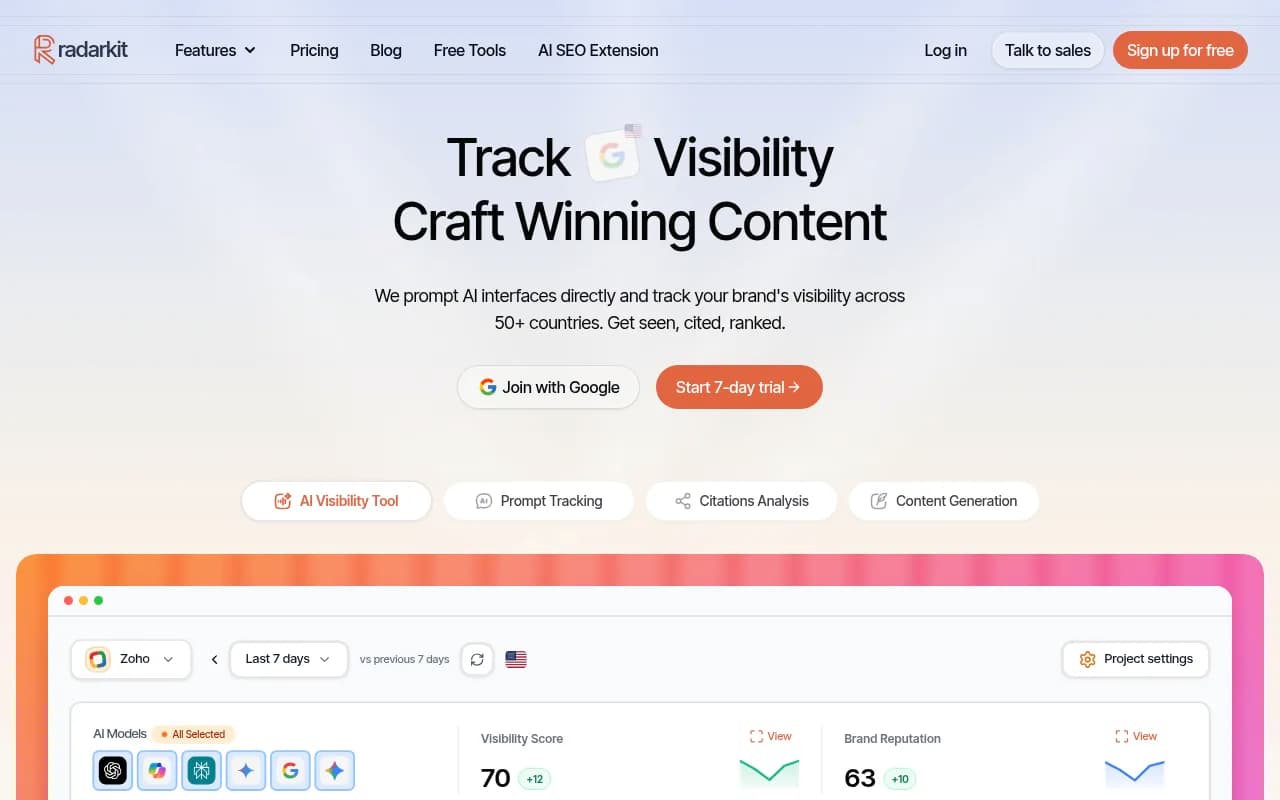
Radarkit is an AI search tracking and GEO content optimization platform that monitors brand visibility across ChatGPT, Perplexity, Gemini, Copilot, and Google AI Overviews. It tracks keyword rankings, analyzes citations, generates AI-optimized content, and measures traffic from LLM referrals across 50+ countries. Starting at $29/mo (Lite plan), it's one of the more affordable options with content optimization features.
What it does well: combines monitoring with content optimization. Radarkit tracks your AI visibility and provides recommendations for improving your content's AI-friendliness. The platform includes a content optimization tool that helps you create AI-optimized content based on citation analysis and competitive research. This puts it ahead of pure monitoring tools like Otterly.AI or Peec AI.
What it doesn't do as well as Promptwatch: the content optimization features are basic compared to Promptwatch's AI writing agent and answer gap analysis. Radarkit gives you recommendations and optimization suggestions, but Promptwatch actually generates the content for you based on 880M+ citations analyzed, prompt volumes, and competitor research. Radarkit also lacks crawler logs (no visibility into how AI models are discovering your content) and advanced prompt intelligence (no volume estimates or difficulty scoring).
Compared to Nightwatch: Radarkit is cheaper ($29/mo vs $32/mo starting price) and includes content optimization features that Nightwatch lacks. Nightwatch has stronger traditional SEO features (rank tracking, site audit, keyword research), but Radarkit is more focused on AI search optimization.
Compared to Promptwatch: Radarkit is monitoring + basic optimization. Promptwatch is monitoring + advanced optimization + content generation. If you want recommendations and can handle content creation yourself, Radarkit works. If you want the platform to generate the content for you, Promptwatch is the better choice.
Best for: Small teams and agencies that need AI visibility monitoring with basic content optimization features on a budget. Good middle ground between pure monitoring tools (Otterly.AI, Peec AI) and full optimization platforms (Promptwatch).
How to choose the right Nightwatch alternative
The decision comes down to what you actually need:
If you want to improve your AI search rankings, not just track them: Promptwatch is the only platform built around the optimization loop. It shows you what's missing (answer gap analysis), helps you create content that ranks (AI writing agent), and tracks the results (page-level visibility + traffic attribution). Most competitors stop at monitoring.
If you're an enterprise team with content resources in-house: AthenaHQ provides comprehensive monitoring and competitive intelligence without the content generation features you don't need. Strong choice if you just want data and can handle execution yourself.
If you're already using Semrush or Ahrefs for SEO: The AI visibility add-ons (Semrush AI Visibility Toolkit, Ahrefs Brand Radar) are convenient ways to extend your existing workflow. They're basic, but if you're not ready to invest in a dedicated GEO platform, they're better than nothing.
If budget is your primary constraint: Otterly.AI ($29/mo) provides basic monitoring at the lowest price point. Good starting point if you're new to GEO and want to understand the landscape before committing to a more expensive platform.
If you need multi-language tracking: Peec AI has the strongest multi-language support and smart suggestions for international brands. Good choice if you're monitoring AI visibility across multiple markets.
If you want monitoring + basic optimization on a budget: Radarkit ($29/mo) combines tracking with content optimization recommendations. Middle ground between pure monitoring tools and full optimization platforms.
The AI search landscape in 2026 is moving fast. Traditional SEO tools (Semrush, Ahrefs, SE Ranking) are adding AI visibility features, but they're playing catch-up to platforms purpose-built for GEO. Nightwatch is a solid all-in-one option if you want traditional SEO and AI tracking in one place, but if AI search is a strategic priority, you'll likely outgrow it quickly. The platforms that help you optimize -- not just monitor -- are the ones that will drive actual results.