Key Takeaways
- Promptwatch is the best choice if you need AI search visibility tracking and content gap analysis with built-in optimization tools -- it's the only platform that shows you what's missing and helps you fix it with AI-generated content
- Scalenut offers the most affordable entry point at $59/mo with both SEO and GEO tracking, making it ideal for small teams testing AI search optimization
- Surfer SEO delivers the most polished content editor experience with strong SERP analysis, best for teams focused primarily on Google rankings
- Frase provides the best balance of research, writing, and tracking in one agentic platform starting at $39/mo
- Clearscope is the premium choice for enterprise teams that need deep intent analysis and comprehensive tracking across both Google and AI platforms
MarketMuse built its reputation on AI-powered content planning and topic modeling. But at $150/mo for the Standard plan with limited queries, many teams find themselves hitting usage caps or paying for features they don't need. The platform excels at identifying content gaps and building topic clusters, but it stops short of actually helping you create the content or track how it performs in AI search results.
That's the problem: MarketMuse tells you what to write, but leaves you to figure out the rest. In 2026, when ChatGPT, Claude, and Perplexity drive significant traffic, you need tools that close the loop -- from identifying gaps to generating content to tracking AI visibility.
Here's how the alternatives stack up.
Promptwatch

Promptwatch isn't just a monitoring dashboard. It's the only platform that combines AI visibility tracking with actionable content optimization and generation.
The core difference: MarketMuse shows you topic gaps based on competitor analysis. Promptwatch shows you prompt gaps based on 880M+ real citations from ChatGPT, Claude, Perplexity, and other AI models. You see exactly which prompts competitors rank for but you don't, then the platform helps you create content engineered to get cited.
The workflow is simple. Answer Gap Analysis identifies missing content by comparing your visibility to competitors across specific prompts. The built-in AI writing agent generates articles grounded in citation data, prompt volumes, and persona targeting. Then you track results with page-level visibility scores and traffic attribution (code snippet, GSC integration, or server logs).
What you get that MarketMuse doesn't offer:
- Real-time AI crawler logs showing which pages ChatGPT, Claude, and Perplexity read from your site
- Prompt Intelligence with volume estimates and difficulty scores
- Citation and source analysis revealing which pages, Reddit threads, and YouTube videos AI models reference
- Reddit and YouTube insights that surface discussions influencing AI recommendations
- ChatGPT Shopping tracking for product recommendations
- Competitor heatmaps comparing AI visibility across LLMs
- Multi-language and multi-region monitoring with customizable personas
Promptwatch monitors 10 AI models: ChatGPT, Perplexity, Google AI Overviews, Google AI Mode, Claude, Gemini, Meta/Llama, DeepSeek, Grok, Mistral, and Copilot.
Pricing is straightforward. Essential at $99/mo covers 1 site, 50 prompts, and 5 AI-generated articles. Professional at $249/mo adds crawler logs and state/city tracking for 2 sites, 150 prompts, and 15 articles. Business at $579/mo scales to 5 sites, 350 prompts, and 30 articles. All plans include a 7-day free trial.
The trade-off: Promptwatch focuses on AI search optimization and visibility. If you only care about traditional Google SEO and don't need AI tracking, MarketMuse's topic modeling might feel more familiar. But if you want to rank in ChatGPT and Claude -- not just Google -- Promptwatch is the only platform that shows you the gaps and helps you fix them.
Best for: Marketing teams, SEO teams, and agencies that want to capture traffic from AI search engines and need a platform that goes beyond monitoring to actual optimization.
Scalenut

Scalenut combines traditional SEO tools with GEO tracking at a lower price point than MarketMuse. The SEO Suite starts at $59/mo, with GEO tracking available as an add-on from $30/mo for 10 prompts.
The platform covers content research, AI writing, and optimization in one interface. You get SERP analysis, keyword clustering, and an AI article writer that generates drafts based on competitor data. The GEO module tracks brand mentions across Google, ChatGPT, Perplexity, and AI Overviews.
What sets Scalenut apart is the integrated approach. You research a topic, generate an outline, write the article with AI assistance, and optimize it for both Google and AI search -- all without switching tools. The content audit feature identifies underperforming pages and suggests improvements.
Compared to MarketMuse:
- Scalenut costs less and includes AI writing built-in (MarketMuse focuses on planning, not generation)
- GEO tracking is available but costs extra and covers fewer prompts than dedicated platforms
- Topic modeling is simpler -- good for straightforward content strategies, less sophisticated for complex authority building
- The AI writer is fast but sometimes generic -- you'll need to edit for depth and specificity
The main limitation: GEO tracking at $30/mo for 10 prompts is restrictive if you're serious about AI visibility. You'll hit the cap quickly and need to upgrade. Dedicated platforms like Promptwatch or Frase offer more comprehensive AI tracking at similar or lower total costs.
Best for: Small teams or solo creators who want an affordable all-in-one platform for SEO and light GEO tracking. Good entry point if you're testing AI search optimization without committing to a specialized tool.
Surfer SEO
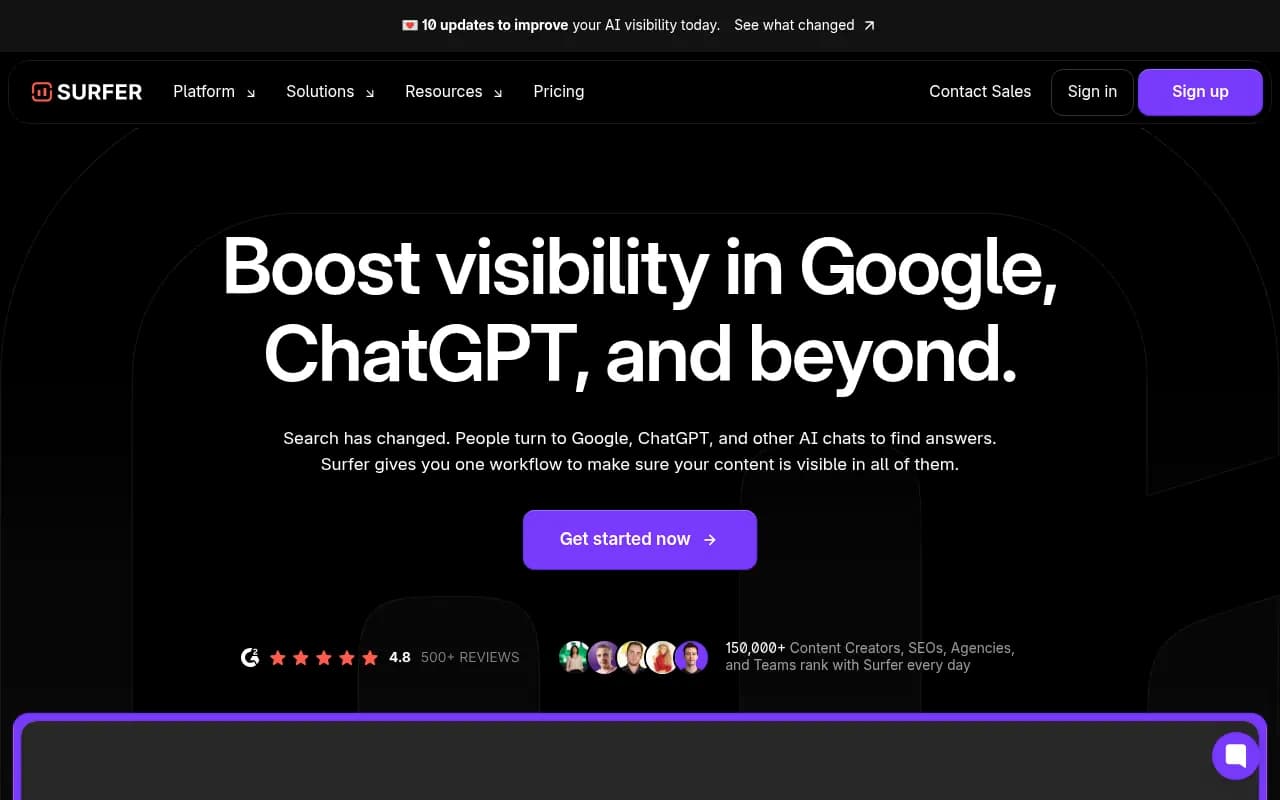
Surfer SEO is the gold standard for content optimization focused on Google rankings. The platform analyzes top-ranking pages and provides detailed recommendations for word count, keyword usage, headers, and structure.
Pricing starts at $99/mo for the Essential plan (1 site, 360 AI prompts, 50 Content Editors, 5 AI articles). Professional at $249/mo and Business at $579/mo scale up sites, prompts, and articles. Surfer AI articles cost extra: $29 each on Essential, $20 on Professional, $17 on Business.
The Content Editor is where Surfer shines. You write in a Google Docs-style interface with real-time scoring based on SERP analysis. The tool suggests keywords, optimal article length, and structural improvements as you type. It's polished and intuitive.
Surfer added AI search tracking in 2025, but it's not the core focus. You can monitor visibility in Google, ChatGPT, and Perplexity, but the insights are surface-level compared to platforms built specifically for GEO. The AI writing feature (Surfer AI) generates decent drafts but requires significant editing for accuracy and depth.
Compared to MarketMuse:
- Surfer focuses on optimizing individual articles; MarketMuse focuses on planning topic clusters and content strategy
- Surfer's Content Editor is more user-friendly and faster for hands-on optimization
- MarketMuse provides better high-level strategic guidance; Surfer is better for tactical execution
- Both platforms now offer AI visibility tracking, but neither is as comprehensive as dedicated GEO tools
The weakness: AI article costs add up fast. If you're generating 10-20 articles per month, you're paying $200-$400 extra on top of the subscription. Platforms like Frase or Promptwatch include AI generation in the base price.
Best for: Content teams that prioritize Google rankings and want a polished, easy-to-use optimization editor. Good for agencies managing multiple clients who need consistent content quality.
Frase
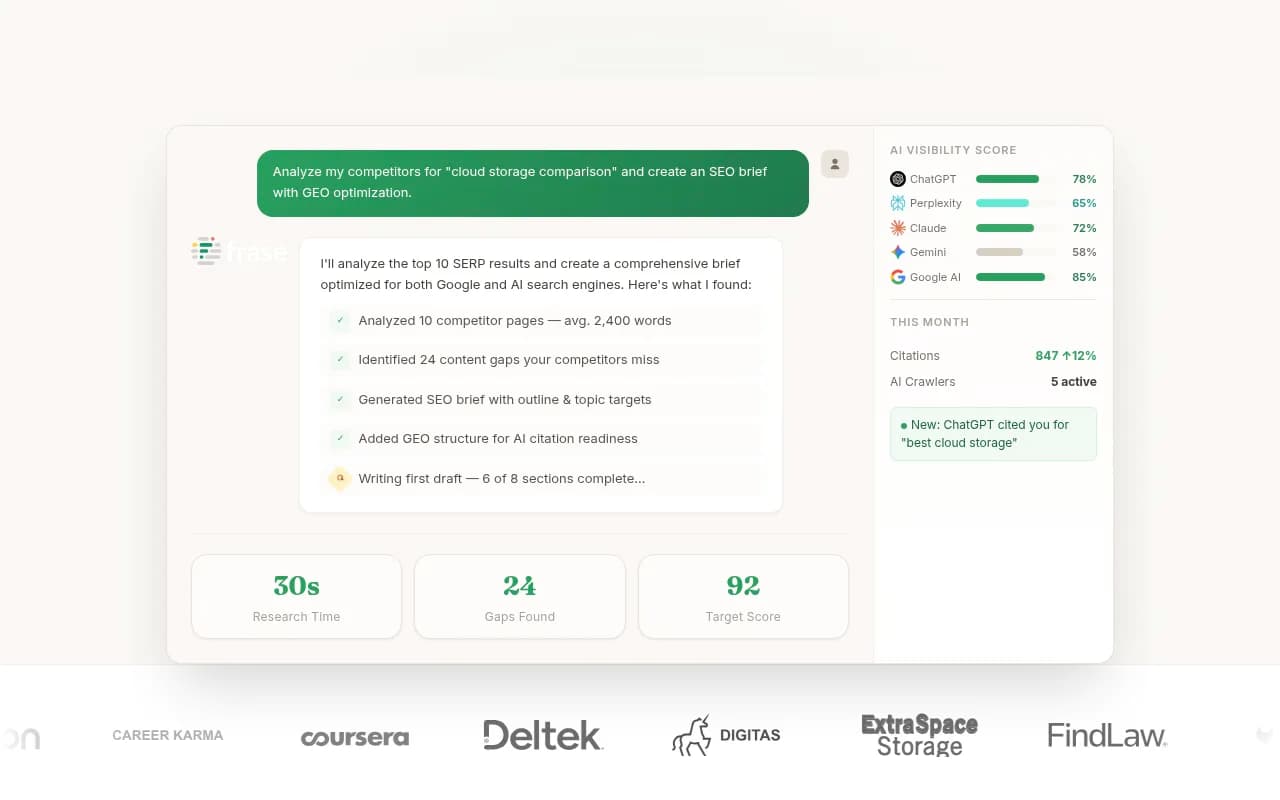
Frase positions itself as an "agentic SEO and GEO platform" -- one AI agent with 80+ skills that researches, writes, optimizes, and tracks content across Google, ChatGPT, and Perplexity.
Pricing is aggressive. Starter at $39/mo includes 10 AI articles. Professional at $103/mo includes 30 articles and full AI tracking. Both plans come with a 7-day free trial.
The workflow is streamlined. You input a keyword, Frase analyzes the top 10 SERP results, generates a content brief with SEO and GEO optimization, and writes a first draft. The platform identifies content gaps your competitors miss and structures articles for both Google rankings and AI citation readiness.
What makes Frase different:
- AI articles are included in the subscription (no per-article fees like Surfer)
- The research phase is fast -- 30 seconds to analyze competitors and generate a brief
- GEO optimization is built into the content creation process, not bolted on
- The platform tracks visibility across Google, ChatGPT, and Perplexity with page-level attribution
Compared to MarketMuse:
- Frase costs significantly less ($39/mo vs $150/mo)
- MarketMuse offers deeper topic modeling and authority analysis
- Frase is faster for execution; MarketMuse is better for strategic planning
- Frase includes AI writing and GEO tracking; MarketMuse requires separate tools for both
The trade-off: Frase's topic modeling isn't as sophisticated as MarketMuse. If you need to map complex content ecosystems and build multi-layered authority, MarketMuse's patented AI has an edge. But for most teams, Frase's speed and integrated workflow are more practical.
Best for: Content teams that want a single platform for research, writing, optimization, and tracking without paying for multiple tools. Ideal for agencies and in-house teams producing 10-30 articles per month.
Clearscope
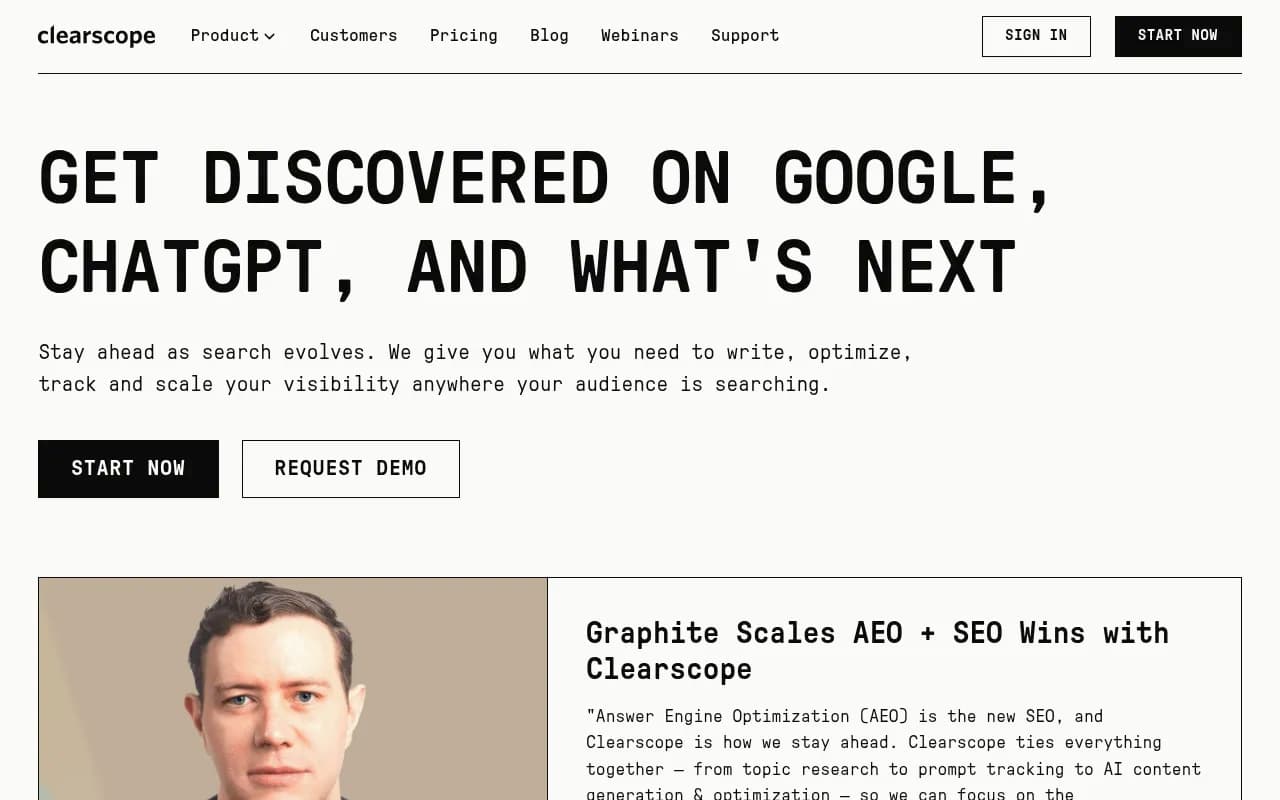
Clearscope is the premium choice for content optimization and AI search visibility. Used by IBM, Webflow, and thousands of enterprise teams, it combines traditional SEO with Answer Engine Optimization (AEO) in a polished, comprehensive platform.
Pricing starts at $189/mo for Essentials, $399/mo for Business, and custom Enterprise pricing. It's expensive, but the depth of analysis justifies the cost for teams that need it.
Clearscope's strength is search intent analysis. The platform doesn't just suggest keywords -- it explains why users search for a term and what they expect to find. This helps you create content that feels like the perfect answer, not just keyword-stuffed filler.
The AI visibility tracking covers Google, ChatGPT, and Gemini. You see which sources AI models cite, track your brand mentions over time, and identify opportunities where competitors are visible but you're not. The Topic Explorations feature helps you discover high-impact content clusters before competitors do.
Compared to MarketMuse:
- Clearscope costs more but provides deeper intent analysis and more polished UX
- MarketMuse focuses on topic authority and content planning; Clearscope focuses on intent and discoverability
- Both platforms now offer AI tracking, but Clearscope's implementation is more mature
- Clearscope integrates better with enterprise workflows (Google Docs, WordPress, custom APIs)
The downside: Clearscope doesn't include AI content generation. You get research and optimization, but you'll need a separate tool (or human writers) to create the actual articles. Platforms like Frase and Promptwatch bundle generation into the workflow.
Best for: Enterprise content teams with budgets to match. Ideal for brands that need deep intent analysis, comprehensive tracking across Google and AI platforms, and polished integrations with existing tools.
Semrush Writing Assistant
Semrush Writing Assistant is an AI content optimization plugin that analyzes your writing for SEO, readability, tone, and originality as you type. It integrates with Google Docs, WordPress, and MS Word.
The catch: it's not a standalone tool. You need a full Semrush subscription, which starts at $165.17/mo for Semrush One (annual billing). There's a 14-day free trial, but no way to buy Writing Assistant separately.
The plugin provides real-time recommendations based on top-ranking competitor pages. You see keyword suggestions, readability scores, tone analysis, and originality checks (to avoid duplicate content). It's useful if you're already paying for Semrush and want optimization guidance while writing.
Compared to MarketMuse:
- Semrush Writing Assistant is a plugin, not a platform -- it lacks MarketMuse's strategic planning features
- MarketMuse costs less if you only need content intelligence ($150/mo vs $165/mo)
- Semrush gives you the full SEO toolkit (keyword research, backlink analysis, rank tracking); MarketMuse focuses on content
- Neither platform includes AI visibility tracking or content generation
The limitation: Writing Assistant is a nice-to-have feature for existing Semrush users, but it's not worth subscribing to Semrush just for content optimization. Dedicated platforms like Surfer, Frase, or Clearscope offer better optimization tools at lower prices.
Best for: Teams already using Semrush for SEO who want real-time content optimization in Google Docs or WordPress. Not recommended as a standalone MarketMuse alternative.
Content Harmony
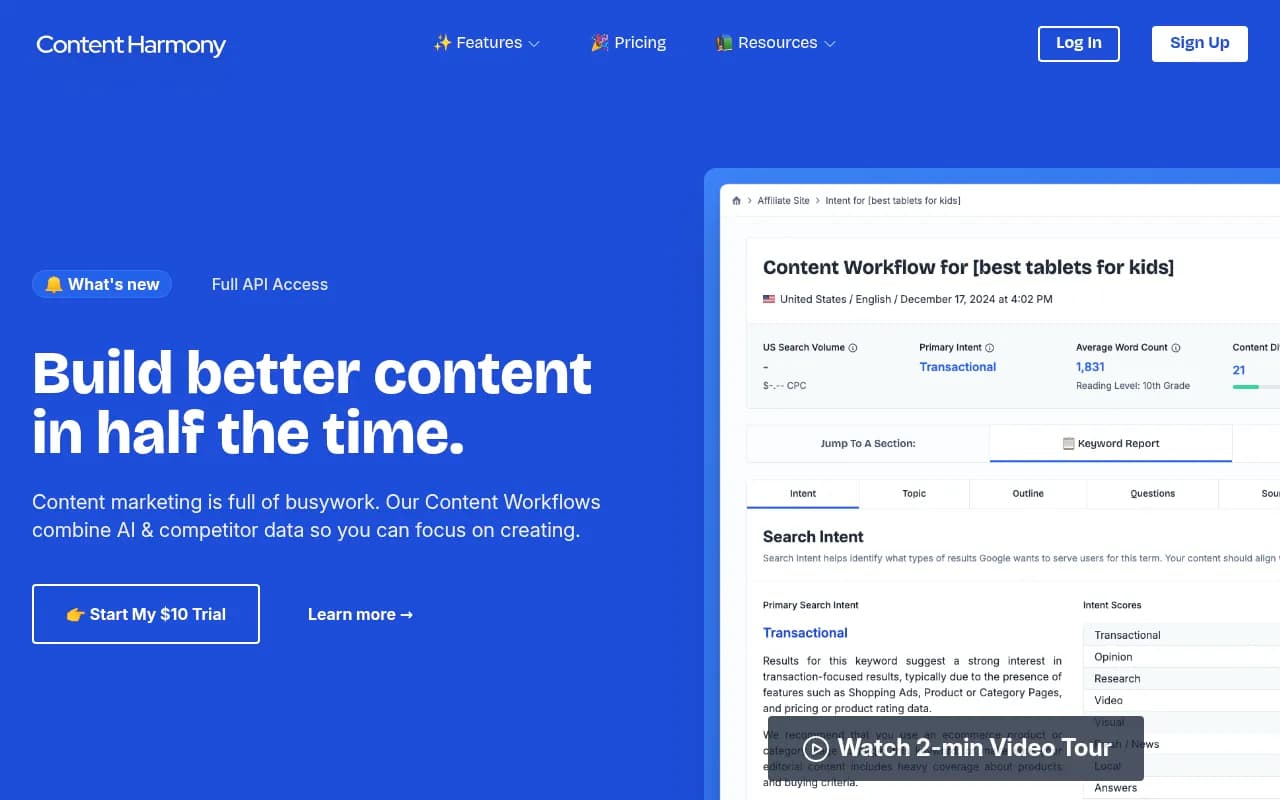
Content Harmony is a content optimization platform built by former agency operators. It streamlines the workflow from keyword research and search intent analysis to standardized briefs and AI-driven content grading.
Pricing starts at $99/mo for around 10 workflows. Credits roll over month to month, and you get unlimited users and projects. There's a $10 starter offer for your first 10 workflows.
The platform focuses on process efficiency. You analyze search intent, review overlapping keywords and entities, study competitor document structure, build an outline, cite authoritative sources, and identify visual content requirements. Content Harmony packages all of this into a standardized brief format that you can share with writers, editors, and clients.
The content grader scores drafts against an AI-driven topic model, helping you publish comprehensive content every time. It's not as sophisticated as MarketMuse's topic modeling, but it's faster and more practical for agencies managing multiple clients.
Compared to MarketMuse:
- Content Harmony costs less and focuses on workflow standardization
- MarketMuse offers deeper AI analysis and topic authority insights
- Content Harmony is better for agencies that need consistent brief formats and easy client sharing
- MarketMuse is better for in-house teams building long-term content authority
The trade-off: Content Harmony doesn't include AI writing or GEO tracking. You get research and grading, but you'll need separate tools for generation and AI visibility monitoring.
Best for: Agencies and content teams that need a reliable, repeatable process for producing high-quality briefs. Good for teams that already have writers and want better coordination tools.
NeuronWriter
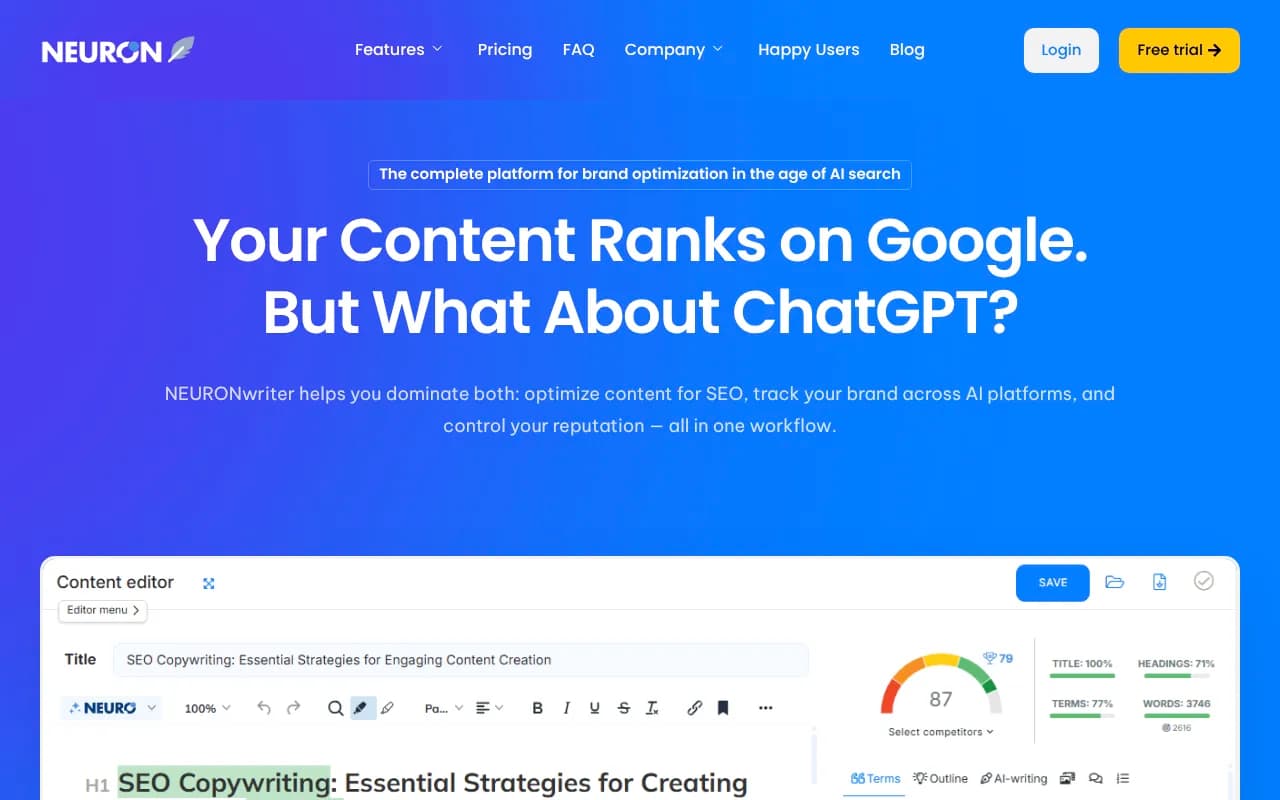
NeuronWriter combines semantic SEO analysis with AI writing capabilities. It analyzes top-ranking competitors, extracts NLP-based keyword recommendations, and helps you build articles that rank on Google.
Pricing starts at $23/mo for Bronze and scales to $117/mo for Diamond. Annual billing saves 20%, and there's a 7-day free trial. It's one of the most affordable options.
The platform uses semantic models (NLP) to identify related terms and concepts that Google associates with your target keyword. You get a content editor with real-time scoring, competitor analysis, and AI writing assistance. The interface is straightforward -- you see what to include, write or generate content, and track your score as you optimize.
NeuronWriter integrates with WordPress and Google Search Console, making it easy to optimize existing content and track performance over time.
Compared to MarketMuse:
- NeuronWriter costs significantly less ($23/mo vs $150/mo)
- MarketMuse offers more sophisticated topic modeling and strategic planning
- NeuronWriter is faster for hands-on optimization and includes AI writing
- MarketMuse provides better high-level content strategy guidance
The limitation: NeuronWriter doesn't track AI search visibility. It's focused entirely on Google SEO. If you need GEO tracking, you'll need a separate tool like Promptwatch, Scalenut, or Frase.
Best for: Budget-conscious content creators and small teams that want solid SEO optimization with AI writing assistance. Good for bloggers, freelancers, and small businesses focused on Google rankings.
How to Choose the Right Alternative
MarketMuse excels at strategic content planning and topic authority analysis. But in 2026, that's only part of the equation. You need tools that help you execute -- generate content, optimize for AI search, and track results.
Here's how to decide:
Choose Promptwatch if you need comprehensive AI search visibility tracking with built-in content gap analysis and generation. It's the only platform that shows you what's missing and helps you fix it. Best for teams serious about capturing traffic from ChatGPT, Claude, and Perplexity.
Choose Scalenut if you want an affordable all-in-one platform for SEO and light GEO tracking. Good entry point for small teams testing AI search optimization without committing to a specialized tool.
Choose Surfer SEO if you prioritize Google rankings and want a polished, easy-to-use content editor. Best for agencies managing multiple clients who need consistent content quality.
Choose Frase if you want a single platform for research, writing, optimization, and tracking without paying for multiple tools. Best balance of features and price for teams producing 10-30 articles per month.
Choose Clearscope if you're an enterprise team that needs deep intent analysis, comprehensive tracking across Google and AI platforms, and polished integrations with existing tools.
Choose Content Harmony if you're an agency that needs a reliable, repeatable process for producing high-quality briefs and coordinating with writers and clients.
Choose NeuronWriter if you're budget-conscious and focused primarily on Google SEO with AI writing assistance.
The biggest shift since MarketMuse launched: content planning alone isn't enough. You need platforms that close the loop from strategy to execution to tracking. That's why tools like Promptwatch, Frase, and Scalenut are gaining ground -- they help you create content that ranks in both Google and AI search engines, then show you the results.