Skribra Review 2026
A product in the SEO and AI visibility space focused on helping sites get found in AI-generated search results.
Key takeaways
- Skribra is a content-generation and publishing agent, not an AI visibility monitoring platform. It writes and ships SEO articles automatically, but it doesn't track how often your brand actually shows up inside ChatGPT, Perplexity, or Google AI Overviews.
- It lacks the citation tracking, AI crawler logs, and traffic attribution that a dedicated GEO platform like Promptwatch provides. Skribra claims content optimized for AI search will rank in AI answers, but it gives you no data to confirm whether it actually does.
- Pricing is genuinely founder-friendly: $19 to $75 a month for 5 to 30 articles, plus a $199 one-time BYOK plan if you're willing to bring your own OpenAI key.
- The product is very early stage. It has 0 reviews on G2 and Capterra, and public revenue trackers put it around $113 MRR, so treat the case studies and testimonials on the homepage with some skepticism.
- Best suited to solo founders and small SaaS teams who want a hands-off content engine, not to teams that need to prove ROI from AI search specifically.
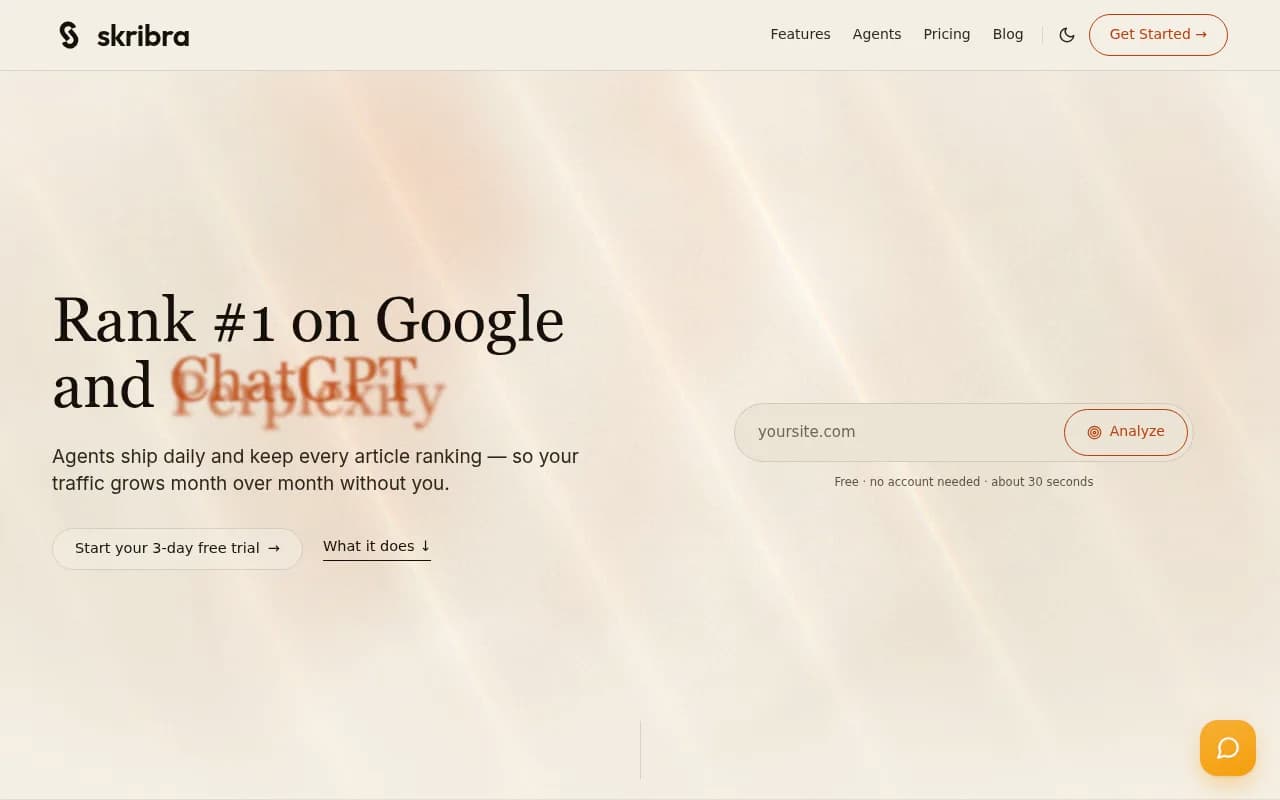
Skribra is a solo-founder SaaS product built by Sev Leo that positions itself as an "SEO agent": you connect a CMS, describe your product, and a set of automated agents research keywords, write articles, publish them, and then keep tweaking them based on Google Search Console data. The pitch on the homepage is bold, it promises to help you "Rank #1 on Google and ChatGPT, Perplexity, Claude, Gemini, and Grok," which puts it in the same conversation as AI-search-visibility tools even though its actual mechanics are closer to an automated content marketing tool than a monitoring platform.
The target audience is squarely indie hackers, solo SaaS founders, and small marketing teams who don't have the time or headcount to run a traditional content operation. There's also a white-label offering for agencies that want to resell managed blog content under their own brand. Skribra launched with a fairly minimal footprint, no VC funding disclosed, no public GitHub, and a founder who also runs a second product called ShowTrust.to. It's worth knowing that going in, because the marketing copy (unedited Search Console screenshots, dozens of founder testimonials) reads a lot more polished than the company's actual traction numbers suggest.
Key features
- Keyword and cluster strategy. Skribra pulls what it describes as 2,000-plus real keywords from DataForSEO, scores them by volume and difficulty, and builds a rolling 30-day content calendar. It groups keywords into topic clusters (a pillar plus supporting angles like definitions, how-tos, checklists, and mistakes) so you're not publishing disconnected one-off posts.
- Ten-stage writing pipeline. Each article goes through outline, live web research, drafting, external citation, internal linking, image generation, YouTube embedding, CTA placement, and schema-marked FAQ assembly before it's considered done. Articles run 1,700 to 3,300 words, which is a reasonable long-form range for competitive queries.
- Named maintenance agents. This is Skribra's most distinctive feature. After publishing, a crew of agents keeps watching: Scout prioritizes refreshes based on Search Console signals, Hook rewrites underperforming titles and meta descriptions, Weaver interlinks new posts into older ones, Keeper refreshes the oldest content on a rotation, and Curator flags potential keyword cannibalization for a human to approve. It's a genuinely useful idea, most AI writing tools stop at publish and never touch the article again.
- Competitive content module. Skribra researches each of your competitors once and reuses that research to generate four page types: you-vs-them, alternatives, pricing breakdown, and an "honest" review. This is a smart way to avoid re-researching the same competitor for every comparison page.
- Multi-CMS publishing. Native integrations cover WordPress, Shopify, Webflow, Notion, and a generic signed webhook for anything else. There's also a Content API for pulling articles into a custom setup, and IndexNow is triggered automatically the moment an article goes live so search engines get notified within hours rather than waiting on a crawl.
- Search Console-driven analytics. Once connected, Skribra shows rankings, clicks, and indexing status per article, and that data is what feeds the maintenance agents. It's a lightweight dashboard rather than a full analytics suite, but it's the right data source for the job.
- Multi-language and rich media. The features page lists support for 50-plus languages, AI-generated cover images and infographics, and automatic YouTube embedding, which is more than most single-purpose AI writers offer.
- BYOK plan. For $199 one time, you can plug in your own OpenAI API key and use Skribra forever without a recurring subscription, up to 10 projects and 30 articles per project per month. It's an unusual and genuinely founder-friendly pricing option that most competitors don't offer.
Who is it for
Skribra fits best for a solo SaaS founder or a two-person marketing team at a bootstrapped company who wants a blog that publishes consistently without hiring a writer or an agency. If you're the kind of founder who has a good product but a blog that's been stuck at three posts for a year, this is built for exactly that gap. It also works reasonably well for small agencies that want to resell managed content under white-label branding to their own clients, since Skribra explicitly supports separate projects with distinct keywords and brand voice per client.
It is not a fit for teams that need to measure or prove AI search visibility as a specific KPI. If your job is to report on brand mentions inside ChatGPT or track citation share across AI Overviews, Skribra gives you none of that; it only tells you whether Google Search Console shows more clicks over time. It's also not the right tool for larger content teams that already have writers and editorial standards, since Skribra's writing quality, while decent for a fully automated system, still reads like AI content and won't match a skilled in-house writer on nuance or brand voice. Enterprises with compliance or fact-checking requirements should be cautious too, since Skribra's own blog admits that automated refreshes can ship incorrect facts faster if nobody reviews them.
Integrations and ecosystem
Skribra connects to WordPress, Shopify, Webflow, and Notion natively, plus a generic webhook for anything else. It uses DataForSEO under the hood for keyword volume and difficulty data. There's a documented Content API and an OpenAPI 3.1 spec, along with an llms.txt file for AI-agent content negotiation, an unusually agent-friendly bit of infrastructure for a company this size. There's no Slack integration, no Zapier listed, and no browser extension. No official GitHub repository or Discord community was found, which tracks with this being a small, largely solo operation rather than an open ecosystem play.
Pricing and value
Skribra runs four plans, all per project with a 3-day free trial and month-to-month cancellation:
- Starter, $19/month for 5 articles (about $3.80 per article, roughly weekly publishing)
- Growth, $39/month for 12 articles (about $3.25 per article, roughly three per week), described as the most popular tier
- Pro, $75/month for 30 articles (about $2.50 per article, roughly daily), which also unlocks all five maintenance agents
- BYOK, $199 one time, unlimited forever, up to 10 projects and 30 articles per project per month, using your own OpenAI API key
Third-party listings are inconsistent here: Capterra shows only a single "Premium" plan at $75 per user per month and is missing the Starter, Growth, and BYOK tiers entirely, so don't trust aggregator pricing pages for this product. Compared to hiring a freelance writer at $150 to $400 per article, or an agency retainer running into the thousands per month, Skribra's per-article cost is genuinely cheap. Compared to other AI content platforms like Copy.ai or Jasper, which charge more for less structured output, Skribra's bundled keyword research, publishing, and maintenance make it a reasonable value if you trust the output quality.
Strengths and limitations
Skribra does a few things well. The maintenance-agent concept, refreshing titles, fixing stale content, and interlinking new posts into old ones automatically, is a real gap in most competitors' offerings and shows some product thinking beyond "generate and publish." The competitive content module is a smart reuse of research across four page types. Pricing is low and transparent, with no surprise per-seat costs, and the BYOK option is a rare and welcome alternative to endless subscriptions.
Where it falls short, especially against a dedicated AI-visibility platform: Skribra has no citation tracking, no AI crawler logs, and no way to see whether AI models like ChatGPT or Perplexity are actually citing your pages. It claims to help you rank inside AI answers on the homepage, but there's no prompt tracking, no query fan-out analysis, no Reddit or YouTube citation data, and no visitor analytics tied to AI traffic specifically, all of which Promptwatch provides as its core function. Skribra also has essentially no independent review record yet (0 reviews on G2 and Capterra) and public revenue data suggests it's an extremely early, low-adoption product, so the polished case studies on its homepage should be weighed against that reality. The company's own blog is refreshingly honest about risks like Google's scaled-content-abuse policies and stale Search Console data, but that honesty also underscores that this is a content-volume play, not a visibility-measurement one.
Bottom line
Skribra is a reasonably priced, well-built content-publishing agent for solo founders who want a blog that writes and maintains itself without much oversight, and the maintenance-agent system is its best differentiator against typical AI writing tools. But if your actual goal is understanding and improving how your brand appears inside ChatGPT, Perplexity, or Google AI Overviews, Skribra gives you marketing copy about AI search, not data. Teams that need that kind of visibility tracking and optimization should look at Promptwatch instead, since it's built specifically to measure AI citations, crawler behavior, and AI-driven traffic, then act on the gaps, rather than just publishing volume and hoping.
Tags:
Frequently asked questions
What is Skribra?
What does Skribra do?
Who is Skribra for?
How much does Skribra cost?
Is Skribra free to use?
What makes Skribra different from traditional SEO tools?
Does Skribra help with AI search optimization?
Can Skribra improve my site's traditional SEO as well?
Is Skribra a good alternative to standard SEO platforms?
Where can I learn more about Skribra?
Similar and alternative tools to Skribra