Open Forge Review 2026
Finds AI visibility gaps, drafts content briefs, matches journalists and publishes to a CMS. Aimed at mid-to-large B2B teams.
Key takeaways
- Open Forge is a combined AI visibility tracker and execution platform. It monitors your brand and competitors, then uses named agents (Helix, Phoenix, Apex, Orion) to create content and chase third-party citations.
- Compared with Promptwatch, it publishes far less about its tracking method. There are no published details on IP-verified AI crawler logs, prompt volumes and difficulty, query fan-outs, Brand Narrative with Fact Check, Reddit/YouTube/LinkedIn/Instagram citation reports, or AI Shopping and Ads Radar.
- Pricing is confusing. The homepage shows plans from $149 per rooftop to $4,999 per month for a managed service, while a third-party comparison page quotes plans from $399. Confirm everything on a demo call.
- Every success story comes from vendor-published testimonials. We found no G2 or Capterra listings and no independent reviews.
- Best for small and mid-sized marketing teams and agencies that want a hands-on vendor and month-to-month terms. Large enterprises needing security certifications and documented data methodology should ask hard questions first.
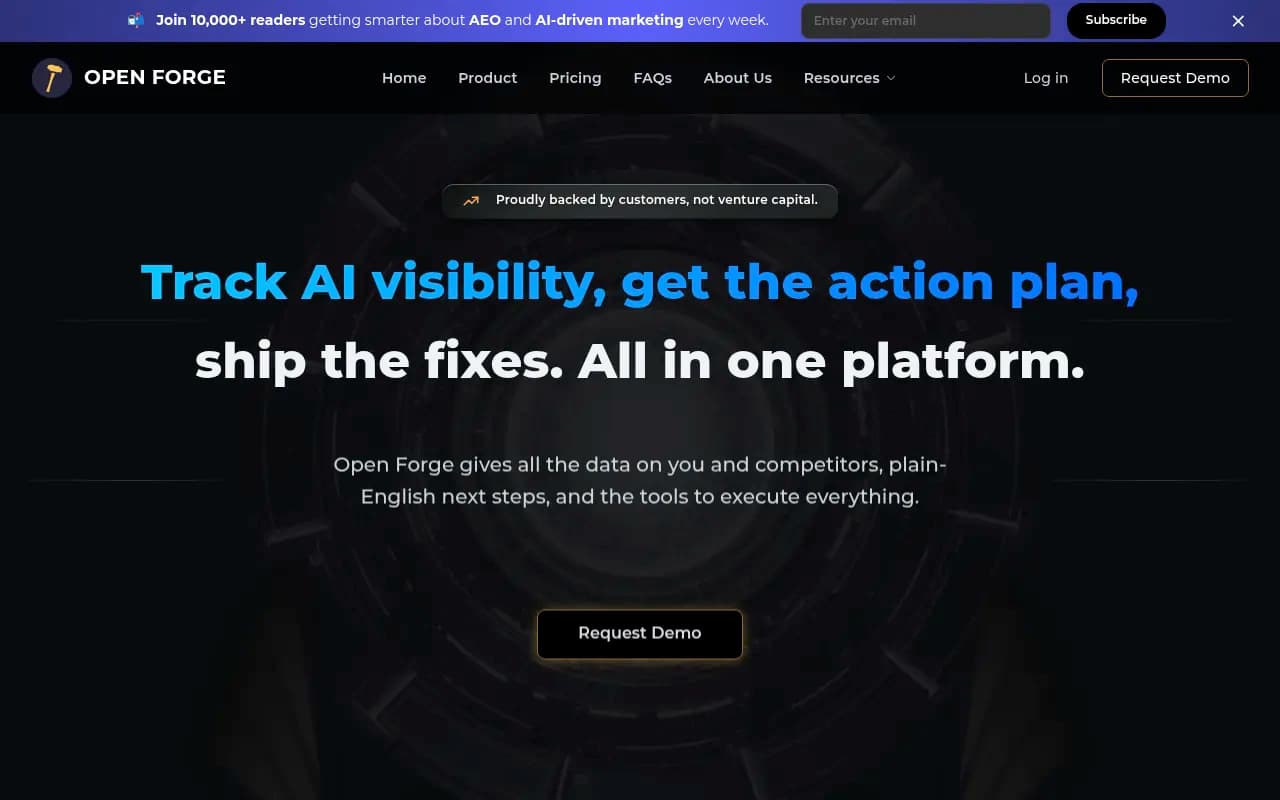
Open Forge is an AI search visibility platform that says it does more than report a score. It tracks how your brand and your competitors show up in ChatGPT and other AI answer engines, produces plain-English next steps, and gives you tools to carry them out: content creation, content refreshes, third-party citation building and workflow automation. The company describes itself as "backed by customers, not venture capital", so it is bootstrapped, and the CEO, Jason, is the named contact on the site.
The audience is wide. The FAQ says any marketing or SEO team member at a B2B or B2C company should use it, and the testimonials back that up in a scattered way: local businesses (a golf-trip operator, a New York co-working brand), small SaaS firms, agencies like Full Funnel Growth, Helium SEO and PlayerCoach, and a few larger B2B names such as AppViewX and Quilter AI. There is also a newsletter on AEO with a claimed 10,000+ readers and a blog with guides on e-commerce and multi-location hospitality.
The pitch is straightforward and fairly familiar in this category: track, get the action plan, ship the fixes. What differs is how much of the shipping the platform claims to automate, and how much room is left for you to see under the hood. That second part is where I have reservations.
Key features
Brand and competitor visibility tracking. The core dashboard measures your AI brand visibility, share of voice and head-to-head performance against named competitors. It also covers a competitor landscape view, visibility mapping and trend identification. Real-time monitoring is described across "thousands of queries", but the site does not publish which AI models are covered, how many prompts you get, or whether the data comes from the real consumer interfaces or from APIs. Pricing pages say "track unlimited queries" on the Online Brands plan and "no token limits", which is generous if true.
Four named AI agents. This is the most distinctive part of the product.
- Helix secures third-party citations to boost AI credibility. It pairs with the journalist-matching angle mentioned in the existing listing.
- Phoenix refreshes old content to improve visibility.
- Apex creates AI-optimized content for topics your audience searches.
- Orion targets competitive queries and builds content to win them.
It is a tidy division of labor. Promptwatch bundles similar work into its Content Agent, Content Refresh and Action Board, and adds a closed loop that tracks each published page through AI crawls, citations and traffic. Open Forge's site doesn't describe a comparable measurement loop for the content its agents produce, though it does mention weekly result tracking.
Actionable insights and prioritization. A three-step flow runs through the product: discover opportunities, prioritize actions ranked by potential impact and effort, then execute and track with guided workflows. Insights are labeled by impact (the screenshot shows a HIGH IMPACT tag). This is the part customers praise most, with phrases like "exactly what to fix" appearing repeatedly.
Workflows and CMS publishing. You can build custom automations, such as generating content directly into your CMS every day. The site doesn't list which CMS platforms are supported, so ask about WordPress, Webflow and Framer specifically.
Chat interface and MCP. A chat interface lets you strategize against your own data, and MCP support lets you use Open Forge inside other AI tools. Both are included on every plan. Promptwatch offers a similar pairing (Agent Chat plus a hosted MCP server with 110+ tools), so this is table stakes in 2026 rather than a differentiator.
Google Analytics and social listening. A dedicated Google Analytics view helps you understand traffic, which is how Quilter AI's claimed 243.3% rise in ChatGPT-attributable direct traffic would be measured. Social Listening shows how AI perceives you across popular platforms. Depth is unclear. Promptwatch breaks Reddit, YouTube, LinkedIn and Instagram citations into dedicated reports with engagement data, which is a more concrete product than a one-line description.
Competitor intelligence suite. This covers competitor citation opportunities, content gaps, and positioning and messaging analysis. The "Reveal competitor citation opportunities" and "Expose competitor gaps" modules are the practical heart of it, and they feed the agents.
Reporting, presentations and API. You can generate custom reports, build presentations from your data, and receive email reporting. The API exposes raw brand visibility data. An ICP Simulator and custom dashboards appear on the Online Brands plan. Local plans add multi-location tracking and personas.
Multi-brand and team management. Seats are unlimited at no extra charge. Multiple brands live in one dashboard, each with its own data and recommendations, but extra brands cost more and the amount is not published.
Who is it for
The sweet spot is a small or mid-sized marketing team that has no AEO program yet and wants a vendor to hold its hand. A VP of Marketing at a 30-person SaaS firm, a founder-led e-commerce brand, or a multi-location business like a dealership or hospitality group would all fit. The per-rooftop plan is clearly designed for franchises, dealers and brick-and-mortar operators who track several locations. The testimonials stress responsiveness: the founders will hop on calls to troubleshoot, which matters if you are new to this.
Agencies are the second audience. Unlimited users, multiple brand accounts and the $3,999 Growth Cannon plan (built to send AI visibility audits to prospects in bulk and analyze thousands of businesses at once) suggest a real agency and lead-gen use case. If you run pitches at volume, that last plan is unusual and worth a look.
Who should be careful? Enterprise buyers who need documented security certifications, SSO, audit logs and a published data methodology will find little on the site to hang a procurement review on. Teams that want to inspect how data is collected, how many responses are sampled, or which AI crawlers hit their site will also find gaps. And anyone who insists on independent proof should know that every result quoted is a testimonial hosted by the vendor.
Integrations and ecosystem
The site names a short list: Google Analytics, MCP support for use inside other AI tools, a REST-style API for raw data, and CMS publishing through workflows. There is no integrations page, and we found no listing of supported CMS platforms, Slack, Google Search Console or Looker Studio connections. Custom dashboards and integrations are mentioned on the Online Brands plan, which suggests some work happens through the sales team.
There is no browser extension or mobile app described. Export options are limited to email reports, presentations and API access as far as the site shows. By comparison, Promptwatch publishes a full integration catalog covering Cloudflare, AWS CloudFront, Vercel and other CDNs for crawler logs, WordPress, Webflow and Framer publishing, Google Search Console, Bing Webmaster Tools, Looker Studio and Slack. If integrations drive your purchase, press Open Forge for specifics.
Pricing and value
Pricing is the murkiest part of the review. The homepage lists four offerings, though a third-party comparison page from Authoritas quotes "plans starting from $399" and carries a disclaimer that figures may change.
- Local and brick-and-mortar businesses: $149 per month per rooftop. Includes 1:1 onboarding, unlimited agent usage and automations, unlimited users, multi-location tracking, personas, MCP, API, Google Analytics insights and Social Listening.
- Online brands and businesses: $399 per month, plus a sliding scale for additional brands. Adds unlimited tracked queries, an ICP Simulator and custom dashboards and integrations.
- Growth Cannon Data Platform: $3,999 per month. Built for AI search data at scale, bulk prospect audits, visuals and downloadables.
- Managed service: $4,999 per month. A dedicated AEO operator handles strategy and execution, with weekly reporting and executive check-ins. No commitment required.
An annual option saves 20%, and there is no long-term contract: month-to-month, cancel anytime, with a "real value or money back" pledge. I found no free trial. Demos are free with no payment needed. Verify current numbers before budgeting, because the research turned up conflicting figures.
On value, $399 for unlimited queries, unlimited users and unlimited agent usage is aggressive if the limits really are unlimited. Compare that with Promptwatch, where a 7-day free trial is available and plans start at $95 per month (Essential), $245 (Professional) and $579 (Business, which adds the Content Agent). Promptwatch agency plans run $199, $399 and $799 per month, with metered prompts and responses, so you can see exactly what each tier covers. Open Forge's "unlimited" claims are simpler but harder to check.
Strengths and limitations
What it does well
- A clear loop from insight to action, with agents purpose-built for citations, refreshes, new content and competitive queries.
- Generous seat and usage terms: unlimited users, unlimited agent runs, month-to-month billing.
- Hands-on service. Almost every testimonial praises founder-level responsiveness, and a managed tier exists for teams that want it done for them.
- Useful vertical packaging: per-rooftop pricing for local businesses and the Growth Cannon plan for agency prospecting.
Limitations
- Opaque methodology. The site doesn't say which AI models are tracked, how prompts are collected, or whether data comes from real interfaces.
- No independent validation. We found no G2 or Capterra reviews, so every claim, including the 467.8% traffic lift at Quilter AI, comes from the vendor's own testimonials.
- Unclear pricing and a thin integration story.
What Promptwatch has that Open Forge doesn't document
For teams that want optimization with measurable proof, Promptwatch covers ground Open Forge doesn't describe:
- IP-verified AI crawler logs and crawl-to-citation tracking, so you can tell an access problem from a content problem.
- Visitor analytics that attribute AI traffic and conversions, alongside Google Search Console and Bing Webmaster data.
- Prompt volumes and difficulty scoring, plus query fan-outs showing the searches AI runs per response.
- Brand Narrative and Fact Check, which pull out the individual claims AI makes about you and find the pages teaching it the wrong thing.
- Dedicated Reddit, YouTube, LinkedIn and Instagram citation reports, offsite mentions, and Page Tracker.
- AI Shopping (ChatGPT and Amazon Alexa) and Ads Radar.
- Real-UI tracking of 20 AI engines and models, including Meta AI, Amazon Alexa, and coding agents like Codex and Claude Code.
- The Content Agent with WordPress, Webflow and Framer publishing, which then tracks each published page through crawls, citations and traffic.
- Local GEO/SEO targeting at exact coordinates, up to hourly tracking, ISO/IEC 27001 certification and a published API and MCP catalog.
See Promptwatch's ChatGPT citation data for the kind of published research that backs a methodology. AI citation patterns shift month to month, so tools should be judged on how transparently they handle that.
Bottom line
Open Forge is a credible, founder-driven option for small and mid-sized teams, agencies and multi-location businesses that want one vendor to track AI visibility and help ship the content. Month-to-month terms and responsive support lower the risk of trying it, and the per-rooftop plan is a smart fit for local operators. Just ask for a live walkthrough of the models covered, the CMS integrations, and current pricing before you commit.
If you want optimization backed by crawler logs, traffic attribution, citation research and a closed loop that checks whether each fix worked, Promptwatch is the stronger alternative, and you can start with a 7-day free trial or the free AI visibility report. Best use case for Open Forge: a multi-location or mid-market brand that wants a hands-on partner to turn AI visibility gaps into published content.
Frequently asked questions
What is Open Forge?
How much does Open Forge cost?
Is there a free trial for Open Forge?
Who is Open Forge best for?
How does Open Forge compare to Promptwatch?
Does Open Forge integrate with other tools?
Similar and alternative tools to Open Forge