Key takeaways
- These three tools solve different problems. Yext manages the data behind your locations, Conductor folds AI visibility into an enterprise SEO deployment, and Promptwatch measures and improves how AI engines answer questions at each location.
- Location precision is the deciding feature for multi-location brands. Promptwatch pins prompts to an exact point with a 20 m to 5 km radius, one monitor per location. Yext Scout and Conductor work at a broader level.
- Promptwatch does not manage listings, reviews, or Google Business Profiles. If you need that, Yext (or a tool like Birdeye or SOCi) stays in your stack.
- Conductor does not publish pricing, and Yext's enterprise pricing is quote-based. Treat any public Yext figure from third-party blogs with suspicion.
- For most brands the realistic answer is a pairing: a listings platform for data, plus a GEO platform for measurement and content.
Why multi-location brands need a different kind of GEO platform
A national brand and a 400-branch franchise do not have the same AI visibility problem. The national brand asks, "Does ChatGPT recommend us?" The franchise asks, "Does ChatGPT recommend the Leeds branch when someone stands in Headingley and asks for the best option nearby, and which sources did it use to decide?"
That second question is hard. ChatGPT, Google AI Overviews and Google AI Mode adapt "near me" answers to where the user is. Two neighborhoods in the same city can get completely different shortlists. A chain can be recommended in one district and missing a few kilometers away. A platform that averages everything at country or city level hides exactly the gap you need to find.
So when you compare Yext, Conductor and Promptwatch, the useful question is not "which is best?" It is "which part of the local AI visibility problem does each one actually touch?"
The short version of each platform
Yext
Yext is a digital presence platform. Its core job is keeping your business data (hours, addresses, services, listings) consistent across a directory network and search surfaces. Yext Scout is its AI search and competitive intelligence agent, built for multi-location brands and aimed mostly at enterprises that already run their listings on Yext.
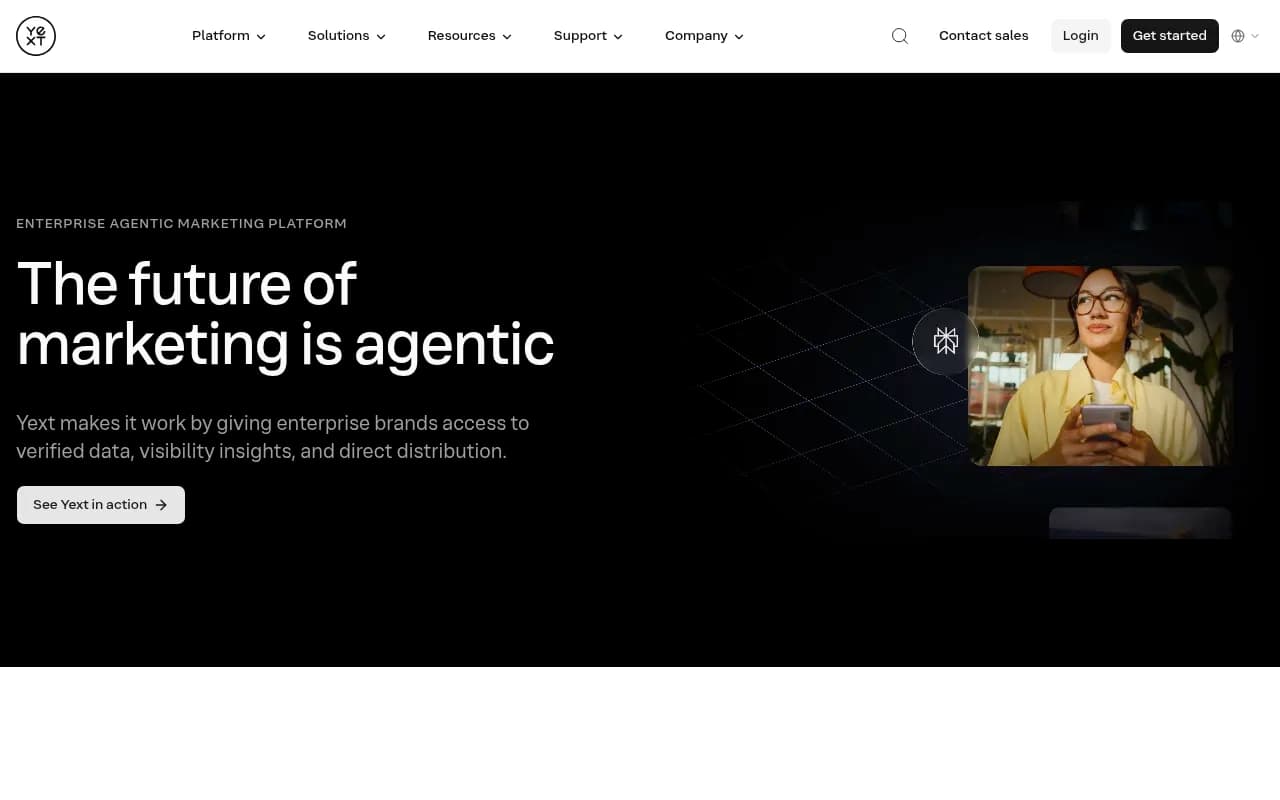
If your problem is that AI engines and directories pull wrong or inconsistent location data, Yext attacks the source of the mess. Its weakness for GEO buyers is that the monitoring layer is an add-on to a listings product, not the other way around.
Conductor
Conductor is an enterprise SEO and content intelligence platform that has added AI visibility tracking with persona customization. Comparison pages from KIME and Brandlight describe it as strongest where Conductor already runs your SEO reporting and governance, with a Writing Assistant for drafts, coverage across roughly nine AI engines, and 160+ markets. A 3-week trial is mentioned for its Essentials tier. No dollar figures are published.
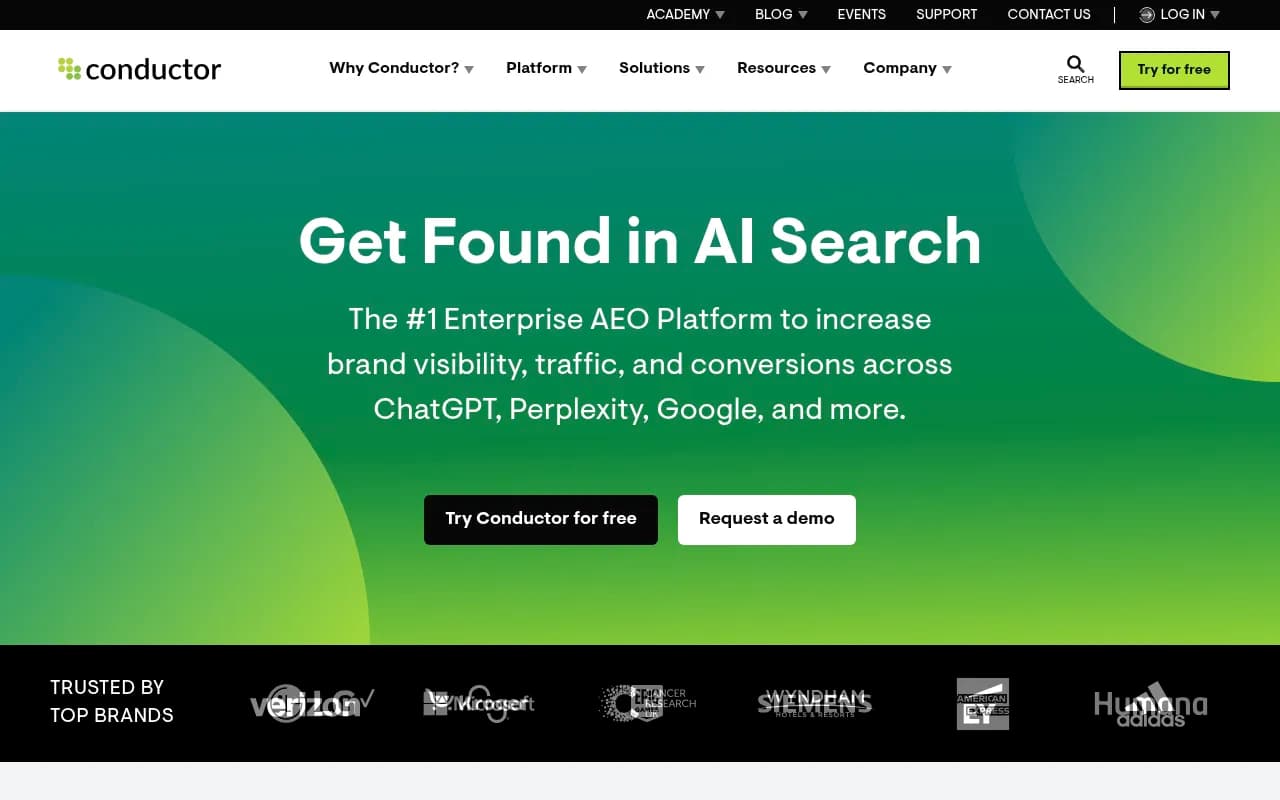
Brandlight's own comparison says to skip it if you are buying for AI visibility alone. That is a fair read. Conductor makes the most sense as a consolidation move for teams already inside it.
Promptwatch
Promptwatch is an end-to-end AI visibility platform: it monitors what ChatGPT, Gemini, Claude, Perplexity, Google AI Overviews, Google AI Mode, Copilot and others say about you, traces the sources behind those answers, helps you act on the gaps (Action Board, Content Agent, CMS publishing), and measures the result through crawler logs and visitor analytics.
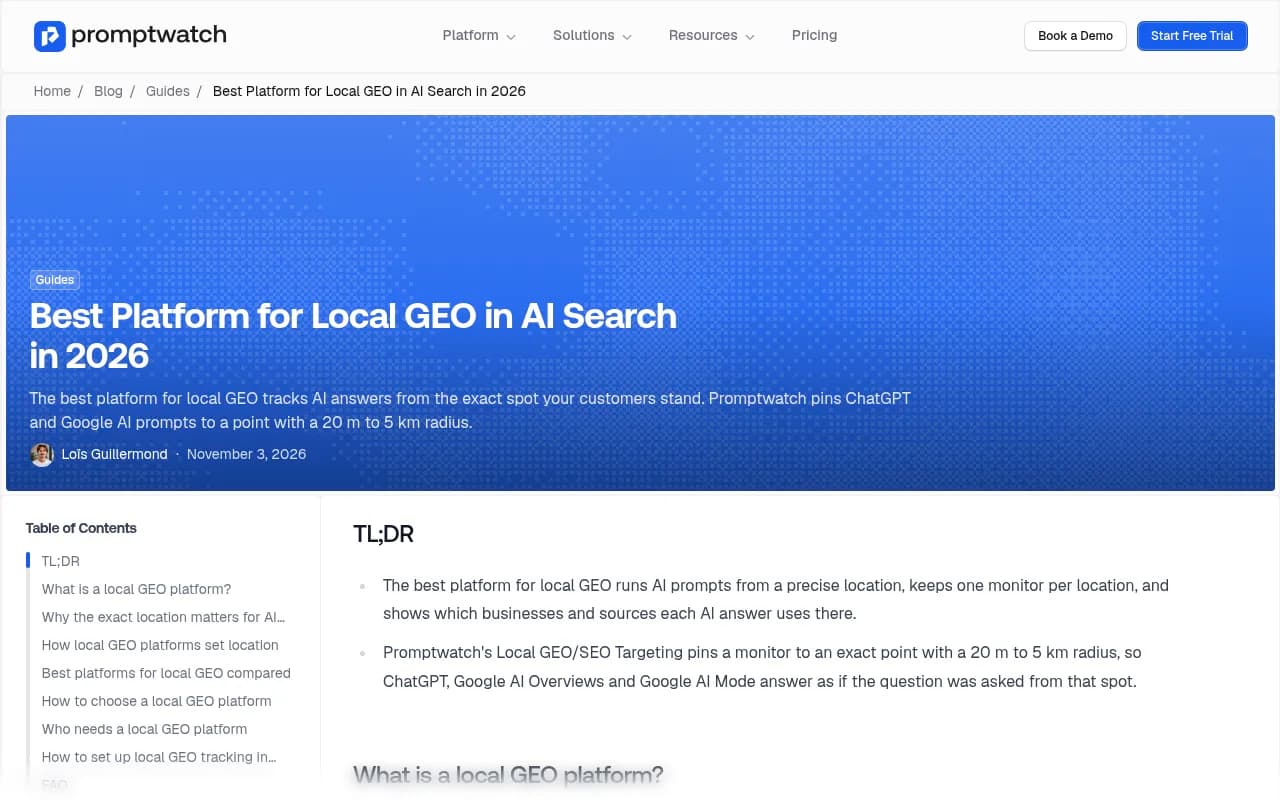
The local piece is Local GEO/SEO Targeting, released October 27, 2026. You pin a monitor to exact coordinates (search a place or drop a pin, with an accuracy radius from 20 m to 5 km) so ChatGPT, AI Overviews and AI Mode answer as if asked from that spot. It runs one monitor per location. It is available on Business, Agency Scale and Enterprise plans, and in the REST API and MCP.

One limit, stated plainly by Promptwatch itself: it measures AI answers and citations. It does not manage listings, reviews or Google Business Profiles.
Side-by-side comparison
| Capability | Yext | Conductor | Promptwatch |
|---|---|---|---|
| Primary job | Listings and location data management | Enterprise SEO and content intelligence | AI visibility measurement and optimization |
| AI visibility tracking | Yext Scout (agent inside platform) | Yes, about 9 AI engines per third-party comparisons | Yes, real interfaces of ChatGPT, AI Overviews, AI Mode, Gemini, Perplexity, Copilot, Alexa, Meta AI and more |
| Exact-location prompt targeting | Not a headline capability | Market-level (160+ countries) | Pin to a point, 20 m to 5 km radius |
| Listings and review management | Core strength | No | No |
| Content creation | Location pages and data syndication | Writing Assistant, 60 to 600 drafts per year | Content Agent with WordPress, Webflow and Framer publishing |
| AI crawler logs | Not a known focus | Not a known focus | IP-verified crawler logs |
| AI traffic analytics | Limited | Via SEO reporting | Visitor analytics for AI referrals |
| Pricing | Quote-based | Not published | Published: Business $579/mo, Agency Scale $799/mo (confirm at promptwatch.com/pricing) |
| Best fit | Brands already on Yext | Teams already on Conductor | Brands that want to measure and fix AI answers by location |
Treat the Yext and Conductor cells as what each vendor and third-party comparisons say publicly, not as a hands-on test. Public capability pages cannot tell you data quality or implementation fit, so verify in a demo.
What actually changes AI answers for a location
Before picking a tool, it helps to know what moves the needle. Promptwatch Data gives some useful signals.
In Promptwatch's ChatGPT citation share by content type report (Sep 28 to Oct 4, 2026), product pages were the most cited type at 22.4% of classified citations, with landing pages next at 16.8%. That is about 39% of citations going to pages describing what a company sells. For commercial prompts, product and landing pages together reach 46.6%. For branded prompts, reviews made up 5.6% of citations, more than three times their share across all prompts.
For a multi-location brand, that points to boring but effective work: complete, factual location and service pages, reviews collected on trusted sites, FAQ pages and comparison content. Notice that two of those four (location pages, reviews) overlap with what a listings platform like Yext handles, and the other two (FAQs, comparisons) are content work.
Social sources matter differently by engine. Per Promptwatch's social media citations report for Sep 28 to Oct 4, 2026, social platforms were 12.2% of Google AI Overviews citations but only 0.46% of ChatGPT's. In AI Overviews, YouTube hit 4.28%, Facebook 2.38% and Instagram 1.61%. So public Facebook pages, Instagram profiles and YouTube videos for each branch matter more for Google surfaces than for ChatGPT.
Also worth knowing: content half-life data shows news losing half its cited pages in about 5 weeks, while landing pages and docs keep most of theirs for months. Evergreen location pages are a better bet than local news posts.
Where each platform wins
Choose Yext if your data is the problem
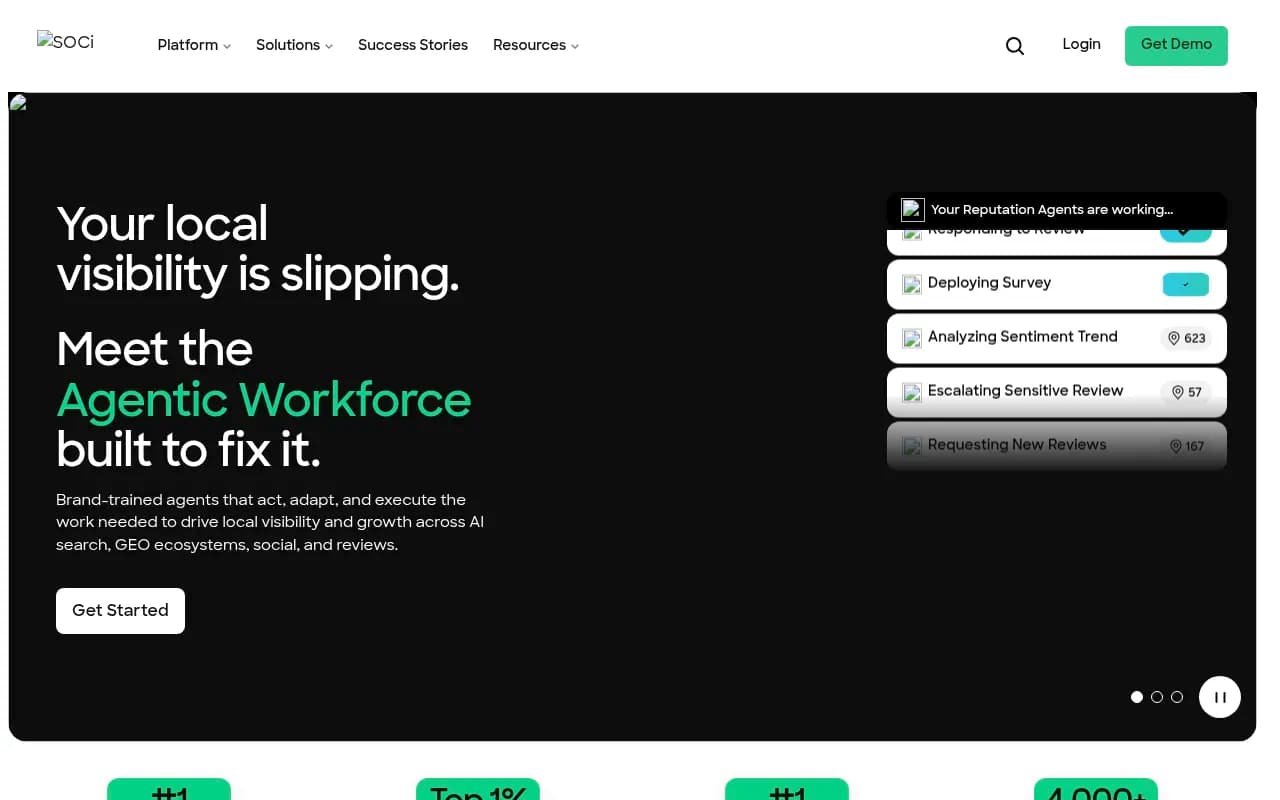
If AI answers show wrong hours, closed branches or inconsistent names, the fix lives in your listings data. Yext is built for this, and Scout makes the most sense if you already run on it. Alternatives in the same lane include Birdeye, SOCi, Reputation.com and BrightLocal, each leaning differently toward reviews, social or local rankings.

Choose Conductor if SEO governance is the priority
For a large organization where Conductor already holds keyword, content and reporting workflows, adding AI visibility there keeps one vendor and one set of permissions. You trade away depth: location precision and crawler-level diagnosis are not what the public comparisons highlight.
Choose Promptwatch if you need to see and fix what AI says per branch
This is the strongest case for Promptwatch. You set one monitor per branch, see which businesses and sources AI uses in that spot, then act. The Action Board turns gaps into a prioritized to-do list, the Content Agent writes and publishes pages, and crawler logs plus Page Tracker show whether bots read the page and whether AI cites it. Brand Narrative also pulls out the specific claims AI makes about you, so you can catch statements like "limited parking" repeating across branches.
If you want the long version of the setup, Promptwatch's local GEO platform guide walks through it. For plan details, check promptwatch.com/pricing, since local targeting requires Business or above. The 7-day free trial is on monthly billing for Business.
How to run the three together
Honestly, for many enterprises the answer is not either/or. A workable split:
- Yext (or a similar listings tool) owns the source-of-truth data and syndication.
- Conductor, if you already have it, owns traditional SEO governance and reporting.
- Promptwatch owns the AI layer: location-pinned monitoring, citation and source analysis, content gaps, crawler access and AI traffic.
The handoff that matters is between steps 1 and 3. When Promptwatch shows an AI answer for a branch citing an outdated directory page, that becomes a ticket for whoever manages listings. When it shows a branch missing from AI shortlists with no strong local pages cited, that becomes a content task.
How to evaluate in a demo
Don't let any vendor show you a headline visibility score and call it a day. Ask each one:
- Can you run the same prompt from two neighborhoods in one city and show me different results? How is the location set: exact coordinates, city, or proxy?
- Does the data come from the real AI interfaces or APIs only? User-facing answers and citations can differ from API output.
- How many locations can I monitor, and what does each extra location cost?
- Can I see which sources were cited per answer, and which of my own pages AI bots actually crawled?
- What happens after the report? Who writes the fix, and how do you measure that it worked?
- Do you manage listings, or do you integrate with a tool that does?
Pick three branches you know well, two strong and one weak, and test each vendor against them. If a platform cannot reproduce what you already know about those branches, do not trust it for the other 397.
Other tools worth a look
If none of the three fit, the field is wide. Browse the GEO software directory at bestgeosoftware.com for more options. Enterprise-minded names from our catalog include Profound, Bluefish, BrightEdge and Botify.

The verdict
If you must pick one for the GEO job specifically, Promptwatch is the better fit for multi-location brands because it is the only one of the three built around exact-location AI answers, sources, and the content work that follows. Yext remains the right tool for the listings layer, and Conductor makes sense mainly if you are already inside it. Just do not expect Promptwatch to replace your listings or review platform. It will not, and it says so.
Start with the free AI visibility report to see a baseline, then test location-pinned monitors on a handful of branches before committing a full rollout.