Key takeaways
- Searchable offers solid AI visibility monitoring but lacks content generation, crawler logs, and traffic attribution -- the features teams need to actually act on their data
- Most teams switching away cite the same frustration: great data, no clear path to improving their rankings
- The best alternatives depend on your use case: some teams want a full optimization platform, others just need better tracking at a lower price
- Tools like Promptwatch go beyond monitoring to help you find content gaps, generate AI-optimized content, and track results -- closing the loop that monitoring-only tools leave open
- This guide covers 8 alternatives with honest takes on who each one is actually for
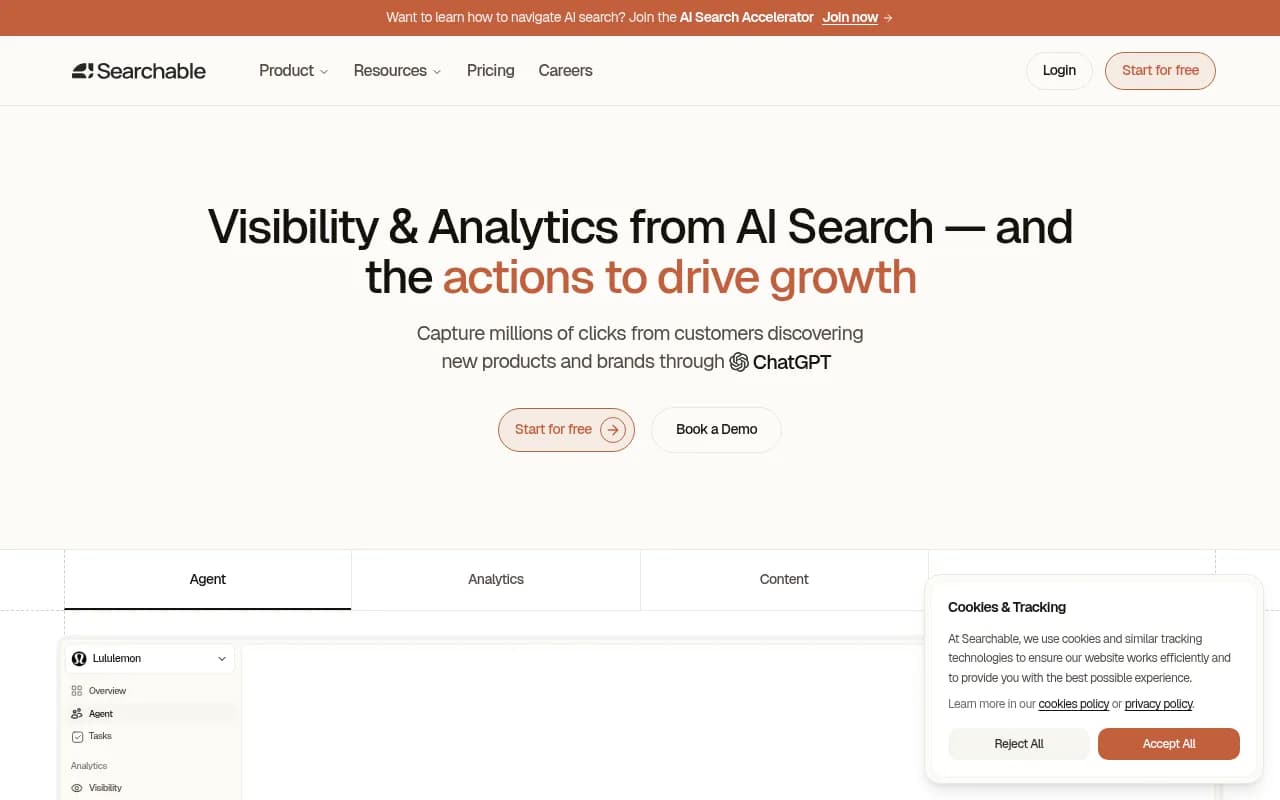
Searchable has been around long enough to build a real user base. It's not a bad tool. The interface is clean, the monitoring is functional, and for teams just getting started with AI visibility, it does the job.
But "does the job" isn't the same as "solves the problem."
The problem teams actually have in 2025 isn't that they don't know they're invisible in AI search. Most marketing teams already suspect it. The problem is they don't know why they're invisible, and more importantly, they don't know what to do about it. That's where Searchable starts to fall short -- and where teams start looking around.
Here's an honest breakdown of what's driving the switch, and which tools are picking up those users.
Why teams are leaving Searchable
The feedback pattern is pretty consistent across teams that have moved on. A few themes come up again and again.
The data doesn't connect to action. Searchable shows you where you appear (or don't) in AI responses. That's useful context. But it doesn't tell you which content gaps are causing you to miss out, which prompts your competitors are winning that you're not, or what you should write to close those gaps. You get a score. You don't get a plan.
No content generation. In 2025, the teams winning in AI search are publishing content specifically engineered to get cited by ChatGPT, Perplexity, and Claude. That requires understanding what those models want to cite -- and then actually creating it. Searchable doesn't have a content layer. You're on your own to figure out what to write and then go write it somewhere else.
Missing crawler data. Knowing that AI models aren't citing you is one thing. Knowing that Perplexity's crawler is hitting your site but encountering errors -- or never returning to certain pages -- is a different level of insight. Crawler logs are table stakes for serious optimization work, and Searchable doesn't offer them.
Limited prompt intelligence. Not all prompts are worth chasing. Some have high volume and low competition; others are dominated by entrenched brands. Without difficulty scores and volume estimates, you're essentially guessing which battles to fight.
Traffic attribution is absent. If you can't connect AI visibility to actual website traffic and revenue, you can't justify the investment to stakeholders. Teams running quarterly reviews need that connection.
None of this makes Searchable a bad tool. It makes it an incomplete one for teams that have moved past the "let's see what's happening" phase into the "let's actually fix this" phase.
The best Searchable alternatives in 2025
1. Promptwatch -- best for teams that want to close the full loop
Promptwatch is the most direct answer to the core complaint about Searchable: it doesn't just show you the problem, it helps you fix it.
The workflow is built around three steps. First, Answer Gap Analysis surfaces the specific prompts where competitors are visible and you're not -- not vague categories, but the actual questions AI models are answering without citing you. Second, a built-in AI writing agent generates articles, listicles, and comparisons grounded in real citation data from 880M+ citations analyzed. Third, page-level tracking shows which of your pages are getting cited, by which models, and how often -- with traffic attribution via GSC integration, a code snippet, or server log analysis.
It also covers things Searchable doesn't touch: real-time AI crawler logs (see exactly when ChatGPT or Perplexity crawls your pages and what errors they hit), Reddit and YouTube insights showing which discussions are influencing AI recommendations, ChatGPT Shopping tracking, and competitor heatmaps across 10+ AI models.
Pricing starts at $99/month for the Essential plan (1 site, 50 prompts, 5 articles). Professional is $249/month with crawler logs and city-level tracking. There's a free trial.

2. Profound -- best for enterprise teams with budget
Profound has a strong feature set and is genuinely well-regarded among larger marketing teams. It covers monitoring across major AI models, has solid competitive analysis, and the reporting is polished enough for executive presentations.
The tradeoff is price -- Profound sits at a higher price point than most alternatives here, which makes it harder to justify for smaller teams or agencies managing multiple clients. It also doesn't have Reddit tracking or ChatGPT Shopping monitoring, which matters if those channels are part of your AI visibility picture.

3. Otterly.AI -- best for teams on a tight budget
If your main complaint about Searchable is the price rather than the feature gaps, Otterly.AI is worth a look. It's one of the more affordable options in the space and covers the core monitoring basics: brand mentions across AI models, visibility scores, and basic competitive tracking.
The honest caveat: Otterly.AI is monitoring-only. There's no content generation, no crawler logs, no traffic attribution. If you're leaving Searchable because you want more action-oriented features, Otterly.AI won't solve that. But if you just need a lighter, cheaper monitoring tool, it's a reasonable choice.

4. Peec AI -- best for multi-language monitoring
Peec AI stands out for its multi-language and multi-region support, which is genuinely useful for brands operating across markets. If you're monitoring AI visibility in French, German, Spanish, or other languages, the options narrow quickly -- and Peec AI handles this better than most.
Like Otterly.AI, it's primarily a monitoring platform. Don't expect content generation or deep prompt intelligence. But for international teams that need reliable cross-language tracking, it's one of the better options available.

5. AthenaHQ -- best for teams focused on competitive benchmarking
AthenaHQ does competitive analysis well. You can track your brand against specific competitors across 8+ AI search engines, see who's winning for which prompts, and get a clear picture of the competitive landscape.
The limitation is similar to Searchable's: AthenaHQ is monitoring-focused. It shows you where you stand but doesn't help you move. Teams that already have a content operation and just need better competitive intelligence will get value from it. Teams looking for an end-to-end optimization platform will hit the same wall they hit with Searchable.

6. Scrunch AI -- best for brand-focused monitoring
Scrunch AI takes a brand-first approach to AI visibility, which suits certain use cases well -- particularly PR teams and brand managers who care more about sentiment and share of voice than granular prompt-level data.
It's a cleaner product than some of the more technical alternatives, which is either a feature or a limitation depending on what you need. If you want a tool your whole marketing team can use without a learning curve, Scrunch AI is accessible. If you need deep prompt intelligence and content optimization, it's not the right fit.
7. SE Ranking -- best for teams that want AI visibility alongside traditional SEO
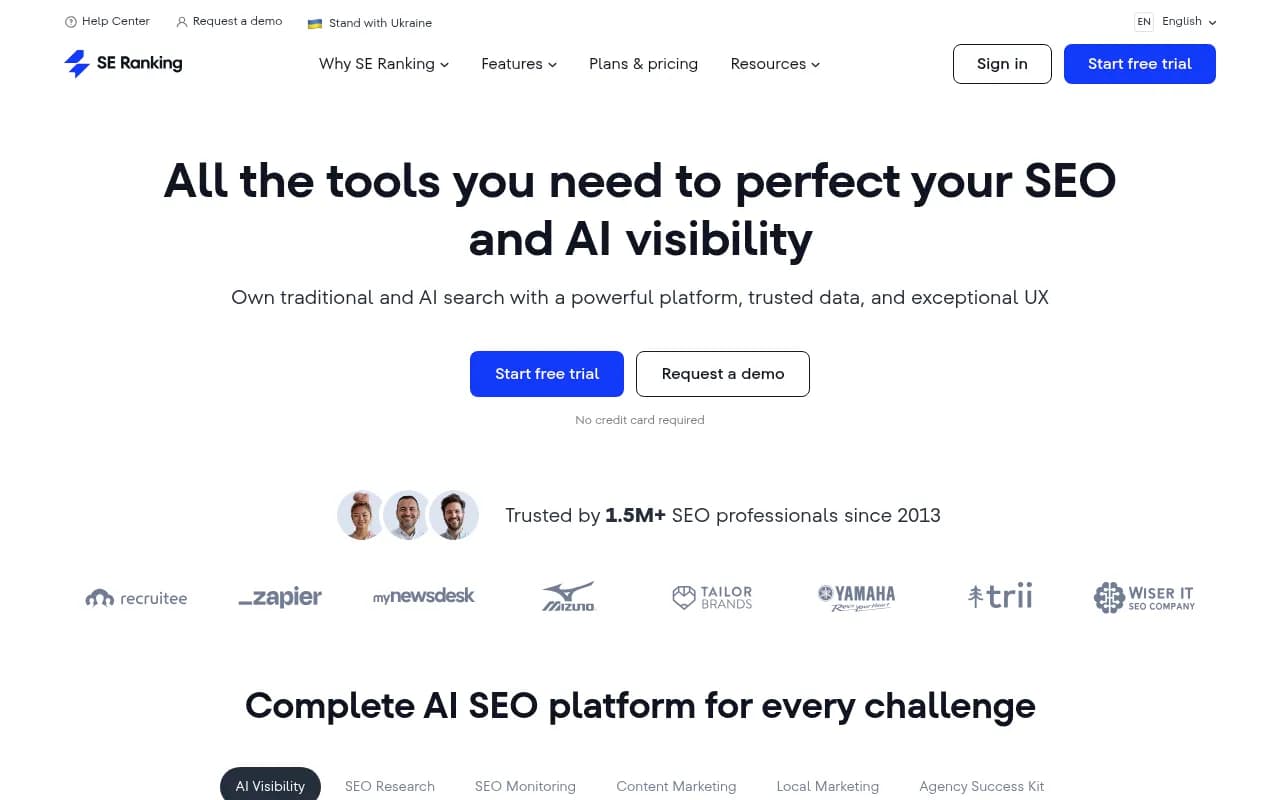
SE Ranking is an all-in-one SEO platform that has added AI visibility tracking to its existing toolkit. For teams that don't want to manage separate tools for traditional SEO and AI search monitoring, this is a practical option.
The AI visibility features aren't as deep as dedicated GEO platforms, but the integration with keyword research, site audits, and rank tracking is genuinely useful. If you're already using SE Ranking for SEO, the AI visibility module is worth exploring before you add another tool to your stack.
8. Rankscale -- best for agencies tracking multiple clients
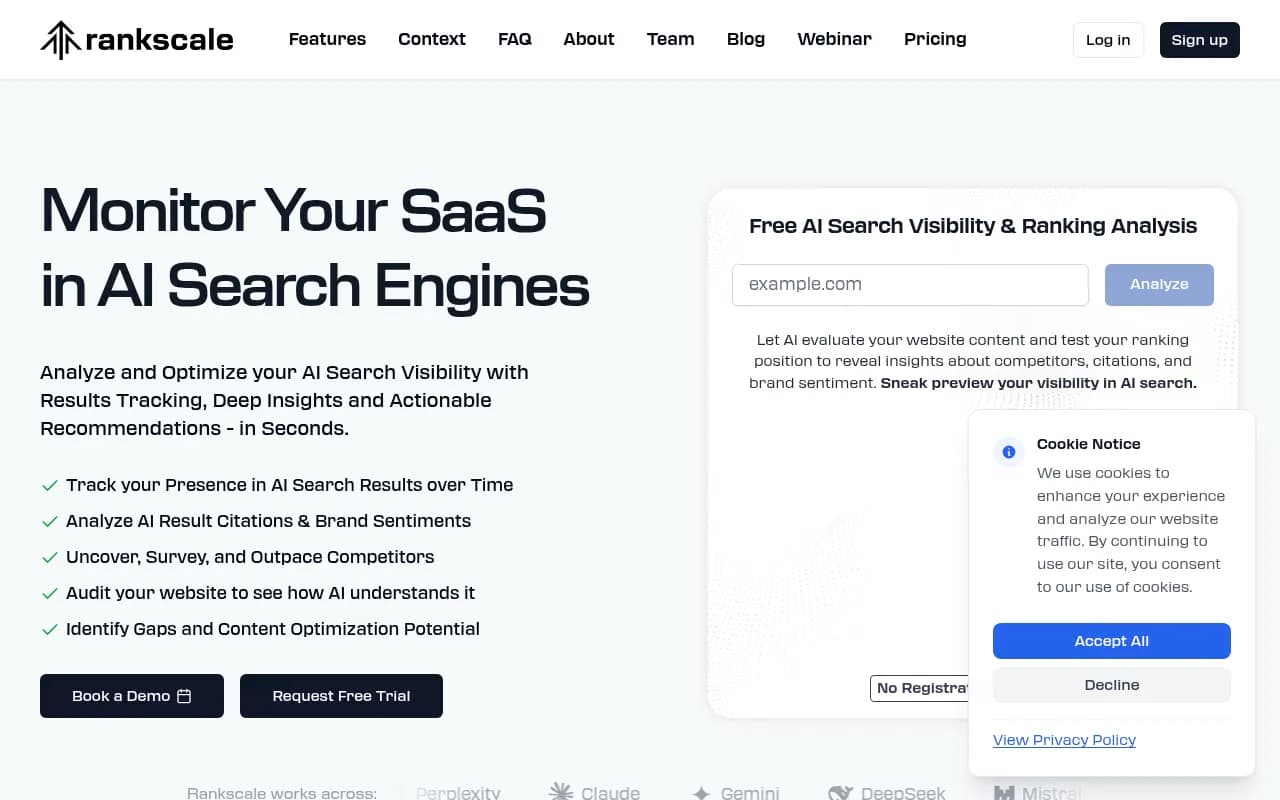
Rankscale is built with agency workflows in mind. Multi-client management, white-label reporting, and the ability to track AI visibility across a portfolio of sites make it a practical choice for agencies that found Searchable's multi-site capabilities limiting.
The content optimization features are lighter than Promptwatch's, but the reporting and client management infrastructure is solid. Agencies that need to show clients clear visibility data across AI models will find it easier to work with than most alternatives.
How the alternatives compare
| Tool | Content generation | Crawler logs | Traffic attribution | Reddit/YouTube tracking | Best for |
|---|---|---|---|---|---|
| Promptwatch | Yes (AI writing agent) | Yes | Yes (GSC, snippet, logs) | Yes | Full optimization loop |
| Profound | No | No | Limited | No | Enterprise monitoring |
| Otterly.AI | No | No | No | No | Budget monitoring |
| Peec AI | No | No | No | No | Multi-language tracking |
| AthenaHQ | No | No | No | No | Competitive benchmarking |
| Scrunch AI | No | No | No | No | Brand/PR monitoring |
| SE Ranking | Limited | No | No | No | SEO + AI combo |
| Rankscale | No | No | No | No | Agency multi-client |
| Searchable | Limited | No | No | No | Basic monitoring |
What to look for when switching
A few things worth checking before you commit to a new platform:
Does it cover the AI models you care about? ChatGPT and Perplexity get most of the attention, but Google AI Overviews and Google AI Mode are where a lot of search traffic actually lives. Make sure the tool monitors the models your audience actually uses.
Can it connect visibility to revenue? A visibility score is a vanity metric unless you can tie it to traffic and conversions. Look for tools that offer traffic attribution -- whether through Google Search Console integration, a tracking snippet, or server log analysis.
Does it help you create content, or just measure it? This is the core question. Monitoring tells you where you are. Optimization tools help you get somewhere better. If you're switching because you want results, not just data, prioritize tools with content gap analysis and content generation built in.
What's the prompt intelligence like? Volume estimates and difficulty scores for individual prompts let you prioritize. Without them, you're chasing every gap equally, which isn't a strategy.
The bottom line
Searchable is a reasonable starting point for AI visibility monitoring. But teams that have been using it for a while tend to hit the same ceiling: good data, no clear path forward.
The tools that are picking up those users fall into two camps. One camp is cheaper, simpler monitoring tools (Otterly.AI, Peec AI) for teams that just want to spend less. The other camp is more capable optimization platforms (Promptwatch, Profound) for teams that want to actually move the needle.
If you're switching because you want to do something with your AI visibility data -- not just look at it -- the second camp is where you should be looking. Promptwatch is the most complete option there, particularly for teams that want content gap analysis, AI content generation, and traffic attribution in one place. But the right choice depends on your team size, budget, and how seriously you're treating AI search as a channel.
The one thing that's clear: monitoring-only tools are a starting point, not a destination.