Key takeaways
- The most common reason Scrunch AI users switch is the gap between visibility data and actionable next steps -- the platform shows you where you're invisible but doesn't help you fix it
- Scrunch's pricing model (starting around $300/month, scaling to $1,000+ when you add team seats at $25/user) is a recurring complaint in community discussions
- The tools people are actually switching to split into two camps: monitoring-first alternatives and full optimization platforms
- Platforms with content generation, crawler logs, and prompt volume data are pulling the most users away from Scrunch in 2026
- If you're a solo marketer or small team, the calculus is different from an enterprise team managing large budgets -- the right alternative depends heavily on your use case
Why people are leaving Scrunch AI
Scrunch was genuinely ahead of the curve when AI search visibility first became a real concern. It covers 10+ AI platforms, has a clean interface, and its Agent Experience Platform (AXP) concept -- delivering AI-optimized content directly to AI agents -- was interesting when it launched.
But in 2026, the complaints have gotten louder and more specific.
One practitioner summed it up on r/SEO: "Scrunch provides prompt and citation tracking but doesn't share prompt volume data -- and its prompt trend feature is too basic to be actionable." That's the core tension. You can see that competitors are beating you in AI responses. You can't easily figure out why, or what to write to close the gap.
The pricing is the other sticking point. The base plan sits around $300/month, which is defensible if the platform delivers ROI. But the per-seat pricing at $25/user means a team of five adds $100/month before you've touched any features. For enterprise teams running large marketing budgets, that's not the issue -- the issue is that the data doesn't go deep enough to justify the cost. For smaller teams, the base price is already a stretch.
A third frustration: competitive intelligence that shows that you're losing without explaining how. Knowing a competitor appears more often in ChatGPT responses is useful. Knowing which specific prompts they're winning, what content they published to get there, and how to replicate it -- that's what teams actually need.
These three things -- no prompt volume data, escalating team pricing, and shallow competitive intelligence -- are what's driving the migration.
The two types of alternatives people are switching to
Before getting into specific tools, it helps to understand the split in the market.
One camp is "monitoring-first" alternatives. These tools track AI visibility across ChatGPT, Perplexity, Google AI Overviews, and others. They're often cheaper than Scrunch, sometimes significantly. They're good if you mainly need to report on visibility trends and share data with stakeholders. The tradeoff: they have the same fundamental limitation as Scrunch -- they show you the problem but leave you to solve it yourself.
The other camp is "optimization platforms." These tools monitor and help you act. They include features like content gap analysis, AI-generated briefs or articles, crawler logs showing how AI bots interact with your site, and prompt volume data to prioritize which gaps matter most. They're more expensive but closer to a complete workflow.
Most Scrunch users who are genuinely frustrated -- not just price-shopping -- end up in the second camp.
Platform-by-platform breakdown
Profound
Profound is the most commonly cited alternative for enterprise and mid-market teams. It covers ChatGPT, Perplexity, Microsoft Copilot, Google AI Overviews, and others, with deeper data than Scrunch on prompt volumes and competitive intelligence.

The honest take: Profound is strong on the monitoring and insights side. It has agent analytics, shopping tracking, and a content creation layer. For B2B enterprise clients, it consistently gets recommended over Scrunch in community discussions -- the AllAboutAI YouTube comparison (which has circulated in several Slack groups) concluded Profound was the clear winner for multi-engine coverage and strategic support.
Where it falls short for some users: it's priced for enterprise, and smaller teams sometimes find the feature depth overwhelming relative to what they actually need week to week.
Promptwatch
Promptwatch is the platform that comes up most often when people specifically want to move from monitoring to optimization -- not just see the data, but close the gap.

The core difference from Scrunch is the action loop. Scrunch shows you where competitors are appearing in AI responses that you're not. Promptwatch does that too, but then shows you the specific content your site is missing, generates articles and briefs grounded in real prompt data, and tracks whether those new pages start getting cited. It's the only platform in a recent 12-tool comparison rated as a "Leader" across all categories -- monitoring, content generation, crawler logs, and traffic attribution.
A few things worth knowing: it monitors 10 AI models including ChatGPT, Claude, Perplexity, Gemini, Grok, DeepSeek, and Google AI Overviews. It has real AI crawler logs (most competitors don't), Reddit and YouTube citation tracking, and ChatGPT Shopping monitoring. Pricing starts at $99/month for a single site with 50 prompts, which undercuts Scrunch considerably at the entry level.
For teams that are tired of dashboards that show problems without solving them, this is where most of the migration is going.
AthenaHQ
AthenaHQ tracks brand visibility across 8+ AI search engines with a clean interface that's easier to onboard than some enterprise-grade alternatives.

It's monitoring-focused, which means it has the same fundamental limitation as Scrunch -- no content generation, no crawler logs. But it's a reasonable lateral move if your main complaint with Scrunch is pricing or interface, rather than the lack of optimization features.
Otterly.AI
Otterly is one of the more affordable monitoring options in the market. It covers the major AI engines and has a straightforward prompt tracking setup.

The tradeoff is feature depth. No crawler logs, no visitor analytics, no content generation. If you're a solo marketer who just needs to track a handful of prompts and report on trends, Otterly makes sense. If you're running a team that needs to actually improve visibility scores, you'll hit the ceiling quickly.
Peec AI
Peec AI is worth mentioning specifically for teams with multi-language or multi-region requirements. Its tracking covers multiple languages, which is a gap in several other platforms.

Like Otterly, it's monitoring-first. The prompt tracking is solid, but there's no content optimization layer. Good for international teams that need coverage; less useful for teams trying to close content gaps.
SE Ranking
SE Ranking is an interesting option for teams that want AI visibility tracking bundled into a broader SEO platform. It's not a pure-play GEO tool, but its AI visibility toolkit has improved considerably.
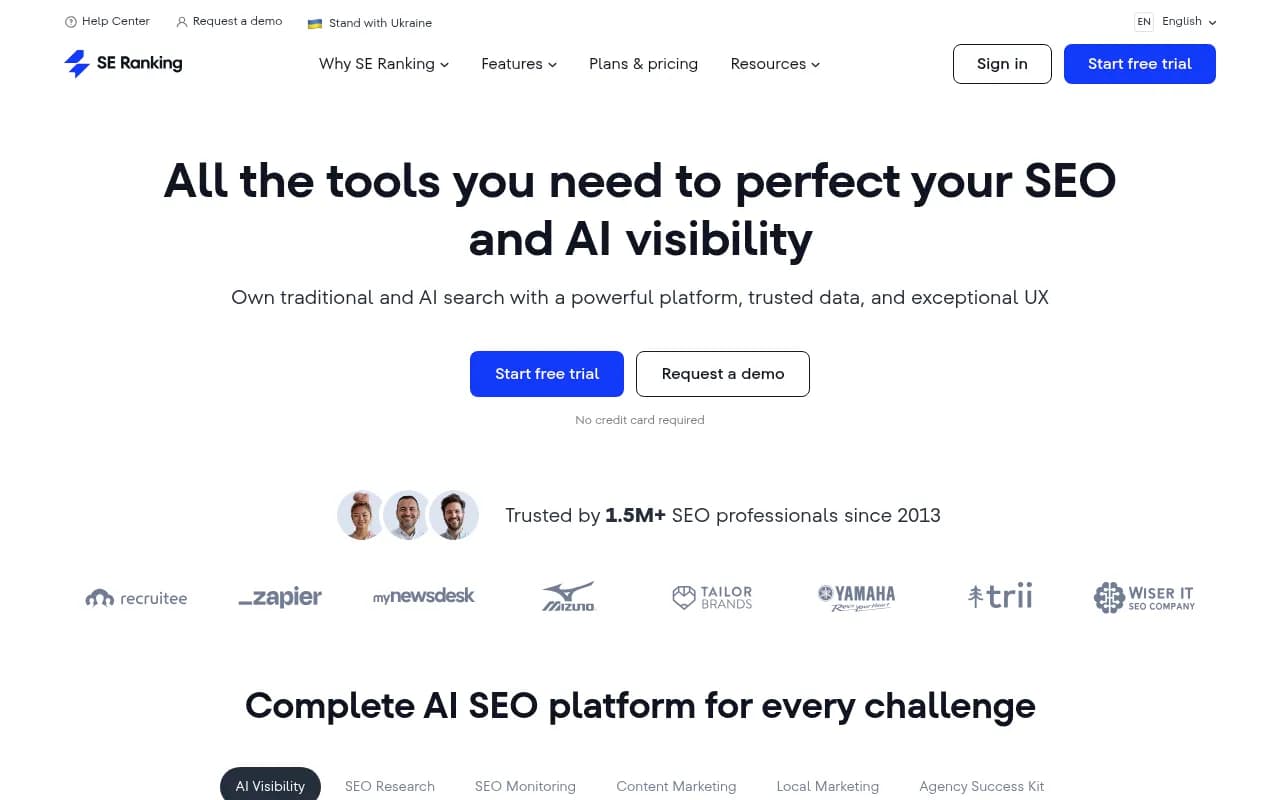
The appeal: if you're already paying for an SEO platform and want AI monitoring without adding another vendor, SE Ranking covers a lot of ground. The limitation: it's not as deep on AI-specific features as dedicated platforms.
Semrush
Semrush has added AI visibility features, and for teams already in the Semrush ecosystem, it's worth knowing what's there.
The honest assessment: Semrush uses fixed prompts rather than dynamic prompt tracking, which limits how useful it is for serious AI visibility work. It's a good supplement to a dedicated GEO tool, not a replacement for one.
Rankscale
Rankscale focuses specifically on AI search ranking and visibility, with a cleaner interface than some of the enterprise options.
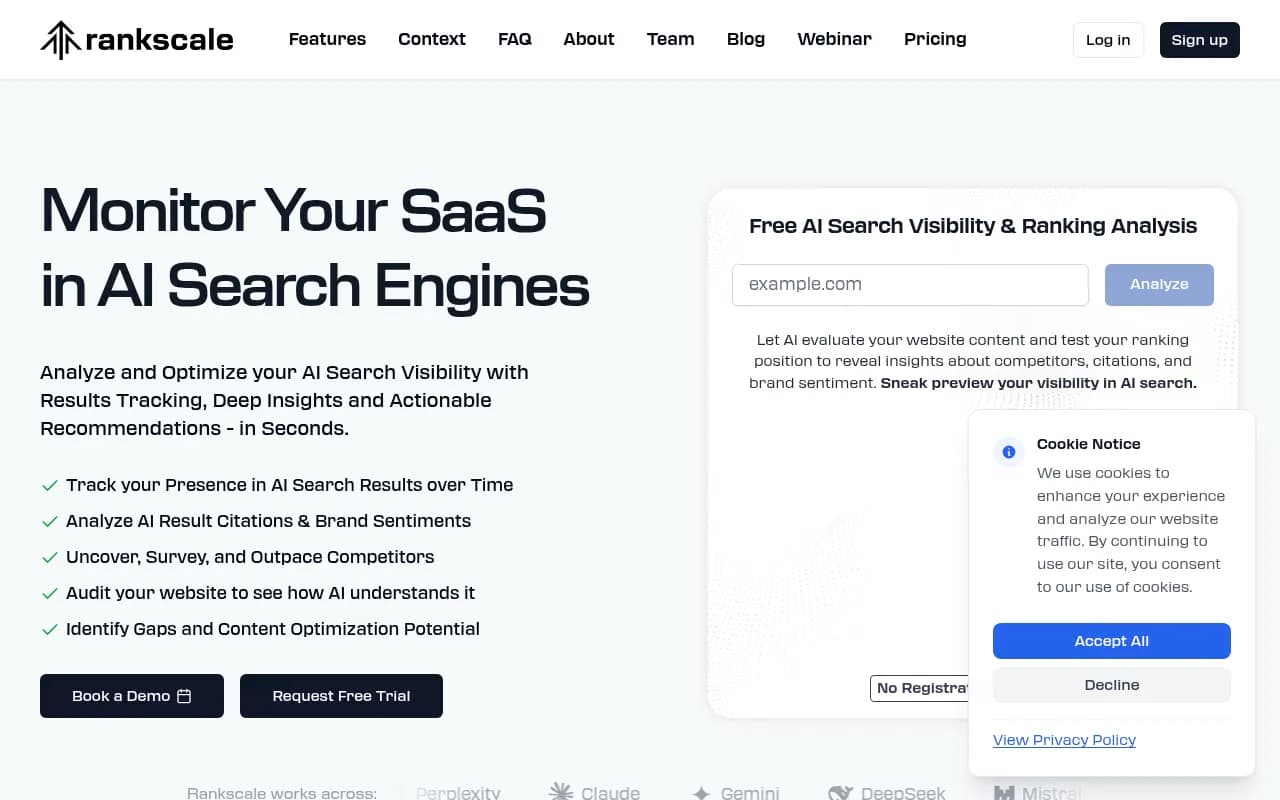
It's a newer entrant but has been picking up users who want something between "basic monitoring" and "full enterprise platform." Worth evaluating if you're a mid-size team.
Comparison table
| Platform | Monitoring | Prompt volumes | Content generation | Crawler logs | Reddit/YouTube tracking | Starting price |
|---|---|---|---|---|---|---|
| Scrunch AI | Yes | No | No | No | No | ~$300/mo |
| Promptwatch | Yes | Yes | Yes | Yes | Yes | $99/mo |
| Profound | Yes | Yes | Partial | Yes | No | Enterprise |
| AthenaHQ | Yes | Limited | No | No | No | ~$99/mo |
| Otterly.AI | Yes | No | No | No | No | ~$49/mo |
| Peec AI | Yes | No | No | No | No | ~$49/mo |
| SE Ranking | Yes | Limited | No | No | No | ~$65/mo |
| Semrush | Yes | No (fixed) | No | No | No | ~$139/mo |
What community discussions actually say
The r/GrowthHacking thread that's been cited in several roundups captures the frustration well: "I've tried a couple and they all kind of blur together. Some are decent for tracking, but I'm still waiting to find one that actually helps make better decisions, not just dump data."
That's the recurring theme. The market is full of monitoring tools. What's scarce is tools that close the loop -- from "here's where you're invisible" to "here's what to publish" to "here's proof it worked."
The other pattern in community discussions: teams that switch to a monitoring-only alternative from Scrunch often switch again within 6-12 months when they realize the core problem hasn't changed. The teams that seem happiest are the ones that moved to a platform with content generation and crawler analytics, even if the price was higher.
How to choose
A few honest questions to help narrow it down:
If your main complaint is price: Otterly.AI or Peec AI will cut your costs significantly. You'll lose features, but if budget is the primary constraint, they're functional.
If your main complaint is shallow competitive intelligence: Profound or Promptwatch are the natural moves. Both go deeper on why competitors are winning, not just that they are.
If your main complaint is the monitoring-only problem: Promptwatch is where most teams with this specific frustration end up. The content generation layer, crawler logs, and prompt volume data together address the core issue -- you can see the gap, generate content to fill it, and track whether it worked.
If you need multi-language coverage: Peec AI handles this better than most alternatives.
If you're already in an SEO platform ecosystem: SE Ranking or Semrush are worth checking before adding another vendor.
If you're an agency managing multiple clients: Promptwatch's agency/enterprise tier or Profound's agency features are the main options worth evaluating.
The bottom line
Scrunch AI isn't a bad platform. It was early to a market that's now crowded, and it still has solid multi-engine coverage. But the gap between "showing you data" and "helping you act on it" has become the defining question in this category, and Scrunch sits firmly on the monitoring side of that line.
In 2026, the platforms pulling the most users away are the ones that answer the question: "OK, I can see I'm invisible for these prompts -- now what?" That's where the market has moved, and it's where the most meaningful platform differences actually live.