Key takeaways
- Otterly.AI is a solid AI visibility monitoring tool with a low entry price ($29/month) and good coverage across ChatGPT, Perplexity, and Google AI Overviews
- Its core strength is automated prompt tracking and citation analysis -- it tells you where your brand appears and how often
- The main limitation is that it's a monitoring-only platform: it shows you the problem but doesn't help you fix it
- Weekly update cycles and limited prompt volumes make it less suitable for fast-moving competitive categories
- Teams that need content optimization, crawler log analysis, or revenue attribution will likely outgrow it quickly
- Several alternatives offer deeper optimization capabilities if you need to move beyond tracking
The GEO tool market in 2026 is crowded, and Otterly.AI was one of the first platforms to show up. That early-mover status earned it a real user base, some genuine credibility, and a reputation as the "easy entry point" into AI visibility monitoring.
But being first doesn't mean being best. And for a lot of teams, the question isn't whether Otterly.AI works -- it's whether it works enough to justify the subscription when the category has matured considerably.
Here's an honest look at what you're actually getting.
What Otterly.AI actually does
Otterly.AI monitors how your brand appears in AI-generated responses across three platforms: ChatGPT, Perplexity, and Google AI Overviews. You set up a list of prompts, and the tool automatically queries those platforms, then reports back on whether your brand was mentioned, how often, and with what sentiment.

The core feature set includes:
- Brand Visibility Index -- a score aggregating how frequently your brand appears across monitored queries
- Link Citations Analysis -- tracks which URLs are being cited in AI responses
- GEO Audit with SWOT analysis -- a structured report on your AI visibility strengths and gaps relative to competitors
- Prompt and keyword tracking -- shows which conversational queries trigger brand mentions
It's genuinely useful for getting a baseline. If you've never tracked your AI visibility before, running your first 50-100 prompts through Otterly.AI will tell you things you didn't know. That has real value.
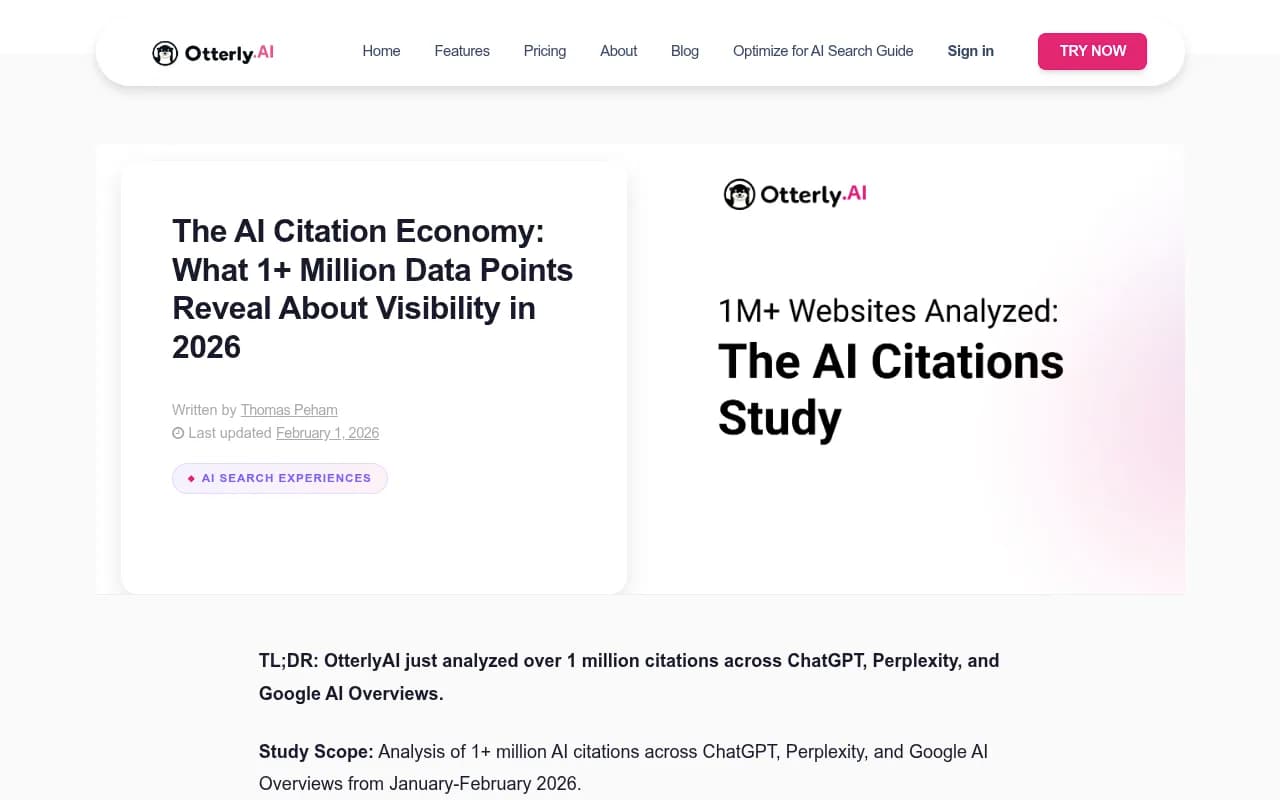
Otterly.AI's own research (analyzing 1+ million citations) found that community platforms like Reddit and Quora capture 52.5% of AI citations vs. 47.5% for brand domains -- which is exactly the kind of insight their monitoring surfaces.
Pricing: accessible at entry, expensive at scale
Otterly.AI's pricing runs from $29/month (Lite) up to $989/month (Pro). The entry tier is genuinely affordable for small teams or solo marketers testing the waters.
| Tier | Price | Best for |
|---|---|---|
| Lite | $29/mo | Individuals, early-stage testing |
| Starter | ~$99/mo | Small marketing teams |
| Growth | ~$299/mo | Growing brands, agencies |
| Pro | $989/mo | Enterprise / high-volume tracking |
The Lite and Starter tiers come with meaningful prompt limits, which is where things get complicated. If you're in a competitive category with dozens of relevant queries, you'll hit the ceiling fast and face a choice between upgrading or leaving gaps in your data.
At the Pro tier, $989/month is a significant commitment for a tool that -- and this is the key point -- only monitors. You're paying nearly $1,000/month to see data without built-in tools to act on it.
What Otterly.AI does well
Let's be fair about this. There are real reasons teams use it.
The setup is fast. You can go from signup to your first prompt results in under an hour, which isn't true of every platform in this category. The interface is clean enough that non-technical marketers can navigate it without a learning curve.
The GEO Audit feature is one of the more useful things it offers -- a structured SWOT-style analysis of your AI visibility compared to competitors. For teams that need to present AI visibility data to stakeholders, this kind of packaged output is easier to work with than raw data exports.
Citation tracking is also genuinely useful. Knowing which specific URLs are being cited in AI responses helps you understand what content is working and which domains AI models are treating as authoritative in your space.
Where it falls short
This is where the honest part of the assessment matters.
It only monitors -- it doesn't optimize
The most common complaint from Otterly.AI users is that the tool shows you where you're invisible without telling you how to fix it. One Reddit user described it plainly: "It tracks the source, but gives zero actionable strategy on how to restructure content to get cited."
That's not a bug -- it's a design choice. Otterly.AI is built as a monitoring dashboard, not an optimization platform. If you're looking for content gap analysis, AI-native content generation, or recommendations on what to write next, you won't find it here.
Weekly update cycles
AI search results shift constantly. A weekly refresh cycle means you're working with data that could be 7 days stale. For brands in fast-moving categories -- software, finance, health -- that lag matters.
No crawler log analysis
Otterly.AI monitors what AI outputs (what it says about you) but doesn't track what AI inputs (which pages AI crawlers are actually reading on your site). That's a meaningful gap. If an AI crawler is hitting your site but encountering JavaScript rendering errors or robots.txt blocks, you won't know from Otterly.AI alone. Otterly.AI's own research found that 73% of sites have technical barriers blocking AI crawler access -- but their tool can't tell you if yours is one of them.
Limited model coverage
Three platforms (ChatGPT, Perplexity, Google AI Overviews) covers a lot of the traffic, but the AI search landscape in 2026 includes Claude, Gemini, Grok, DeepSeek, Copilot, and Meta AI. Teams that need comprehensive coverage across all major models will find gaps.
No traffic attribution
Knowing your brand was mentioned in a Perplexity response is useful. Knowing whether that mention drove actual traffic or revenue is more useful. Otterly.AI doesn't connect visibility data to business outcomes.
Who should use Otterly.AI
There's a clear use case where Otterly.AI makes sense: teams that are just starting to track AI visibility, have a limited budget, and primarily need a baseline snapshot rather than ongoing optimization.
If you're a small brand or solo marketer who wants to know "am I showing up in AI search at all?" -- Otterly.AI answers that question cheaply and quickly.
It also works reasonably well as a supplementary tool if you already have a more capable primary platform and want a lightweight secondary monitor for a specific brand or product line.
Where it doesn't work well: competitive categories, teams that need to show ROI, agencies managing multiple clients, or anyone who needs to move from "I see the problem" to "here's what I'm doing about it."
How it compares to alternatives
The GEO monitoring space has expanded considerably. Here's how Otterly.AI sits relative to the main alternatives:
| Tool | Monitoring | Content optimization | Crawler logs | Traffic attribution | Starting price |
|---|---|---|---|---|---|
| Otterly.AI | Yes | No | No | No | $29/mo |
| Promptwatch | Yes | Yes | Yes | Yes | $99/mo |
| Peec.AI | Yes | No | No | No | ~$49/mo |
| AthenaHQ | Yes | Limited | No | No | Custom |
| Profound | Yes | Limited | No | No | Custom |
| SE Ranking | Yes | Limited | No | No | ~$65/mo |
Promptwatch is the clearest contrast here. Where Otterly.AI stops at monitoring, Promptwatch runs a full loop: it finds the prompts your competitors rank for that you don't, generates content designed to close those gaps, then tracks whether that content starts getting cited. That's a fundamentally different product category, even though both tools show up in the same "AI visibility" searches.




The "implementation gap" problem
There's a broader issue worth naming. A comment from r/b2bmarketing captures it well: "Unless a tool gives clear recommendations or ties to revenue, it's hard to justify $100-$400/month just to know if ChatGPT mentioned your brand today."
This is the implementation gap -- the distance between knowing you have an AI visibility problem and knowing what to do about it. Monitoring-only tools like Otterly.AI sit entirely on the awareness side of that gap. They're useful for diagnosis but don't help with treatment.
As AI search becomes a more significant traffic and revenue channel, the tools that survive will be the ones that close this gap. Teams that are serious about GEO as a growth channel will eventually need more than a dashboard that refreshes weekly.
The verdict
Otterly.AI is a competent monitoring tool with a low barrier to entry. For teams that have never tracked AI visibility before, it's a reasonable starting point -- especially at the $29-$99/month range.
The problems start when you need more than a dashboard. No content optimization, no crawler logs, no traffic attribution, weekly update cycles, and limited model coverage all become real constraints as your GEO program matures. At the Pro tier ($989/month), you're paying enterprise prices for a monitoring-only tool, which is hard to justify when platforms at similar or lower price points offer the full optimization loop.
If you're evaluating Otterly.AI right now, the honest question to ask yourself is: what happens after I see the data? If you have a clear answer -- a content team ready to act, a separate optimization workflow, a technical SEO process for crawler access -- Otterly.AI can be part of that stack. If you're expecting the tool itself to help you improve your AI visibility, not just measure it, you'll want to look elsewhere.