Key takeaways
- Most AI visibility tools were built for consumer brands -- B2B companies need platforms that handle niche, technical, and persona-specific prompts
- Monitoring-only tools show you data but leave you stuck; the best platforms close the loop by helping you create content that gets cited
- Prompt volume, difficulty scoring, and query fan-outs matter more for B2B than raw mention counts
- Crawler logs and page-level citation tracking are essential for understanding why AI models cite (or ignore) specific pages
- Promptwatch is the only platform rated a "Leader" across all categories in a 2026 comparison of 12 GEO platforms, and it's the top pick for B2B SaaS and services
Why B2B visibility in AI search is a different problem
If you sell project management software to enterprise IT teams, or compliance consulting to healthcare CFOs, your buyers are not asking ChatGPT "what's a good app?" They're asking things like "what tools help SOC 2 Type II compliance teams manage evidence collection?" or "how do mid-market companies handle vendor risk management without a dedicated GRC team?"
Those are niche prompts. Long, specific, sometimes jargon-heavy. And most AI visibility platforms were not designed with them in mind.
The tools built for DTC brands and consumer products track broad prompts like "best running shoes" or "top CRM software." That works fine when you're competing for high-volume, general queries. But B2B buyers operate differently -- they use precise language, they research across multiple sessions, and they trust AI responses that demonstrate genuine domain knowledge.
This creates two problems for B2B marketers trying to track AI visibility:
First, generic prompt libraries won't cover your actual buying journey. If a platform gives you a fixed set of prompts to track, those prompts probably don't match how your buyers actually phrase questions to ChatGPT or Perplexity.
Second, most platforms stop at monitoring. They'll tell you that your brand appeared in 12% of responses last month. What they won't tell you is which specific content gaps are causing AI models to recommend competitors instead of you -- or help you fix it.
Gartner projected that traditional search engine volume would decline 25% by 2026 as users shift to AI platforms for answers. For B2B companies, that shift is already happening in the research and shortlisting phase of the buying cycle.
What to look for in an AI visibility tracker for B2B
Before comparing specific tools, it's worth being clear about what actually matters for B2B use cases.
Custom prompt tracking is non-negotiable. You need to define the exact queries your buyers use -- not pick from a pre-built list. A cybersecurity vendor's prompts look nothing like a logistics SaaS company's prompts.
Persona and region targeting matters because B2B buyers in different roles ask different questions. A CISO prompts differently than a procurement manager. A platform that lets you simulate different personas gives you a more accurate picture of your actual visibility.
Prompt difficulty and volume scoring helps you prioritize. Not every niche prompt is worth chasing. You want to know which prompts have enough query volume to matter, and which ones you have a realistic shot at winning.
Content gap analysis separates useful platforms from expensive dashboards. Knowing you're invisible for a prompt is only half the job. Knowing what content would make AI models start citing you is the other half.
Crawler logs are underrated. If AI crawlers aren't reading your key pages, or if they're hitting errors, your visibility problems might be technical rather than content-related. Most platforms don't surface this at all.
Traffic attribution closes the loop. AI visibility that doesn't connect to pipeline or revenue is hard to justify to a B2B CFO. You need to know whether AI citations are actually driving visits and conversions.
The platforms worth considering
Promptwatch
Promptwatch is the most complete platform for B2B teams that need to go beyond monitoring. In a 2026 comparison of 12 GEO platforms, it was the only one rated a "Leader" across every category -- and the reason is the action loop it's built around.
The workflow is: find the gaps, create content to fill them, track the results. That sounds simple, but almost no other platform does all three.
The Answer Gap Analysis shows you exactly which prompts competitors are visible for that you're not -- with specific content recommendations, not vague suggestions. The built-in AI writing agent then generates articles, listicles, and comparisons grounded in real citation data from over 880 million citations analyzed. And page-level tracking shows you which pages are being cited, by which AI models, and how often.
For B2B specifically, the persona targeting and multi-language/multi-region support are genuinely useful. You can simulate how a VP of Engineering in Germany prompts differently than a procurement lead in the US. Prompt volume estimates and difficulty scores help you prioritize which niche queries to go after first. And the query fan-out feature shows how one prompt branches into sub-queries -- which is exactly how B2B research sessions actually work.
The crawler logs are a feature most competitors lack entirely. Seeing which pages ChatGPT or Perplexity's crawlers actually read (and which ones they skip or encounter errors on) is the kind of technical insight that can explain why a well-written page isn't getting cited.
Pricing starts at $99/month for the Essential plan (1 site, 50 prompts, 5 articles). Professional is $249/month and adds crawler logs, state/city tracking, and 150 prompts. Business is $579/month for 5 sites and 350 prompts.

Profound
Profound is a solid option for agencies managing multiple B2B clients. Its Agency mode includes brand configurations and pitch environments, which makes client reporting cleaner. The monitoring capabilities are strong, and it covers the major AI models.
Where it falls short for B2B teams is on the content side. Profound is primarily a tracking platform -- it shows you where you stand, but the path from "we're invisible for this prompt" to "here's the content that will fix it" isn't built in. You'll need to take the data elsewhere to act on it.

AthenaHQ
AthenaHQ covers 8+ AI search engines and has a clean interface for tracking brand mentions across models. It's monitoring-focused, which means it's good at telling you your current state but doesn't help you change it. For B2B teams that already have strong content operations and just need visibility data piped in, it's a reasonable option.

Peec AI
Peec AI has strong multi-language support and is often recommended for teams doing deep research across markets. It handles custom prompt tracking reasonably well and has a more research-oriented workflow that suits agencies doing competitive analysis. The gap is on content generation and traffic attribution -- it's a monitoring and research tool, not an optimization platform.

SE Ranking (AI Visibility Toolkit)
SE Ranking is an all-in-one SEO platform that added AI visibility tracking as part of its broader suite. For B2B teams that are already using SE Ranking for traditional SEO, the AI visibility module is a natural extension. The hybrid approach -- tracking both Google rankings and AI mentions in one place -- reduces tool sprawl.
The downside is depth. SE Ranking's AI visibility features are solid for general monitoring but don't go deep on niche prompt customization or content gap analysis. It's a good fit for teams that want one platform for everything, not teams that need to go deep on AI search specifically.
Scrunch AI
Scrunch AI automatically tracks 1,000 industry-specific prompts and suggests prompts to improve visibility. That auto-generation of prompts is useful for teams that don't know where to start, but for B2B companies with very specific buying journeys, a pre-built prompt library may not match your actual audience's language. Worth evaluating if you're in a more mainstream B2B vertical.
Otterly.AI
Otterly.AI is one of the more affordable entry points into AI visibility monitoring. It covers the main AI models and gives you a basic picture of brand mentions. For B2B teams with limited budgets that just want to know whether they're showing up at all, it's a reasonable starting point. But it's monitoring-only -- no crawler logs, no content generation, no traffic attribution.

Cognizo
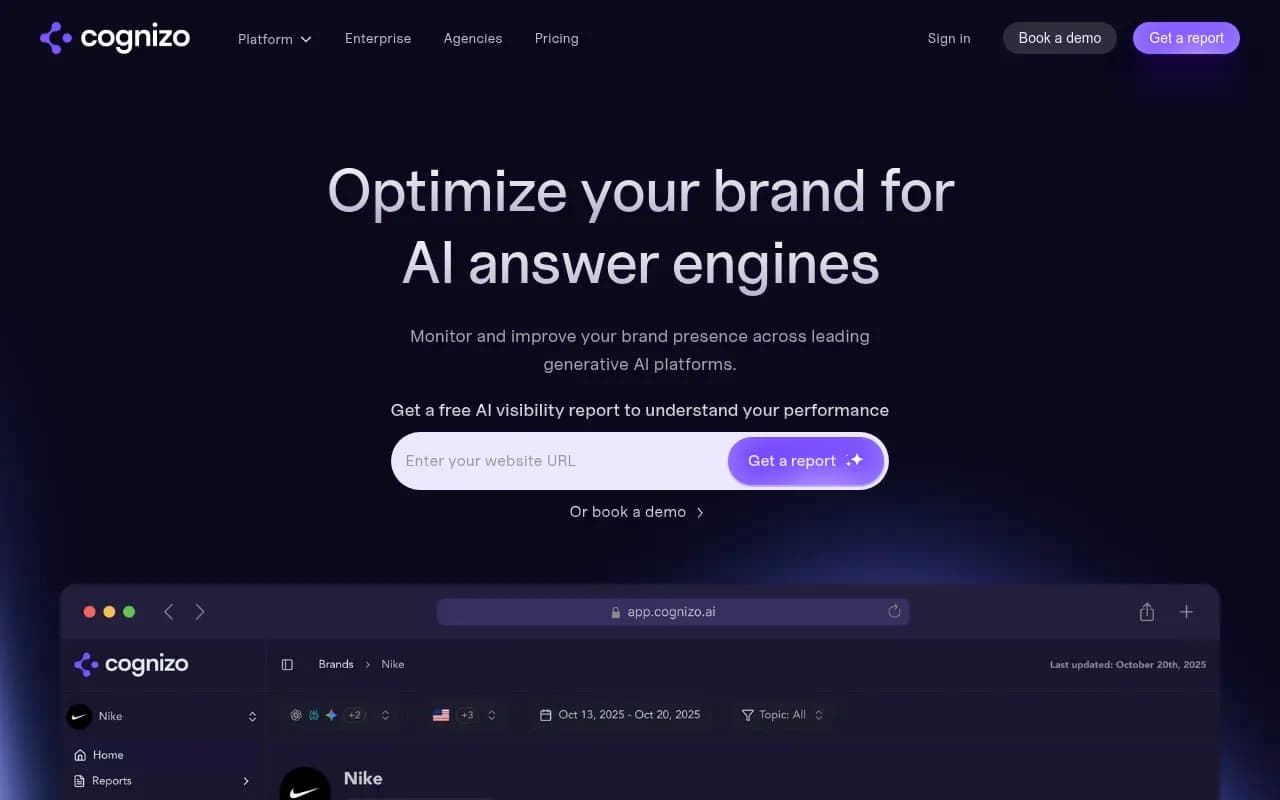
Cognizo is designed for marketers to track AI visibility, analyze contributing sources, and identify optimization opportunities. The source analysis is useful -- seeing which pages, Reddit threads, or external domains AI models are citing when they answer prompts in your category can inform where to publish and what to optimize. It's a more research-oriented tool than an action-oriented one.
Feature comparison table
| Platform | Custom prompts | Content gap analysis | AI content generation | Crawler logs | Traffic attribution | Persona targeting | Pricing starts |
|---|---|---|---|---|---|---|---|
| Promptwatch | Yes | Yes | Yes | Yes | Yes | Yes | $99/mo |
| Profound | Yes | Limited | No | No | No | Yes | Custom |
| AthenaHQ | Yes | No | No | No | No | Limited | Custom |
| Peec AI | Yes | No | No | No | No | Yes | Custom |
| SE Ranking | Limited | No | No | No | No | No | ~$65/mo |
| Scrunch AI | Auto-generated | Limited | No | No | No | No | Custom |
| Otterly.AI | Yes | No | No | No | No | No | ~$29/mo |
| Cognizo | Yes | Limited | No | No | No | No | Custom |
The niche prompt problem, in practice
Here's a concrete example of why niche prompt handling matters for B2B.
Say you're marketing a data governance platform. A generic AI visibility tool might track prompts like "best data management software" or "top data governance tools." Those are fine. But your actual buyers are asking things like:
- "How do companies handle GDPR compliance for third-party data processors?"
- "What's the difference between a data catalog and a data governance platform?"
- "How do mid-market companies build a data stewardship program without a dedicated team?"
If your visibility tool doesn't let you track those specific prompts -- or worse, if it only shows you aggregate mention counts without telling you which prompts you're winning or losing -- you're flying blind on the queries that actually matter.
The platforms that handle this best are the ones that let you define your own prompt library, score those prompts by volume and difficulty, and then show you the specific content gaps preventing AI models from citing you for each one.
That's the workflow Promptwatch is built around. Most other platforms let you track custom prompts but stop there -- they don't connect the dots to content creation.
Reddit and YouTube: the overlooked B2B signal
One thing that often surprises B2B marketers: AI models like ChatGPT and Perplexity frequently cite Reddit threads and YouTube videos in their responses, even for technical B2B topics.
A thread on r/devops discussing your category, or a YouTube comparison video that mentions your product, can directly influence whether an AI model recommends you. Most visibility platforms ignore these channels entirely.
Promptwatch surfaces Reddit discussions and YouTube content that directly influence AI recommendations -- which is a meaningful edge for B2B companies in technical categories where community discussion is active.
How to choose the right platform for your B2B team
The honest answer is that the right tool depends on where you are in your AI visibility journey.
If you're just starting out and want to understand whether you're showing up at all, a simpler monitoring tool like Otterly.AI or SE Ranking's AI module is a low-cost way to get oriented. You'll quickly hit the ceiling of what monitoring alone can tell you, but it's a reasonable first step.
If you're past the "are we visible?" question and into "how do we improve?", you need a platform with content gap analysis and some path to action. That's a much shorter list.
If you're a B2B company with a complex buying journey, technical buyers, and niche prompts that don't appear in any pre-built library, the only platform that handles the full workflow -- custom prompts, gap analysis, content generation, crawler logs, traffic attribution -- is Promptwatch.
The 2026 landscape has a lot of monitoring tools and not many optimization tools. For B2B teams that need to justify AI visibility investment with pipeline impact, the distinction matters.
A note on traditional SEO tools
Semrush and Ahrefs both have AI visibility features now. Semrush uses fixed prompts, which limits how useful it is for niche B2B use cases. Ahrefs Brand Radar also uses fixed prompts and lacks AI traffic attribution. Both are worth having for traditional SEO, but neither is a substitute for a dedicated AI visibility platform if AI search is a serious channel for you.
Bottom line
B2B AI visibility is not the same problem as consumer AI visibility. Your buyers use specific language, research across multiple sessions, and trust AI responses that demonstrate domain expertise. A tool that tracks broad prompts and shows you a mention count is not enough.
The platforms that matter for B2B are the ones that let you define your own prompt universe, tell you what's missing from your content, and help you fix it. That's a short list in 2026 -- and Promptwatch is at the top of it.