Key Takeaways
- Prompt volume and difficulty scoring help you prioritize which AI search queries to target -- not all prompts are worth the effort
- Most AI visibility tools only monitor mentions; the best ones show you which prompts competitors rank for but you don't, then help you create content to close those gaps
- Promptwatch leads the category with 880M+ citations analyzed, query fan-outs, and an AI writing agent that generates content grounded in real prompt data
- Tools like Profound and Conductor offer strong analytics but lack built-in content creation; Writesonic and Searchable include content workflows but weaker prompt intelligence
- Free tiers exist (Otterly.AI, Peec AI) but lack the depth needed for serious optimization -- expect to pay $99-$579/mo for actionable insights
AI search is eating traditional SEO. Your brand can rank #1 on Google but be invisible when someone asks ChatGPT, Perplexity, or Claude for recommendations. The shift is real: 88.1% of AI search queries are answer-driven, not navigational. People aren't clicking through -- they're getting answers directly from LLMs.
The problem? Most AI visibility tools are dashboards that show you data but leave you stuck. They tell you where you're mentioned, where competitors outrank you, and which prompts you're missing. Then they stop. You're left staring at a list of 500 prompts with no idea which ones matter or what to do next.
Prompt volume and difficulty scoring changes that. It tells you which prompts are worth targeting (high volume, winnable difficulty) and which are noise. Then it shows you what content to create to actually rank.
This guide covers 8 tools that go beyond monitoring. Some do it better than others.
What prompt volume and difficulty scoring actually means
Prompt volume estimates how often a specific query is asked across AI search engines. A prompt like "best CRM for small business" might have 12,000 monthly searches across ChatGPT, Perplexity, and Google AI Mode combined. "CRM software for 3-person sales teams in healthcare" might have 40.
Difficulty scoring measures how hard it is to get cited for that prompt. Factors include:
- How many authoritative domains already rank
- Citation density (how many sources AI models typically pull from)
- Content depth required (short answer vs comprehensive guide)
- Competitive saturation (are 10 SaaS companies already optimizing for this?)
The combination tells you what to prioritize. High volume + low difficulty = quick wins. High volume + high difficulty = long-term investment. Low volume + high difficulty = ignore.
Most tools don't surface this. They show you mentions and citations but leave you guessing which prompts to chase.
1. Promptwatch -- action-first platform with query fan-outs and content generation
Promptwatch is the only platform rated as a "Leader" across all categories in a 2026 comparison of 12 GEO tools. The difference: it's built around taking action, not just monitoring.

How prompt intelligence works:
- Answer Gap Analysis shows exactly which prompts competitors are visible for but you're not
- Prompt volume estimates and difficulty scores for each query
- Query fan-outs show how one prompt branches into sub-queries (e.g. "best project management software" fans out into "for remote teams", "with Gantt charts", "under $50/month")
- You see the specific content your website is missing -- the topics, angles, and questions AI models want answers to but can't find on your site
The built-in AI writing agent generates articles, listicles, and comparisons grounded in real citation data (880M+ citations analyzed). This isn't generic SEO filler -- it's content engineered to get cited by ChatGPT, Claude, Perplexity, and other AI models.
What you get:
- AI Crawler Logs: real-time logs of ChatGPT, Claude, Perplexity crawlers hitting your site -- which pages they read, errors they encounter, indexing issues
- Citation & Source Analysis: see exactly which pages, Reddit threads, YouTube videos AI models cite
- Reddit & YouTube Insights: surface discussions that influence AI recommendations
- ChatGPT Shopping Tracking: monitor when your brand appears in product recommendations
- Competitor Heatmaps: compare your visibility vs competitors across LLMs
- Multi-language & multi-region support with customizable personas
Pricing:
- Essential: $99/mo (1 site, 50 prompts, 5 articles)
- Professional: $249/mo (2 sites, 150 prompts, 15 articles, crawler logs, state/city tracking)
- Business: $579/mo (5 sites, 350 prompts, 30 articles)
- Agency/Enterprise: custom pricing
Best for: Teams that want to close content gaps and actually improve AI visibility, not just track it.
Skip if: You only need basic mention monitoring and don't plan to create new content.
2. Profound -- analyst-led platform with near real-time data

Profound is built for teams with dedicated analysts who want raw data, APIs, and near real-time monitoring. It tracks mentions across ChatGPT, Perplexity, Google AI Overviews, Gemini, and Claude.
Prompt intelligence:
- Prompt volume estimates based on search query data
- Difficulty scoring tied to citation density and competitive saturation
- Custom prompt lists with bulk monitoring
- API access for building custom dashboards
What it doesn't do: Content creation. Profound shows you the gaps but doesn't help you fill them. You need a separate content workflow.
Pricing: Starts around $500/mo for mid-market, scales to enterprise.
Best for: Analyst-driven workflows where you want raw data and control.
Skip if: You're a small team without dedicated analysts or you need out-of-the-box recommendations.
3. Conductor -- persona-based tracking with custom prompt sets
Conductor's AI visibility toolkit lets you define personas (e.g. "CFO evaluating accounting software") and track how AI models respond to prompts from that perspective.
Prompt intelligence:
- Custom prompt sets with volume and difficulty estimates
- Persona-based filtering (track prompts by job title, industry, intent)
- Competitive benchmarking across prompt categories
- Integration with Conductor's broader SEO platform
Strength: Persona customization is deeper than most competitors. You can model how different buyer types interact with AI search.
Weakness: No built-in content generation. You still need to write the articles yourself.
Pricing: Enterprise-focused, typically $1,000+/mo.
Best for: Enterprise teams with complex buyer personas and existing content workflows.
Skip if: You're a small team or need content creation tools.
4. Writesonic -- AI visibility + content execution in one platform
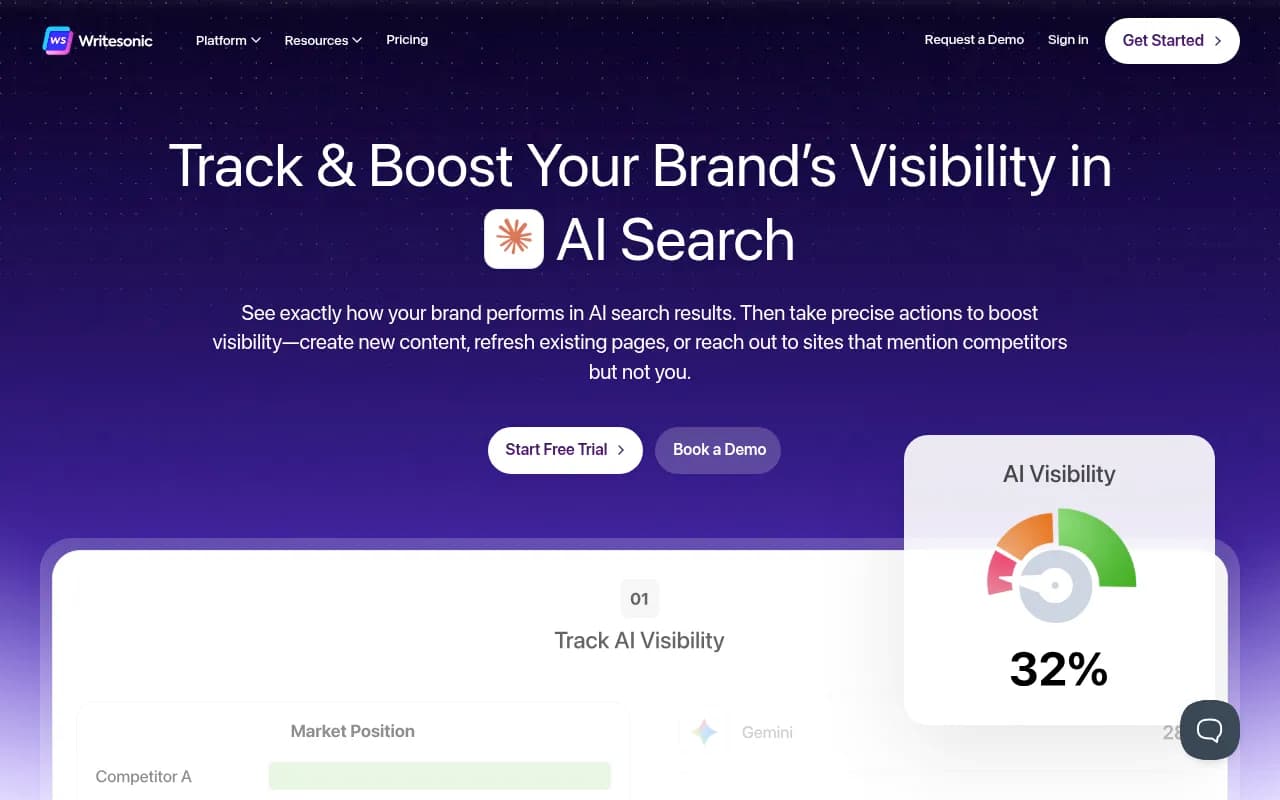
Writesonic combines AI visibility tracking with a content creation engine. It's designed for small content teams that want to spot gaps and publish fast.
Prompt intelligence:
- Basic prompt volume estimates (less granular than Promptwatch or Profound)
- Difficulty scoring tied to SERP competition (not AI-specific)
- Content gap analysis shows missing topics
Content workflow:
- AI writer generates articles optimized for AI search
- Built-in editor with SEO and readability scoring
- One-click publishing to WordPress, Webflow, etc.
Trade-off: Prompt intelligence is weaker than dedicated platforms. Volume estimates are rough, difficulty scoring leans on traditional SEO metrics.
Pricing: Starts at $19/mo for basic plans, scales to $499/mo for teams.
Best for: Small content teams that prioritize speed over depth.
Skip if: You need precise prompt data or deep competitive analysis.
5. Searchable -- monitoring + content optimization for mid-market teams
Searchable tracks AI mentions across ChatGPT, Perplexity, Google AI Overviews, and Gemini. It includes content optimization tools but lacks the depth of Promptwatch's Answer Gap Analysis.
Prompt intelligence:
- Prompt volume estimates based on search data
- Difficulty scoring (basic, tied to citation count)
- Content gap reports show missing topics
Content tools:
- Page-level optimization recommendations
- Schema markup suggestions
- Competitor content analysis
What's missing: No AI writing agent. You get recommendations but have to create content manually.
Pricing: Mid-market focus, around $300-$600/mo.
Best for: Teams that want monitoring + optimization guidance without enterprise complexity.
Skip if: You need built-in content generation or advanced prompt analytics.
6. Otterly.AI -- affordable monitoring with basic prompt metrics

Otterly.AI is the budget option. It tracks mentions across major LLMs and provides basic prompt volume estimates.
Prompt intelligence:
- Rough volume estimates (no granular data)
- No difficulty scoring
- Basic competitive tracking
What you get:
- Mention alerts via email
- Simple dashboard with citation counts
- CSV export for custom analysis
What's missing: Everything beyond monitoring. No content gap analysis, no optimization tools, no content creation.
Pricing: Free tier available, paid plans start at $29/mo.
Best for: Freelancers or small teams that just want to know when they're mentioned.
Skip if: You need actionable insights or content workflows.
7. Peec AI -- multi-language tracking with basic prompt data

Peec AI focuses on multi-language AI visibility. It tracks mentions across ChatGPT, Perplexity, Gemini, and Claude in 50+ languages.
Prompt intelligence:
- Basic volume estimates per language
- No difficulty scoring
- Language-specific competitive benchmarking
Strength: Best-in-class multi-language support. If you're optimizing for non-English markets, Peec AI surfaces prompts competitors miss.
Weakness: Shallow prompt data. You get volume estimates but no prioritization framework.
Pricing: Starts at $99/mo, scales with language coverage.
Best for: Brands optimizing for multiple languages or non-English markets.
Skip if: You only care about English-language AI search or need deep prompt analytics.
8. AthenaHQ -- GEO-focused platform with content gap analysis

AthenaHQ tracks AI visibility across 8+ AI search engines and includes content gap analysis. It's positioned as a GEO (Generative Engine Optimization) platform.
Prompt intelligence:
- Prompt volume estimates based on search data
- Basic difficulty scoring
- Content gap reports show missing topics vs competitors
Content tools:
- Page-level optimization recommendations
- Keyword and entity suggestions
- No AI writing agent
Pricing: Mid-market focus, around $200-$400/mo.
Best for: Teams that want GEO-specific insights without enterprise complexity.
Skip if: You need built-in content generation or advanced prompt analytics.
Comparison table: prompt intelligence features
| Tool | Prompt volume | Difficulty scoring | Query fan-outs | Content generation | AI crawler logs | Pricing (starting) |
|---|---|---|---|---|---|---|
| Promptwatch | Yes (granular) | Yes | Yes | Yes (AI agent) | Yes | $99/mo |
| Profound | Yes (granular) | Yes | No | No | No | $500/mo |
| Conductor | Yes (custom sets) | Yes | No | No | No | $1,000+/mo |
| Writesonic | Basic | Basic (SEO-focused) | No | Yes | No | $19/mo |
| Searchable | Yes | Basic | No | No | No | $300/mo |
| Otterly.AI | Rough estimates | No | No | No | No | $29/mo |
| Peec AI | Basic (multi-language) | No | No | No | No | $99/mo |
| AthenaHQ | Yes | Basic | No | No | No | $200/mo |
Why most tools stop at monitoring (and why that's a problem)
The AI visibility market is crowded with monitoring-only dashboards. They show you:
- Where you're mentioned
- Where competitors outrank you
- Which prompts you're missing
Then they stop. You're left with a list of 500 prompts and no idea what to do next.
The reason: building content creation tools is hard. Most platforms are built by SEO veterans who understand tracking but not content workflows. They can scrape AI responses, parse citations, and build dashboards. But generating content that actually ranks in AI search requires:
- Real citation data (not guesses)
- Prompt volume and difficulty scoring
- Query fan-outs to understand sub-topics
- An AI writing agent trained on what works
Only a few platforms (Promptwatch, Writesonic) have built this. The rest leave you stuck at step one.
How to choose the right tool
If you want to actually improve AI visibility (not just track it):
- Choose Promptwatch. It's the only platform that shows you gaps, helps you create content, and tracks results in one workflow.
If you have dedicated analysts and want raw data:
- Choose Profound. API access, near real-time monitoring, and custom dashboards.
If you're an enterprise team with complex personas:
- Choose Conductor. Persona-based tracking is deeper than competitors.
If you're a small content team prioritizing speed:
- Choose Writesonic. Basic prompt data but fast content creation.
If you only need basic monitoring:
- Choose Otterly.AI. Cheap, simple, no frills.
If you're optimizing for non-English markets:
- Choose Peec AI. Best multi-language support.
What to look for in prompt volume and difficulty data
Not all prompt metrics are created equal. Here's what separates real insights from vanity metrics:
Volume estimates should be:
- Based on actual search data (not guesses)
- Aggregated across multiple LLMs (ChatGPT, Perplexity, Claude, etc.)
- Updated monthly or more frequently
- Segmented by region and language
Difficulty scoring should account for:
- Citation density (how many sources AI models typically pull from)
- Competitive saturation (how many brands are already optimizing)
- Content depth required (short answer vs comprehensive guide)
- Domain authority of current rankers
Red flags:
- Tools that only track one LLM (usually ChatGPT)
- Volume estimates with no data source cited
- Difficulty scores that mirror traditional SEO metrics (keyword difficulty, domain rating)
- No query fan-outs or sub-topic analysis
If a tool can't explain where its prompt data comes from, it's probably guessing.
The action loop: find gaps, create content, track results
The best AI visibility workflow looks like this:
-
Find the gaps: Answer Gap Analysis shows which prompts competitors rank for but you don't. You see the specific content your website is missing.
-
Prioritize with volume and difficulty: Focus on high-volume, winnable prompts. Ignore low-volume, high-difficulty queries.
-
Create content that ranks: Use an AI writing agent (or manual workflow) to generate articles grounded in real citation data. This isn't generic SEO filler -- it's content engineered to get cited.
-
Track the results: See your visibility scores improve as AI models start citing your new content. Page-level tracking shows exactly which pages are being cited, how often, and by which models.
-
Close the loop with traffic attribution: Connect visibility to actual revenue. Code snippet, GSC integration, or server log analysis.
Most tools stop at step one. Promptwatch is the only platform that supports the entire loop.
Final thoughts
Prompt volume and difficulty scoring isn't a nice-to-have. It's the difference between guessing which content to create and knowing which prompts will move the needle.
Most AI visibility tools are monitoring dashboards. They show you data but leave you stuck. The best ones -- Promptwatch, Profound, Conductor -- go further. They show you what's missing, prioritize what matters, and (in Promptwatch's case) help you create content that ranks.
If you're serious about AI visibility, pick a tool that supports the full workflow. Monitoring alone won't get you cited.