Summary
- AI visibility platforms track how your brand appears in AI-generated answers from ChatGPT, Perplexity, Google AI Overviews, and other LLMs -- a critical new channel for brand discovery
- Enterprise needs differ from SMB needs: you need multi-region support, API access, governance workflows, and executive reporting, not just basic monitoring dashboards
- The best platforms combine citation tracking, competitor analysis, content gap identification, and actionable optimization tools -- monitoring alone isn't enough
- Pricing ranges from $99/month for starter plans to custom enterprise contracts, with most platforms offering free trials
- Promptwatch leads the category by combining monitoring with action: it shows you where you're invisible, then helps you fix it with AI content generation and optimization tools

Why enterprise brands need AI visibility platforms
Your customers aren't searching the way they used to. When someone asks ChatGPT "What are the best project management tools for remote teams?" or Perplexity "Which CRM integrates with Salesforce?", your brand either gets mentioned or it doesn't. There's no page two. No chance to optimize your way up the rankings later.
AI models act as gatekeepers now. They synthesize information and deliver answers directly, often without sending users to a website. For enterprise brands, this creates three immediate problems:
- You don't know if you're visible. Most brands have no idea whether ChatGPT, Claude, or Gemini mention them when users ask relevant questions.
- You can't measure competitive positioning. If you don't know how often competitors get cited versus you, you're flying blind.
- You have no playbook for improvement. Traditional SEO tactics don't directly translate to AI visibility. You need different data and different strategies.
This is Generative Engine Optimization (GEO) -- optimizing for AI models instead of search engines. And it requires purpose-built tools.
What makes an AI visibility platform "enterprise-ready"?
Not every tool that tracks AI mentions is built for enterprise use. Small business tools work fine for monitoring a handful of prompts. Enterprise platforms need to handle scale, governance, and integration with existing workflows.
Here's what separates enterprise platforms from basic monitoring dashboards:
Multi-region and multi-language support. Your brand operates globally. You need to track AI responses in German, Japanese, Spanish -- not just English. And you need to see how responses differ by country.
API access and raw data exports. Your BI team wants to build custom dashboards in Looker, Tableau, or Power BI. You need APIs and data exports, not just a web interface.
Team collaboration and governance. Multiple teams need access with different permission levels. You need approval workflows before publishing optimized content.
Executive reporting. Your CMO and board want high-level visibility metrics, not granular prompt-by-prompt data. You need pre-built executive dashboards.
Citation and source analysis. You need to know which pages, domains, and content types AI models cite most often -- not just whether your brand got mentioned.
Competitor benchmarking. Tracking your own visibility in isolation is useless. You need side-by-side comparisons with competitors.
Content optimization tools. Monitoring tells you where you're invisible. Optimization tools help you fix it. The best platforms do both.
Top 10 AI visibility platforms for enterprise brands in 2026
1. Promptwatch
Promptwatch is the only platform that combines monitoring with action. Most competitors show you where you're invisible and leave you stuck. Promptwatch shows you what's missing, then helps you create content that gets cited.
The core workflow: Find gaps → Generate content → Track results. Answer Gap Analysis shows exactly which prompts competitors rank for but you don't. The built-in AI writing agent generates articles grounded in real citation data (880M+ citations analyzed). Page-level tracking shows which content is getting cited and by which models.
Key features:
- Monitors 10 AI models: ChatGPT, Perplexity, Google AI Overviews, Claude, Gemini, Meta AI, DeepSeek, Grok, Mistral, Copilot
- AI crawler logs show real-time crawling activity from AI bots hitting your site
- Reddit and YouTube tracking surfaces discussions that influence AI recommendations
- ChatGPT Shopping tracking monitors product recommendation carousels
- Prompt intelligence with volume estimates and difficulty scores
- Multi-language and multi-region support with customizable personas
- Looker Studio integration and full API access
Pricing: Essential $99/mo (1 site, 50 prompts), Professional $249/mo (2 sites, 150 prompts, crawler logs), Business $579/mo (5 sites, 350 prompts). Enterprise custom pricing available.
Best for: Brands that want to optimize AI visibility, not just monitor it. Marketing teams that need content gap analysis and AI-generated content to close those gaps.
2. Profound

Profound is built for analyst-driven teams that need raw data access and APIs. If your BI team wants to build custom dashboards or your data scientists want to run their own analyses, Profound gives you the infrastructure.
Key features:
- High-frequency citation tracking across major LLMs
- Agent analytics for understanding AI model behavior
- Raw data exports and API access for custom reporting
- AI shopping visibility tracking
- Multi-model coverage (ChatGPT, Perplexity, Google AI Overviews, Gemini, Claude, Copilot, Grok, DeepSeek)
Pricing: Starter $99/mo (ChatGPT only), Growth $399/mo (adds Perplexity and Google AI Overviews), Enterprise custom (full model coverage).
Best for: Large enterprises with dedicated BI and analytics teams that need infrastructure-level control and raw data access.
3. BrightEdge
BrightEdge is the enterprise SEO platform that added AI visibility tracking. If you already use BrightEdge for traditional SEO, adding GEO capabilities keeps everything in one system.
Key features:
- Generative AI visibility tracking integrated with SEO workflows
- AI-driven content optimization recommendations
- Enterprise governance with approval workflows
- Executive dashboards and board-level reporting
- Multi-team collaboration with role-based permissions
Pricing: Custom enterprise pricing only.
Best for: Enterprises already using BrightEdge for SEO that want to add AI visibility without switching platforms. Teams that need tight governance and approval workflows.
4. Conductor
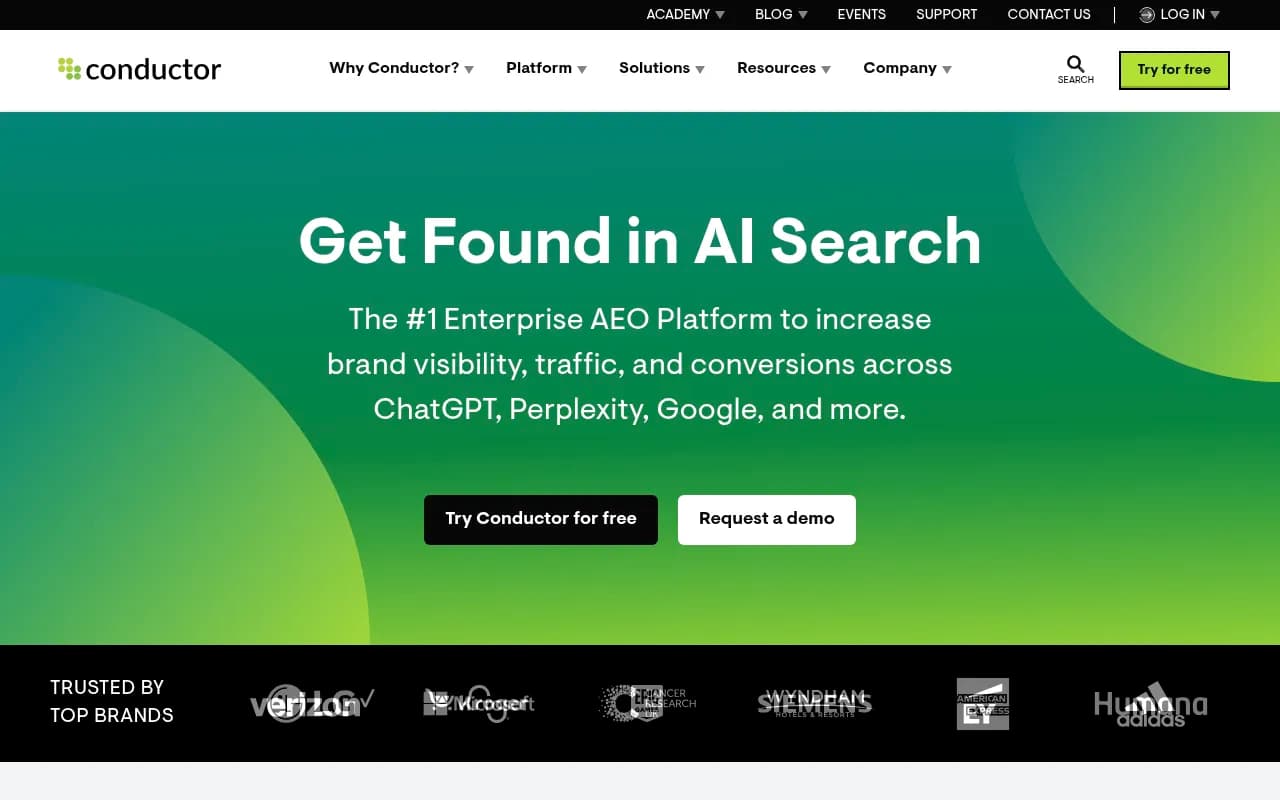
Conductor emphasizes persona customization -- tracking how AI models respond differently based on user intent, industry, and context. If your brand serves multiple audiences, Conductor helps you understand visibility across segments.
Key features:
- Persona-based AI visibility tracking
- Content performance analysis across AI models
- Competitive benchmarking with share-of-voice metrics
- Integration with existing SEO and content workflows
Pricing: Custom enterprise pricing.
Best for: Brands with multiple customer segments that need to track AI visibility by persona and use case.
5. Semrush One
Semrush added AI visibility tracking to its all-in-one digital marketing platform. If you already use Semrush for SEO, PPC, and content marketing, Semrush One consolidates AI visibility into the same dashboard.
Key features:
- AI Overviews tracking for Google AI Mode
- Brand mention monitoring across AI models
- Competitive analysis with share-of-voice metrics
- Integration with Semrush's existing SEO and content tools
Limitations: Uses fixed prompt sets rather than custom prompts. No AI traffic attribution or crawler log analysis.
Pricing: Part of Semrush One subscription (custom enterprise pricing).
Best for: Enterprises already using Semrush that want to add AI visibility without switching platforms.
6. Peec AI

Peec AI focuses on multi-language support and smart optimization suggestions. If your brand operates globally and needs visibility across languages, Peec AI handles localization better than most competitors.
Key features:
- Multi-language AI visibility tracking
- Smart content optimization suggestions
- Citation tracking across major LLMs
- Competitive benchmarking
Pricing: Custom enterprise pricing.
Best for: Global brands that need multi-language tracking and localized optimization recommendations.
7. Otterly.AI

Otterly.AI is the affordable monitoring option. It tracks brand mentions and citations but lacks content optimization and generation features. Good for teams that just need visibility data.
Key features:
- Brand mention tracking across AI models
- Citation frequency analysis
- Basic competitive benchmarking
- Simple dashboard interface
Limitations: No crawler logs, no visitor analytics, no content generation, no optimization recommendations.
Pricing: More affordable than most competitors (specific pricing not publicly listed).
Best for: Teams with limited budgets that need basic monitoring without optimization tools.
8. Scrunch
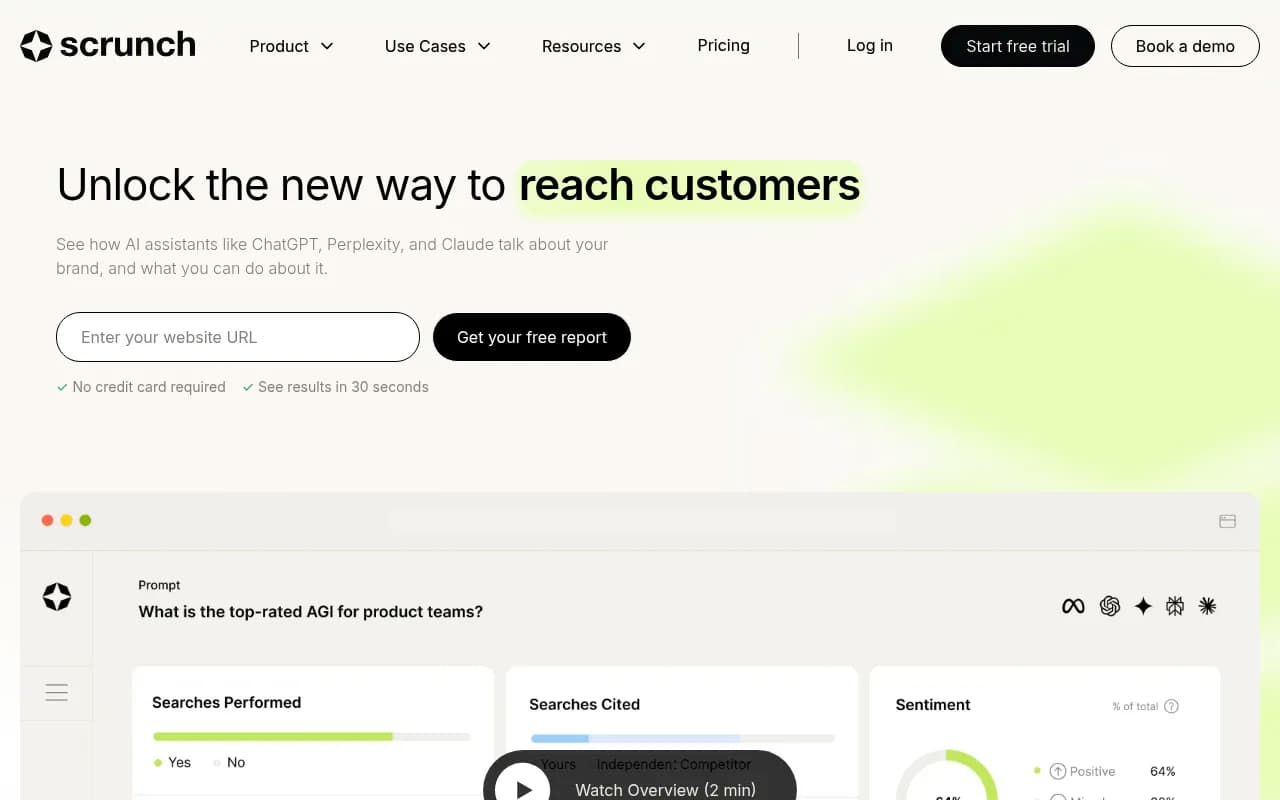
Scrunch combines AI visibility tracking with influencer marketing analytics. If your brand strategy includes influencer partnerships, Scrunch shows how influencer content affects AI visibility.
Key features:
- AI visibility tracking
- Influencer content impact analysis
- Brand mention monitoring
- Social media integration
Pricing: Custom pricing.
Best for: Brands with active influencer marketing programs that want to understand how influencer content affects AI visibility.
9. Ahrefs Brand Radar
Ahrefs added Brand Radar to track brand mentions in AI search results. If you already use Ahrefs for SEO, Brand Radar adds AI visibility to your existing workflow.
Key features:
- Brand mention tracking in AI search results
- Integration with Ahrefs' existing SEO tools
- Basic competitive analysis
Limitations: Uses fixed prompt sets. No AI traffic attribution. Limited optimization features.
Pricing: Included with Ahrefs subscription (starts at $129/mo for basic plans).
Best for: Teams already using Ahrefs that want basic AI visibility tracking without switching tools.
10. ZipTie
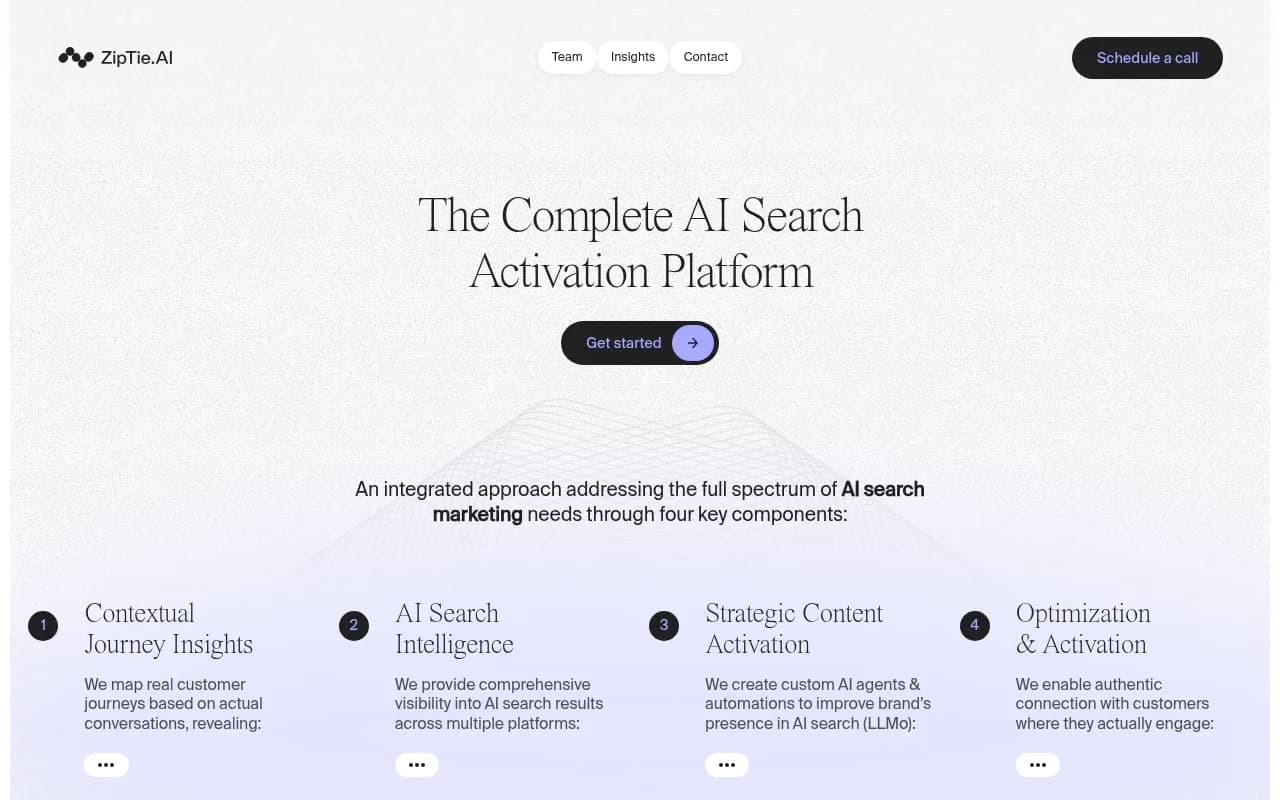
ZipTie offers deep analysis of AI search visibility with granular data on how AI models construct responses. Good for teams that want to understand the mechanics of AI citations.
Key features:
- Deep citation analysis
- Response construction breakdown
- Source attribution tracking
- Competitive positioning analysis
Pricing: Custom pricing.
Best for: Analyst-heavy teams that want granular data on how AI models build responses and attribute sources.
Feature comparison: What each platform offers
| Platform | Citation tracking | Competitor analysis | Content optimization | AI crawler logs | Multi-language | API access | Pricing |
|---|---|---|---|---|---|---|---|
| Promptwatch | Yes (10 models) | Yes | Yes (AI generation) | Yes | Yes | Yes | $99-579/mo |
| Profound | Yes (8 models) | Yes | No | No | Limited | Yes | $99-399/mo |
| BrightEdge | Yes | Yes | Yes | No | Yes | Yes | Custom |
| Conductor | Yes | Yes | Yes | No | Yes | Limited | Custom |
| Semrush One | Yes (limited) | Yes | Limited | No | Yes | Yes | Custom |
| Peec AI | Yes | Yes | Yes | No | Yes | Limited | Custom |
| Otterly.AI | Yes | Basic | No | No | Limited | No | Affordable |
| Scrunch | Yes | Yes | No | No | Limited | Limited | Custom |
| Ahrefs Brand Radar | Yes (limited) | Basic | No | No | Limited | No | $129+/mo |
| ZipTie | Yes | Yes | Limited | No | Limited | Limited | Custom |
How to choose the right platform for your enterprise
Start with your immediate priority:
Choose Promptwatch if you need to optimize AI visibility, not just monitor it. You get monitoring plus content gap analysis, AI content generation, and crawler logs. The action loop -- find gaps, generate content, track results -- is built into the platform.
Choose Profound if your BI and analytics teams need raw data access and APIs to build custom dashboards. Profound gives you infrastructure-level control.
Choose BrightEdge if you already use BrightEdge for SEO and need enterprise governance with approval workflows and board-level reporting.
Choose Conductor if you serve multiple customer segments and need persona-based visibility tracking.
Choose Semrush One or Ahrefs Brand Radar if you already use those platforms for SEO and want to add basic AI visibility without switching tools.
Choose Peec AI if multi-language support is your top priority and you operate globally.
Choose Otterly.AI if you have a limited budget and just need basic monitoring without optimization features.
Most enterprises use a combination: an infrastructure tool for data (Profound) plus a strategic optimization layer (Promptwatch or BrightEdge).
What to look for in a free trial
Most platforms offer free trials. Use the trial to answer these questions:
-
Does the platform track the AI models your customers actually use? If your audience is on ChatGPT and Perplexity but the platform only tracks Google AI Overviews, it's not useful.
-
Can you customize prompts or are you stuck with fixed prompt sets? Fixed prompts rarely match your actual business questions.
-
Does the platform show you what to do next, or just show you data? Monitoring without optimization recommendations leaves you stuck.
-
Can your team actually use the interface? Some platforms are built for analysts. Others are built for marketers. Make sure it matches your team's skill level.
-
Does it integrate with your existing tools? Check for API access, data exports, and integrations with your BI platform, CMS, or marketing stack.
-
Can you track competitors? Visibility in isolation is useless. You need side-by-side comparisons.
The future of AI visibility for enterprises
AI visibility platforms are still early. The category didn't exist two years ago. Expect rapid evolution:
More AI models to track. Today's platforms track 8-10 models. As new LLMs launch (and gain user adoption), platforms will add coverage.
Better attribution. Current platforms struggle to connect AI visibility to actual traffic and revenue. Expect better attribution models that tie citations to conversions.
Tighter CMS integrations. Today, most platforms are separate dashboards. Future versions will integrate directly into WordPress, HubSpot, and other CMSs with inline optimization suggestions.
Automated optimization. Today, platforms suggest what to fix. Tomorrow, they'll fix it automatically -- rewriting content, updating structured data, and republishing without human intervention.
Voice and video AI. Current platforms focus on text-based AI search. As voice assistants and video AI (like ChatGPT's Advanced Voice Mode) grow, platforms will add tracking for those channels.
The brands that master AI visibility now will have a multi-year advantage. The ones that wait will spend years catching up.
Final recommendation
If you're an enterprise brand serious about AI visibility, start with Promptwatch. It's the only platform that combines monitoring with action -- showing you where you're invisible, then helping you create content that gets cited. The built-in AI writing agent, Answer Gap Analysis, and crawler logs give you a complete optimization workflow, not just a monitoring dashboard.
For teams that need raw data access and APIs, add Profound as your infrastructure layer. For teams already using BrightEdge or Semrush, add their AI visibility modules to keep everything in one system.
But don't overthink it. The biggest mistake is waiting. Your competitors are already optimizing for AI visibility. Every month you delay is a month they're building an advantage you'll have to overcome later.