Key takeaways
- Clearscope ($199/mo) and Surfer SEO ($99/mo) are the two strongest performers for traditional on-page optimization, with Clearscope edging ahead on content quality and Surfer winning on workflow depth.
- NeuronWriter offers the best value for budget-conscious teams that want NLP-based optimization plus built-in AI drafting without paying enterprise prices.
- Dashword is genuinely useful for fast content brief generation but lacks the depth to compete with the others on optimization scoring.
- None of these four tools were built for AI search visibility (GEO/AEO) -- they optimize for Google's blue links, not for getting cited by ChatGPT or Perplexity. If that's your goal, you need a separate layer.
- The right choice depends heavily on team size, budget, and whether you're optimizing for traditional search, AI search, or both.
Here's the uncomfortable truth about content optimization tools in 2026: most of them are solving a problem that's getting smaller.
Getting to page one of Google still matters. But a growing share of search queries now get answered directly by AI -- ChatGPT, Perplexity, Google AI Overviews, Claude. Users get a synthesized answer and never click through to your article, no matter how well-optimized it is. The tools in this comparison -- Surfer SEO, Clearscope, NeuronWriter, Dashword -- were all designed for the old game. They're good at it. But "good at the old game" is a more complicated compliment than it used to be.
That said, these tools still matter. Traditional organic search isn't dead. And the content quality signals they help you hit (topical depth, semantic coverage, readability) are the same signals AI models use to decide what's worth citing. So let's actually compare them.
What these tools do (and don't do)
All four tools share a core function: analyze the top-ranking pages for a target keyword, extract the topics and terms those pages cover, and give you a score or grade as you write. The idea is that if your content covers what the top results cover -- and covers it better -- you'll rank.
Where they differ is in how they present that analysis, how much they help you act on it, and what else they offer beyond the core scoring loop.
None of them monitor AI search visibility. None of them tell you whether ChatGPT is citing your competitors. None of them help you identify which prompts you're missing from AI-generated answers. That's a separate category entirely -- and worth keeping in mind as you read.
Surfer SEO
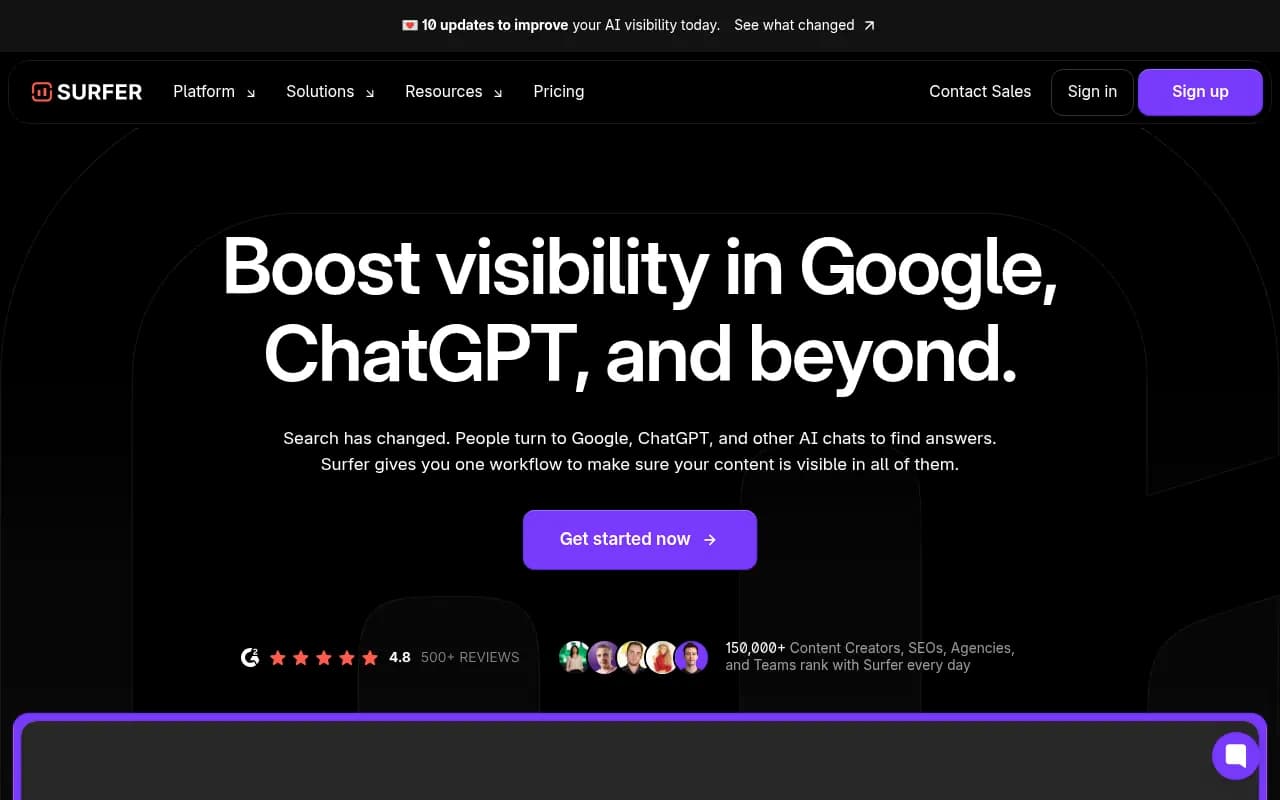
Surfer is the most feature-complete tool in this comparison. It covers keyword research, content briefs, a real-time content editor with NLP scoring, an AI writing assistant (Surfer AI), internal linking suggestions, and a site audit module. For teams that want one tool to handle most of the SEO content workflow, Surfer comes closest.
The content editor scores your article from 0 to 100 based on keyword usage, word count, heading structure, and NLP term coverage. It's genuinely useful for ensuring topical completeness -- you can see at a glance which terms your draft is missing and add them. The brief builder pulls competitor data automatically, which saves real time.
The weaknesses are real, though. The scoring system rewards keyword density in ways that can push writers toward stuffing terms in rather than writing naturally. A score of 75 doesn't mean your article is good -- it means it matches certain surface-level patterns from top-ranking pages. Teams that optimize for the score rather than the reader end up with content that reads like a SERP digest.
Surfer AI (the built-in writing assistant) produces serviceable drafts but nothing that would pass for original thinking. It's useful for getting a skeleton down quickly, less useful if you care about brand voice.
Pricing starts at $99/mo for the Essential plan. The Scale plan ($219/mo) unlocks more articles and the full AI writing features.
Clearscope

Clearscope is the premium option -- $199/mo for the Essentials plan -- and it earns that price for the right team. Its NLP engine is widely considered the most accurate of the four for identifying semantically relevant terms. The grading system (A++ to F) is more intuitive than a 0-100 score for many writers, and the real-time editor gives immediate feedback as you write.
What makes Clearscope worth the money for larger teams is the workflow integration. It connects with Google Docs and WordPress, which means writers don't have to leave their existing environment. The reporting is cleaner than Surfer's, and the term recommendations feel less like keyword stuffing prompts and more like genuine topical guidance.
According to testing by MarketBetter across 90 days of real B2B articles, Clearscope pushed 3 posts to the #1 position -- the strongest result of any tool they tested. That's one data point, not a universal guarantee, but it's consistent with what other practitioners report.
Clearscope has also started moving toward AI search visibility with its Tracked Topics and Expand products, which monitor citations across Google and ChatGPT. It's early-stage compared to dedicated GEO platforms, but it signals where the product is heading.
The main limitation is price. At $199/mo for one user and limited reports, it's hard to justify for solo operators or small teams. And like Surfer, it doesn't help you understand why AI models are or aren't citing your content.
NeuronWriter
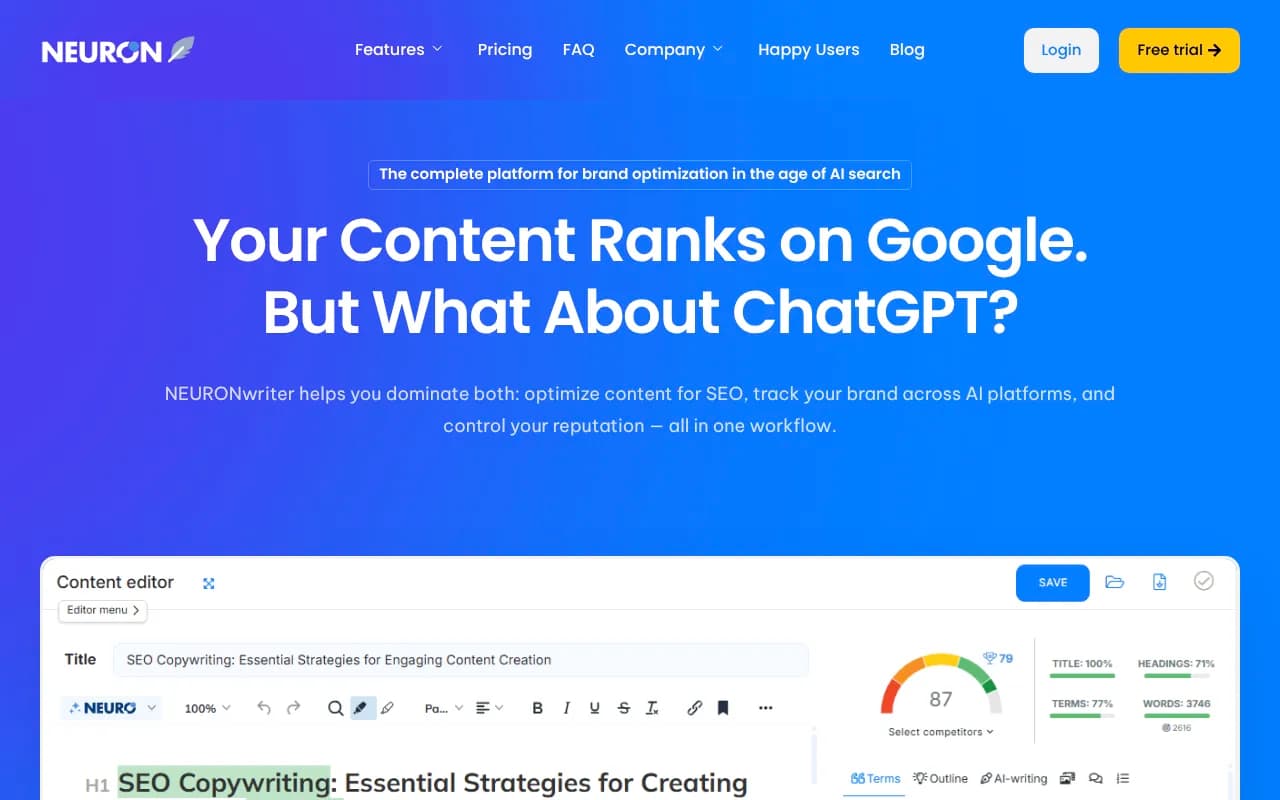
NeuronWriter is the most interesting value play in this comparison. It combines NLP-based content scoring (similar to Surfer and Clearscope) with SERP analysis, competitor content research, and a built-in AI drafting tool -- at a price point that starts around $23/mo on the lower tiers.
The semantic analysis is solid. NeuronWriter uses Google NLP and its own models to surface related terms and questions, and the content editor gives you a score with specific recommendations. It's not quite as refined as Clearscope's term recommendations, but it's close enough for most use cases.
Where NeuronWriter stands out is the all-in-one workflow. You can go from keyword research to brief to first draft to optimization score without switching tools. For a solo operator or a small team without a big budget, that's genuinely valuable.
The trade-off is polish. The interface is busier than Clearscope's, the AI drafts are hit-or-miss, and the scoring can feel inconsistent across different topics. It's a tool that rewards users who understand what they're doing -- if you're new to content optimization, the learning curve is steeper than Surfer or Clearscope.
NeuronWriter's own comparison of content optimization tools (published February 2026) positions it as an all-in-one option combining NLP, SERP analysis, and AI drafting -- which is accurate, though obviously self-serving.
Dashword
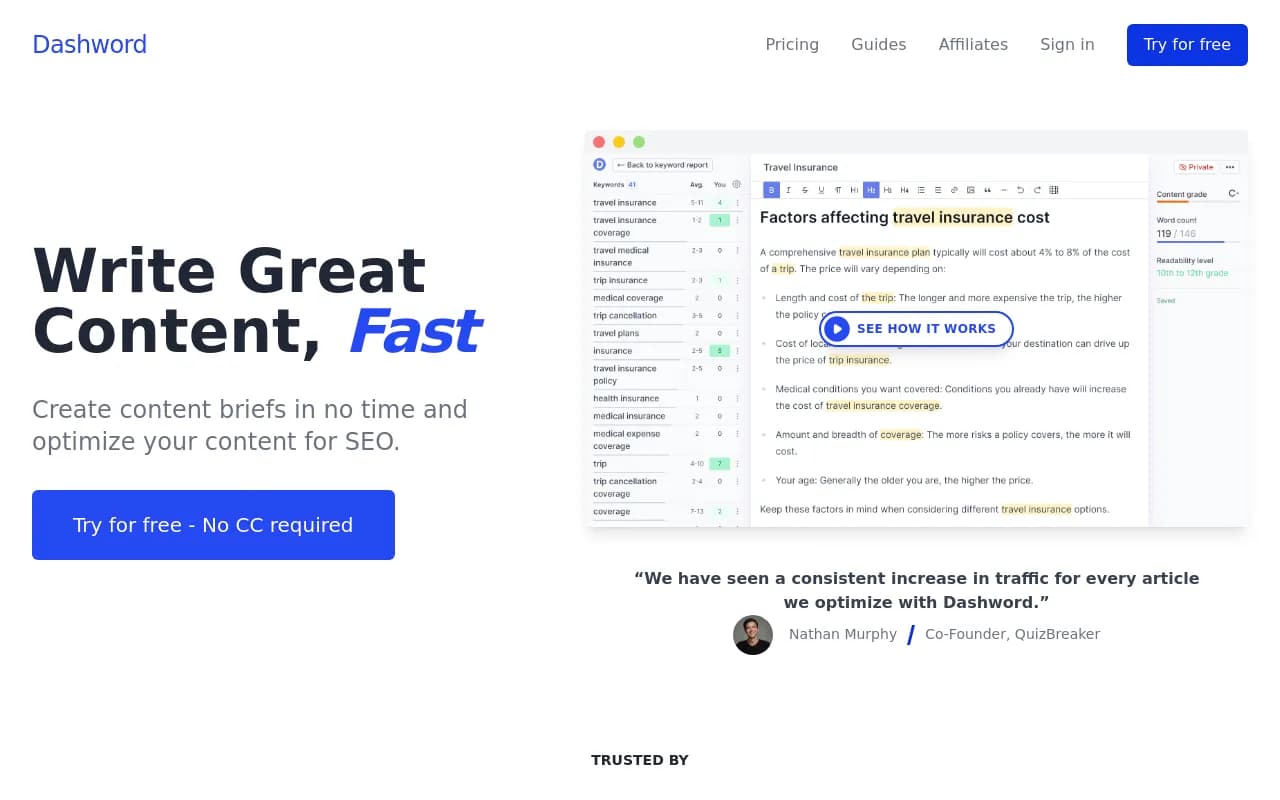
Dashword is the simplest tool in this group, and that's both its strength and its ceiling. It's designed for fast content brief generation -- you enter a keyword, it analyzes the top results, and it produces a brief with recommended topics, questions, and word count targets. The interface is clean and the learning curve is minimal.
For teams that primarily need briefs (to hand off to writers) rather than a full optimization workflow, Dashword does the job at a lower price point than the others. It's also useful for content audits -- you can run existing pages through it to identify gaps.
The limitation is depth. Dashword's content scoring is less sophisticated than Surfer's or Clearscope's, and it doesn't have the semantic NLP analysis that makes those tools genuinely useful for topical optimization. It's a brief builder with a score attached, not a true content optimization platform.
If you're choosing between Dashword and NeuronWriter at similar price points, NeuronWriter gives you more. Dashword makes sense if you specifically want a lightweight brief tool and don't need the full optimization loop.
Head-to-head comparison
| Feature | Surfer SEO | Clearscope | NeuronWriter | Dashword |
|---|---|---|---|---|
| Starting price | $99/mo | $199/mo | ~$23/mo | ~$39/mo |
| Content scoring | 0-100 NLP score | A++ to F grade | NLP score | Basic score |
| AI writing assistant | Yes (Surfer AI) | No | Yes | Limited |
| Brief generation | Yes | Yes | Yes | Yes (core feature) |
| Google Docs integration | Yes | Yes | No | No |
| WordPress integration | Yes | Yes | Yes | Yes |
| Keyword research | Yes | Limited | Yes | No |
| Site audit | Yes | No | No | No |
| AI search visibility | No | Early-stage | No | No |
| Best for | Full-stack SEO teams | Quality-focused content teams | Budget-conscious teams | Brief-focused workflows |
The AI search gap all four tools share
Here's where I have to be direct: if you're publishing content in 2026 and not thinking about AI search visibility, you're missing a growing slice of your potential audience.
All four tools above optimize for Google's ranking algorithm. That's still valuable. But none of them tell you whether your content is being cited by ChatGPT when someone asks a question in your space. None of them show you which competitors are appearing in Perplexity's answers. None of them help you identify the specific content gaps that are keeping you out of AI-generated responses.
That's a different problem requiring different tools. For teams that want to close that gap, platforms like Promptwatch are built specifically for it -- tracking citations across AI models, identifying which prompts you're missing, and helping you create content engineered to get cited.

The content quality signals that Surfer and Clearscope help you hit (topical depth, semantic coverage, authoritative sourcing) do feed into AI citation likelihood. So these tools aren't irrelevant to AI search. But they're not sufficient either.
Which tool should you actually use?
The honest answer depends on what you're optimizing for and what you can spend.
If you're running a content team at a mid-size company and quality matters more than speed, Clearscope is worth the $199/mo. The term recommendations are the most accurate, the workflow integrations are solid, and the grading system is genuinely useful for non-technical writers.
If you want the most complete SEO content workflow in a single tool and can live with some score-chasing temptation, Surfer SEO at $99/mo is the better value. The brief builder, site audit, and internal linking features add real utility beyond just the editor.
If budget is the primary constraint and you need NLP optimization plus AI drafting without paying enterprise prices, NeuronWriter is the pick. It's rougher around the edges but covers more ground per dollar than anything else here.
If you specifically need fast brief generation for a team of writers and don't need deep optimization scoring, Dashword is fine. But most teams will outgrow it quickly.
One more thing worth saying: these tools are complements, not replacements, for good writing. A content score of 85 doesn't mean your article will rank. It means it covers the right topics. The actual ranking still depends on domain authority, backlinks, user engagement, and increasingly, whether AI models find your content credible enough to cite. The score is a floor, not a ceiling.
A note on where content optimization is heading
The tools in this comparison are all iterating toward AI search. Clearscope's Tracked Topics feature is a step in that direction. Surfer has been adding AI features steadily. But the core product architecture of all four tools is still built around Google's ranking signals -- not around the citation patterns of large language models.
The teams that will win in 2026 and beyond are the ones treating traditional SEO optimization and AI search visibility as two separate but related problems. Use Surfer or Clearscope to make sure your content is topically complete and well-structured. Then use a dedicated GEO platform to understand whether that content is actually showing up in AI-generated answers -- and what you need to change if it isn't.
That's not a knock on any of these tools. It's just an accurate description of where the market is right now.