Key takeaways
- Enterprise AI has moved from pilot to production, and GEO budgets now get the same scrutiny as any other AI spend: unit economics, governance, and proof of revenue.
- The GEO tool market is crowded and, from what we can see in the catalog, splitting into monitoring-only dashboards, enterprise SEO suites with an AI module, and platforms that also act on the findings. Expect fewer, broader vendors over time.
- Security certifications and data residency are now procurement gates. Deloitte found 74% of leaders rate data residency and in-region compute as at least moderately important.
- The strongest shift is toward real data: answers collected from actual AI interfaces, IP-verified crawler logs, and first-party traffic attribution rather than modelled estimates.
- Buyers should ask five things: where does the data come from, can I verify crawler access, what certifications exist, can the tool act, and can it prove revenue.
Why enterprise GEO looks different in 2026
Two years ago, GEO was a side project run by one curious SEO. Now it has a line item, a security review, and a CFO asking what it returns. That change tracks what is happening to enterprise AI generally.
The numbers from the big surveys are useful context, because GEO budgets get judged in the same room as every other AI initiative.
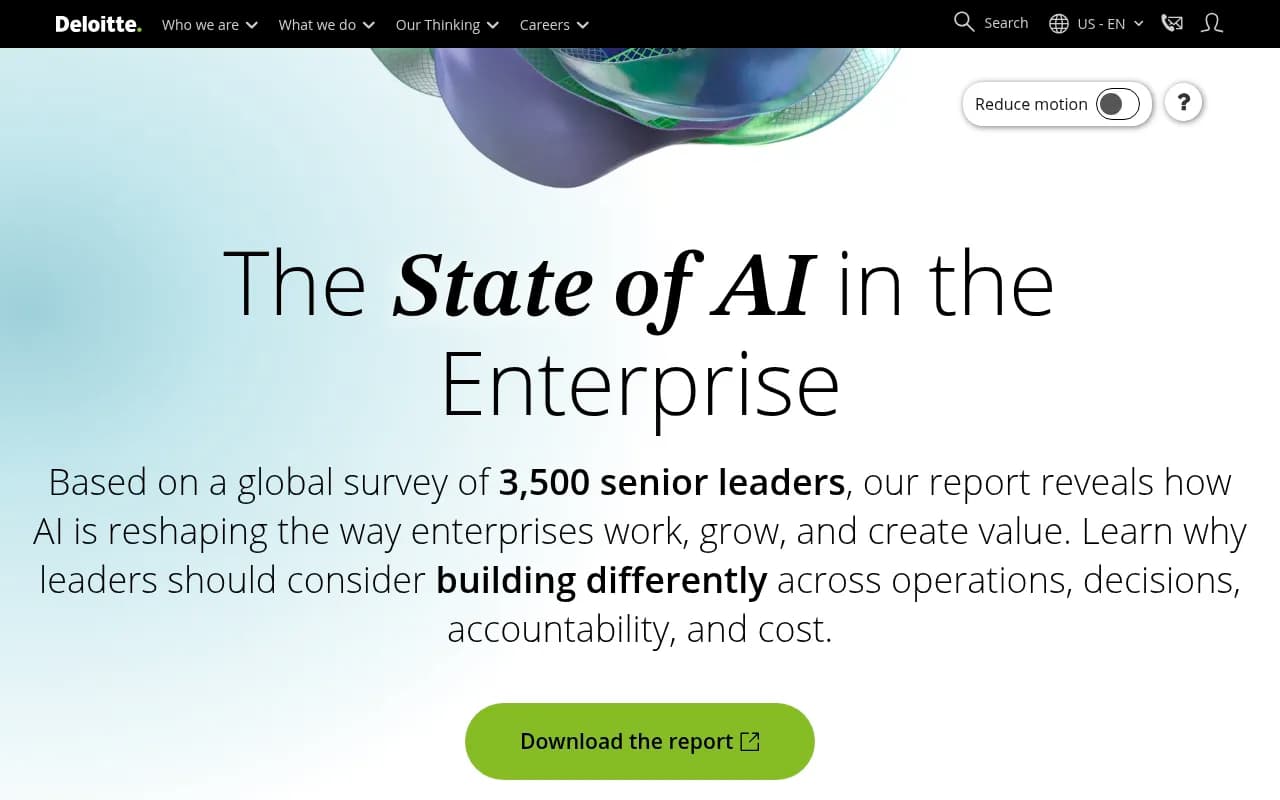
Deloitte's State of AI in the Enterprise reports that 81% of leaders say AI has sped up decision-making and execution, yet only 25% are deeply transforming the business. Revenue gains are real but slower: 28% report them, up from 20% in January. Cost visibility is patchy too. 71% track total inference and API spend, but only 44% track per-unit cost.
McKinsey's 2026 State of AI survey (published August 25, 2026) adds that 40% of respondents from large organizations are scaling AI agents, up from 27% last year, while smaller organizations stayed flat at 22%. About 20% say AI operating costs, including tokens, constrained their usage. And 37% attribute at least some EBIT impact to AI, roughly the same as last year.
What does that mean for GEO? Three things. Large companies are the ones pushing hardest, so enterprise buyers set the pace for the category. Cost discipline applies to tooling, so "how many prompts for how many dollars" is now a real question. And the revenue case has to be shown, not asserted, since most executives still see AI as faster rather than transformative.
Consolidation: a crowded market sorting itself out
A caveat first. I did not research specific acquisitions or funding events for this guide, so I am not going to claim any. What you can observe is the shape of the market, and the tools catalog on this site shows it clearly: well over a hundred products now claim some form of AI visibility tracking. That many vendors cannot all survive with a thin feature set.
The market is sorting into roughly four groups.
| Group | What they do | Examples | Typical enterprise concern |
|---|---|---|---|
| Monitoring-only trackers | Run prompts, report mentions and scores | Otterly.AI, Peec AI, Rankscale | Stops at reporting, no action loop |
| Enterprise SEO suites with an AI module | Add AI tracking to existing SEO workflows | BrightEdge, Botify, seoClarity, Semrush One | Fixed prompt sets, AI data is secondary |
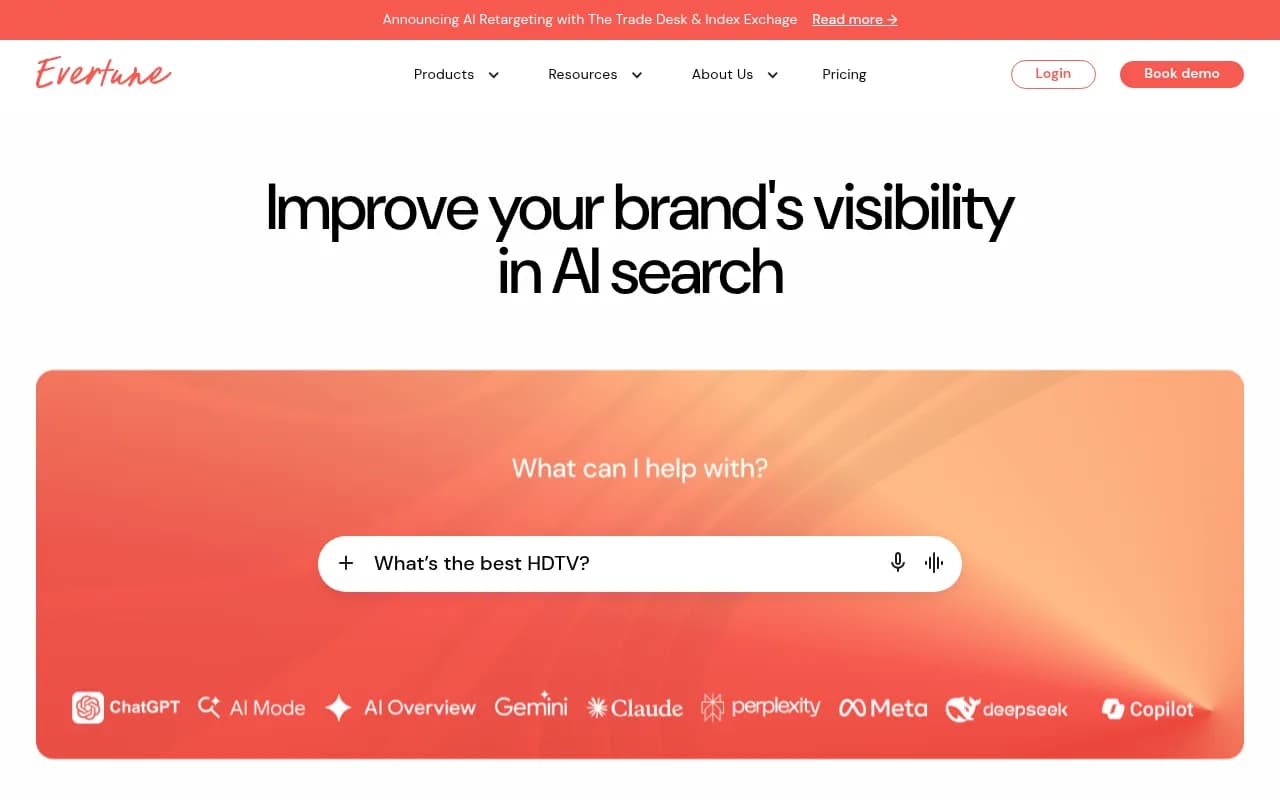
| Enterprise GEO specialists | Deeper monitoring, persona and brand analytics | Profound, Evertune, Bluefish, AthenaHQ | Price, and whether it can execute fixes |
| End-to-end platforms | Monitor, trace, act and measure in one product | Promptwatch | Needs a rollout plan across teams |
The pressure that drives consolidation is simple. Procurement teams do not want six tools to answer one question. If a vendor tracks mentions but a second tool is needed for crawler logs, a third for content, and a fourth for traffic attribution, the integration cost eats the savings. Suites have the distribution advantage, and specialists have the data depth. The vendors in the middle, with a dashboard and little else, are the ones most exposed.
If you are comparing the field, the GEO software directory is a decent place to see how many options exist before you shortlist.
What to expect from vendors
Expect more bundling. Monitoring is becoming a commodity, so vendors are adding content creation, CMS publishing, and analytics. Expect enterprise suites to keep acquiring or building AI modules. And expect buyers to push back on per-seat or per-prompt pricing that scales faster than the value.
Certifications are now a purchase gate
GEO tools touch sensitive material: brand claims, competitor intelligence, site logs, Search Console data, sometimes customer-facing analytics. That puts them in front of security teams. I did not research a certification landscape across vendors, so treat the following as a buyer's checklist rather than a market ranking.
Things procurement will ask for:
- ISO/IEC 27001 certification, not just a security whitepaper
- GDPR compliance and clarity on who processes the data
- Where data is stored and which entity handles it
- Role-based access, project-level permissions, and SSO
- An audit log showing every change and where it came from (dashboard, API, or agent)
- Scoped API keys rather than one master key
The residency question is not hypothetical. Deloitte's survey found 74% say data residency and in-region compute matter at least moderately to their AI strategy, and 62% are at least moderately concerned about reliance on foreign-owned AI. European buyers feel this most. Promptwatch, for example, is ISO/IEC 27001 certified and GDPR compliant, and its data is handled by an EU-based company, which tends to shorten security reviews for European enterprises.

Agents add another governance angle. Deloitte reports 40% of organizations let AI act without human approval to at least a moderate degree, and for 23% accountability for a bad outcome is unclear. If your GEO platform publishes content automatically, you want a review inbox, an audit log, and a clear owner. That is a certification-adjacent question that many buyers forget until legal asks.
The move to real data
This is the shift I find most interesting, because it changes what you can trust.
Early GEO tracking leaned on APIs and modelled estimates. The trouble is that an API answer is not what a person sees. User-facing answers, citations, and shopping results can differ from API output, and they differ by country and language. Enterprise teams making budget decisions on that gap eventually get burned.
Real data in this context means three things.
Answers collected from the actual interfaces
Collecting responses from the real UIs of ChatGPT, Gemini, Perplexity, Google AI Overviews and others shows what buyers actually see. Promptwatch Data, built on 26B+ analysed citations, prompts and responses, is collected this way, with API models tracked alongside to show what models believe from training data. How the collection works is documented in the Academy guide.
IP-verified crawler logs
This is where "real" gets measurable. Promptwatch's AI crawler traffic report covers weekly IP-verified requests from OpenAI, Anthropic, Google, Perplexity and Mistral between June 8 and September 6, 2026. Only requests whose IPs match the operators' published ranges are counted, so spoofed user agents are excluded.
The headline: OpenAI's share of verified AI crawler requests fell from 94.8% (June 8 to 14) to 79.8% (August 31 to September 6). The mix is shifting, and the report's advice is practical. Audit robots.txt, CDN and WAF rules for every provider. Compare your own logs against the overall mix, because a large provider with near-zero requests in your logs suggests you are blocked. And separate training traffic from answer-time fetches.
The Meta shift shows how fast it moves. Promptwatch's Meta-WebIndexer data shows it growing from about 2% to nearly 38% of tracked AI crawler requests between mid-July and August 9, 2026. If you only watched a prompt dashboard, you would not have seen that coming.
For teams that want logs, tools like Promptwatch's AI crawler logs and DarkVisitors both cover this ground, and Promptwatch's analytics work with Cloudflare, Vercel, Fastly and raw server logs.
First-party traffic and conversion data
Visibility scores do not pay for anything. Traffic and conversions do. Crisp reported 2x higher conversion rates from AI traffic than from traditional channels, and TreeHouse grew AI search to about 25% of organic conversions. The Crisp case study and the TreeHouse case study are worth reading for how they got there.
One attribution wrinkle to plan for: ChatGPT stopped sending a referrer on October 8, 2026, so untagged ChatGPT visits will look like direct traffic. Tag links with utm_source=chatgpt.com where you can, and read the attributing AI traffic guide.
What real data says about where citations come from
Real data also corrects folk wisdom. A few findings from Promptwatch Data that enterprise teams should factor into planning:
- In the content type report (September 28 to October 4, 2026), product pages earn 22.4% of ChatGPT citations and landing pages 16.8%. Together, 39% of citations go to pages describing what a company sells. Listicles earn 13.6%, documentation 7.5%, how-to guides 8.7%, and comparisons 5.9%.
- For commercial prompts, product pages, landing pages, listicles and comparisons make up almost 70% of citations.
- For branded prompts, reviews earn 5.6%, more than three times their overall share.
- Social is not one story. In the October 2026 social citations report, social platforms made up just 0.46% of ChatGPT citations, versus 12.2% for Google AI Overviews and 2.7% for Perplexity.
- Reddit's share of ChatGPT citations collapsed from about 4% to 0.5% on August 14, 2026, per Promptwatch's Reddit data.
The social finding matters most for strategy. A team that spent a year building a Reddit program for ChatGPT visibility watched most of that value vanish in a day. The same Reddit work still counts somewhat in AI Overviews, where Reddit holds 2.15% of citations. Different engines, different sources. Per-engine data is the only defence against this kind of whiplash.
Content lifespan matters too. The content half-life report found news loses half its cited pages in about five weeks, while landing pages and docs keep most of theirs for months. That should shape where an enterprise puts its production budget.
The shift from dashboards to execution
Real data gets you a diagnosis. The 2026 pattern is that buyers want the treatment too.
McKinsey found 32% of respondents decided against buying software because agentic coding tools could build it in-house. The same instinct shows up in GEO: some enterprise teams are wiring APIs, MCP servers, and automation tools such as n8n or Zapier into their own workflows rather than paying for another dashboard. That is a legitimate path if you have engineers, but it moves the cost from licence to maintenance.
The alternative is a platform that closes the loop itself. The pattern is monitor, trace the sources, act on gaps, then measure. Promptwatch frames this as agentic AI search optimization: the Content Agent plans, writes and publishes to WordPress, Webflow or Framer on a schedule with a review inbox, then crawler logs, page tracking and visitor analytics show whether each page got read, cited and clicked. Agent Chat and an MCP server with 110+ tools let analysts query the data without exporting spreadsheets.
How the main enterprise options compare
This table is a buyer's orientation, not a scorecard. Check each vendor's current pricing and features directly, because I did not research them for this guide.
| Tool | Positioning | Strength to evaluate | Question to ask |
|---|---|---|---|
| Promptwatch | End-to-end GEO platform | Real UI data, crawler logs, Content Agent, ISO 27001 | Does the plan tier include the agent features you need? |
| Profound | Enterprise AI visibility | Monitoring depth | Does it cover crawler logs and execution? |
| Evertune | Enterprise GEO for large brands | Fortune 500 focus | What is the data collection method? |
| Bluefish | Enterprise AI marketing | Large-brand visibility | Does it publish or only report? |
| BrightEdge | Enterprise SEO suite with AI Catalyst | Existing SEO workflow integration | How fixed is the prompt set? |
| Botify | Enterprise SEO and GEO with agents | Large-site crawling | How are AI answers collected? |
| seoClarity | Enterprise SEO with AI tracking | Familiar suite | Depth of AI-specific data |

For head-to-head detail, Promptwatch publishes comparisons such as Promptwatch vs Profound and a 2026 platform comparison. Treat vendor-authored comparisons as a starting point and verify claims in a trial. For tracker-specific lists, the AI rank tracking directory is another useful cross-check.
A practical buying checklist
Here is how I would run an enterprise evaluation in 2026.
- Demand the data method. Ask whether responses come from real interfaces or APIs, and whether you can filter by country and language. If a vendor cannot answer in one sentence, that is an answer.
- Test crawler visibility on your own site. Run the free Agentic Readiness Check or the AI Crawler URL Inspector, then compare with logs from a trial. Blocked bots are the cheapest problem to fix and the most common.
- Send the security questionnaire early. ISO/IEC 27001, GDPR, residency, SSO, audit log, scoped keys. Do this in week one, not week six.
- Check unit economics. Divide plan price by tracked responses. Deloitte's finding that only 44% track per-unit AI cost is a warning to do this for your GEO stack too.
- Decide how much autonomy you accept. Review inbox, approval flows and audit logs are the governance controls for agent-written content.
- Define the revenue test. Pick a conversion metric and a date. Visitor analytics tied to AI referrers beats a visibility score alone.
- Run a 90-day program. The 90-day GEO program is a reasonable template.
On pricing, Promptwatch lists Essential at $95/mo, Professional at $245/mo and Business at $579/mo, with agency plans from $199/mo. The Content Agent, hourly tracking, Fact Check and local targeting start at Business. Confirm everything on the pricing page before budgeting. There is a 7-day free trial on monthly billing, and a free AI visibility report if you want a first look without a login.
If you would rather hand the whole program to specialists, an agency can run the stack for you. 1001 SEO Media runs GEO programs on Promptwatch for clients who want strategy and execution together.
What I would watch for the rest of 2026
Three things. First, engine behaviour keeps changing without notice: ChatGPT started using the site: operator in about 17% of fanout queries on August 8, 2026, up from roughly 0.4% (data here), and average citations per response dropped around the GPT-5.3 rollout on March 4 (data here). Any program built on last quarter's assumptions is already stale.
Second, the gap between large and small organizations will keep widening, as McKinsey's 40% versus 22% agent-scaling split suggests. Enterprise GEO budgets will grow where agents are already trusted.
Third, vendors without verified data or an execution layer will struggle to justify a renewal. Buy for what you can verify, and ask every vendor to prove it on your own site during a trial.