Key takeaways
- Slate combines AI search tracking (ChatGPT, Perplexity, AI Overviews, AI Mode) with a no-code workflow builder, bulk content operations, and CMS publishing.
- Current pricing on Slate's own site is $499/mo (Growth), $999/mo (Scale), $2,000/mo (Agency), plus custom Enterprise. The older Capterra tiers look stale.
- The headline "10,000 AI answers" on Growth covers only about 333 prompts tracked daily on one platform. Plan your prompt count before you buy.
- Public third-party evidence is thin: Capterra shows 0 reviews and no rating, so most claims come from the vendor.
- It is a strong fit for content teams that want tracking and execution in one place, and a harder sell for single-brand owners or small agencies.
What Slate is
Slate (slatehq.com) sells itself as citation tracking tied to content execution. According to its Capterra listing, it is a cloud-based platform that monitors brand mentions, citations, and sentiment across AI search engines, then automates research, drafting, and content refresh cycles. Content is published directly to WordPress or Webflow, and a human has to approve it before anything goes live.

The pieces you actually touch:
- An AI search tracker for prompts, citations, and sentiment
- A visual workflow builder with no-code pipelines
- Spreadsheet-style bulk operations across thousands of pages
- Content scoring and a recommendation engine
- A Brand Kit that applies voice and style rules to outputs
- An outreach tool for citation opportunities
- Integrations with GA4, Google Search Console, Semrush, Ahrefs, and HubSpot
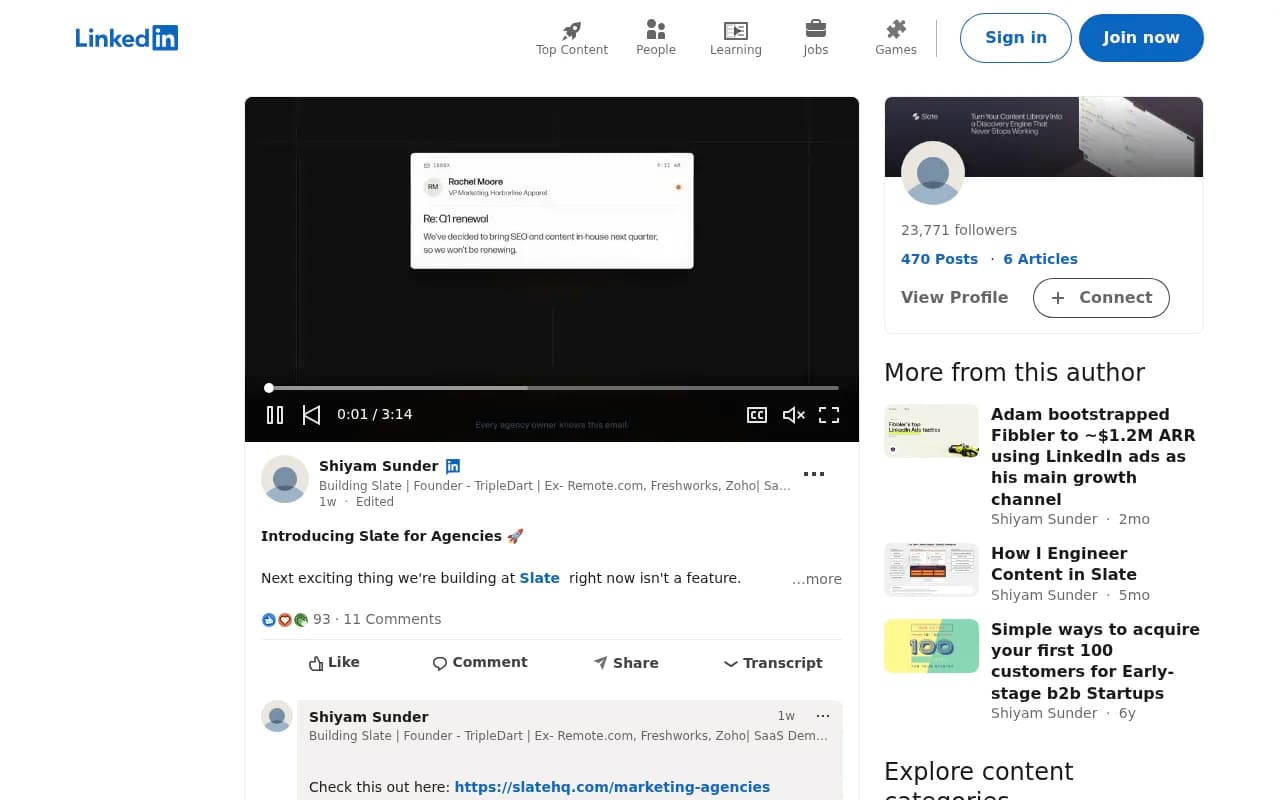
The company also publishes a lot of content about AI visibility, and has announced "Slate for Agencies" on LinkedIn. I could not pull details from that post, so I will not guess at what it includes.
Pricing in 2026
Two sources disagree here. The Capterra listing shows tiers with 4,500, 24,000, and 50,000 prompt answers and up to 5 or 10 users. Slate's official pricing page shows something different and more expensive. Treat the Capterra numbers as outdated and confirm everything at slatehq.com/pricing. Annual billing saves 20%.
| Plan | Monthly price | Credits | AI answers/mo | Prompts | Pages monitored | Notable extras |
|---|---|---|---|---|---|---|
| Growth | $499 | 15,000 | 10,000 | 333 | 1,000 | 1 user, 1 workspace, 1 region, BYOK, self-serve onboarding |
| Scale (most popular) | $999 | 50,000 | 20,000 | 667 | 5,000 | Custom users and workspaces, multi-region, weekly reports, 1:1 onboarding, account manager |
| Agency | $2,000 | 100,000 | 50,000 | 1,667 | 10,000 | Custom users and workspaces, onboarding and training, account manager |
| Enterprise | Custom | Custom | Custom | Custom | Custom | All six platforms and the premium add-on included |
All plans track ChatGPT, Perplexity, Google AI Overviews, and Google AI Mode. Claude and Gemini cost extra, sold in packs of 1,000 answers.
How credits and answers work
There are two separate meters, which trips people up.
Credits pay for agent work: Cowork tasks and workflow runs. Tracking draws from separate allowances for answers and pages. Alerts fire at 90% usage and at zero. When credits hit zero, workflows pause and resume from the stopped step once you add more. Credit packs come in 5,000, 50,000, and 100,000. Credits are shared across workspaces unless an admin sets limits.
An "AI answer" is one response from one platform, for one prompt, in one location. That definition matters more than the headline number.
The answer allowance pitfall
Slate's own math: 333 prompts tracked daily on one platform uses about 10,000 answers a month. That is the entire Growth allowance. Add a second platform and you either halve your prompts or drop to weekly checks. Run the same 333 prompts weekly and you use around 1,450 answers.
So "10,000 answers" sounds generous until you remember that four platforms are included. If you want daily tracking across all four, Growth covers roughly 80 prompts. That is a real constraint for anyone who thought they were buying 333 prompts across every engine.
Citation behavior also differs by engine, which affects how you read the numbers. Promptwatch Data's average sources per response report found ChatGPT cites about 5 sources per web-search answer, while Google AI Overviews and Perplexity cite about 10. A tracker's per-platform visibility numbers are not directly comparable without that context.
What works well
Tracking and execution in one system
Most trackers stop at a dashboard and leave you to figure out what to write. Slate's pitch is that the recommendation engine feeds the workflow builder, which feeds the CMS. If your team already thinks in pipelines, that is appealing. Bulk operations across thousands of pages are the part I would want to test hardest, since it is where a spreadsheet-style interface either saves days or creates a mess.
Bring-your-own API key
Growth includes BYOK, which can keep model costs predictable if you already have provider agreements. The documentation I could see does not spell out how BYOK interacts with credits, so ask during a demo.
Human review before publishing
Nothing goes live without approval. For brands with legal or compliance review, that is a feature rather than a limitation.
Where the agency-first approach falls short
The Agency plan is the only tier explicitly positioned for multiple client brands, and that is where the problems show up.
The entry price is steep
A single brand starts at $499 a month. A small agency that wants to manage five or six clients is pushed toward the $2,000 Agency plan, which is a lot of fixed cost before any client pays you. Compare that with tools built for agencies at lower prices (more on those below).
Agency features are unclear
The research I could gather did not confirm white-label reporting, client portals, or per-client workspace permissions. Scale and Agency list "custom users and workspaces," but that is not the same as a client-facing portal. The comparison table also lists an MCP server, Slate Coworker, bulk execution, custom agent build, and LinkedIn and email outreach, but the text did not show which tiers include each. Get this in writing before you sign.
Onboarding is tiered
Growth is self-serve. The 1:1 expert onboarding and dedicated account manager start at Scale. The comparison table also mentions a priority Slack channel and a GTM Engineer for Scale, though the plan card does not. If you are buying Growth, you are on your own.
Thin independent evidence
Capterra shows zero reviews and no rating for Slate (last updated September 29, 2026). Most of what exists is vendor content, including a study claiming 93% of brands show up in Google AI Overviews and 71% of citations come from sites they do not own. That is vendor-reported and I did not verify it. Ask for customer references and a trial with real prompts.
Monitoring depth
Slate's tracking is built around answers, citations, and sentiment. I found no mention of IP-verified AI crawler logs, AI visitor analytics, or Reddit and YouTube citation reporting. For teams that need to know why they are not being cited, not just that they are not, that matters.
How Slate compares to alternatives
| Tool | Starting point | Strength | Gap |
|---|---|---|---|
| Slate | $499/mo | Tracking tied to workflows and CMS publishing | High entry price, unclear agency features |
| Promptwatch | Free tier, paid from $95/mo, agencies from $199/mo | Tracking, crawler logs, traffic attribution, and content creation | Broader platform to learn |
| Profound | Enterprise pricing | Deep monitoring | Higher price, less execution |
| Peec AI | Lower entry | Simple multi-language tracking | No content or workflow layer |
| Otterly.AI | Low entry | Affordable monitoring | Basic tracking only |
| AirOps | Varies | Content workflow engine | Visibility data is secondary |
Promptwatch
If your problem is agency scale and cost, Promptwatch is worth a look. Its agency plans start at $199/mo (Kick-off) and include unlimited projects, 10 seats, and white-label reporting, which is the part Slate leaves vague. It also tracks real ChatGPT, AI Overviews, AI Mode, Gemini, Perplexity, and Copilot interfaces, and its IP-verified crawler logs show whether AI bots can even read your pages. The Content Agent writes and publishes to Webflow, Framer, or WordPress, so it competes with Slate on the execution side too.

Profound, Peec AI, and Otterly.AI
Profound is the heavyweight monitoring option, and Peec AI and Otterly.AI are the budget trackers. If you only need to know whether you are mentioned, the cheaper two are enough. If you want something that fixes problems, they are the wrong choice.



AirOps
AirOps is the closest comparison on the workflow side. It is a content engineering platform and a better match if your main need is production rather than tracking.
For wider lists, the GEO software directory at bestgeosoftware.com covers dozens more options.
Who should buy Slate
Slate makes sense if:
- You run a content team of reasonable size and want tracking and production in the same system.
- Your budget can absorb $999 a month for Scale without much pain.
- You value approval workflows and CMS publishing over deep crawler analytics.
Look elsewhere if:
- You manage a single small brand and need basic monitoring.
- You are a small agency that needs white-label reports and a client portal at a lower fixed cost.
- You need to diagnose why AI engines ignore your pages, rather than only count mentions.
Questions to ask before you sign
- How many prompts can I track daily across all four platforms on my plan?
- Which tiers include the MCP server, Slate Coworker, bulk execution, and outreach tools?
- Is there white-label reporting or a client portal on the Agency plan?
- Does the free trial limit credits, and what happens when they run out?
- Can you provide two customer references in my industry?
Verdict
Slate has a coherent idea: close the gap between knowing you are invisible and publishing something to fix it. The execution layer is the interesting part. But the pricing starts high, the answer allowance is smaller than it looks, independent reviews are almost nonexistent, and the agency features I most wanted to verify were not documented in what I could see. Run a trial with your real prompt list and do the answer-allowance math before committing. If you are an agency watching margins, price out Promptwatch's agency plans alongside it.