Key takeaways
- Both Searchable and Otterly.AI are budget-friendly AI visibility tools, but they're built for different stages of maturity
- Otterly.AI is the more established option with a broader LLM coverage and a lower entry price (starting around $29/month)
- Searchable leans harder into content tooling alongside monitoring, making it a better fit if you want to act on data, not just collect it
- Neither tool offers the full action loop (gap analysis + content generation + crawler logs + traffic attribution) that more complete platforms provide
- If your team has outgrown pure monitoring dashboards, there are stronger options worth considering before committing to either
The AI visibility tool market in 2026 is crowded in a specific way: dozens of products that show you a score, give you a chart, and leave you wondering what to do next. Searchable and Otterly.AI both live in the budget tier of that market, which makes them appealing to small teams, early-stage startups, and marketers who aren't ready to spend $500+ per month on enterprise platforms.
But "budget" doesn't mean they're interchangeable. They make different bets on what matters most, and choosing the wrong one means either paying for features you won't use or hitting a ceiling the moment you want to do something with your data.
This guide breaks down exactly where each tool excels, where each one falls short, and who should actually pick which.
What these tools actually do
Before comparing them, it's worth being precise about the category. AI visibility tools track how your brand, products, and content appear in AI-generated answers from platforms like ChatGPT, Perplexity, Google AI Overviews, Claude, and Gemini. That's meaningfully different from traditional rank tracking, which tells you where you sit on a results page. When the answer is the destination, being cited inside it is what drives traffic.
Both Searchable and Otterly.AI operate in this space. They run prompts, capture AI responses, and tell you whether your brand shows up. Where they diverge is in what happens after that.

Otterly.AI: the accessible entry point
Otterly.AI has been in the AI monitoring space longer than most of its budget competitors, and that shows in the product. It covers the major LLMs, has a clean interface, and gets you set up quickly. For a team that just wants to know "are we showing up in ChatGPT and Perplexity?" it answers that question without much friction.
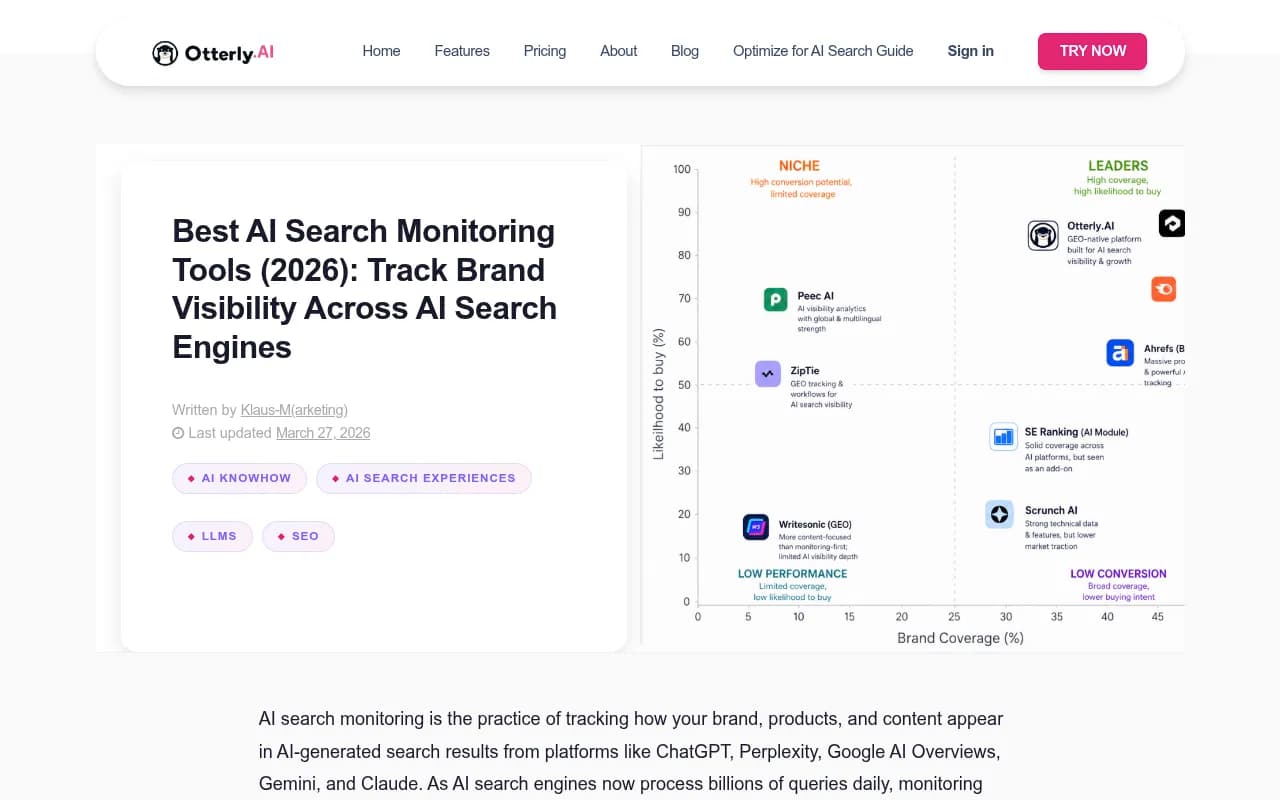
Pricing starts around $29/month, which is genuinely accessible. Plans scale up from there based on the number of prompts you track and how frequently they refresh. The free tier is limited but usable for a quick proof-of-concept.
What Otterly.AI does well:
- Fast setup with minimal configuration
- Clean brand mention tracking across ChatGPT, Perplexity, Gemini, and Google AI Overviews
- Competitive share-of-voice comparisons (you can see how often competitors appear vs. you)
- Sentiment tracking on how AI models describe your brand
- Alerts when your visibility drops or a competitor surges
What it doesn't do: Otterly.AI is fundamentally a monitoring dashboard. It tells you what's happening. It doesn't tell you why, and it doesn't help you fix it. There's no content gap analysis, no content generation, no crawler logs showing which pages AI bots are actually reading. You get the data, then you're on your own.
For teams at the "we need to understand the baseline" stage, that's fine. For teams that have already been monitoring for a few months and want to improve their numbers, it becomes a ceiling.
Searchable: monitoring with a content layer
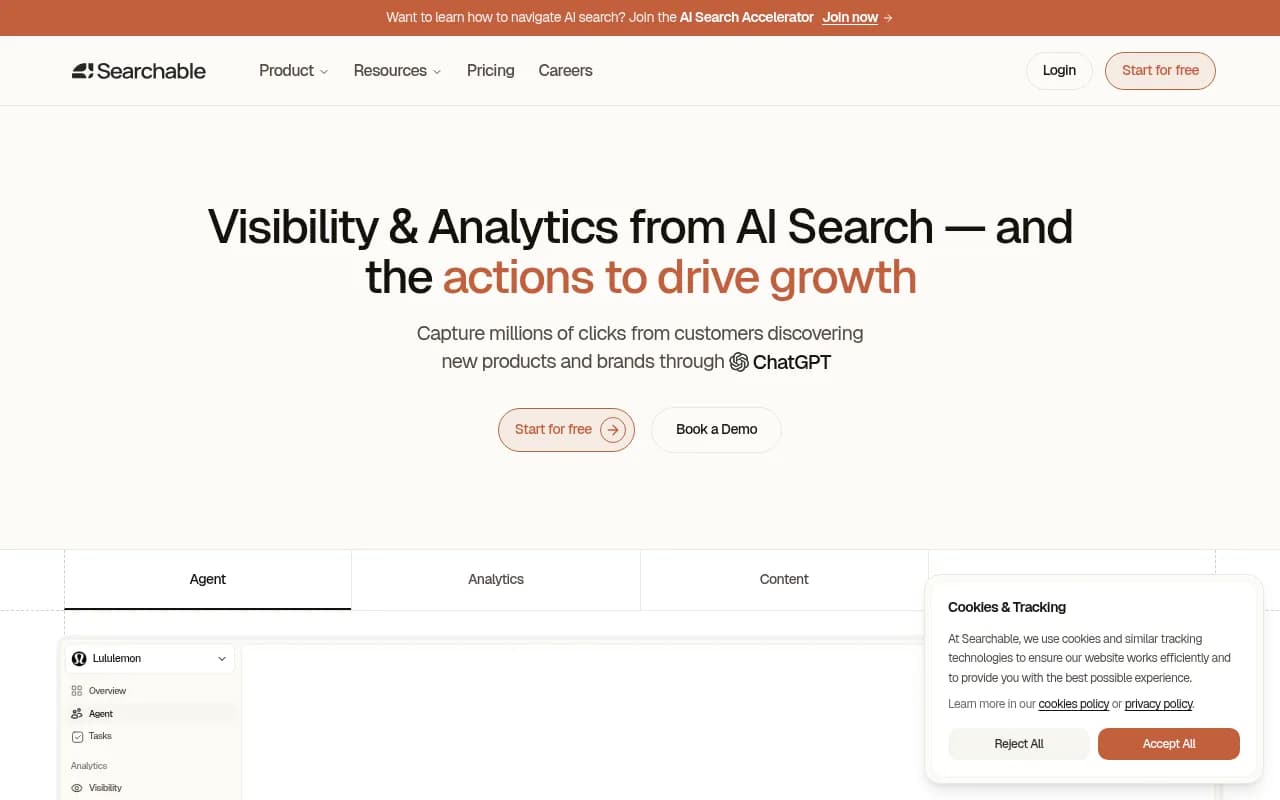
Searchable takes a slightly different approach. It still covers the core monitoring use case, but it layers in content tooling that's meant to help you act on what you find. The pitch is that you shouldn't need to export your visibility data into a separate tool to figure out what content to create.
In practice, this means Searchable includes features like content gap identification and some degree of content brief generation alongside its tracking dashboards. It's positioned for teams that want a tighter loop between "we're not showing up for this prompt" and "here's what we should publish."
The tradeoff is that Searchable is a newer, smaller player. Its LLM coverage is narrower than Otterly.AI's, and the depth of monitoring data (sentiment analysis, historical trends, competitive heatmaps) isn't as mature. You're getting a broader workflow at the cost of some monitoring depth.
Feature comparison
Here's how the two tools stack up across the dimensions that matter most for a typical marketing or SEO team:
| Feature | Otterly.AI | Searchable |
|---|---|---|
| Starting price | ~$29/month | Mid-range budget tier |
| LLM coverage | ChatGPT, Perplexity, Gemini, Claude, Google AI Overviews | Core LLMs (narrower coverage) |
| Brand mention tracking | Yes | Yes |
| Sentiment analysis | Yes | Limited |
| Competitor share-of-voice | Yes | Yes |
| Content gap analysis | No | Yes (basic) |
| Content brief generation | No | Yes (basic) |
| AI crawler logs | No | No |
| Traffic attribution | No | No |
| Prompt volume/difficulty scoring | No | No |
| Reddit/YouTube citation tracking | No | No |
| Free trial | Yes | Yes |
| Best for | Monitoring-first teams, early-stage validation | Teams wanting monitoring + basic content workflow |
The pattern here is consistent with what you see across most budget AI visibility tools: monitoring is table stakes, and the differentiator is how much the tool helps you do something about what it finds.
Where both tools hit the same wall
This is worth saying directly: both Searchable and Otterly.AI are monitoring-first products. Even Searchable's content features are relatively basic compared to what a full GEO platform offers.
The gap becomes obvious when you ask questions like:
- Which specific pages on my site are AI crawlers actually reading?
- Which prompts are my competitors ranking for that I'm completely absent from?
- What's the volume of real user queries behind each prompt I'm tracking?
- How long does it take from publishing a new article to getting cited by Perplexity?
- Is my AI visibility actually driving traffic and revenue?
Neither tool answers these questions well. They show you a visibility score and some brand mentions, but the connective tissue between "we're invisible for this topic" and "here's the content that will fix it, and here's proof it worked" isn't there.
That's not a knock on either product specifically. It's a structural limitation of the monitoring-only category. If you're at the stage where those questions matter, you've outgrown both tools.
Who should pick Otterly.AI
Otterly.AI makes sense if:
- You're just starting to track AI visibility and want a low-risk entry point
- Your team's primary need is a clean dashboard to report on brand presence to stakeholders
- You want competitive share-of-voice data without a lot of setup complexity
- Budget is genuinely tight and $29/month is the ceiling
It's a solid tool for what it is. The monitoring data is reliable, the interface is clean, and the pricing is honest. Just go in knowing that when you want to improve your numbers, you'll need to figure out the content strategy elsewhere.
Who should pick Searchable
Searchable makes sense if:
- You want monitoring and content tooling in one place, even if neither is the deepest on the market
- You're a small team without a dedicated SEO or content strategist, and you want the tool to give you more direction
- You're comfortable with a newer product that's still building out its feature set
The risk with Searchable is that it's trying to do more, which means it's not the best at any single thing. If monitoring depth matters most, Otterly.AI wins. If content generation quality matters most, there are better options. Searchable sits in the middle, which is useful for some teams and frustrating for others.
The broader picture: what to consider if you need more
Both tools are worth considering at the early stages of an AI visibility program. But if your team has been monitoring for a while and you're ready to actually move the needle, the monitoring-only tier of tools starts to feel limiting fast.
The next tier up includes platforms that close the full loop: find the gaps, create content to fill them, and track whether it worked. That means features like answer gap analysis (which specific prompts are competitors winning that you're not?), AI content generation grounded in real prompt data, and crawler logs that show you exactly which pages AI bots are reading and how often.
Promptwatch is one platform that covers this full workflow. It tracks visibility across 10 AI models, shows you which prompts competitors are winning, generates content briefs and articles based on that gap data, and connects AI visibility to actual traffic and revenue. It's a step up in price from Otterly.AI or Searchable, but it's also a different category of tool.

There are also other options worth knowing about depending on your specific situation:


Comparison across the broader budget-to-mid-market range
For teams evaluating the full range of options, here's a wider view:
| Tool | Price range | Monitoring depth | Content tools | Crawler logs | Best fit |
|---|---|---|---|---|---|
| Otterly.AI | From ~$29/mo | Good | None | No | Early-stage monitoring |
| Searchable | Budget-mid | Moderate | Basic | No | Small teams wanting one tool |
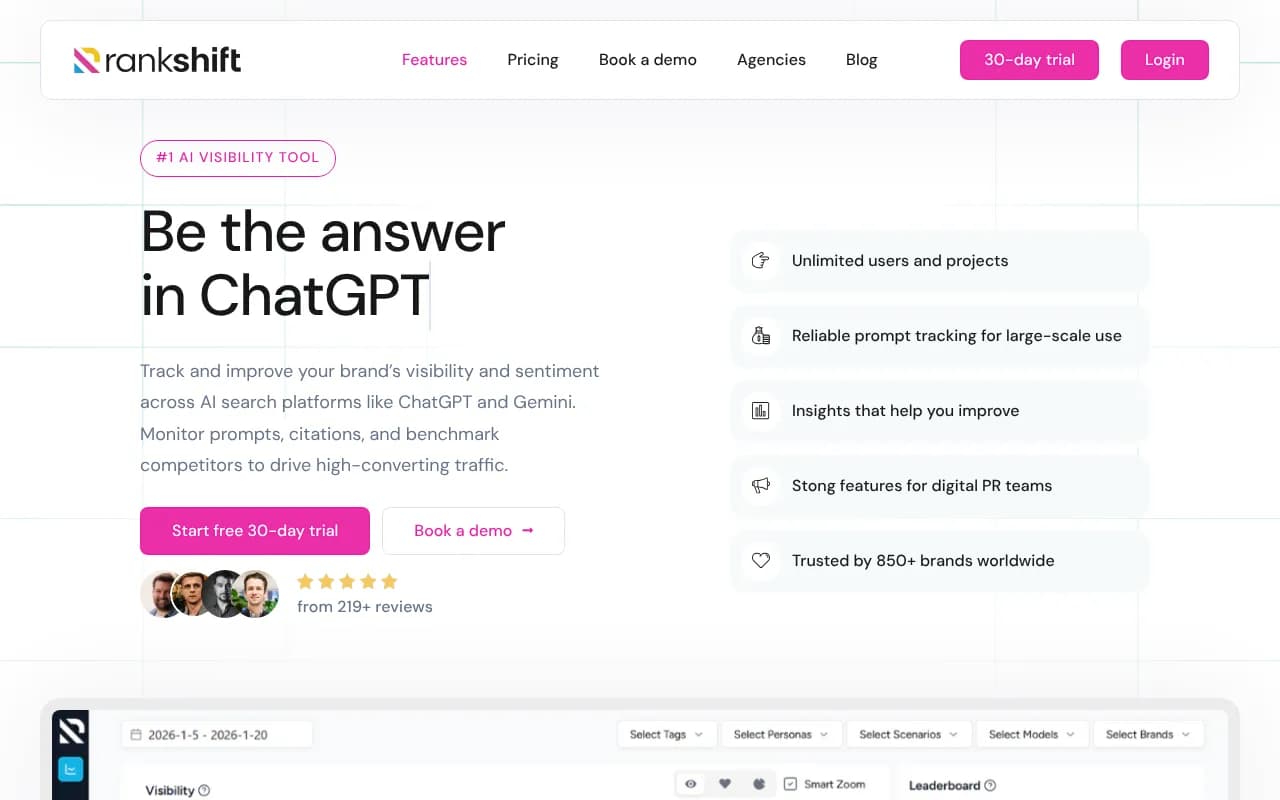
| Rankshift | Budget | Basic | None | No | Lean teams, validation sprints |
| Peec AI | Budget-mid | Good | None | No | Multi-language monitoring |
| Promptwatch | From $99/mo | Strong | Full (gap analysis + generation) | Yes | Teams ready to optimize, not just track |
| Profound | Mid-enterprise | Very strong | Limited | No | Enterprise reporting |
The honest verdict
If you're choosing between Searchable and Otterly.AI specifically, the decision mostly comes down to what you'll do with the data.
Otterly.AI is the safer pick if you want reliable monitoring with a proven track record and the lowest possible price. It does one thing well and doesn't try to be more than it is.
Searchable is worth a look if you want the monitoring and content workflow in one place and you're okay with a product that's still maturing. The content features are a genuine differentiator at this price point, even if they're not deep.
What neither tool does is help you understand why your visibility is what it is, or give you a clear path from data to published content to measurable improvement. If that's what you're actually after, it's worth spending an extra hour evaluating what the next tier of platforms offers before committing to a dashboard you'll outgrow in six months.