Key takeaways
- Nightwatch is primarily an SEO rank tracker that added AI visibility as a paid add-on ($99/month on top of its base plan), making it a good fit for teams that already live in traditional rank tracking workflows.
- Searchable is built from the ground up for AI search, tracking up to 7 LLMs and including content creation tools in its platform starting at $50/month.
- Neither tool offers the full action loop (gap analysis + content generation + crawler logs) that more advanced platforms provide -- but Searchable gets closer.
- For teams that need to move from monitoring to actually fixing their AI visibility, both tools have meaningful gaps worth understanding before you commit.
- Price alone doesn't tell the full story: Nightwatch's AI add-on can push total costs well above Searchable's equivalent tier.
The AI visibility tool market has gotten crowded fast. In early 2024, you had maybe a handful of options. By mid-2026, there are 28+ platforms competing for the same budget line. That's good for buyers in theory, but it also means a lot of tools that look similar on a features checklist are actually quite different in practice.
Searchable and Nightwatch are a good example of this. Both show up on "best AI visibility tools" lists. Both serve marketing teams in roughly the same size bracket. But they were built with different philosophies, and those differences matter depending on what you actually need to do with the data.
This comparison breaks down what each tool does well, where each one falls short, and which type of team is better served by which platform.
What each tool actually is
Nightwatch
Nightwatch started as an SEO rank tracking tool -- and that's still its core identity. It tracks keyword rankings across Google and Bing, monitors backlinks, and generates white-label reports for agencies. The AI visibility layer was added as a separate paid module, not baked into the base product.
That context matters. When you use Nightwatch for AI visibility, you're using a feature that was grafted onto an existing SEO platform. It tracks four AI models (ChatGPT, Perplexity, Google AI Overviews, and Gemini based on available information) and shows you brand mentions and citation data across those models. The interface and reporting inherit from the SEO side of the product, which is polished and well-designed.
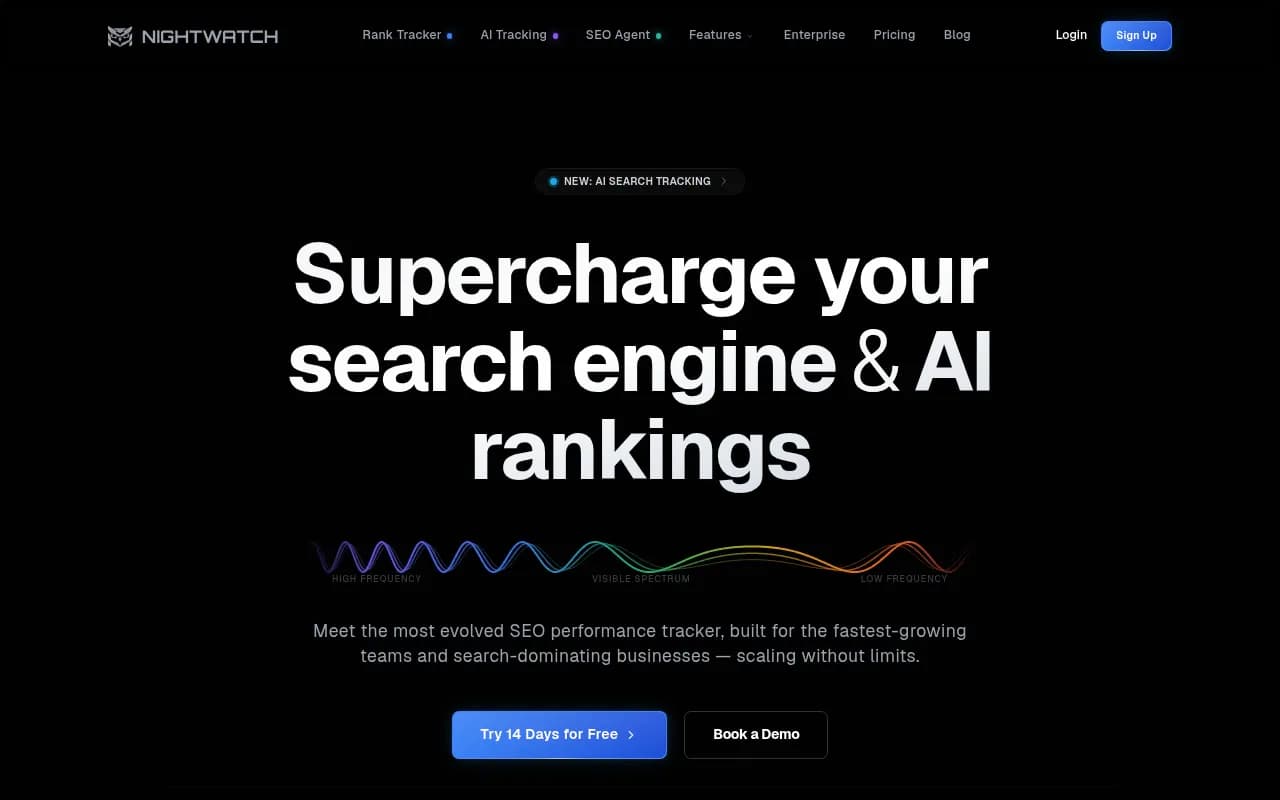
The catch: the AI add-on costs $99/month on top of Nightwatch's base plan, which starts at $32/month. So you're looking at $131/month minimum to get meaningful AI visibility features. For teams that were already Nightwatch customers for SEO, this is a natural upsell. For teams evaluating it fresh purely for AI visibility, the math is less compelling.
Searchable
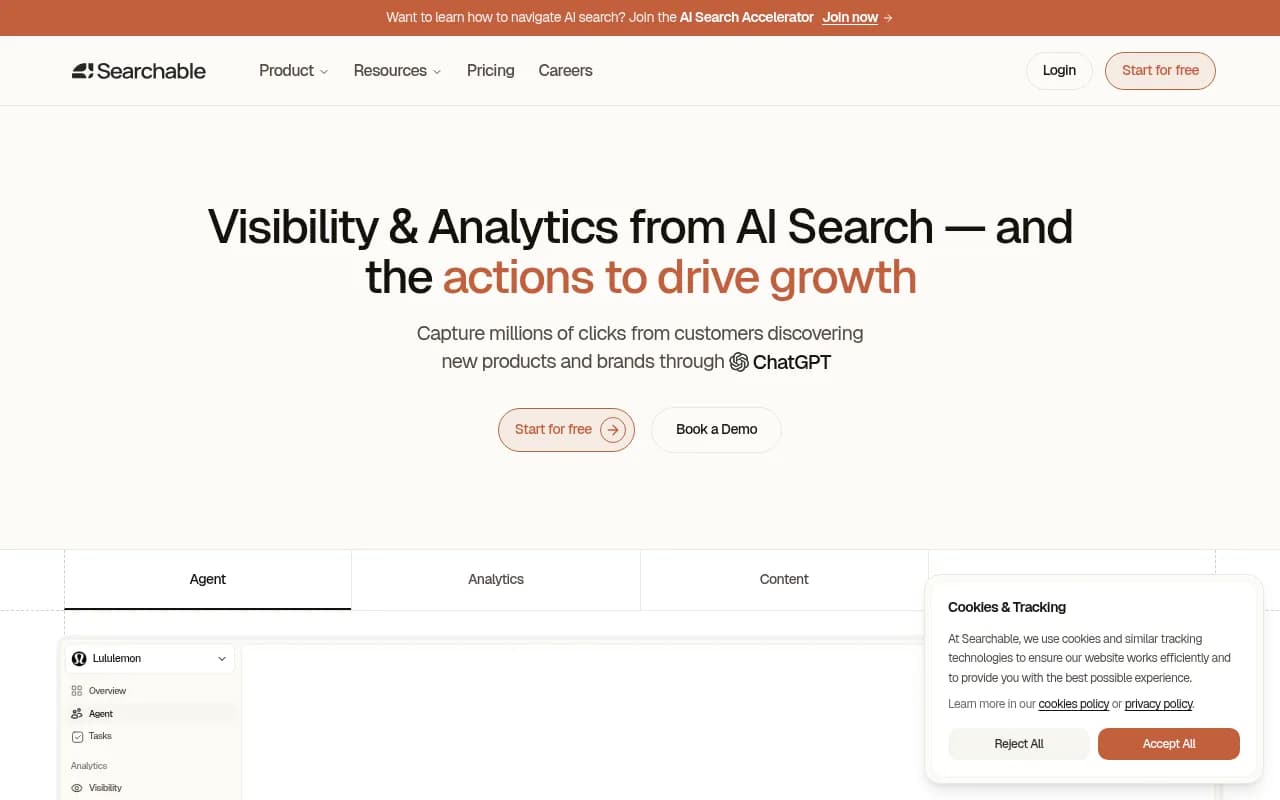
Searchable was built specifically for AI search visibility, not retrofitted from an SEO tool. It tracks up to 7 LLMs, which gives it broader model coverage than Nightwatch, and its starting price of $50/month includes both monitoring and content creation tools.
The "monitor + create + optimize" positioning is what distinguishes Searchable from pure monitoring plays. It's not just showing you where you appear -- it's giving you tools to do something about gaps. That said, "content creation tools" can mean a lot of things across different platforms, and the depth of those features matters.
Feature-by-feature comparison
Here's how the two platforms stack up across the dimensions that matter most to a growing marketing team:
| Feature | Nightwatch | Searchable |
|---|---|---|
| AI models tracked | 4 | Up to 7 |
| Starting price | $32/mo base + $99/mo AI add-on | $50/mo |
| Traditional SEO rank tracking | Yes (core feature) | Limited/none |
| Content creation tools | No | Yes |
| Citation tracking | Yes (with AI add-on) | Yes |
| Share of voice metrics | Yes | Yes |
| White-label reporting | Yes | Unknown |
| Multi-brand support | Yes | Yes |
| Crawler logs / AI agent analytics | No | No |
| Answer gap analysis | No | Limited |
| Reddit/YouTube tracking | No | No |
| ChatGPT Shopping tracking | No | No |
| Free trial | Yes | Yes |
A few things jump out from this table.
First, model coverage. Nightwatch's four-model limit is a real constraint in 2026. Perplexity, Claude, Gemini, and ChatGPT are the obvious four, but Meta AI, Grok, DeepSeek, and Copilot are increasingly part of how buyers research decisions. If you're only tracking four models, you have blind spots.
Second, the content tools gap. Nightwatch has none. If your workflow is "track visibility, identify gaps, create content to fill them," Nightwatch handles step one and leaves you to figure out steps two and three yourself. Searchable at least attempts to close that loop.
Third, what neither tool has. Both are missing crawler logs (which show you when and how AI bots are actually reading your pages), deep answer gap analysis, Reddit and YouTube citation tracking, and ChatGPT Shopping monitoring. These aren't niche features -- they're increasingly the difference between knowing you have a visibility problem and knowing what to do about it.
Pricing in practice
The pricing comparison deserves more attention than a simple number comparison.
Nightwatch's base plan at $32/month is genuinely affordable for SEO rank tracking. But if you're evaluating it for AI visibility, you need the $99/month add-on. That's $131/month total, and you're still only getting four AI models and no content creation tools.
Searchable at $50/month gives you seven models and content tools included. On a pure AI visibility basis, Searchable is better value at comparable price points.
That said, if you're already a Nightwatch customer for SEO and you want to add AI visibility without switching platforms, the $99 add-on is a reasonable incremental cost. The consolidation benefit (one tool for both SEO and AI visibility) has real workflow value even if the AI features aren't best-in-class.
Where Nightwatch wins
Nightwatch is the better choice in a few specific scenarios.
If your team is already using it for SEO rank tracking, adding the AI module is the path of least resistance. Your team already knows the interface, your reports are already set up, and you're not introducing a new tool into the stack.
The white-label reporting is also genuinely good -- agencies that need to send branded reports to clients will find Nightwatch's reporting layer more polished than most alternatives at this price point.
And if traditional SEO is still your primary channel and AI visibility is a secondary concern you want to monitor without building a whole new workflow around it, Nightwatch's approach makes sense. You get a solid SEO tool with AI visibility as a bonus, rather than an AI visibility tool that tries to bolt on SEO.
Where Searchable wins
For teams whose primary concern is AI search visibility (not traditional SEO), Searchable is the stronger starting point.
Seven models versus four is a meaningful difference. The content tools mean you can act on what you find without immediately needing another platform. And the $50/month entry point is lower than Nightwatch's effective AI-visibility cost.
Searchable also fits better for teams that are building an AI visibility practice from scratch -- teams where AI search is the primary channel they're trying to optimize, not a secondary metric they're adding to an existing SEO dashboard.
What both tools are missing
Here's the honest part of this comparison: neither Searchable nor Nightwatch is a complete AI visibility solution for a team that wants to move beyond basic monitoring.
The category has matured enough in 2026 that "we show you your brand mention rate across X models" is table stakes. The harder problems -- why are competitors getting cited and you're not, which specific content gaps are costing you visibility, how do AI crawlers actually interact with your pages, which Reddit threads and YouTube videos are influencing AI recommendations -- require more infrastructure than either of these tools provides.
For teams that hit those limits, the next step up is a platform built around the full optimization loop: find gaps, create content, track results. Promptwatch is one of the few platforms that handles all three -- it shows you which prompts competitors appear for that you don't, generates content engineered to fill those gaps, and tracks whether that content actually gets cited after publication. It also includes crawler logs showing how AI bots interact with your pages, which is something neither Searchable nor Nightwatch offers.

That's not a knock on Searchable or Nightwatch specifically -- it's just where the category ceiling is right now. Both tools are honest about what they are.
How to choose
The decision tree here is actually pretty simple.
Choose Nightwatch if:
- You're already using it for SEO rank tracking and want to add AI visibility without changing platforms
- You run an agency and need strong white-label reporting
- Traditional SEO is your primary channel and AI visibility is a secondary metric
Choose Searchable if:
- AI search visibility is your primary focus and you're evaluating tools from scratch
- You want content creation tools included in your AI visibility platform
- You need broader model coverage (7 vs 4 models)
- Budget is a constraint and you want the best AI-specific value at the $50-100/month range
Consider a more advanced platform if:
- You need to understand why you're invisible, not just that you're invisible
- You want crawler logs showing how AI bots read your pages
- You need content gap analysis that maps competitor citations to your missing content
- You're tracking AI traffic attribution back to revenue
The broader context
It's worth stepping back and noting what this comparison reveals about where the mid-market AI visibility space is in 2026.
Both Searchable and Nightwatch are solid tools for what they do. But "solid" in this category means "good at monitoring." The teams that are actually moving the needle on AI visibility -- improving their citation rates, showing up in more AI-generated answers, winning share of voice from competitors -- are the ones that have closed the loop between measurement and action.
Monitoring without action is just expensive anxiety. You know you're invisible in ChatGPT. You know your competitor gets cited more often. But if your tool can't tell you what content to create, which prompts to target, or how AI crawlers are actually engaging with your site, you're stuck.
That gap is real, and it's worth factoring into your tool evaluation -- not just "does this tool show me my brand mention rate" but "does this tool help me improve it."
Both Searchable and Nightwatch are reasonable starting points for teams that are early in building an AI visibility practice. If you're just getting started and want to understand your baseline before investing in more sophisticated tooling, either one will get you there. Just go in with clear eyes about what you'll need next.