Key takeaways
- Both Searchable and AthenaHQ offer competitor tracking in AI search engines, but they differ significantly in depth and actionability
- AthenaHQ has stronger prompt-level competitor analysis, letting you see which brands win specific queries across multiple LLMs
- Searchable leans more toward content-side tooling, making it useful if you want to pair monitoring with content fixes
- Neither platform closes the full loop from gap detection to content creation to traffic attribution -- for that, you'd need a more complete platform
- If competitor analysis is your primary use case, the right choice depends on whether you want raw intelligence or something you can act on immediately
When AI search started eating into traditional organic traffic, most brands scrambled to figure out two things: where they stood, and where their competitors stood. Those are related questions, but they're not the same question -- and the tools you use to answer them matter a lot.
Searchable and AthenaHQ are two platforms that have positioned themselves in this space. Both track brand visibility across AI engines like ChatGPT, Perplexity, and Google AI Overviews. Both offer some form of competitor analysis. But "some form" is doing a lot of work in that sentence.
This guide breaks down exactly how each platform handles competitor analysis, where they're strong, where they fall short, and which one makes more sense depending on what you're actually trying to do.
What we mean by "competitor analysis" in AI visibility
Before comparing the two tools, it's worth being specific about what good competitor analysis looks like in the AI search context. It's not just "can I add a competitor's domain and see their score." That's table stakes.
Real competitor analysis for AI visibility should answer questions like:
- Which prompts is my competitor being cited for that I'm not?
- Which AI models favor my competitor over me, and why?
- What content or sources are driving their citations?
- How has their visibility changed over time, and what triggered those changes?
- Which of their citation sources could I replicate or outrank?
The gap between platforms that answer one of those questions and platforms that answer all of them is significant. Let's see where Searchable and AthenaHQ land.
Searchable: what the platform does
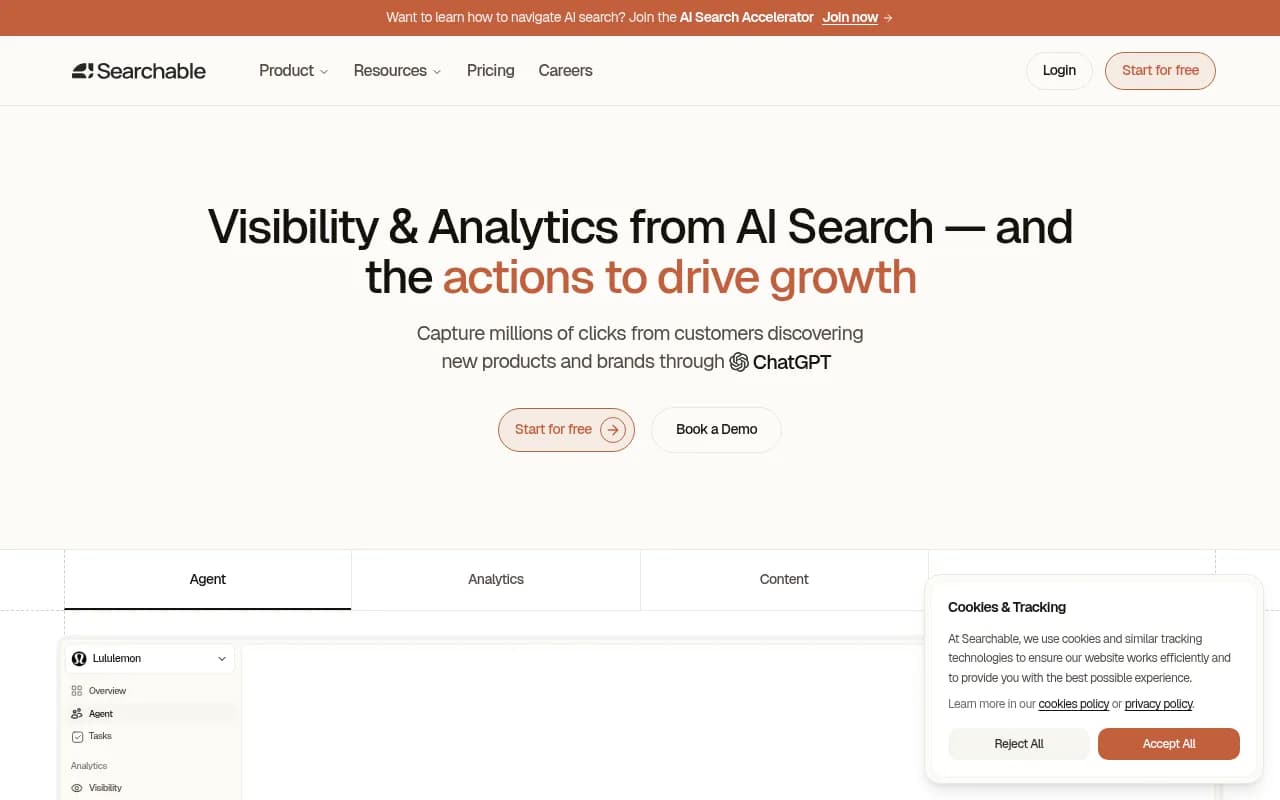
Searchable positions itself as an AI search visibility platform with both monitoring and content tools. On the monitoring side, it tracks how brands appear in responses from major AI engines and provides share-of-voice metrics across a set of tracked prompts.
Competitor analysis in Searchable
Searchable lets you add competitor domains to your workspace and compare their visibility scores against yours. The core view is a side-by-side share-of-voice comparison -- you can see, for a given set of prompts, how often your brand appears versus how often a competitor appears.
Where Searchable does reasonably well is in the content-side integration. If you identify that a competitor is outperforming you on a cluster of prompts, the platform can help you understand what content might be missing and generate briefs to address it. This makes the competitor data feel more connected to action than a pure monitoring dashboard.
The limitations show up when you want to go deeper. Searchable's competitor analysis tends to work at the brand level rather than the prompt level. You can see that Competitor X has higher overall visibility, but drilling into which specific prompts they're winning -- and what's driving those wins -- requires more manual work. The platform also doesn't surface the external citation sources (Reddit threads, third-party listicles, YouTube videos) that are often the real reason a competitor is getting cited.
AthenaHQ: what the platform does

AthenaHQ is more explicitly monitoring-focused. It tracks brand and competitor visibility across eight or more AI search engines and gives you detailed breakdowns by model, prompt, and time period. The interface is built around competitive intelligence -- you can tell that's where the product team has put most of their energy.
Competitor analysis in AthenaHQ
AthenaHQ's competitor analysis is more granular than Searchable's at the prompt level. You can see which specific queries your competitors are winning, compare performance across individual AI models (so you might notice that a competitor dominates on Perplexity but is weak on Claude), and track how their visibility has shifted over time.
The model-by-model breakdown is genuinely useful. Different AI engines have different citation preferences, and knowing that your competitor is strong on one but weak on another helps you prioritize where to focus your own optimization efforts.
AthenaHQ also does a reasonable job of showing sentiment and framing -- not just whether a competitor is mentioned, but how they're described in AI responses. That's a meaningful distinction for brand positioning work.
The limitation with AthenaHQ is the one that affects most monitoring-focused platforms: it shows you the data but doesn't help you do much with it. You can see that Competitor X is winning 40 prompts you're not visible for. What you do next is largely up to you.
Head-to-head comparison
| Feature | Searchable | AthenaHQ |
|---|---|---|
| AI models tracked | Multiple (ChatGPT, Perplexity, Gemini, others) | 8+ including ChatGPT, Claude, Perplexity, Gemini |
| Competitor domain tracking | Yes | Yes |
| Prompt-level competitor breakdown | Limited | Strong |
| Model-by-model competitor comparison | Basic | Detailed |
| Competitor sentiment/framing analysis | Limited | Yes |
| Citation source analysis (what's driving competitor visibility) | Partial | Limited |
| Historical competitor tracking | Yes | Yes |
| Content gap identification from competitor data | Yes (integrated) | Manual/export |
| Content generation from gaps | Yes | No |
| Traffic attribution | Limited | No |
| Pricing transparency | Moderate | Limited public info |
Where AthenaHQ wins
If your primary goal is understanding the competitive landscape in AI search -- who's winning which prompts, on which models, and how that's changed -- AthenaHQ gives you more to work with. The prompt-level granularity and model-by-model breakdowns are genuinely useful for teams doing strategic competitive research.
For enterprise brands or agencies that need to present competitive intelligence to stakeholders, AthenaHQ's reporting tends to be cleaner and more structured. The data is there; you just need analysts to interpret it.
Where Searchable wins
Searchable has an edge if you want competitor analysis to feed directly into content creation. The tighter integration between "here's where you're losing" and "here's what to write about it" reduces the friction between insight and action. For smaller teams that don't have dedicated analysts to turn raw competitive data into a content plan, that integration matters.
The gap both platforms share
Here's the honest assessment: both Searchable and AthenaHQ are primarily monitoring tools. They show you the competitive landscape. Neither one closes the full loop.
What's missing from both:
- Deep citation source analysis (which specific Reddit posts, third-party articles, or YouTube videos are driving a competitor's citations)
- AI crawler logs that show how AI engines are actually discovering and reading competitor content
- Prompt volume and difficulty scoring to help you prioritize which competitive gaps are worth chasing
- Traffic attribution that connects competitive visibility changes to actual revenue
These aren't minor gaps. If you're trying to build a systematic GEO program -- not just monitor it -- you'll hit the ceiling of both platforms fairly quickly.
For teams that need the full stack, Promptwatch covers all of this: competitor heatmaps, answer gap analysis that shows exactly which prompts competitors win and you don't, citation source tracking (including Reddit and YouTube), AI crawler logs, and content generation tools that turn gap data into published articles. It's a different category of tool.

Which platform should you choose?
The decision comes down to what you're optimizing for.
Choose AthenaHQ if:
- You need detailed, prompt-level competitive intelligence across multiple AI models
- Your team has the analytical capacity to turn data into strategy
- Reporting and stakeholder communication is a priority
- You're primarily in research/monitoring mode
Choose Searchable if:
- You want competitor insights connected to content creation in one workflow
- You have a smaller team and need the tool to do more of the interpretation work
- You're already producing content and want AI visibility data to inform your editorial calendar
Consider a more complete platform if:
- You need to go beyond monitoring into actual optimization
- Citation source analysis and AI crawler data are important to your strategy
- You want to track how competitive visibility changes translate to traffic and revenue
Other tools worth knowing about
If you're evaluating platforms in this space more broadly, a few others are worth a look depending on your specific needs.
Profound has strong enterprise-grade monitoring with good competitor tracking features:

Otterly.AI is a lighter-weight option if you're just getting started with AI visibility monitoring:

Peec AI is worth considering if you need multi-language competitor analysis:

Scrunch AI offers monitoring with a focus on brand narrative, which can complement competitor analysis work:
Final take
Searchable and AthenaHQ are both legitimate tools, and neither is a bad choice for what they do. AthenaHQ edges ahead on raw competitive intelligence depth -- if you want to understand the AI search competitive landscape in detail, it gives you more to work with. Searchable is the better pick if you want that intelligence connected to content action without switching tools.
But if you're building a serious GEO program in 2026, the more important question is whether you want a monitoring dashboard or an optimization platform. Both Searchable and AthenaHQ are closer to the former. The platforms that help you find gaps, create content to fill them, and track the results are a different category -- and that's where the real competitive advantage gets built.