Key takeaways
- These three tools are not like-for-like. Search Atlas is a full software suite with OTTO automation, NytroSEO is an apply-changes snippet layer, and Ranked AI is a managed service with software included.
- NytroSEO is the cheapest way to push metadata and schema live on any CMS ($59/mo Business, $119/mo Professional), but it does not write body content or run a full audit.
- Search Atlas fits agencies and in-house teams that want one platform for research, content, local and automation. Expect a learning curve and layered pricing.
- Ranked AI fits owners who want someone else to do the work at a flat per-site price starting at $99/mo.
- I found no independent head-to-head test of the three. Ranking claims below come from vendors, so run your own pilot.
Why this comparison is awkward
Most comparison articles line tools up feature by feature. That does not work well here, because the three products answer different questions.
Search Atlas asks: what if one platform did your research, content, audits and on-page fixes? NytroSEO asks: what if you only automated the on-page change layer, on any CMS? Ranked AI asks: what if you did not run the software at all?
A team that buys the wrong one ends up paying for the wrong part of the job. So start with your bottleneck, then pick the tool.
A word on sources. Pricing and feature details below come from vendor pages and review write-ups, and some of them disagree. Confirm everything on the live pricing pages before you buy.
The three platforms at a glance
| Search Atlas | NytroSEO | Ranked AI | |
|---|---|---|---|
| Model | Software suite with OTTO automation | Apply-changes snippet layer | Managed service plus software |
| Entry price | $99/mo (Starter) | Free, then $59/mo | $99/mo per website |
| Pricing unit | Projects, seats and credits | Pages and keywords | Per site |
| Applies on-page changes | Yes, via OTTO | Yes, via JavaScript snippet | Yes, by the team (schema and Core Web Vitals fixes) |
| Writes content | Yes | No | Yes, weekly articles |
| Full site audit | Yes | No | Not clearly documented |
| AI visibility tracking | Yes (Growth plan and up) | Not its job | Yes, on all plans |
| Best for | Agencies, in-house teams | Large sites, any CMS | Owners who want it done for them |
Search Atlas: the all-in-one suite
Search Atlas positions itself as an "AI SEO Automation Platform." It bundles keyword research, rank tracking, content tools, a site auditor, local SEO, LLM visibility tracking and white-label reporting. The automation piece is OTTO SEO, which applies titles, schema, canonicals, headings, alt text and internal link changes to live pages. According to the vendor's own coverage, deployment runs through the OTTO pixel, a Cloudflare Worker or CMS connectors.
What it does well
Breadth is the pitch, and it is real. A team paying separately for Semrush or Ahrefs, Surfer and Screaming Frog can collapse that into one invoice. The platform reads from Search Console, Google Analytics and Google Business Profile, and the local tooling (heatmaps, GBP management) is bundled rather than bolted on. AirOps, reviewing the market, calls it the pick when "your primary bottleneck is getting changes applied to live sites quickly."
Where it gets complicated
Pricing is the first thing I would check. Sources disagree on the details, so treat these numbers as a starting point.
| Plan | Monthly price | OTTO projects | Seats |
|---|---|---|---|
| Starter | $99 | 1 | 1 |
| Growth | $199 | 2 | 3 |
| Pro | $399 | 4 | 5 |
| Agency | $999 | 10 | 10 |
Those figures come from a LinkGraph review. Search Atlas's own review lists lower annual-billing prices (Starter $79/mo, Growth $159, Pro $319). On top of the plan, a LinkGraph write-up lists OTTO activations beyond the base allocation at $99 per site for one site, dropping to $49 per site at 25 to 99 sites. Add credits for AI features and you have a multi-layered bill that is hard to forecast.
User feedback is consistent on two points. The learning curve is steep (one review suggests planning two weeks before you feel fluent), and some users report OTTO changes need manual verification, which eats into the promised time savings. One Reddit user tested the $199 Growth plan in March 2026, but that is a single anecdote. Search Atlas's own materials also advise turning on approval mode before letting OTTO push changes live. I would do that.
Who should pick it
Agencies with several client sites, and in-house teams that need research, content, local and automation under one roof. Solo operators with one small site will probably pay for controls they never touch.
NytroSEO: the apply-changes layer
NytroSEO does one job. It applies titles, descriptions, canonical hints, image alt text and structured data to live pages through a JavaScript header snippet or tag manager. It works on any CMS without CMS access, scoped by sitemap, with a preview before rules go live, page-level overrides, a change log, rollback and drift monitoring. If a plugin or template overwrites an approved value, it re-applies it. It connects to Search Console.
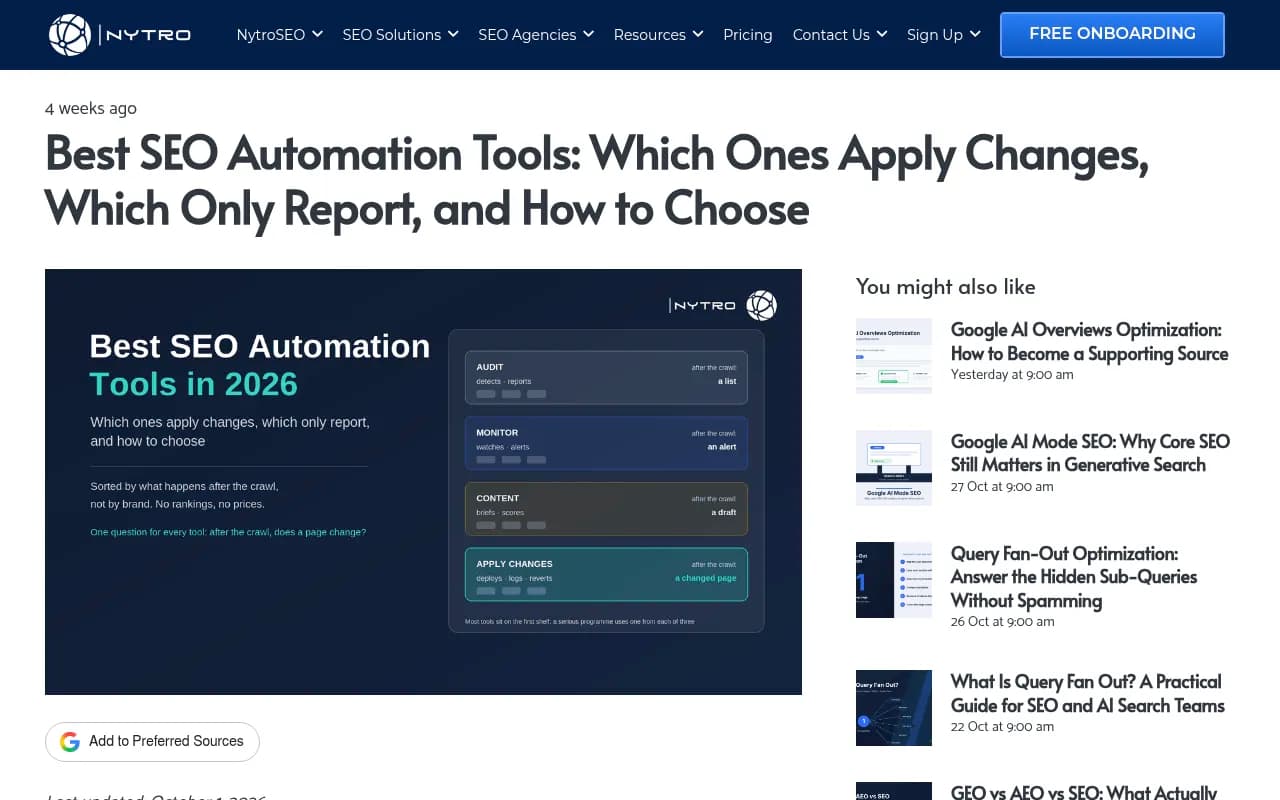
The vendor's own guide is unusually candid about what the tool does not do, and that candor is useful.
- It does not fix rendering or server problems.
- It does not write body content, brief writers or score drafts.
- It does not crawl the site for issues beyond its own layer.
- Because it delivers through JavaScript, changes are read by systems that render (Google, Bing) and may be invisible to third-party AI crawlers that fetch raw HTML, unless the same values are also served server-side.
That last point matters if AI search is part of your goal. Promptwatch's crawler research tracks how much of AI crawler traffic comes from different bots, and not all of them execute JavaScript. See Promptwatch's AI crawler traffic data for weekly verified request volumes from June 8 to September 6, 2026.
Pricing
| Plan | Price | Sites | Pages | Keywords optimized | Runs/month |
|---|---|---|---|---|---|
| Free | $0 | 1 | 50 | 5 | 1 |
| Business | $59/mo | 1 | 500 | 20 | 1 |
| Professional | $119/mo | 10 | 3,000 | 100 | 10 |
| Agency tier | $499/mo | 100 | 30,000 | 1,100 | 300 |
Extra pages are listed at $11/mo per 1,000 pages. Third-party listings such as Software Advice show older prices ($29 and $69), which do not match the current page. AppSumo lifetime-deal tiers have also appeared, so check whether a deal is still available and what its terms are.
Who should pick it
Teams with a large backlog of metadata and schema work, no developer time, and an existing crawler and content process. The vendor itself says a serious program usually runs a crawler, a monitor and an apply-changes platform together. That is a refreshing thing to read from a vendor, and I take it at face value. The free plan makes it a cheap test.
Ranked AI: SEO as a managed service
Ranked AI describes itself as "AI SEO & PPC Managed By Humans." The team handles software, content and implementation. It is month to month, with 20% off for yearly billing, and the company claims 5,000+ businesses.
Plans
Pricing is per website, with one site per plan.
| Plan | Price | Focus keywords | Articles | Backlinks per month |
|---|---|---|---|---|
| Standard | $99/mo | 25 | 1 per week | About 4 |
| Plus | $198/mo | 50 | 2 per week | About 8 |
| Enterprise | $349/mo | 100 | 4 per week | About 16 |
All plans list unlimited team members, tracked keywords and tracked AI prompts, daily rank tracking including AI Mode, visibility across ChatGPT, Claude, Gemini, Perplexity, Grok and Meta, white-label reports, a hosted AEO blog CMS, schema and Core Web Vitals fixes, and content in 35+ languages.
Reading the claims
The customer stories are vendor-selected. LiveImpact reportedly moved from #108 to #4 for "social services software," and Alpine Aire went from 2 to 173 top-10 keywords. Those are single examples, picked by the seller. Ranked AI's comparison page also claims it "edits every article and earns real links from $99/mo" against SEO.AI at $149/mo, which is marketing, not a test.
The thing to scrutinize is the backlink line. Roughly four links a month at the entry price depends entirely on where those links come from. Ask for examples before you sign. Month-to-month terms make that low-risk to test.
Who should pick it
Small business owners and lean marketing teams who would rather pay someone than learn a platform. If you want to inspect every change before it ships, the managed model will feel like giving up control.
Side by side: matching the tool to your situation
| Your situation | Better fit | Why |
|---|---|---|
| Agency with 5+ client sites | Search Atlas | White-label reports, multi-project plans, one invoice |
| Large site, thousands of thin or missing meta tags | NytroSEO | Rule-based metadata and schema on any CMS, with rollback |
| Single small-business site, no SEO staff | Ranked AI | Humans do content and implementation |
| Need to write and publish content weekly | Ranked AI or Search Atlas | NytroSEO does not write body content |
| Need a full technical audit | Search Atlas (or a crawler alongside NytroSEO) | NytroSEO does not audit beyond its layer |
| Tight budget, want to test automation first | NytroSEO Free | 50 pages, no card needed to preview |
| Want AI visibility tracking included | Search Atlas or Ranked AI | NytroSEO is not a tracking tool |
Costs once you add things up
The sticker prices look similar at the low end, around $99. They behave differently as you scale.
- Search Atlas costs rise by project, seat, credit and per-site OTTO activation. Plan for the add-ons.
- NytroSEO scales by pages and keywords, and stays cheap per site on the Professional and Agency tiers.
- Ranked AI scales by site. Ten sites at the entry tier is a lot of $99 lines.
Two more costs hide outside the invoice: your team's time and your risk. Search Atlas asks for onboarding time. NytroSEO asks you to pair it with an audit tool and a content tool. Ranked AI asks you to trust a third party with your content.
Safety checks before any of them touch your live site
Whichever you pick, automated changes on live pages deserve guardrails.
- Start with approval mode or a preview. Do not let any tool push everything unattended on day one.
- Pilot on a slice of pages, ideally a section with a clear baseline in Search Console.
- Check that titles and descriptions are unique and accurate. Mass-generated near-duplicates are a spam risk under Google's policies.
- Make sure structured data only describes content visible on the page.
- Confirm you can roll changes back.
- Compare against a control group of untouched pages for four to six weeks.
That last step is the only way to know whether a result came from the tool. A vendor case study will not tell you.
Where AI visibility tracking fits
Search Atlas and Ranked AI both include some AI visibility tracking. If that becomes your main concern, a dedicated platform may go deeper. Tools like Promptwatch track how brands appear in ChatGPT, Google AI Overviews, Perplexity and others, and show which pages AI crawlers actually read.

This is relevant to the JavaScript limitation above. Promptwatch's data shows citation behavior shifting quickly, for example in its ChatGPT citation share by content type report, where product pages made up 22.4% of ChatGPT citations from Sep 28 to Oct 4, 2026. If your metadata fixes are not visible to the crawlers that feed those answers, you will not see the benefit there. For more options in this category, the GEO software directory lists alternatives.
A two-week pilot you can run on any of them
- Day 1: pick 50 to 100 pages in one section. Record clicks, impressions and average position from Search Console.
- Day 2 to 3: connect the tool, set scope, and review the preview or approval queue.
- Day 4 to 7: apply changes to half the pages. Leave the other half alone.
- Day 8 to 14: check the change log, spot-check rendered pages, and watch for errors or drift.
- Weeks 3 to 6: compare treated pages with the control group.
If a tool cannot show you a preview, a log and a rollback option during that pilot, that tells you something.
My take
I would not call a winner, because they do not compete head to head. If I managed a handful of client sites and wanted one login, I would trial Search Atlas first, with approval mode on and a hard look at the per-site add-on costs. If I had a large site with a metadata backlog and an existing audit stack, I would start on NytroSEO's free plan, because the downside is close to zero. If I ran a small business and had no appetite for SEO software, Ranked AI is the most honest fit, as long as I got proof of the links and edited content.
The weakness shared by all three is the evidence. There is no independent test comparing them, so your own pilot is the best data you will get. Verify pricing on each vendor's live page, since the numbers above conflict across sources and change often.