Key takeaways
- Profound is the category leader with $155M raised and a $1B valuation -- best for large enterprises with compliance requirements and budget to match.
- Scrunch is the most accessible of the four enterprise tools, with stronger topic-level analysis and a lower price point than Profound.
- Evertune positions itself as a GEO-first platform for Fortune 500 brands, with a focus on AI narrative optimization rather than pure monitoring.
- Bluefish targets enterprise marketing teams with brand visibility features, but has fewer publicly documented capabilities than the other three.
- If you want monitoring AND content optimization in one loop, none of these four fully close that gap -- which is worth knowing before you sign a contract.
The enterprise AI search visibility market has gotten crowded fast. Between summer 2025 and spring 2026, the category raised over $300M in funding. Every platform now claims to be "the leader." Every comparison article puts its own product at the top.
So let's cut through it. This guide looks at four platforms that genuinely target enterprise buyers: Scrunch, Profound, Evertune, and Bluefish. They're all real, they're all well-funded, and they're all expensive enough that picking the wrong one hurts. Here's what actually separates them.
What these tools are supposed to do
Before comparing features, it's worth being precise about what "AI search visibility" means in practice. When someone asks ChatGPT "what's the best project management software for remote teams?" your brand either appears in the answer or it doesn't. AI visibility tools track that -- at scale, across multiple AI models, for hundreds or thousands of relevant prompts.
The core metrics most platforms track:
- Visibility percentage: how often your brand appears in relevant AI responses
- Position/ranking: where you appear within those responses (first mention vs. tenth matters a lot)
- Brand sentiment: how AI models describe you when they do mention you
- Competitor share of voice: who's winning the prompts you're losing
The better platforms go further -- identifying which content gaps are causing you to miss citations, and helping you fix them. That distinction between "monitoring" and "optimization" is the most important thing to understand when evaluating these four tools.
Profound

Profound is the closest thing the AI visibility category has to an established market leader. It has raised $155M, achieved a $1B valuation, and counts Fortune 500 companies among its clients. The platform covers 5+ AI models including Copilot and Claude, and it's the tool most often recommended when enterprise security requirements are non-negotiable -- Profound holds SOC 2 Type II certification, which matters a lot in regulated industries.
What Profound does particularly well is consumer panel data. Rather than just querying AI models programmatically, it incorporates data from real AI search sessions, which gives a more accurate picture of how actual users are experiencing AI responses about your brand. That's a meaningful differentiator.
The trade-off is price. Profound is firmly enterprise-tier, and the pricing reflects it. For teams that don't need the compliance certifications or the consumer panel methodology, it can feel like paying for capabilities they'll never use. One Reddit user who tested multiple platforms in April 2026 described Profound as "more polished" but noted it felt built for a specific kind of enterprise buyer -- one with procurement processes and legal review cycles.
Profound is also primarily a monitoring and analytics platform. It shows you where you're visible and where you're not. The optimization side -- actually fixing the gaps -- is less developed than the tracking side.
Best for: Large enterprises with compliance requirements, regulated industries, and teams that need to justify AI visibility spend to a CFO with a SOC 2 checklist.
Scrunch
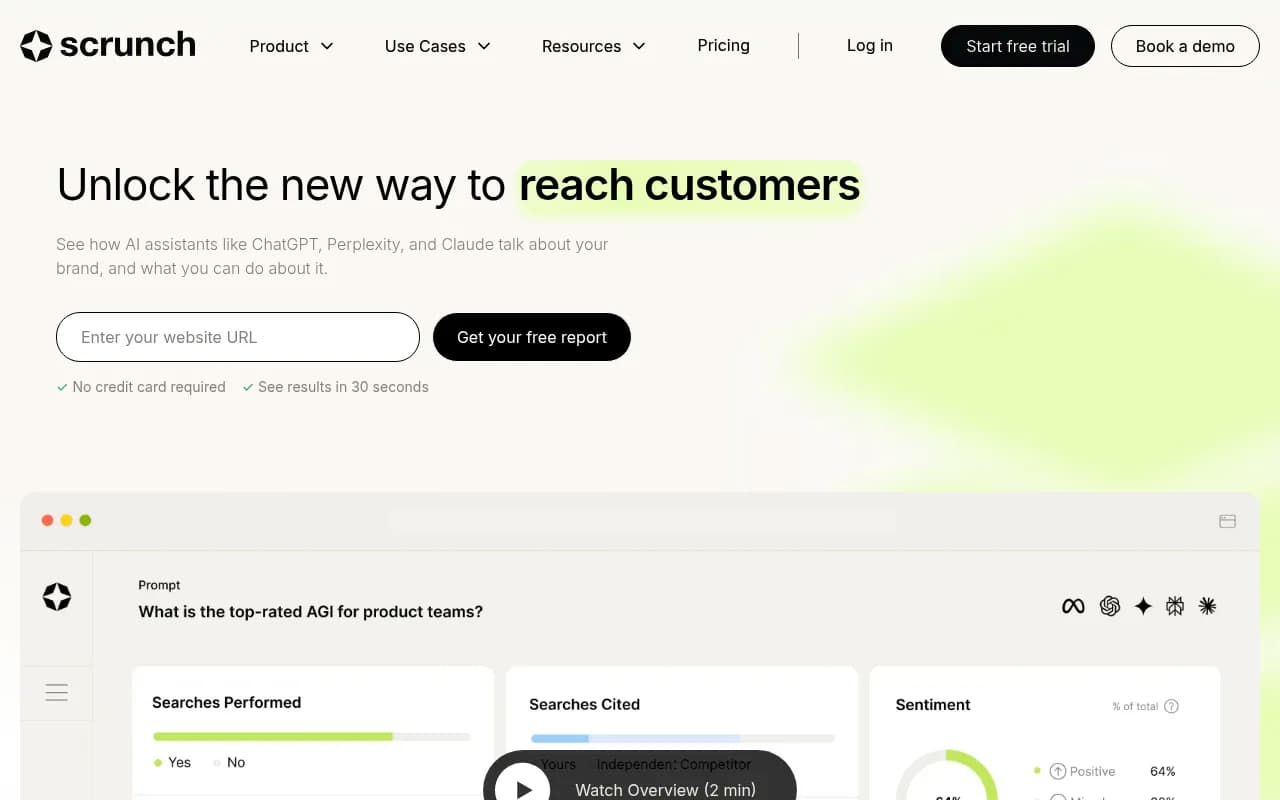
Scrunch has carved out a position as the more accessible enterprise option. Where Profound leans into compliance and consumer panel data, Scrunch leans into topic-focused analysis. The platform is particularly strong at breaking down AI visibility by topic cluster -- useful if you want to understand not just "are we visible?" but "which subject areas are we winning or losing?"
One comparison from Stackmatix's 2026 platform review summarized it well: "Profound for enterprise security requirements; Scrunch AI for topic-focused analysis at lower price point." That's a fair read. Scrunch is still an enterprise tool -- it's not cheap -- but it's priced below Profound and tends to appeal to marketing teams that want analytical depth without the full compliance apparatus.
Scrunch also publishes its own list of the best AEO/GEO tools (which includes itself, naturally), and the platform has been active in the GEO community. That visibility in the practitioner community has helped it build credibility with SEO and content teams, not just enterprise procurement.
The limitation is similar to Profound's: Scrunch is primarily a monitoring platform. It tells you what's happening. Turning that data into content that actually improves your AI visibility requires work outside the tool.
Best for: Enterprise marketing and SEO teams that want topic-level AI visibility analysis without paying Profound's full price, and who have content teams capable of acting on the data independently.
Evertune
Evertune takes a different angle. Where Profound and Scrunch are fundamentally analytics platforms, Evertune positions itself more explicitly around GEO -- Generative Engine Optimization -- and what it calls "AI narrative optimization." The idea is that your brand has a narrative that AI models have absorbed from training data and real-time sources, and Evertune helps you understand and shape that narrative.
The platform targets Fortune 500 brands and publishes its own "10 Best AI Visibility Tools" list (which, predictably, puts itself at the top). That self-promotion aside, Evertune does appear to offer capabilities that go slightly beyond pure monitoring -- including analysis of how AI models characterize your brand, not just whether they mention you.
What's harder to assess is the depth of Evertune's optimization capabilities. The platform talks about GEO insights, but the specifics of what actions you can take within the tool -- versus what you need to do externally -- are less clearly documented than Profound's or Scrunch's feature sets. For an enterprise buyer doing due diligence, that opacity is worth probing in a demo.
Best for: Brands that care specifically about how AI models describe them (not just whether they appear), and enterprise teams that want a GEO-first framing rather than a pure analytics framing.
Bluefish
Bluefish is the least publicly documented of the four. It's described as an enterprise AI marketing platform for Fortune 500 brand visibility, and it appears in multiple roundups of well-funded enterprise AI visibility tools. But compared to Profound, Scrunch, and Evertune, Bluefish has fewer publicly available case studies, feature breakdowns, and third-party reviews.
That's not necessarily a red flag -- some enterprise platforms deliberately keep a lower public profile and sell through direct relationships. But it does mean that evaluating Bluefish requires getting into a sales conversation earlier than the other three, because there's less you can assess independently.
What's clear is that Bluefish targets the same enterprise buyer as the others: large brands, significant budgets, and a focus on AI visibility as a strategic priority rather than an experimental one.
Best for: Enterprise teams willing to engage directly with sales to evaluate fit, particularly if they've already assessed the other three and want to see what Bluefish specifically offers their use case.
Head-to-head comparison
| Feature | Profound | Scrunch | Evertune | Bluefish |
|---|---|---|---|---|
| Target market | Fortune 500 / enterprise | Enterprise / mid-market | Fortune 500 | Fortune 500 |
| Funding / scale | $155M raised, $1B valuation | Well-funded | Well-funded | Well-funded |
| Compliance (SOC 2) | Yes (Type II) | Not publicly confirmed | Not publicly confirmed | Not publicly confirmed |
| Consumer panel data | Yes | No | No | Unknown |
| Topic-level analysis | Moderate | Strong | Moderate | Unknown |
| AI narrative / sentiment | Yes | Yes | Strong focus | Unknown |
| Content optimization | Limited | Limited | Moderate | Unknown |
| Price point | Highest | Lower than Profound | Enterprise | Enterprise |
| Public documentation | Strong | Strong | Moderate | Limited |
| Best use case | Compliance-heavy enterprise | SEO/content teams | GEO-first brands | Direct sales evaluation |
The gap none of them fully close
Here's something worth saying plainly: all four of these platforms are primarily monitoring tools. They're excellent at showing you where you stand. They're less good at helping you do something about it.
The missing piece is the loop from "we're invisible for this prompt" to "here's the content we need to create" to "here's proof it worked." Most enterprise AI visibility platforms show you the first part. The second and third parts are left to your team.
If closing that loop matters to you -- and it should, because visibility data without action is just expensive reporting -- it's worth looking at platforms that are built around optimization, not just observation. Promptwatch is one of the few that explicitly connects gap analysis, content generation grounded in citation data, and traffic attribution in a single workflow.

That's not to say Profound or Scrunch are bad choices -- they're not. But knowing what you're buying is important. If your team has the content capacity to act on monitoring data independently, the four platforms above are strong options. If you need the tool to help you act, not just observe, make sure you're evaluating that capability specifically.
How to choose
A few practical questions to guide your decision:
Do you have compliance requirements? If your legal or security team needs SOC 2 Type II, Profound is the clear answer. None of the others publicly confirm that certification.
What's your budget ceiling? Profound is the most expensive. Scrunch is meaningfully cheaper while still being enterprise-grade. Evertune and Bluefish require direct conversations to get pricing.
Do you care more about analytics depth or narrative framing? Scrunch wins on topic-level analytical depth. Evertune wins if you want to think about AI visibility as a brand narrative problem rather than a data problem.
How much can your team do with raw data? If you have a strong content team that can turn monitoring insights into content strategy, any of these four works. If you need the tool to help generate and optimize content, look elsewhere or supplement with a tool that does.
Are you willing to engage sales early? Bluefish requires it. The others have enough public information to do meaningful pre-sales evaluation.
The bottom line
Profound is the safest enterprise choice if budget isn't the constraint and compliance is. Scrunch is the smarter choice if you want analytical depth at a lower price point. Evertune is worth a look if you think about AI visibility as a narrative and positioning problem. Bluefish is hard to evaluate without talking to their team directly.
None of them are cheap, and none of them fully solve the problem of turning visibility data into visible results. That's the honest answer -- and it's the one worth knowing before you sign a contract.