Key takeaways
- Otterly.AI and Peec.ai are solid monitoring tools but stop at showing you the data -- neither generates content, tracks AI crawlers, or helps you close visibility gaps.
- Qwairy positions itself as a GEO strategy platform with optimization features, but its data depth and prompt coverage are more limited than Promptwatch's.
- Promptwatch is the only platform in this comparison that covers the full loop: find gaps, create content, track results -- including AI crawler logs, content generation agents, and traffic attribution.
- If budget is the primary constraint, Otterly.AI at $29/month is the most accessible entry point for basic monitoring.
- For teams that need to actually improve their AI visibility (not just measure it), Promptwatch is the clear choice.
The "monitoring-only trap" is real, and it's frustrating. You sign up for an AI visibility tool, you see a dashboard full of data showing your brand barely appears in ChatGPT or Perplexity responses, and then... nothing. The tool has done its job. You're on your own to figure out what to do about it.
That's the state of most GEO platforms in 2026. A lot of them are essentially dashboards dressed up as strategy tools. So this comparison focuses on one question above all others: which of these four platforms actually helps you do something about your AI visibility, rather than just measuring how bad it is?
Let's get into it.
What we're comparing and why it matters
AI search is eating traditional organic traffic. Similarweb's 2025 Generative AI Report found AI platforms generated over 1.1 billion referral visits in June 2025 -- up 357% year-over-year. Meanwhile, AI Overviews now trigger on more than 13% of Google queries and cause a 34.5% drop in click-through rates for position-one organic results.
Your brand can rank #1 in Google and still be completely invisible when someone asks ChatGPT to recommend a solution in your category. That's not a hypothetical -- it's happening to most brands right now.
The four platforms in this comparison each claim to solve this problem:
- Qwairy -- positions itself as a GEO strategy and optimization platform
- Promptwatch -- end-to-end AI visibility and GEO platform used by 1,480+ brands
- Otterly.AI -- affordable monitoring tool covering multiple AI engines
- Peec.ai -- mid-market monitoring with strong multi-language support
Platform-by-platform breakdown
Qwairy
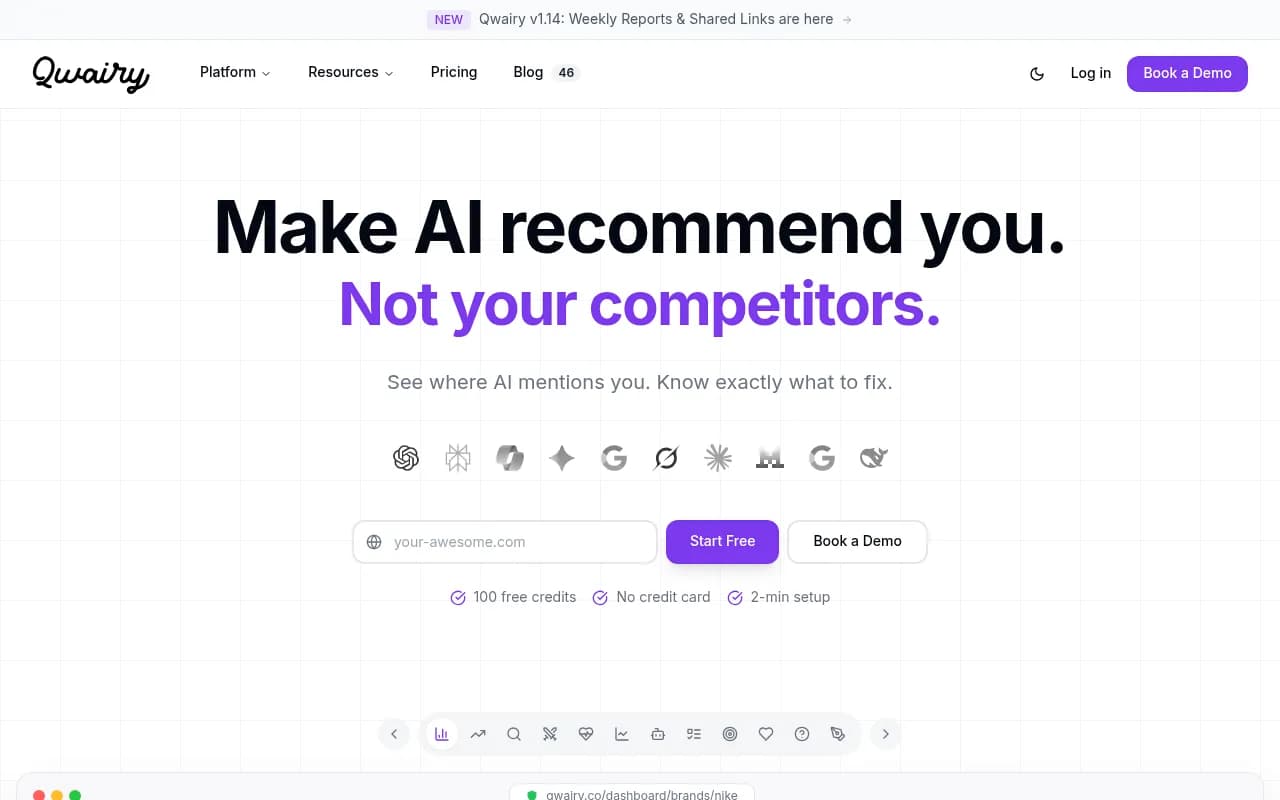
Qwairy markets itself as the "ultimate GEO strategy and optimization platform," which is a bold claim. It covers prompt tracking across major AI engines and includes some optimization guidance -- which puts it a step ahead of pure monitoring tools. The interface is designed around helping teams understand where they stand and what to prioritize.
That said, Qwairy's data depth is harder to verify independently. Prompt volume estimates, query fan-outs, and AI crawler log data -- the kind of infrastructure that makes optimization actionable -- aren't clearly documented as core features. For teams that need to move from "we know we're invisible" to "here's the content we need to publish," Qwairy's optimization layer feels thinner than what Promptwatch offers.
It's worth evaluating if you want a GEO-focused tool with a strategy-oriented interface, but go in with clear questions about what the optimization features actually produce.
Otterly.AI

Otterly is the budget entry point in this comparison, starting at $29/month for 15 prompts. It monitors AI search platforms and gives you visibility data across several engines. The interface is clean, the setup is fast, and for a small team or solo marketer who just needs to know whether their brand is showing up, it does the job.
The honest limitation: Otterly is a monitoring tool. It doesn't generate content, doesn't show you which pages AI crawlers are reading, and doesn't tell you why competitors are getting cited while you aren't. You get the "what" but not the "why" or "what to do about it." For teams that already have strong content capabilities and just need a lightweight tracker, that's fine. For teams that need to actually improve their position, it's not enough.
Otterly does cover 6+ AI engines and offers unlimited seats on some plans, which is genuinely useful for agencies or larger teams sharing access.
Peec.ai

Peec.ai sits in the mid-market tier, starting around €89/month. Its standout feature is multi-language support -- genuinely best-in-class for brands operating across multiple regions and languages. The reporting is polished, and it supports up to 9 AI engines. If you're a European brand or a global company that needs to track AI visibility in French, German, Spanish, and English simultaneously, Peec is worth serious consideration.
Like Otterly, though, Peec is fundamentally a monitoring platform. There's no content generation, no AI crawler logs, no traffic attribution connecting AI visibility to actual revenue. The data is good; the action layer is missing. You'll know you have a problem. You'll still need to solve it yourself.
Promptwatch
Promptwatch is the only platform in this comparison built around the full optimization loop rather than just monitoring.

The core difference is what happens after you see the data. Promptwatch's Answer Gap Analysis shows you exactly which prompts competitors are visible for that you're not -- not just as a metric, but mapped to specific content your site is missing. Then Content Agents generate articles, listicles, comparisons, and briefs grounded in that real prompt data, citation patterns, and competitor analysis. Then page-level tracking shows you whether the new content is actually getting cited, by which models, and how often.
That loop -- find gaps, create content, track results -- is what separates it from every other tool in this comparison.
A few other capabilities worth noting:
- AI Crawler Logs: Real-time logs of when ChatGPT, Claude, Perplexity, and other AI crawlers hit your site, which pages they read, errors they encounter, and when pages move from crawl to citation. Most competitors don't have this at all.
- Prompt Intelligence: Volume estimates and difficulty scores for each prompt, plus query fan-outs showing how one prompt branches into sub-queries. This lets you prioritize high-value, winnable prompts instead of guessing.
- Reddit & YouTube Insights: Surfaces discussions that directly influence AI recommendations -- a channel most platforms ignore entirely.
- ChatGPT Shopping Tracking: Monitors when your brand appears in ChatGPT's product recommendations and shopping carousels.
- Traffic attribution: Connects AI visibility to actual revenue, not just citation counts.
Promptwatch monitors 10 AI models: ChatGPT, Perplexity, Google AI Overviews, Google AI Mode, Claude, Gemini, Meta/Llama, DeepSeek, Grok, and Copilot.
Feature comparison table
| Feature | Qwairy | Promptwatch | Otterly.AI | Peec.ai |
|---|---|---|---|---|
| AI engine coverage | Multiple | 10 models | 6+ engines | 9 engines |
| Prompt tracking | Yes | Yes | Yes | Yes |
| Content gap analysis | Partial | Yes (Answer Gap Analysis) | No | No |
| AI content generation | Partial | Yes (Content Agents) | No | No |
| AI crawler logs | Unclear | Yes | No | No |
| Traffic attribution | No | Yes | No | No |
| Reddit/YouTube insights | No | Yes | No | No |
| ChatGPT Shopping tracking | No | Yes | No | No |
| Multi-language support | Limited | Yes | Limited | Yes (best-in-class) |
| Prompt volume/difficulty scores | Unclear | Yes | No | No |
| Starting price | Not publicly listed | $99/month | $29/month | €89/month |
| Free trial | Unclear | Yes | Yes | Yes |
The monitoring-only trap, explained
It's worth being direct about what "monitoring-only" actually means in practice, because the gap between monitoring and optimization is larger than it sounds.
A monitoring tool tells you your brand appears in 12% of relevant AI responses while your top competitor appears in 47%. That's useful information. But it doesn't tell you:
- Which specific prompts your competitor is winning that you're not
- What content on their site (or third-party sites) is driving those citations
- Which pages on your site AI crawlers are actually reading
- What content you need to create to close the gap
- Whether the content you've already published is being crawled and cited
Without those answers, you're left doing a lot of manual investigation. You're reading competitor sites, guessing at content topics, publishing articles, and waiting months to see if anything changes -- with no way to connect the dots.
That's the trap. The data tells you you're losing. It doesn't tell you how to win.
Promptwatch is built specifically to break out of that trap. Otterly and Peec are honest monitoring tools that don't pretend to be more. Qwairy sits somewhere in between, with optimization aspirations that are worth testing but harder to verify at depth.
Pricing comparison
| Platform | Entry tier | Mid tier | Higher tier |
|---|---|---|---|
| Promptwatch | $99/mo (1 site, 50 prompts, 5 articles) | $249/mo (2 sites, 150 prompts, 15 articles, crawler logs) | $579/mo (5 sites, 350 prompts, 30 articles) |
| Otterly.AI | $29/mo (15 prompts) | Higher tiers available | -- |
| Peec.ai | €89/mo | Higher tiers available | -- |
| Qwairy | Not publicly listed | -- | -- |
Promptwatch's pricing reflects its broader feature set. The $99/month Essential plan is a reasonable starting point for a single brand that wants to move beyond monitoring. The $249/month Professional plan adds crawler logs and state/city tracking, which is where the deeper optimization work happens. A free trial is available.
Otterly's $29/month entry point is genuinely accessible and makes sense as a starting point for teams with tight budgets who just need basic visibility data. Peec's €89/month is reasonable for the multi-language coverage it provides.
Who should use which platform
The right choice depends on what you actually need to accomplish.
Use Otterly.AI if: You're a small team or solo marketer with a limited budget, you just need to know whether your brand is showing up in AI responses, and you have the internal capability to act on the data yourself. It's the lowest-friction entry point.
Use Peec.ai if: Multi-language and multi-region monitoring is your primary need. If you're tracking AI visibility across several European markets or languages, Peec's coverage is hard to beat at its price point.
Evaluate Qwairy if: You want a GEO-focused platform with some optimization framing and are willing to test whether its strategy features deliver on their promise. Go in with specific questions about what the optimization layer actually produces.
Use Promptwatch if: You need to actually improve your AI visibility, not just measure it. If your team is being asked to show results -- more citations, more AI-referred traffic, measurable improvement in share of voice across AI engines -- Promptwatch is the only platform here that gives you the tools to make that happen. The content gap analysis, AI content generation, and crawler logs together form a workflow that monitoring-only tools simply can't replicate.
A note on data quality
One thing that gets overlooked in these comparisons: how platforms collect their data matters a lot.
Some tools query AI models through APIs. Others track how AI search engines behave in real user interfaces. These can produce different results -- user-facing answers, citations, and shopping recommendations don't always match what you get through an API call. Promptwatch tracks real user-interface behavior across all 10 models it monitors, which means the data reflects what actual users are seeing when they search.
This is particularly relevant for ChatGPT Shopping and Google AI Overviews, where the user-facing experience diverges meaningfully from API outputs.
Bottom line
Most AI visibility tools in 2026 are still stuck in the monitoring-only trap. They show you a problem and hand you a dashboard. What you do next is your problem.
Otterly.AI and Peec.ai are honest about being monitoring tools, and they do that job well within their respective niches. Qwairy has optimization ambitions worth exploring. But if you're being measured on actual AI visibility improvement -- more citations, more AI traffic, better share of voice against competitors -- Promptwatch is the only platform in this comparison built to get you there.
The gap between knowing you're invisible and becoming visible is exactly where most GEO platforms leave you stranded. Promptwatch is built to close it.