Key takeaways
- Most AI visibility platforms are monitoring dashboards -- they show you citation gaps but don't help you close them.
- Promptwatch is the only platform in this comparison with a full action loop: gap analysis, AI content generation, and crawler logs that show when pages move from crawl to citation.
- AthenaHQ and Peec.ai are solid for tracking but stop short of optimization -- useful if you have a separate content team to act on the data.
- Qwairy positions itself as a GEO strategy platform, with more emphasis on recommendations than raw monitoring.
- If your goal is to actually improve AI visibility (not just measure it), the platform you choose needs to do more than report.
There's a pattern that plays out constantly in AI search right now. A marketing team signs up for a visibility tool, gets a dashboard showing their brand barely appears when buyers ask ChatGPT for vendor recommendations, and then... sits with that information. The tool refreshes the numbers every week. The numbers don't improve.
This is the monitoring-only trap. And most platforms in the GEO space are still stuck in it.
The four tools in this comparison -- Qwairy, Promptwatch, AthenaHQ, and Peec.ai -- each take a different approach to the problem. Some are genuinely trying to close the loop between insight and action. Others are polished dashboards that leave the hard work to you. Here's how they actually compare.
What the monitoring-only trap actually looks like
Before getting into the tools, it's worth being precise about the problem.
When a prospect types "what's the best project management software for remote teams?" into ChatGPT, the model generates an answer from its training data and real-time web retrieval. It cites sources. It recommends brands. If your brand isn't in those citations, you're invisible to that buyer at a critical moment.
Monitoring tools tell you this is happening. They show you which prompts your competitors appear for that you don't. They track your citation rate over time. That data is genuinely useful -- you need to know where the gaps are before you can fix them.
The problem is that knowing you have a gap and knowing what to do about it are completely different things. Most platforms stop at the first part. They show you the wound but don't hand you a bandage.
A platform that breaks out of the monitoring trap needs to answer at least two more questions: what content should I create to close this gap, and how do I know when it's working?
The four platforms, honestly assessed
Peec.ai

Peec.ai was one of the earlier purpose-built tools for AI visibility tracking. It uses UI scraping (not just API calls) to simulate how real users experience AI search results, which matters because what ChatGPT shows in its interface can differ from what the API returns.
The platform tracks share of voice and citation rates across ChatGPT, Perplexity, and Google AI Overviews. Pricing starts around $100/month, which makes it accessible for smaller teams. It also offers unlimited seats on its plans, which is useful for agencies or teams where multiple people need to see the data.
Where Peec.ai runs into limits: it's a monitoring platform. It shows you where you appear and where you don't. It suggests prompts to track. But it doesn't generate content, doesn't give you briefs, and doesn't have crawler logs that show you whether AI agents are even reading your pages. If your citation rate is low, Peec.ai tells you that clearly. What to do about it is your problem.
For teams that already have strong content operations and just need the visibility data piped in, Peec.ai works well. For teams that need the full workflow, it's a starting point, not a solution.
AthenaHQ

AthenaHQ covers more AI models than most tools at this price point -- tracking across 8+ engines including ChatGPT, Claude, Gemini, and Perplexity. Its interface is clean and the competitive heatmaps (showing which brands dominate which prompts) are genuinely useful for prioritization.
The platform leans into monitoring depth. You get good data on which prompts trigger citations, which competitors are winning, and how your visibility shifts over time. It's a solid choice for teams doing competitive research or building a business case internally for GEO investment.
But AthenaHQ is still fundamentally a tracking tool. There's no content generation, no crawler log analysis, and limited guidance on what to actually change on your site to improve results. The gap analysis shows you what's missing; the execution is entirely on you.
It's a well-built monitoring platform. That's both its strength and its ceiling.
Qwairy
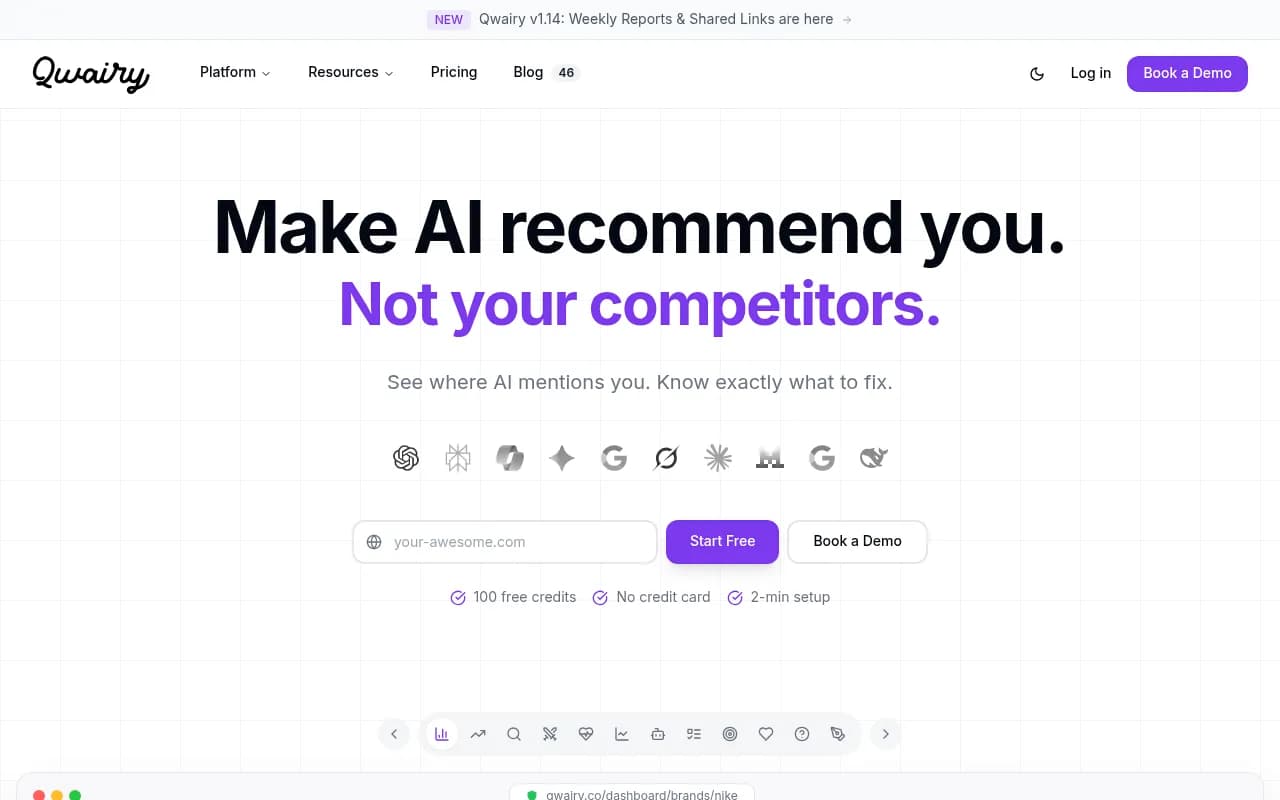
Qwairy positions itself as a GEO strategy platform rather than just a tracker, which is a meaningful distinction. The emphasis is on recommendations -- not just showing you where you're invisible, but suggesting what to prioritize and why.
In practice, Qwairy sits somewhere between a pure monitoring tool and a full optimization platform. It gives you more strategic guidance than Peec.ai or AthenaHQ, with features oriented around GEO execution rather than just data collection. For teams that want a more opinionated tool that tells them where to focus, that's a real differentiator.
The platform is newer and the feature set is still developing compared to more established players. If you're evaluating it, it's worth testing against your specific use case -- the strategic framing is appealing, but the depth of data and the breadth of AI model coverage matters a lot for day-to-day work.
Promptwatch

Promptwatch is the most complete platform in this comparison, and the gap between it and the others is significant once you get past basic monitoring.
The core difference is what happens after you see a visibility gap. Promptwatch's Answer Gap Analysis shows you exactly which prompts competitors rank for that you don't -- not as a vague observation, but as specific questions and topics that AI models are already answering without citing your content. From there, Content Agents generate articles, listicles, and briefs grounded in that prompt data, with brand guidance, competitor context, and citation analysis built in. Then page-level tracking shows you when those new pages get crawled by AI agents and when they start generating citations.
That loop -- find the gap, create content to fill it, track the result -- is what separates an optimization platform from a monitoring dashboard.
A few capabilities that stand out specifically:
The AI Crawler Logs (Agent Analytics) are something most competitors don't have at all. You can see in real time when ChatGPT, Claude, Perplexity, and other crawlers hit your pages, which pages they're reading, and whether those visits are converting to citations. If an AI model is crawling your site but not citing it, that's a fixable problem -- but only if you can see it happening.
Prompt Intelligence gives you volume estimates and difficulty scores for each prompt, plus query fan-outs showing how one question branches into related sub-queries. That lets you prioritize the prompts worth winning rather than spreading effort across everything.
The Reddit and YouTube tracking is also worth mentioning. AI models frequently cite Reddit threads and YouTube videos in their responses. Most platforms ignore this channel entirely. Promptwatch surfaces which discussions are influencing AI recommendations, which opens up a distribution strategy most teams haven't thought about.
Pricing runs from $99/month (Essential) to $579/month (Business), with agency and enterprise tiers available. It's not the cheapest option, but the feature depth justifies the gap.
Feature comparison
| Feature | Qwairy | Promptwatch | AthenaHQ | Peec.ai |
|---|---|---|---|---|
| AI model coverage | Multiple | 10+ models | 8+ models | ChatGPT, Perplexity, Google AI |
| Citation tracking | Yes | Yes | Yes | Yes |
| Competitive share of voice | Yes | Yes | Yes | Yes |
| Prompt volume/difficulty scores | Limited | Yes | No | No |
| Answer gap analysis | Partial | Yes (detailed) | Basic | No |
| Content generation | No | Yes (Content Agents) | No | No |
| AI crawler logs | No | Yes | No | No |
| Reddit/YouTube tracking | No | Yes | No | No |
| ChatGPT Shopping tracking | No | Yes | No | No |
| Page-level citation tracking | No | Yes | Limited | No |
| Traffic attribution | No | Yes | No | No |
| Multi-language/region | Limited | Yes | Limited | Yes |
| Starting price | Varies | $99/mo | Varies | ~$100/mo |
Which platform is right for your situation
The honest answer depends on what you're trying to accomplish.
If you're at the "we need to understand the problem" stage -- building a business case, doing initial competitive research, figuring out which AI models matter for your category -- Peec.ai or AthenaHQ will get you there at a reasonable cost. They're clean, focused tools that answer the monitoring question well.
If you want more strategic guidance on where to focus, Qwairy's positioning around GEO strategy is worth exploring, particularly if you find pure data dashboards hard to act on without more direction.
If you're past the awareness stage and need to actually move the needle on AI visibility, Promptwatch is the only platform here that gives you the full workflow. The content generation alone changes the economics -- instead of paying for data and then separately paying a content team to act on it, you have both in one place. The crawler logs are the other piece that's genuinely hard to replicate elsewhere: knowing that an AI agent crawled your page but didn't cite it is actionable information. Not knowing that means you're optimizing blind.
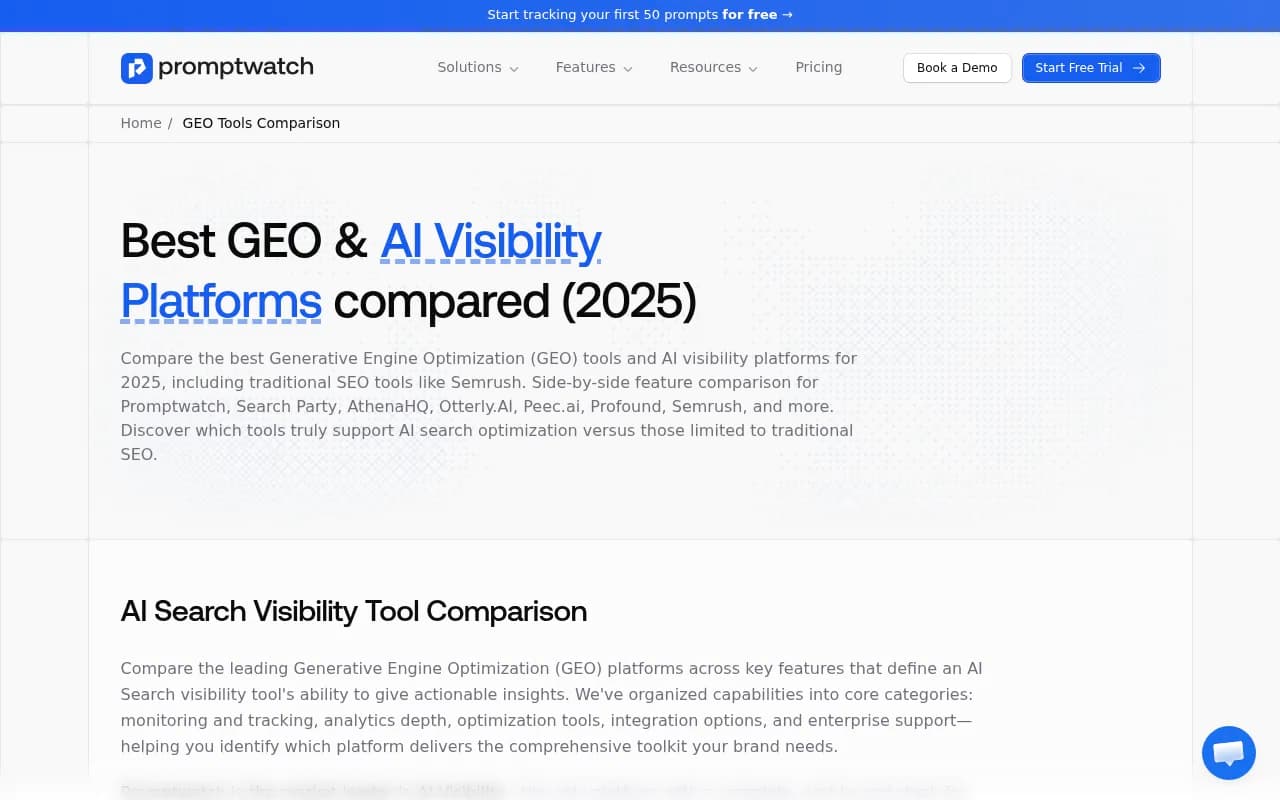
The comparison above from Promptwatch's own research across 12 GEO platforms makes the gap visible: most tools cluster in the "monitoring" quadrant, while Promptwatch sits alone in the "Leader" category across functionality and value dimensions.
The content question most teams are avoiding
There's something worth saying directly: the reason so many teams stay stuck in monitoring-only mode isn't that they don't know they need to create content. It's that creating content specifically engineered for AI citation is genuinely hard.
Regular SEO content doesn't automatically translate to AI citations. AI models cite content that directly and comprehensively answers the questions users are asking. That means you need to know which questions are being asked (prompt data), what format AI models prefer for those answers (citation analysis), and how to write content that fills the gap rather than just adding more pages to your site.
Promptwatch's Content Agents are built around this specific problem. They're not generic AI writers -- they generate content grounded in actual prompt data, citation patterns, and competitor analysis. The difference between content that gets cited and content that doesn't is usually precision: does this page answer the exact question AI models are trying to answer, or does it just cover the topic broadly?
A note on the monitoring-only platforms
It would be unfair to dismiss Peec.ai and AthenaHQ entirely. For certain teams and certain stages, monitoring-only is the right call.
If you're at an agency managing 20+ clients and need a cost-effective way to track AI visibility across all of them, a lighter tool makes sense. If you're in a category where AI search is still emerging and you're mostly doing research, you don't need the full optimization stack yet.
The trap isn't using a monitoring tool -- it's staying in monitoring mode after you've identified the gaps. At some point, the data stops being new information and starts being a reminder of a problem you haven't solved. That's when you need a platform that helps you act.
Bottom line
The GEO platform market in 2026 is still sorting itself into two categories: tools that show you the problem and tools that help you fix it. Peec.ai and AthenaHQ are good at the first category. Qwairy is trying to bridge the gap with strategic guidance. Promptwatch is the only platform here that has built the full loop from gap identification to content creation to citation tracking.
If you're choosing between these four, the question to ask yourself is: after I see the data, what happens next? If your answer is "we figure it out ourselves," any of these will work. If your answer is "we need the platform to help us close the gap," Promptwatch is the only one built for that.