Key takeaways
- Qwairy is a capable GEO/AI visibility tool, but it lacks several features enterprise teams typically require: SSO, multi-site management, crawler log access, and content generation at scale.
- The best enterprise-grade alternatives in 2026 combine AI visibility monitoring with content optimization, prompt intelligence, and traffic attribution -- not just dashboards.
- Promptwatch is the only platform in this comparison rated as a "Leader" across all enterprise categories, with crawler logs, multi-site tracking, SSO support, and a full content generation workflow built in.
- Platforms like Profound, BrightEdge, and seoClarity offer strong enterprise feature sets but come at higher price points and with narrower AI-specific capabilities.
- The key question for enterprise buyers isn't just "can it monitor?" -- it's "can it help us act on what we find?"
Why enterprise teams outgrow Qwairy
Qwairy does a solid job of tracking brand visibility across AI search engines. For a solo marketer or a small team running a handful of prompts, it's a reasonable starting point. But enterprise teams hit friction fast.
The issues tend to cluster around the same pain points: no SSO or SAML integration (which means IT won't approve it), no multi-site management (which means agencies and multi-brand companies are juggling separate accounts), limited prompt volume at accessible price tiers, and no path from "we found a gap" to "here's the content that fixes it."
That last one is the real problem. Most GEO tools in 2026 are monitoring dashboards. They show you where you're invisible in ChatGPT or Perplexity. They don't help you do anything about it.
Enterprise teams need more than a visibility score. They need to know which prompts matter, which competitors are winning them, what content is missing from their site, and how to create content that actually gets cited. That's a different product category from what Qwairy offers.
Here's a breakdown of the platforms worth evaluating.
The top Qwairy alternatives for enterprise teams in 2026
Promptwatch
Promptwatch is the most complete AI visibility platform available in 2026, and it's the one most enterprise teams end up comparing everything else against.

What separates it from Qwairy and most other alternatives is the action loop. Most tools stop at monitoring -- they show you that a competitor appears in ChatGPT responses for a given prompt and you don't. Promptwatch goes further: it identifies the specific content gaps on your site, generates content briefs and full articles grounded in real prompt data, and then tracks whether those new pages start getting cited by AI models.
For enterprise teams specifically, the relevant capabilities are:
- Multi-site management across up to 5 sites on the Business plan, with custom agency/enterprise tiers available
- AI Crawler Logs that show exactly which pages ChatGPT, Perplexity, Claude, and other crawlers are reading -- and which ones they're ignoring or hitting errors on
- SSO and team access controls for enterprise accounts
- Prompt intelligence with volume estimates and difficulty scores, so teams can prioritize instead of guessing
- Page-level citation tracking that connects specific pages to specific AI models and prompt types
- Traffic attribution that links AI visibility to actual revenue
It monitors 10 AI models: ChatGPT, Perplexity, Google AI Overviews, Google AI Mode, Claude, Gemini, Meta/Llama, DeepSeek, Grok, and Copilot. The data behind it -- more than 4.5 billion citations and prompts processed -- is what makes the prompt volume estimates credible rather than guesswork.
Pricing starts at $99/month (Essential) and goes to $579/month (Business, 5 sites, 350 prompts, 30 articles/month). Enterprise and agency pricing is custom.
Profound
Profound is a strong enterprise-focused AI visibility platform with a clean interface and solid multi-model tracking. It's been a popular choice for larger marketing teams that want structured reporting and competitive benchmarking across AI search engines.

Where Profound does well: prompt tracking across multiple AI models, share-of-voice metrics, and competitive heatmaps. It's built for teams that need to report upward -- the dashboards are polished and the data is easy to present to stakeholders.
Where it falls short compared to Promptwatch: no content generation capabilities, no crawler logs, and no Reddit or YouTube tracking. You can see where you're losing visibility, but the platform doesn't help you fix it. For teams that already have a content operation and just need the monitoring layer, that's fine. For teams that want an end-to-end workflow, it's a gap.
Pricing is higher than Promptwatch at comparable feature tiers, which matters when you're running multiple sites or managing clients.
BrightEdge
BrightEdge is one of the oldest enterprise SEO platforms and has been adding AI search visibility features through its AI Catalyst product. If your organization already uses BrightEdge for traditional SEO, the AI visibility layer is a natural extension.
The enterprise credentials are solid: SSO, role-based access, dedicated customer success, and deep integrations with existing SEO workflows. BrightEdge also has strong content optimization tooling that predates the GEO trend.
The limitation is that BrightEdge's AI visibility features feel bolted on rather than native. The platform was built for Google rankings, and the AI search tracking is catching up. Crawler log analysis, prompt intelligence, and AI-specific content generation aren't as mature as what you get from platforms built specifically for AI search from the ground up.
It's a reasonable choice if you're already a BrightEdge customer and want to extend into AI visibility without switching platforms. It's harder to justify as a standalone purchase when purpose-built alternatives exist.
seoClarity
seoClarity is another established enterprise SEO platform that has added AI visibility tracking. The platform is known for its data depth -- it handles large-scale crawls, keyword tracking at enterprise volume, and integrates with most major data warehouses.
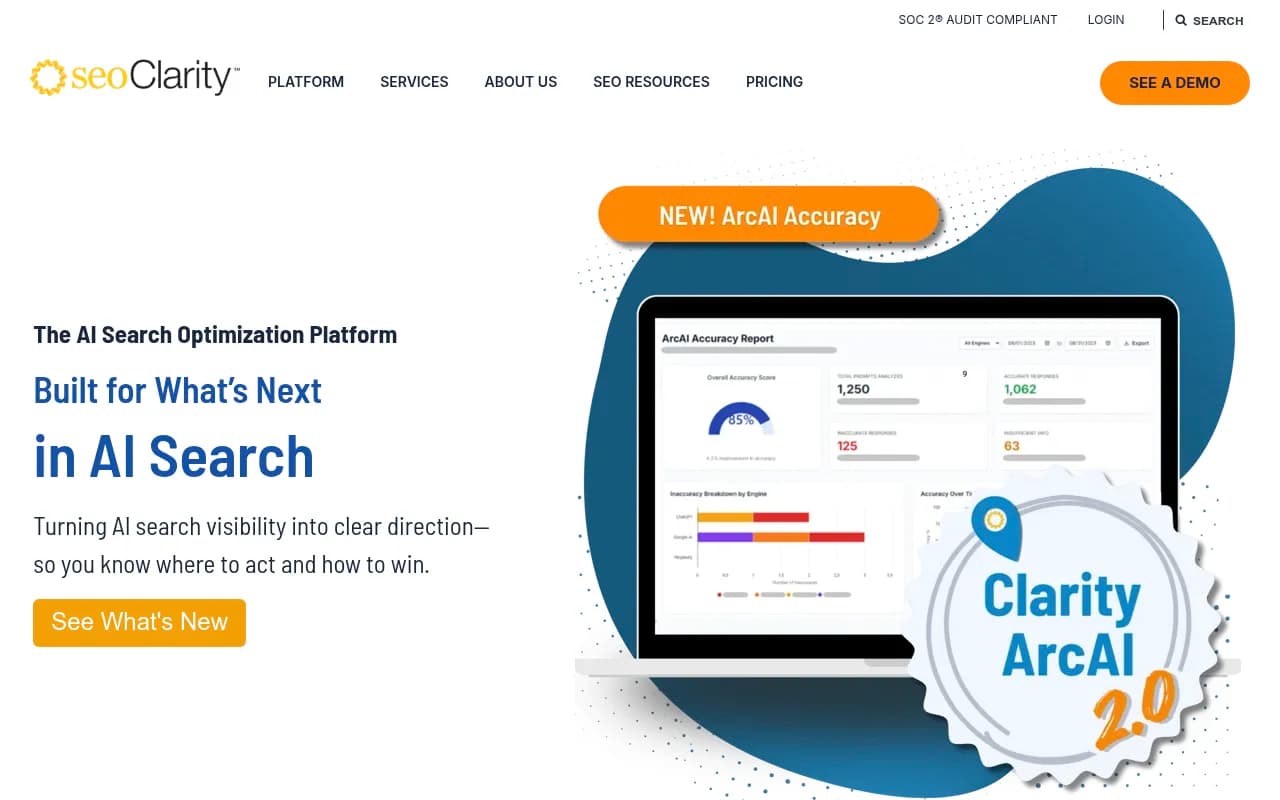
For teams that need AI visibility as one component of a broader SEO program, seoClarity is worth evaluating. It has SSO, multi-site support, and the kind of enterprise security posture that IT teams require.
The AI search tracking is functional but not the core product. If your primary need is understanding and improving AI visibility specifically -- rather than traditional SEO with AI visibility as a feature -- you'll likely find the AI-specific capabilities thinner than what dedicated GEO platforms offer.
AthenaHQ
AthenaHQ is a dedicated AI visibility platform that tracks brand mentions across 8+ AI search engines. It's positioned as an enterprise tool with a cleaner interface than some of the older platforms.

The monitoring capabilities are solid. AthenaHQ does a good job of showing share of voice across models, competitive comparisons, and prompt-level tracking. The enterprise tier includes SSO and team management.
The gap is the same one that affects most monitoring-only platforms: AthenaHQ shows you the problem but doesn't help you solve it. There's no content generation, no crawler logs, and no path from gap identification to content creation. For teams that want a dedicated monitoring layer and handle content separately, it's a viable option.
Peec.ai
Peec.ai sits in the middle ground between lightweight monitoring tools and enterprise platforms. It has solid multi-country competitive tracking and is one of the better options for teams with international visibility requirements.

The multi-language support is genuinely strong -- if you're tracking AI visibility across different regions and languages, Peec.ai handles that better than most. The interface is clean and the data is reliable.
For enterprise teams, the limitations are the same as AthenaHQ: monitoring without optimization. No content generation, no crawler logs, no traffic attribution. It's a good fit for teams that need international coverage and have a separate content workflow.
Semrush
Semrush has added AI visibility tracking to its existing suite, making it relevant for teams already using it for SEO. The advantage is consolidation -- one platform for keyword research, site audits, content optimization, and AI visibility monitoring.
The limitation for AI visibility specifically is that Semrush uses fixed prompt sets rather than dynamic prompt tracking. You're monitoring a predefined list of queries rather than discovering new prompts your audience is actually using. For enterprise teams that want to understand the full landscape of AI queries relevant to their category, that's a meaningful constraint.
That said, if your team is already deep in the Semrush ecosystem and you want basic AI visibility coverage without adding another tool, the built-in tracking is a reasonable starting point.
Feature comparison: Qwairy vs enterprise alternatives
| Platform | SSO/Enterprise auth | Multi-site | Crawler logs | Content generation | Prompt intelligence | AI models tracked | Starting price |
|---|---|---|---|---|---|---|---|
| Qwairy | Limited | Limited | No | No | Basic | Select | Low |
| Promptwatch | Yes (enterprise) | Up to 5+ | Yes | Yes (AI agents) | Yes (volume + difficulty) | 10 | $99/mo |
| Profound | Yes | Yes | No | No | Basic | Multiple | Higher |
| BrightEdge | Yes | Yes | No | Partial | Partial | Multiple | Enterprise |
| seoClarity | Yes | Yes | No | Partial | Partial | Multiple | Enterprise |
| AthenaHQ | Yes (enterprise) | Yes | No | No | Basic | 8+ | Mid |
| Peec.ai | Limited | Yes | No | No | Basic | Multiple | Mid |
| Semrush | Yes | Yes | No | Partial | No (fixed prompts) | Limited | $139/mo |
What enterprise teams should actually evaluate
The feature checklist matters, but the more important question is what workflow you're trying to support.
If you're a large brand with a dedicated content team and you just need visibility data to inform their work, a monitoring-only platform like AthenaHQ or Profound might be sufficient. You'll get the data, your content team will act on it independently, and the tool doesn't need to close that loop.
If you're a marketing team that needs to move fast -- identify gaps, create content, and track results -- you need a platform that handles the full cycle. That's where Promptwatch stands apart. The Answer Gap Analysis shows exactly which prompts competitors are winning that you're not. The Content Agents generate articles and briefs grounded in that data. The page-level tracking shows when those new pages start getting cited. That cycle is what makes it an optimization platform rather than a monitoring tool.
For agencies managing multiple clients, the multi-site architecture matters enormously. Managing 10 clients across 10 separate accounts is operationally painful. Platforms with proper agency tiers -- consolidated billing, client-level reporting, white-label options -- are worth the premium.
For teams in regulated industries or with strict IT security requirements, SSO and audit logging aren't nice-to-haves. They're requirements. Platforms that treat compliance as an afterthought will fail procurement regardless of how good the features are.
The monitoring-only trap
One pattern worth naming directly: a lot of teams buy a GEO monitoring tool, get a dashboard full of visibility scores, and then... don't do much with it. The data is interesting. The scores go up and down. But the team doesn't have a clear path from "we're invisible for this prompt" to "here's what we're publishing to fix it."
This isn't a failure of the team -- it's a failure of the tool. Monitoring-only platforms create a visibility gap between insight and action. You know you're losing. You don't know exactly what to do about it.
The platforms that close that gap are the ones worth paying for at enterprise scale. The question to ask in any demo: "Show me what happens after I find a gap. How does your platform help me fix it?"
If the answer is "you export the data and take it to your content team," that's a monitoring tool. If the answer involves content briefs, AI-generated articles grounded in prompt data, and tracking that shows when those articles start getting cited, that's an optimization platform.
Bottom line
Qwairy is a reasonable entry point for AI visibility tracking, but enterprise teams need more: SSO, multi-site management, crawler logs, content generation, and a clear path from gap identification to content creation and result tracking.
Promptwatch is the most complete option in 2026 for teams that want to close that loop. Profound and AthenaHQ are solid choices if you need monitoring without optimization. BrightEdge and seoClarity make sense if you're already invested in those platforms and want AI visibility as an extension. Peec.ai is worth a look if international coverage is a priority.
The right choice depends on whether you need a dashboard or a workflow. For most enterprise teams trying to actually improve their AI search visibility, the workflow matters more.