Key takeaways
- Otterly.AI ($29/mo) and Peec.ai (€89/mo) are solid entry points for monitoring, but both stop at showing you data -- neither helps you act on it.
- Rankscale sits in the middle of the market: reasonable feature depth, but limited content optimization and no crawler log visibility.
- Promptwatch is the only platform here that closes the full loop: find gaps, generate content, track results. It's the right choice if you want to move the needle, not just watch it.
- If budget is genuinely the deciding factor, Otterly.AI is the most affordable starting point. Just know what you're not getting.
Why this comparison matters
Most AI visibility tools launched in the last 18 months. That's not a criticism -- it reflects how fast AI search has moved. ChatGPT, Perplexity, Google AI Overviews, and a dozen other models are now answering questions that used to send people to your website. If your brand isn't in those answers, you're invisible to a growing slice of your audience.
The problem is that "AI visibility tool" now covers everything from a $29/month dashboard that checks a handful of prompts to a full optimization platform with content generation, crawler logs, and traffic attribution. Comparing them by price alone is like comparing a speedometer to a GPS -- they both involve numbers, but they do very different things.
This guide focuses on four tools that come up constantly in the conversation: Promptwatch, Peec.ai, Otterly.AI, and Rankscale. They represent different price points, philosophies, and levels of ambition. Here's what each one actually does.
The four tools at a glance
| Promptwatch | Peec.ai | Otterly.AI | Rankscale | |
|---|---|---|---|---|
| Starting price | $99/mo | €89/mo | $29/mo | Custom |
| AI models tracked | 10+ | Multiple | Multiple | Multiple |
| Prompt monitoring | Yes | Yes | Yes | Yes |
| Content gap analysis | Yes | Limited | No | No |
| AI content generation | Yes | No | No | No |
| Crawler logs | Yes (Pro+) | No | No | No |
| Reddit/YouTube tracking | Yes | No | No | No |
| ChatGPT Shopping tracking | Yes | No | No | No |
| Traffic attribution | Yes | No | No | No |
| Prompt volume/difficulty | Yes | No | No | No |
| Free trial | Yes | Yes | Yes | Varies |
| Best for | Teams that want to optimize, not just monitor | SMBs wanting simple dashboards | Budget-conscious teams, freelancers | Mid-market monitoring |
Promptwatch
Promptwatch is the most complete platform in this comparison, and the gap between it and the others is wider than the price difference suggests.

The core idea is an action loop: find the prompts where competitors are visible but you aren't, create content engineered to get cited by AI models, then track whether it worked. Most tools in this space only do the first part. Promptwatch does all three.
The Answer Gap Analysis is genuinely useful. It shows you specific prompts your competitors rank for that you don't -- not vague topic suggestions, but actual questions that real users are asking AI models. You can see which content is missing from your site and why AI models aren't citing you for those queries.
The built-in writing agent then generates articles, listicles, and comparisons grounded in citation data from over 880 million sources analyzed. This isn't generic AI writing -- it's content built around what AI models actually cite, which is a meaningful distinction.
A few capabilities that set it apart from the other three tools:
- AI crawler logs: Real-time logs showing when ChatGPT, Claude, Perplexity, and other crawlers visit your site, which pages they read, and what errors they hit. This is rare in the market and genuinely useful for diagnosing why certain pages aren't getting cited.
- Prompt intelligence: Volume estimates and difficulty scores for each prompt, plus query fan-outs showing how one question branches into sub-queries. This helps you prioritize instead of guessing.
- Reddit and YouTube tracking: Surfaces discussions that directly influence AI recommendations. Most tools ignore these channels entirely.
- ChatGPT Shopping tracking: Monitors when your brand appears in ChatGPT's product recommendation carousels -- something none of the other three tools do.
- Traffic attribution: Connects AI visibility to actual site traffic via a code snippet, Google Search Console integration, or server log analysis.
Promptwatch tracks 10 AI models: ChatGPT, Perplexity, Google AI Overviews, Google AI Mode, Claude, Gemini, Meta/Llama, DeepSeek, Grok, Mistral, and Copilot.
Pricing runs from $99/month (Essential: 1 site, 50 prompts, 5 articles) to $249/month (Professional: 2 sites, 150 prompts, crawler logs) to $579/month (Business: 5 sites, 350 prompts, 30 articles). Agency and enterprise plans are available. A free trial is available on all tiers.
The honest caveat: Promptwatch is more tool than some teams need. If you genuinely just want to check whether your brand shows up in ChatGPT answers and you have no interest in content optimization, the $29/month Otterly.AI plan will do that job. But if you're serious about improving your AI visibility -- not just measuring it -- Promptwatch is the only platform here that gives you the tools to actually do that.
Peec.ai
Peec.ai positions itself as a clean, approachable entry point for AI visibility monitoring. At €89/month, it sits between Otterly.AI's budget tier and Promptwatch's mid-range pricing.

The dashboard is genuinely easy to use. You set up prompts, Peec.ai runs them across AI models, and you get brand mention data and competitor benchmarks. For teams that are new to AI visibility and want to understand the basics without a steep learning curve, it works.
Peec.ai does offer some content recommendations -- it will suggest topics for content creation and offsite activities based on what it finds. That's more than Otterly.AI offers, though it's a different category from Promptwatch's full content generation capability. The recommendations are directional rather than execution-ready.
What Peec.ai doesn't have: crawler logs, traffic attribution, prompt volume data, Reddit/YouTube tracking, or any way to generate content directly in the platform. It's a monitoring tool with some advisory features layered on top.
Multi-language support is a genuine strength. If you're tracking AI visibility across multiple markets and languages, Peec.ai handles that reasonably well.
The honest assessment: Peec.ai is a solid monitoring tool for SMBs and teams that want a clean interface and don't need to go deep on optimization. The content recommendations are a nice touch. But if you're expecting to close the loop between visibility data and content output, you'll hit the ceiling quickly.
Otterly.AI
Otterly.AI is the most affordable serious option in this comparison. At $29/month, it's genuinely accessible for freelancers, small agencies, and teams that are just starting to think about AI visibility.

The core product is prompt-based monitoring. You set up the prompts you care about, Otterly.AI tests them across AI models, and you get data on brand mentions and share of voice. The GEO audit feature is useful for getting a baseline picture of where you stand.
Zapier called it out specifically for affordability, and that's the right framing. For what it costs, it delivers a reasonable amount of monitoring capability. The automated prompt testing saves time compared to doing this manually.
What you don't get: content gap analysis, content generation, crawler logs, traffic attribution, prompt volume/difficulty scoring, Reddit tracking, or ChatGPT Shopping monitoring. Otterly.AI is monitoring-only, and it doesn't pretend otherwise.
The practical limitation is that monitoring without action is only useful up to a point. You can see that your competitor appears in ChatGPT's answer to "best project management tools for remote teams" and you don't. But Otterly.AI can't tell you why, what content you'd need to fix it, or whether fixing it actually drove more traffic. That gap matters more the longer you use the tool.
For teams that genuinely just need a visibility check and have limited budget, Otterly.AI is a reasonable starting point. Just be clear-eyed about what you're buying.
Rankscale
Rankscale occupies an interesting position in the market. It's less talked about than the other three but has a reasonable feature set for mid-market teams.
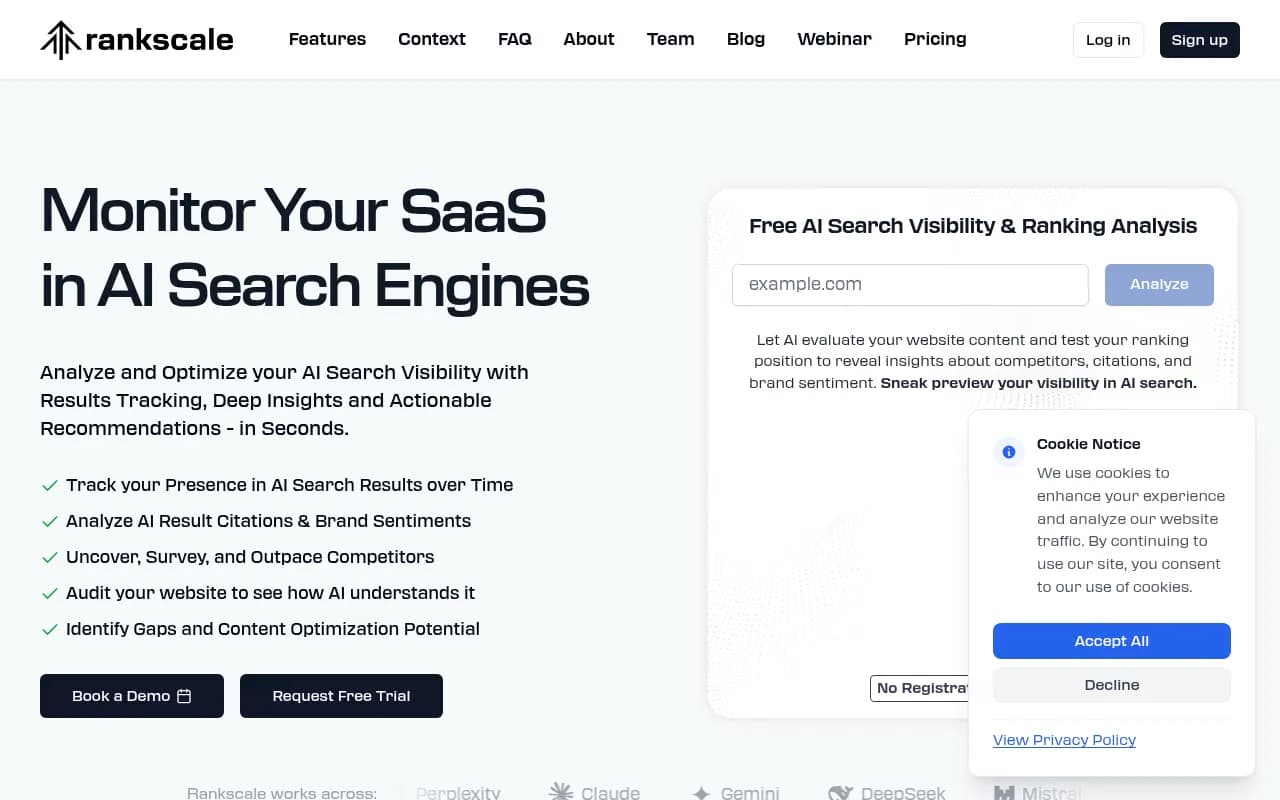
The platform covers AI search ranking and visibility monitoring across multiple models, with competitive comparison features. It's more capable than Otterly.AI in terms of depth, and the interface is built for teams that want to track multiple competitors across a range of prompts.
Where Rankscale falls short relative to Promptwatch: no content generation, no crawler logs, no traffic attribution, and no Reddit/YouTube tracking. It's a monitoring and analysis tool, not an optimization platform. Pricing is custom, which makes direct comparison harder -- it's worth requesting a demo to understand what you'd actually pay.
For agencies managing multiple client accounts who want solid monitoring without the full optimization stack, Rankscale is worth evaluating. But if content optimization is part of your mandate, you'll need to pair it with something else.
Head-to-head: the monitoring-only problem
The most important distinction in this comparison isn't price -- it's philosophy.
Peec.ai, Otterly.AI, and Rankscale are all monitoring tools. They show you data about where your brand appears (or doesn't) in AI search results. That data is genuinely valuable. Knowing you're invisible in ChatGPT for a high-intent prompt is better than not knowing.
But monitoring without action is a dead end. You can spend months watching your visibility score stay flat while your competitors improve theirs, because they're using tools that help them create content that gets cited.
Promptwatch is built around the idea that visibility data is only useful if it leads somewhere. The Answer Gap Analysis tells you what's missing. The writing agent helps you create it. The tracking shows you whether it worked. That's a fundamentally different product category, even though it lives in the same "AI visibility tool" conversation.
This isn't a knock on Otterly.AI or Peec.ai -- they're honest about what they are. But if you're evaluating tools with the goal of actually improving your AI visibility, not just measuring it, the comparison isn't really between four similar tools. It's between one optimization platform and three monitoring dashboards.
Which tool should you actually use?
The right answer depends on what you're trying to accomplish.
Use Otterly.AI if: You're just getting started with AI visibility, budget is tight, and you mainly want to know whether your brand shows up in AI answers. It's the lowest-risk way to start tracking.
Use Peec.ai if: You want a cleaner interface than Otterly.AI, you operate in multiple languages or markets, and you'd find directional content recommendations useful even if they're not execution-ready.
Use Rankscale if: You're managing multiple client accounts or competitors and want solid monitoring depth without committing to a full optimization platform. Request a demo to understand the pricing.
Use Promptwatch if: You want to actually improve your AI visibility, not just watch it. If you're serious about content optimization for AI search, need crawler logs to diagnose indexing issues, want to track ChatGPT Shopping appearances, or need to connect AI visibility to revenue -- Promptwatch is the only tool here that does all of that.
The $99/month entry point is reasonable for what you get. The Professional tier at $249/month is where the platform really opens up, with crawler logs and expanded prompt tracking.
A few other tools worth knowing about
If none of the four above feel like the right fit, a few other platforms are worth a look depending on your situation.
For enterprise teams with larger budgets, Profound has strong monitoring depth and automation capabilities.

For agencies that want traditional SEO and AI visibility in one place, SE Ranking has added AI visibility tracking to its existing SEO suite.
For teams that want deep competitive intelligence specifically, AthenaHQ covers 8+ AI search engines with solid monitoring features.

The bottom line
The AI visibility tool market is crowded and moving fast. Most tools launched in the last year or two, and many of them are still figuring out what they actually are.
The four tools in this comparison represent a real spectrum: from Otterly.AI's $29/month monitoring entry point to Promptwatch's full optimization platform. The price difference is real, but so is the capability difference.
If you're evaluating these tools in 2026, the most important question to ask isn't "which one is cheapest?" It's "what do I actually need to do with this data?" Monitoring tells you where you stand. Optimization moves you forward. Know which one you're buying before you sign up.