Key takeaways
- All four platforms track brand visibility in AI search engines, but they differ significantly in what they do with that data
- Promptwatch is the only platform in this comparison that closes the full loop: find gaps, generate content, track results
- Conductor and BrightEdge AI Catalyst are strong if you're already invested in their broader SEO ecosystems
- Evertune is purpose-built for enterprise GEO with solid narrative monitoring, but lacks content generation
- For teams that need to act on AI visibility data, not just observe it, Promptwatch has the clearest advantage
The GEO platform market has matured fast. A year ago, most tools were glorified dashboards that told you whether ChatGPT mentioned your brand. Now, the better platforms are starting to answer the harder question: what do I do about it?
This comparison focuses on four platforms that enterprise teams actually evaluate: Promptwatch, Conductor, Evertune, and BrightEdge AI Catalyst. They're not the only options, but they represent four distinct philosophies about what a GEO platform should be. Understanding those differences will save you a lot of time.
What enterprise GEO actually requires
Before getting into the platforms, it's worth being specific about what "enterprise GEO" means in practice. It's not just running a few prompts and seeing if your brand shows up. Enterprise teams need:
- Monitoring across multiple AI engines (ChatGPT, Perplexity, Claude, Gemini, Grok, and others) at scale
- Competitive benchmarking, not just your own visibility
- Content gap analysis that shows what's missing, not just what's there
- Some path to actually fixing the gaps, whether through content recommendations or generation
- Traffic attribution that connects AI visibility to revenue
- Multi-region and multi-language support
- Integrations with existing reporting stacks
Most platforms handle the first two reasonably well. The gaps appear in everything after that.
Platform overviews
Promptwatch
Promptwatch is built around what it calls the "action loop": find gaps, create content, track results. That framing matters because it signals the product is designed for optimization, not just observation.
The platform monitors 10 AI engines (ChatGPT, Perplexity, Claude, Gemini, Grok, DeepSeek, Meta AI, Copilot, Mistral, and Google AI Overviews), which is the broadest coverage in this comparison. Its Answer Gap Analysis shows you the specific prompts where competitors appear but you don't, down to the exact content topics and angles that are missing from your site.
What separates it from monitoring-only tools is the built-in AI writing agent. It generates articles, listicles, and comparisons grounded in citation data from over 880 million analyzed citations, prompt volumes, and competitor positioning. This isn't a generic content tool bolted on as an afterthought. The output is specifically engineered to get cited by AI models.
Other notable capabilities: AI Crawler Logs show you which pages ChatGPT, Claude, and Perplexity are actually reading on your site (and which they're ignoring or hitting errors on). Prompt Intelligence includes volume estimates and difficulty scores. There's Reddit and YouTube tracking, which most platforms skip entirely. ChatGPT Shopping tracking monitors product recommendation carousels. And traffic attribution connects AI visibility to actual site visits through a code snippet, GSC integration, or server log analysis.
Pricing starts at $99/month (Essential: 1 site, 50 prompts, 5 articles), $249/month (Professional: 2 sites, 150 prompts, 15 articles, crawler logs), and $579/month (Business: 5 sites, 350 prompts, 30 articles). Enterprise and agency pricing is custom. A free trial is available.

Conductor
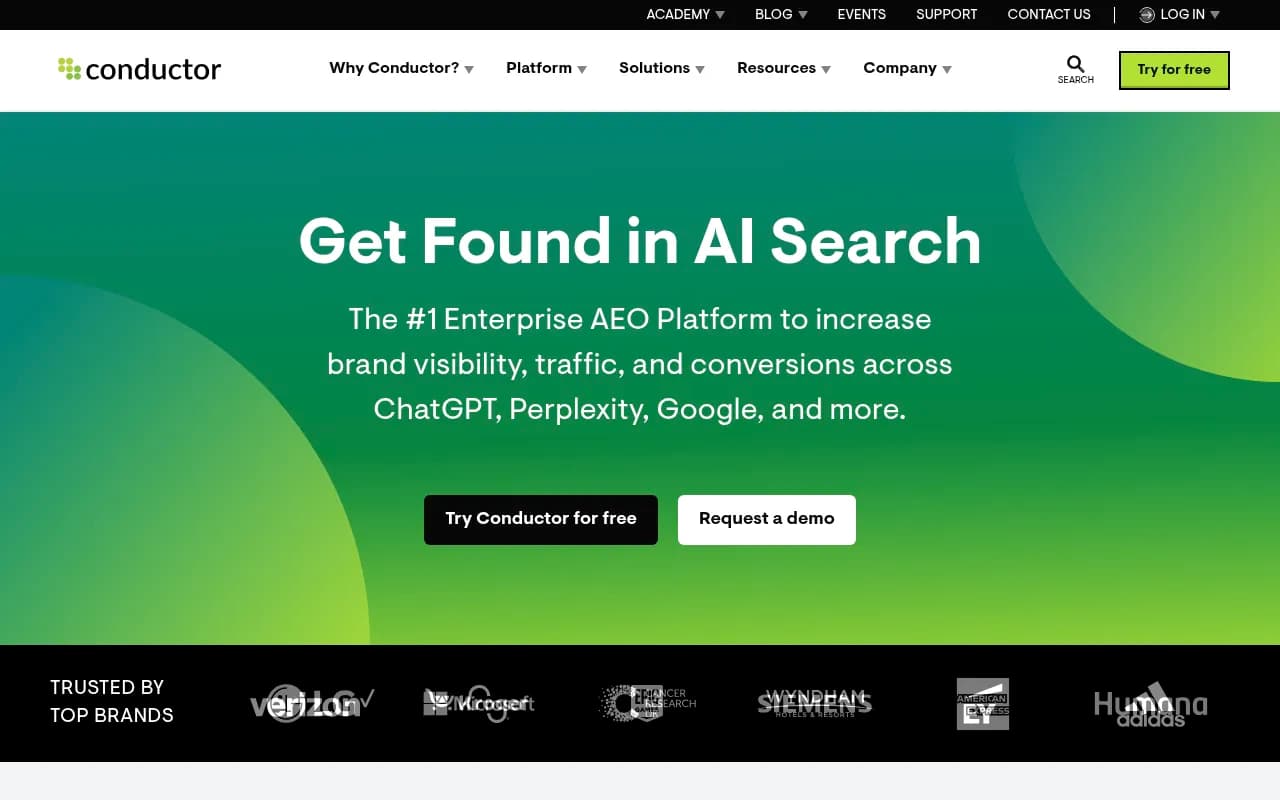
Conductor has been an enterprise SEO platform for years, and its GEO capabilities are an extension of that existing infrastructure. The platform added AI visibility tracking as search behavior shifted, which means it integrates naturally with the organic search workflows teams already have.
Conductor's strength is the SEO-to-AI bridge. If your team is already using it for traditional rank tracking, content guidance, and technical SEO, adding AI visibility monitoring doesn't require a separate tool or workflow. The persona customization for AI query monitoring is a genuine differentiator, letting you simulate how different audience segments prompt AI engines.
The limitation is that Conductor remains primarily a monitoring and guidance platform. It shows you where you stand and offers recommendations, but content generation and the kind of deep citation analysis Promptwatch provides aren't core features. For teams that want a unified SEO and GEO dashboard without switching platforms, it's a reasonable choice. For teams that need to close the gap between data and published content, it falls short.
Evertune
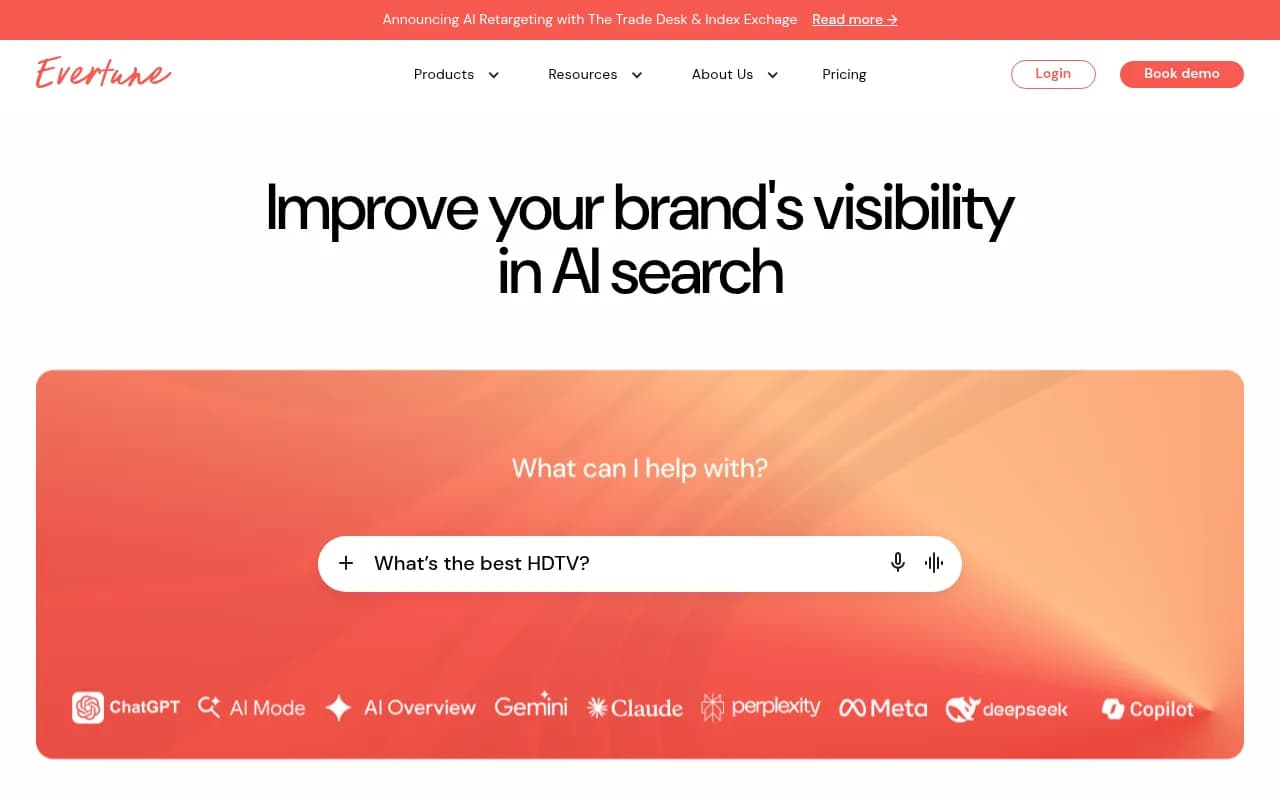
Evertune is purpose-built for enterprise GEO, which gives it a focus that broader SEO platforms lack. Its brand narrative monitoring is particularly strong: it doesn't just track whether you're mentioned, it tracks how you're described, what attributes AI models associate with your brand, and how that narrative compares to competitors.
The platform covers the major AI engines and provides competitive heatmaps that show share of voice across different prompt categories. For brand and communications teams that care as much about perception as presence, Evertune's framing is more useful than a raw mention count.
Where Evertune falls short is on the optimization side. Like most enterprise GEO tools, it's strong on monitoring and analysis but doesn't provide a path to fixing what it finds. There's no content generation, no crawler logs, and no traffic attribution. The data is good; the "now what" is left to the team.
BrightEdge AI Catalyst
BrightEdge has been an enterprise SEO staple for over a decade, and AI Catalyst is its answer to the GEO shift. The product tracks AI-generated answer visibility across major engines and integrates with BrightEdge's existing content performance and technical SEO data.
The enterprise credentials are real. BrightEdge has deep integrations, a mature reporting infrastructure, and the kind of account support that large organizations expect. If you're already a BrightEdge customer, AI Catalyst is a natural extension.
The honest limitation: AI Catalyst is still catching up to purpose-built GEO platforms on depth. The AI visibility tracking is solid but not as granular as Promptwatch or Evertune on citation analysis, competitive benchmarking, or prompt-level intelligence. It's a strong addition to an existing BrightEdge deployment, but harder to justify as a standalone GEO solution.
Head-to-head comparison
| Feature | Promptwatch | Conductor | Evertune | BrightEdge AI Catalyst |
|---|---|---|---|---|
| AI engines monitored | 10 | 5-6 | 6+ | 5-6 |
| Answer gap analysis | Yes | Limited | Limited | No |
| Content generation | Yes (AI writing agent) | No | No | No |
| AI crawler logs | Yes | No | No | No |
| Prompt volume/difficulty scoring | Yes | No | No | No |
| Reddit & YouTube tracking | Yes | No | No | No |
| ChatGPT Shopping tracking | Yes | No | No | No |
| Traffic attribution | Yes (3 methods) | Limited | No | Limited |
| Competitive heatmaps | Yes | Yes | Yes | Yes |
| Persona customization | Yes | Yes | Yes | Limited |
| Multi-language/region | Yes | Yes | Limited | Yes |
| Traditional SEO integration | Standalone | Deep (native) | Standalone | Deep (native) |
| Pricing (entry) | $99/mo | Enterprise custom | Enterprise custom | Enterprise custom |
| Free trial | Yes | No | No | No |
Where each platform wins
When Promptwatch is the right choice
If your team's goal is to actually improve AI visibility, not just measure it, Promptwatch is the clearest option. The combination of gap analysis, content generation, and crawler logs creates a workflow that the other platforms in this comparison don't offer. You can identify a prompt where a competitor is visible and you're not, generate an article targeting that gap, publish it, and then watch your visibility score change as AI models start citing the new content.
The 880M+ citation database also means the content recommendations aren't generic. The platform knows which sources AI models actually cite, which topics they want answers to, and which angles tend to get picked up. That's a different kind of intelligence than traditional keyword research.
For teams managing multiple brands or client accounts, the agency and enterprise tiers add the scale needed without requiring a separate tool for each use case.
When Conductor makes sense
Conductor is the right call for enterprise teams already using it for SEO who want to add AI visibility monitoring without adding another vendor. The workflow integration is real, and the persona customization is genuinely useful for teams that need to model different audience segments.
It's not the right choice if AI visibility is a primary initiative rather than an add-on. The monitoring depth and optimization capabilities aren't at the level of purpose-built GEO platforms.
When Evertune makes sense
Evertune is worth serious consideration for brand and communications teams where narrative accuracy matters as much as citation frequency. If your concern is not just "are we mentioned" but "are we described correctly and favorably," Evertune's framing is more aligned with that goal.
It's also a reasonable choice for enterprise teams that have a separate content production workflow and just need strong monitoring and competitive intelligence to feed it.
When BrightEdge AI Catalyst makes sense
Existing BrightEdge customers are the obvious audience. If you're already paying for the platform and have the account infrastructure in place, AI Catalyst adds AI visibility tracking without a new procurement process. For net-new buyers evaluating GEO platforms, it's harder to recommend over purpose-built alternatives.
The monitoring-only problem
One pattern worth naming directly: most enterprise GEO platforms, including Evertune, Conductor, and BrightEdge AI Catalyst to varying degrees, are monitoring-first products. They tell you what's happening. They don't help you change it.
This isn't a minor gap. The whole point of tracking AI visibility is to improve it. If your platform shows you that a competitor appears in 40% of relevant AI responses and you appear in 8%, the next question is: what do I publish to close that gap? Most platforms leave that question unanswered.
Promptwatch's answer gap analysis and content generation are designed specifically for this. The platform shows you the exact prompts where you're losing, the content topics that would address them, and then generates that content. It's a workflow, not just a report.
Practical considerations for enterprise buyers
A few things that don't show up in feature tables but matter in practice:
Onboarding speed. Promptwatch has a free trial and transparent pricing, which means you can evaluate it without a sales cycle. Conductor, Evertune, and BrightEdge AI Catalyst all require enterprise conversations before you can see the product in depth.
Prompt coverage. The number of prompts you can monitor matters at scale. Promptwatch's Business tier covers 350 prompts across 5 sites. If you need more, enterprise pricing is available. For large brands with hundreds of product categories, this is a real planning consideration across all platforms.
Attribution. Connecting AI visibility to revenue is still an unsolved problem for most teams. Promptwatch offers three attribution methods (code snippet, GSC integration, server log analysis), which is more than any other platform in this comparison provides.
Crawler intelligence. Understanding which pages AI engines actually read, and which they skip or encounter errors on, is a capability that most platforms don't offer at all. Promptwatch's AI Crawler Logs fill a gap that matters for technical teams trying to understand why certain pages aren't getting cited.
Bottom line
These four platforms aren't really competing for the same buyer. BrightEdge AI Catalyst is for existing BrightEdge customers. Conductor is for teams that want SEO and GEO in one place and are already in the Conductor ecosystem. Evertune is for enterprise brand teams that prioritize narrative monitoring.
Promptwatch is for teams that want to actually move the number. The monitoring is there, the competitive intelligence is there, but the differentiator is what happens after you see the data: a clear path to creating content that gets cited, tracking whether it works, and connecting the whole thing to traffic and revenue.
For most enterprise marketing and SEO teams evaluating GEO platforms in 2026, that's the capability that matters most.