Key takeaways
- Profound is the most feature-rich of the three, with up to 10 LLMs tracked and agent-based content tools, but its pricing reflects that -- it's built for enterprise teams with the budget to match.
- Scrunch AI sits in a similar price bracket, with strong multi-engine coverage and SOC 2 Type II compliance, but leans heavily on insights rather than actionable optimization.
- Searchable is the most affordable entry point of the three, but covers fewer AI engines and is better suited to smaller teams or those just starting out with AI visibility.
- None of the three platforms offer the full action loop (gap analysis + content generation + traffic attribution) that more complete GEO platforms provide -- worth knowing before you commit.
- If you're a B2B SaaS team that needs to move from tracking to actually improving AI visibility, the platform you choose matters more than it might seem.
The AI search visibility category has gotten crowded fast. In 2024, there were maybe a handful of tools worth considering. By mid-2026, there are dozens -- and the differences between them are real enough to matter for your budget and your results.
Profound, Searchable, and Scrunch are three platforms that come up regularly in B2B SaaS conversations. They're not the cheapest options, and they're not identical. This guide breaks down what each one actually does, where they fall short, and which type of team is most likely to get value from each.
Let's get into it.
What we're actually comparing
Before the feature breakdown, it helps to be clear about what "AI visibility" means in practice. When a prospect asks ChatGPT "what's the best project management tool for remote engineering teams?" -- your brand either appears in that answer or it doesn't. AI visibility tools track how often you appear, in which AI engines, for which prompts, and how you compare to competitors.
The question is whether a tool just shows you that data, or whether it helps you do something about it. That distinction separates monitoring dashboards from optimization platforms -- and it's the most important lens for evaluating these three tools.
Profound

Profound has positioned itself as the enterprise standard for AI search visibility. It tracks up to 10 LLMs on its higher tiers -- ChatGPT, Perplexity, Claude, Gemini, and others -- and its dashboard gives you share of voice data, citation tracking, and prompt-level breakdowns.
The agent-based content features are the most interesting part of Profound's pitch. Rather than just showing you where you're invisible, it has tools that help you generate content responses to specific prompts. That's closer to the optimization end of the spectrum than pure monitoring.
Pricing
Profound starts at $99/month for a single AI engine. That's a reasonable entry point, but the single-engine limitation is a real constraint -- if you want multi-LLM coverage, you're moving up the pricing ladder quickly. Enterprise tiers with 10 LLMs are custom-priced.
One thing worth noting: Profound has SOC 2 compliance, which matters if you're selling into regulated industries or if your own security team needs to sign off on third-party tools.
What B2B SaaS teams like about it
The depth of prompt-level data is genuinely useful. You can see exactly which questions your competitors are getting cited for and you're not -- that's actionable intelligence for a content team. The agent-based features, while not fully autonomous, give you a starting point for creating content that's more likely to get picked up by AI models.
Where it falls short
The price-to-value equation gets harder to justify for teams below a certain size. If you're a 5-person marketing team at a Series A company, the enterprise features are probably more than you need, and the entry-level plan's single-engine coverage is probably less than you need. There's an awkward middle ground.
Profound also doesn't offer Reddit or YouTube tracking -- two sources that heavily influence what AI models cite. That's a gap for any B2B SaaS brand where community discussions drive awareness.
Searchable
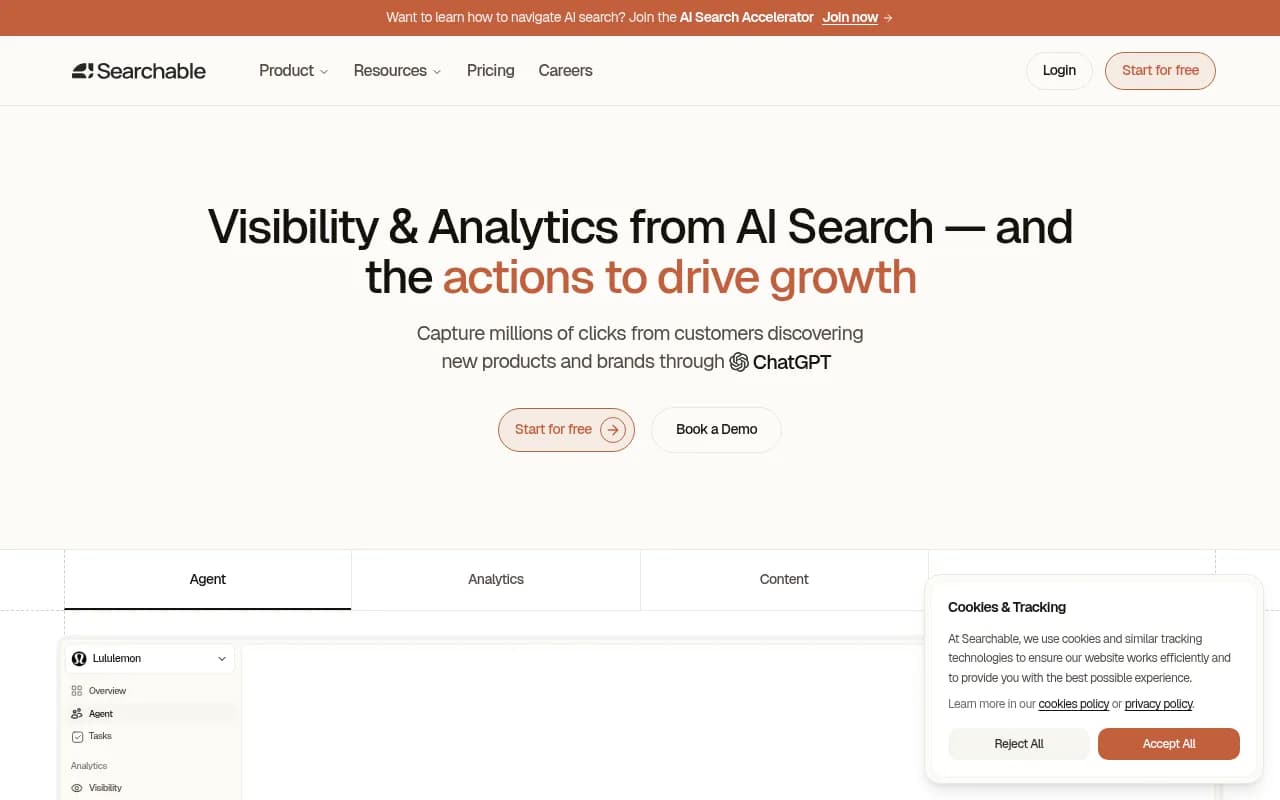
Searchable is the most affordable of the three, starting around $50/month. It covers fewer AI engines on its starter plan (one engine, scaling to three on the Pro tier), but it includes AI content generation tools alongside its monitoring features.
That combination -- monitoring plus content help at a lower price point -- makes it worth considering for smaller B2B SaaS teams that are just getting started with GEO and don't have the budget for an enterprise platform.
Pricing
The $50/month entry point is genuinely accessible. The Pro tier unlocks more engines and more content generation capacity. For a startup or a small marketing team running lean, this is one of the more realistic options in the category.
What B2B SaaS teams like about it
The site audit features are a useful addition. Beyond just tracking AI citations, Searchable looks at your site's overall structure and content in a way that connects AI visibility to your broader SEO health. For teams that don't have a dedicated technical SEO resource, that's a practical bonus.
The content generation angle also means you're not just receiving data -- you have a path to acting on it within the same platform.
Where it falls short
Three AI engines on the Pro plan is limiting in 2026. If you care about visibility across ChatGPT, Perplexity, Claude, Gemini, and Google AI Overviews simultaneously (which most B2B SaaS teams should), three engines won't cover your bases. You'd be making trade-offs about which AI models to monitor.
The platform also lacks the depth of prompt intelligence -- volume estimates, difficulty scoring, query fan-outs -- that more mature platforms offer. If you're trying to prioritize which prompts to target first, you're largely working without that data.
Scrunch AI
Scrunch AI sits at the higher end of the self-serve market. Its Core plan is around $250-300/month and covers 4-8 AI engines depending on the tier, with 5 user licenses included. The Enterprise tier tracks 9 LLMs and is custom-priced.
Scrunch has SOC 2 Type II certification, which is the same compliance standard as Profound -- useful for enterprise procurement conversations. It also includes a 7-day free trial on the Core plan.
Pricing
The $250-300/month Core plan includes 125 prompts and 5 user seats. For a team that needs multiple people accessing the same dashboard, the seat bundling is a practical advantage over tools that charge per user. The per-prompt economics are reasonable at that tier.
What B2B SaaS teams like about it
The multi-user access at the Core tier is genuinely useful for B2B SaaS marketing teams where multiple people -- content, demand gen, product marketing -- need to pull data. Not having to negotiate seat costs separately simplifies the buying conversation.
The enterprise-grade compliance posture also makes Scrunch easier to get approved through procurement at larger companies.
Where it falls short
Scrunch leans heavily on insights and reporting. The platform shows you what's happening in AI search, but the path from data to action is less clear than you'd hope. There's no built-in content generation, no answer gap analysis that surfaces specific content you're missing, and no traffic attribution to connect AI visibility to actual pipeline.
One comparison from Nick Lafferty's blog is worth noting: Profound ranked #1 in AI search with 47.1% AI visibility versus Scrunch's #23 ranking at 4.7%. That's not a definitive verdict on which tool is better for your brand, but it does suggest Profound's own team has invested more in the optimization side of the equation.
Side-by-side comparison
| Feature | Profound | Searchable | Scrunch AI |
|---|---|---|---|
| Starting price | $99/mo | $50/mo | ~$250-300/mo |
| AI engines (entry plan) | 1 | 1 | 4 |
| Max AI engines | 10 (Enterprise) | 3 (Pro) | 9 (Enterprise) |
| Content generation | Agent-based | Yes | No |
| Answer gap analysis | Partial | Limited | No |
| Reddit/YouTube tracking | No | No | No |
| Traffic attribution | No | No | No |
| AI crawler logs | No | No | No |
| SOC 2 compliance | Yes | Not confirmed | Yes (Type II) |
| Multi-user seats | Per plan | Per plan | 5 included (Core) |
| Free trial | Yes | Yes | 7-day |
| Best for | Enterprise teams | Smaller teams / startups | Mid-market / enterprise |
The gap none of them fully close
Here's the honest assessment: all three platforms are primarily monitoring tools. Profound comes closest to optimization with its agent-based features, but even there, the loop isn't fully closed.
What B2B SaaS teams actually need is a workflow that goes: find the prompts you're missing → understand why → create content that fixes it → track whether that content gets cited → connect citations to traffic and revenue. That's a complete cycle, and none of these three platforms deliver all of it.
If that full loop matters to you, it's worth looking at platforms built specifically around the optimization workflow rather than monitoring-first. Promptwatch is one example -- it's built around answer gap analysis, AI-native content generation grounded in citation data, and traffic attribution that connects AI visibility to actual revenue. It's a different philosophy from the three tools above.

That said, Profound, Searchable, and Scrunch each have legitimate use cases. The question is whether monitoring alone is enough for where your team is right now.
Which one should you choose?
The honest answer depends on three things: your budget, your team size, and what you actually want to do with the data.
Choose Profound if you're at a growth-stage or enterprise company with a real content team, you need SOC 2 compliance, and you want the deepest prompt-level data available in a self-serve platform. Be prepared for the price to scale as you add engines.
Choose Searchable if you're a smaller B2B SaaS team, you're earlier in your GEO journey, and you want monitoring plus some content generation capacity without spending $250+ per month. Accept the limitation of fewer AI engines and build from there.
Choose Scrunch AI if you need multiple team members accessing the same platform, SOC 2 compliance matters for your procurement process, and you're comfortable with an insights-focused tool rather than one that guides you toward specific actions.
Consider alternatives if you need the full optimization loop -- gap analysis, content generation, and traffic attribution in one place. The monitoring-only approach will tell you where you're losing, but it won't help you win.
A note on the broader landscape
The AI visibility category is still maturing. Platforms that launched in 2024 as pure monitoring dashboards are adding optimization features. Established SEO tools like Semrush and Ahrefs have added AI visibility modules, though with limitations -- Semrush uses fixed prompts, and Ahrefs Brand Radar lacks traffic attribution.
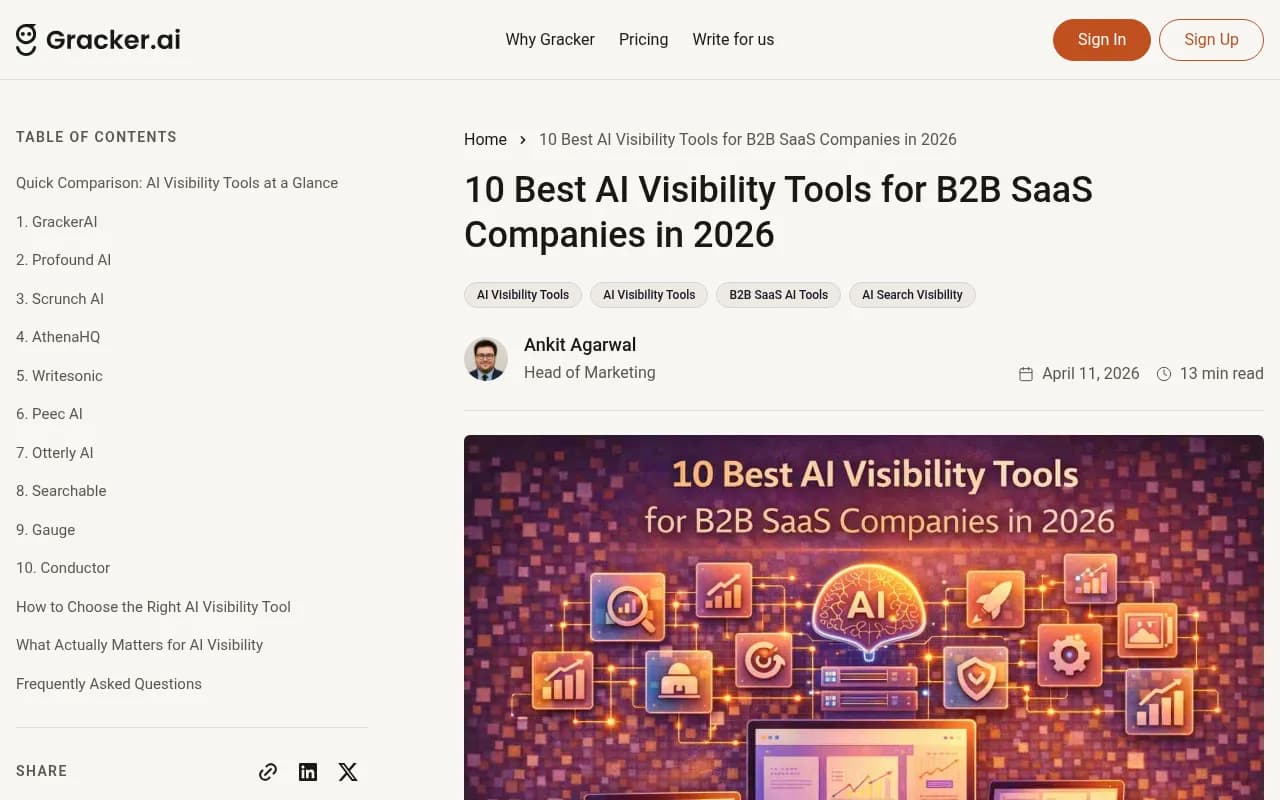
For B2B SaaS specifically, the stakes are high. According to research cited by GrackerAI, 40% of B2B buyers now use AI assistants to research software solutions. If your brand isn't appearing in those answers, you're invisible to a meaningful chunk of your potential pipeline -- and a monitoring dashboard alone won't fix that.
The right tool is the one that helps you move from knowing you're invisible to doing something about it.