Key takeaways
- Peec.ai is a clean monitoring tool that tracks AI citation visibility across multiple engines -- good for reporting, but stops there.
- Gauge focuses on competitive intelligence, showing you how rivals appear in AI search and where the gaps are.
- Promptwatch is the only one of the three that closes the loop: it finds gaps, generates content to fill them, and tracks whether that content gets cited.
- If your goal is to actually improve your AI search visibility (not just measure it), Promptwatch is the most complete option.
- All three have free trials, so you can test before committing.
The GEO tool market has gotten crowded fast. In early 2025, there were maybe a dozen platforms worth considering. By mid-2026, there are well over fifty. Most of them do roughly the same thing: query a handful of AI engines, check if your brand shows up, and put the results in a dashboard.
So when someone asks "which platform should I use?" the honest answer is: it depends on what you're trying to do with the data.
This guide compares three platforms that come up frequently in that conversation -- Peec.ai, Gauge, and Promptwatch. They're not identical products. They have meaningfully different philosophies about what "AI search visibility" actually means and what you should do about it. That difference matters more than any feature checklist.
What each platform is actually trying to do
Before getting into specifics, it helps to understand the core purpose of each tool.
Peec.ai launched as one of the earlier dedicated AI visibility trackers. Its pitch is clean reporting: track where your brand appears in AI-generated responses, monitor competitors, and surface prompt-level analytics. It covers Google AI Overviews, ChatGPT-style engines, and a handful of other LLMs. The interface is tidy and the data is easy to read. It's genuinely useful if you need to show stakeholders "here's how we're doing in AI search."
Gauge positions itself more explicitly around competitive intelligence. The emphasis is on understanding the competitive landscape in AI search -- who's getting cited, for which prompts, and what the gap looks like between you and your rivals. It's a useful framing for teams that care less about their absolute visibility score and more about relative positioning.
Promptwatch takes a different approach entirely. It's built around what it calls an action loop: find the gaps, create content to fill them, track the results. The monitoring is there, but it's treated as the starting point rather than the destination.

Peec.ai: solid monitoring, limited action
Peec.ai does the basics well. You set up your brand, add competitor names, define a set of prompts, and the platform starts querying AI engines to see who appears where. The reporting is clean. The UI doesn't require much onboarding.

Where it runs into trouble is the "now what?" question. Peec.ai shows you data. It doesn't tell you what to do with it. If your visibility score drops, you'll see the drop -- but the platform doesn't help you understand why, or what content you'd need to create to recover.
A few other limitations that come up in real usage:
- Coverage is decent but not exhaustive. Perplexity, ChatGPT, and Google AI Overviews are covered, but some of the newer or more niche AI engines aren't.
- Prompt research is thin. You can track prompts you define, but there's no built-in tool to discover which prompts are worth tracking in the first place.
- No content generation. If you identify a gap, you're on your own to fix it.
- No crawler log data. You can't see which AI bots are visiting your site or how often.
That said, for teams that just need a reporting layer -- something to put in a monthly deck or share with a client -- Peec.ai is functional and not expensive. Starting at $89/month, it's one of the more affordable options in the space.
The honest assessment: Peec.ai is a monitoring tool. It's good at monitoring. If that's all you need, it works. If you need to act on what you find, you'll need something else alongside it.
Gauge: competitive intelligence with a strategic lens
Gauge takes a more competitive-intelligence-oriented angle. The core question it's designed to answer is: "Who is winning in AI search for my category, and why?"
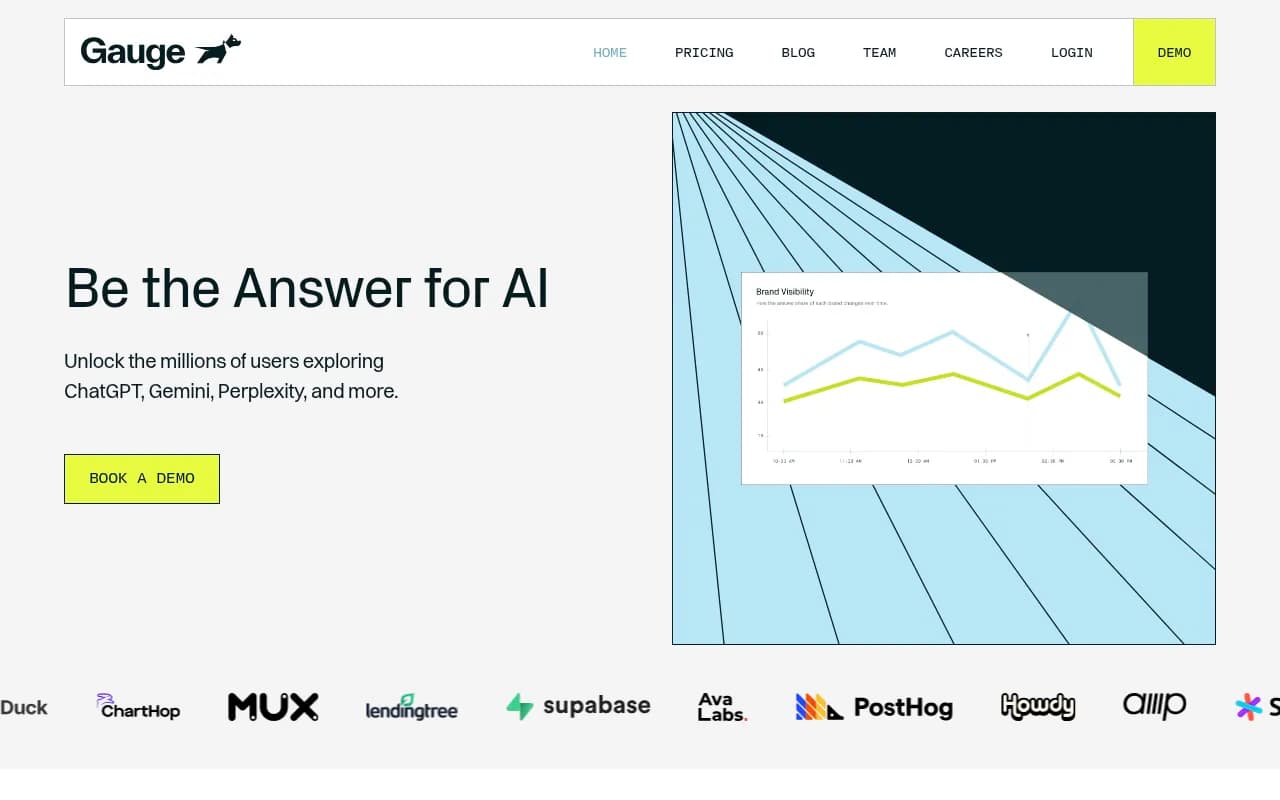
That framing makes it genuinely useful for a certain kind of user -- typically a strategist or a competitive analyst who wants to understand the AI search landscape before deciding where to invest. Gauge surfaces which competitors are getting cited, for which types of prompts, and across which AI engines. The heatmap-style views make it easy to spot patterns.
What Gauge does well:
- Competitive benchmarking is the strongest part of the product. The side-by-side views of brand vs. competitor citation rates are clear and actionable.
- The platform is good at surfacing prompt categories where competitors are visible but you're not -- which is genuinely useful intelligence.
- The interface is well-designed and the learning curve is low.
Where it falls short:
- Like Peec.ai, Gauge is primarily a monitoring and analysis tool. It shows you the gap; it doesn't help you close it.
- Content generation isn't part of the product. You get the intelligence, but the execution is on you.
- Prompt volume data is limited. Knowing a competitor ranks for a prompt is useful, but knowing how many people are actually asking that prompt is more useful -- and Gauge doesn't go deep there.
- No crawler log visibility.
Gauge is a good fit for teams doing competitive research or building a GEO strategy from scratch. It's less useful for teams that already know where they're losing and need help winning.
Promptwatch: monitoring plus the full optimization loop
Promptwatch covers the monitoring basics that Peec.ai and Gauge offer, but the product is built around what happens after you have the data.
The Answer Gap Analysis is the most distinctive feature. It shows you exactly which prompts your competitors are visible for that you're not -- not just as a list, but with context about what content would need to exist on your site for AI models to cite you. That's a different kind of output than a visibility score.
From there, Promptwatch has a built-in AI writing agent that generates articles, listicles, and comparison pages grounded in citation data. The content it produces is engineered to get cited by ChatGPT, Claude, Perplexity, and other AI engines -- not generic SEO filler. The platform has analyzed over 880 million citations to understand what kinds of content AI models actually reference.
Then the loop closes: page-level tracking shows which of your pages are being cited, by which AI engines, and how often. Traffic attribution connects that visibility to actual sessions and revenue.
A few other things that set it apart:
- AI crawler logs show you which AI bots (ChatGPT, Claude, Perplexity, etc.) are crawling your site, which pages they're reading, and whether they're hitting errors. Most competitors don't offer this at all.
- Prompt Intelligence includes volume estimates and difficulty scores, so you can prioritize high-value prompts instead of guessing.
- Reddit and YouTube tracking surfaces discussions that directly influence AI recommendations -- a channel most platforms ignore.
- ChatGPT Shopping tracking monitors when your brand appears in product recommendations and shopping carousels.
- Multi-language and multi-region monitoring with customizable personas.
Promptwatch monitors 10 AI models: ChatGPT, Perplexity, Google AI Overviews, Google AI Mode, Claude, Gemini, Meta/Llama, DeepSeek, Grok, Mistral, and Copilot.
Pricing runs from $99/month (Essential: 1 site, 50 prompts, 5 articles) to $249/month (Professional: 2 sites, 150 prompts, 15 articles, crawler logs) to $579/month (Business: 5 sites, 350 prompts, 30 articles). Agency and enterprise pricing is available on request.
Side-by-side comparison
| Feature | Peec.ai | Gauge | Promptwatch |
|---|---|---|---|
| AI engine coverage | ChatGPT, Perplexity, Google AIO, others | ChatGPT, Perplexity, Google AIO, others | 10 engines incl. Claude, Gemini, Grok, DeepSeek, Copilot, Meta AI |
| Brand monitoring | Yes | Yes | Yes |
| Competitor tracking | Yes | Yes (strong) | Yes |
| Prompt-level analytics | Basic | Moderate | Advanced (volume + difficulty scores) |
| Answer gap analysis | No | Partial | Yes (full gap analysis) |
| Content generation | No | No | Yes (AI writing agent) |
| AI crawler logs | No | No | Yes |
| Reddit/YouTube tracking | No | No | Yes |
| ChatGPT Shopping tracking | No | No | Yes |
| Traffic attribution | No | No | Yes (GSC, code snippet, server logs) |
| Page-level citation tracking | No | No | Yes |
| Multi-language/region | Limited | Limited | Yes |
| Starting price | $89/mo | Custom | $99/mo |
| Best for | Reporting, small teams | Competitive analysis | Full optimization cycle |
Who should use which tool
The right answer genuinely depends on what stage you're at and what you're trying to accomplish.
Peec.ai makes sense if you're early in your GEO journey, need a simple reporting layer, and aren't yet ready to invest in optimization. It's also a reasonable choice for agencies that need to show clients AI visibility data without a big budget commitment.
Gauge is a better fit if competitive intelligence is the primary use case -- if you're doing market research, building a strategy, or trying to understand the AI search landscape in your category before deciding where to invest. The competitive benchmarking is genuinely strong.
Promptwatch is the right choice if you want to actually move the needle. The monitoring is there, but the product is built for teams that want to find gaps, create content that fills them, and track whether it's working. That's a fundamentally different product than a monitoring dashboard -- and for most marketing teams, it's the more useful one.
A note on the broader market
These three platforms aren't the only options. The GEO tool space has expanded significantly, and there are solid alternatives worth knowing about depending on your specific needs.
For teams that want SEO and AI visibility in one platform, tools like SE Ranking and Semrush have added AI monitoring features to their existing suites.

For teams focused specifically on brand narrative and how AI models describe your company (not just whether you appear), Scrunch AI takes a different angle.
For enterprise teams with more complex requirements, AthenaHQ and Profound both offer strong feature sets, though at higher price points.


And for agencies that need something lightweight and affordable to show clients, Otterly.AI covers the basics at a lower cost.

The monitoring-only problem
One thing worth saying directly: most GEO tools stop at monitoring. They show you data. They don't help you act on it.
That's not a criticism of any specific platform -- it's just an accurate description of where most of the market is right now. Peec.ai and Gauge both fall into this category. They're useful tools, but they hand you a report and leave you to figure out the rest.
The teams that are actually improving their AI search visibility in 2026 are the ones closing the loop: identifying gaps, creating content specifically engineered to get cited, and tracking whether it works. That cycle is harder to execute without tooling that supports all three steps.
Promptwatch is currently the most complete option for that full cycle. Whether that's worth the price difference over a monitoring-only tool depends on how seriously you're treating AI search as a channel -- and how much time you want to spend doing the optimization work manually.
If AI search is a nice-to-have metric you're tracking, Peec.ai or Gauge will do the job. If it's a channel you're actively trying to win, the monitoring-only approach will leave you stuck.
Bottom line
Peec.ai is a clean, affordable monitoring tool. Gauge is a strong competitive intelligence platform. Promptwatch is the only one of the three that's built to help you actually improve your visibility, not just measure it.
All three have free trials. The best way to evaluate them is to run the same set of prompts through each and see which output is most useful for your specific situation. The data will tell you more than any comparison guide can.