Key takeaways
- Brand-level AI visibility tells you how a franchise is described nationally. It says little about whether ChatGPT recommends the Dallas location or the one in Tulsa.
- Location-level tracking needs three things: realistic prompts built from service + city, results recorded by location, and a way to separate mentions, citations and recommendations.
- Tool coverage varies a lot. Some trackers only cover ChatGPT and Gemini, some do grid-style geographic sampling, and some charge extra for city-level tracking.
- Per-location landing pages, reviews and consistent listings are the practical levers. ChatGPT's own search queries are getting shorter, so lead with service and city.
- Treat every single response as a sample, not a verdict.
Why franchises need location-level AI tracking
A homeowner with a burst pipe doesn't ask an AI assistant for plumbing theory. They ask for an emergency plumber who can arrive fast. As Localogy noted in October 2026, the answer depends on where the person is prompting from, which geographic terms they use, and which businesses have a real presence nearby.
For a franchise, that creates an awkward reporting problem. Your national dashboard might say the brand shows up in 40% of relevant prompts. Meanwhile twelve locations could be invisible and three could be dominating. The average hides both groups.
Brand-level tracking still matters. It covers product comparisons, reputation checks and generic "best of" requests with no geography. Local tracking answers a different question: where do we actually earn recommendations, and where do we not?
| Question | Brand-level tracking | Location-level tracking |
|---|---|---|
| Typical prompt | "Best tax prep company" | "Tax preparer near Austin, TX" |
| What it tells you | National reputation and share of voice | Which stores get recommended |
| Who acts on it | Corporate marketing | Franchisees, regional managers, local agencies |
| Main fix | PR, content, brand sources | Location pages, reviews, listings |
How ChatGPT knows where the user is
This is worth understanding before you design a test. Users on the OpenAI community forum have guessed that ChatGPT infers location from IP address geolocation, and Reddit threads show people noticing location-flavored answers on topics that never mentioned a place. Neither is an official explanation, so treat it as a working assumption, not a fact.
The practical consequence is that you can't just run a prompt from your head office and assume everyone sees the same answer. Either put the city in the prompt, or use a tool that simulates the location for you.
Mentions, citations and recommendations are different things
AEO consultant Jenny's walkthrough on local business mentions in ChatGPT makes a distinction I find useful, and plenty of dashboards blur it:
- A mention means the business name appears in the answer.
- A citation means a page from your site, or a page about you, is listed as a source.
- A recommendation means the AI actually points the user toward you, usually in a ranked or highlighted position.
A location can be mentioned without being recommended ("Other options include..."). It can be cited without being named. Track all three per location, because each points at a different problem. Mentions without citations suggest ChatGPT knows you exist but doesn't trust your own pages. Citations without recommendations suggest your content is fine but competitors have stronger local signals.
A manual method you can start this week
Before buying anything, run a small test on five or six locations. It will tell you whether the problem is big enough to pay to monitor.
Build the prompt set
For each location, write 5 to 10 prompts that a real customer would type. Use service + city, and vary the intent:
- Commercial: "best [service] in [city]"
- Urgent: "[service] open now near [neighborhood]"
- Branded: "is [brand] in [city] any good"
- Comparison: "[brand] vs [competitor] in [city]"
Use neighborhoods and suburbs too, not just the headline city. Franchise territories rarely match city limits.
Record results consistently
Use one spreadsheet with a row per location, prompt and date. Columns: mentioned (yes/no), position in the list, cited URL, which competitors appeared, and which sources were cited. Run each prompt several times, because AI answers vary between runs and one response is only a sample.
Review who else shows up and why
Look at the cited sources. If a directory, a local news piece or a Reddit thread keeps appearing in a city where you're absent, that's your gap. Reddit is worth checking, but note that Promptwatch Data shows reddit.com's share of ChatGPT citations fell from about 4% to 0.5% on August 14, 2026, so don't build a local strategy on forum mentions alone.
Manual testing breaks down fast. Fifty locations times eight prompts times three runs is 1,200 checks per cycle. That's where tools come in.
Approaches to automated local tracking
There are three broad designs, and they suit different franchise setups.
Grid-based sampling
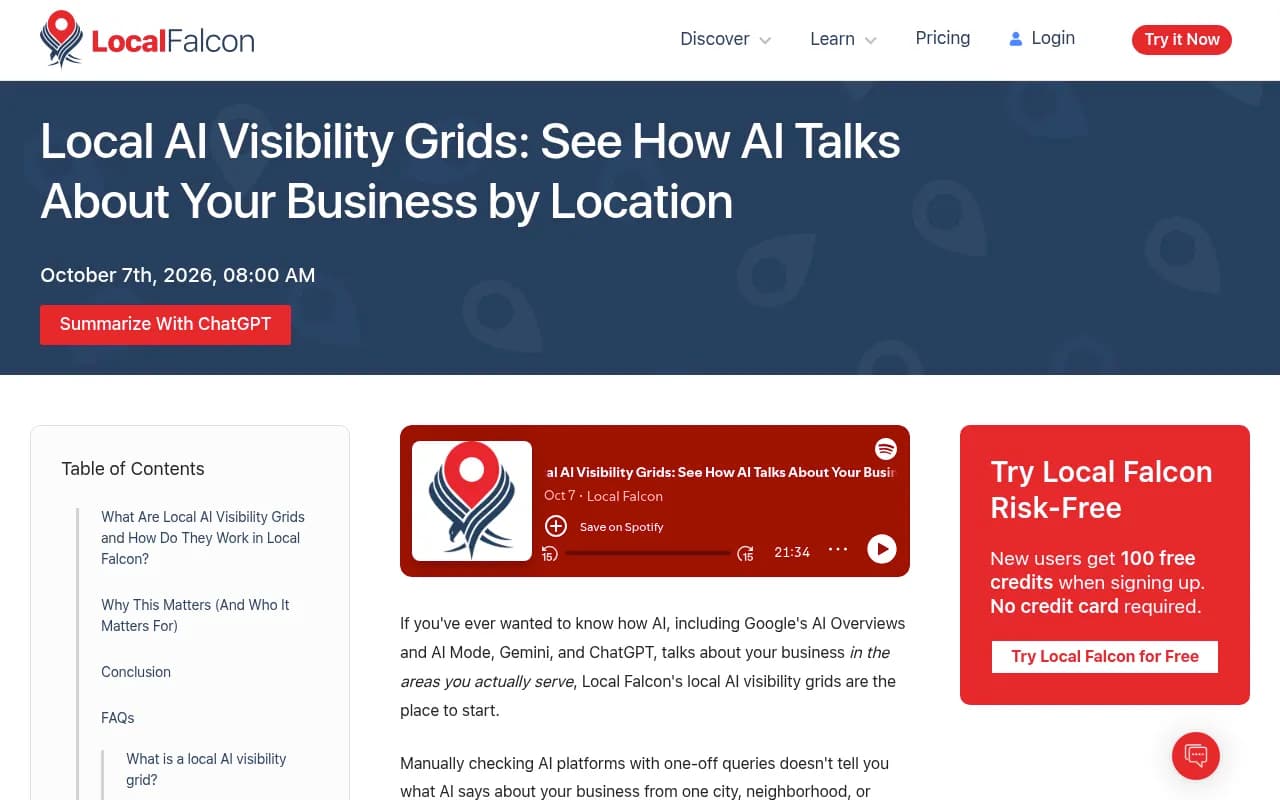
Local Falcon published a piece in October 2026 on local AI visibility grids. The idea carries over from map-pack rank tracking: sample AI answers from many points across the area a business serves, then show how the picture changes from one neighborhood or block to the next. Its article covers Google AI Overviews, AI Mode, Gemini and ChatGPT, and argues that one-off manual checks can't show that variation. I only saw the introduction, so check its documentation for the exact metrics and color scale.
Grids are strongest for a single location's service area. They get heavy when you manage 200 stores.
Multi-location dashboards
Platforms built for franchise marketing teams track by assistant, prompt and location in one view, so a regional manager can see which stores to lift next. Social Places runs an AI visibility product like this, though its FAQ says it currently covers ChatGPT and Gemini only. That's a real limit if your customers use Perplexity, Copilot or Google AI Mode.
SOCi pitches itself as agentic AI for local search, social and reviews across locations. Its AI-visibility page timed out when I tried to read it, so I can't vouch for specifics.
Yext and Birdeye come from the listings and reputation side, which matters because local AI answers lean on that data.
Prompt trackers with city-level tracking
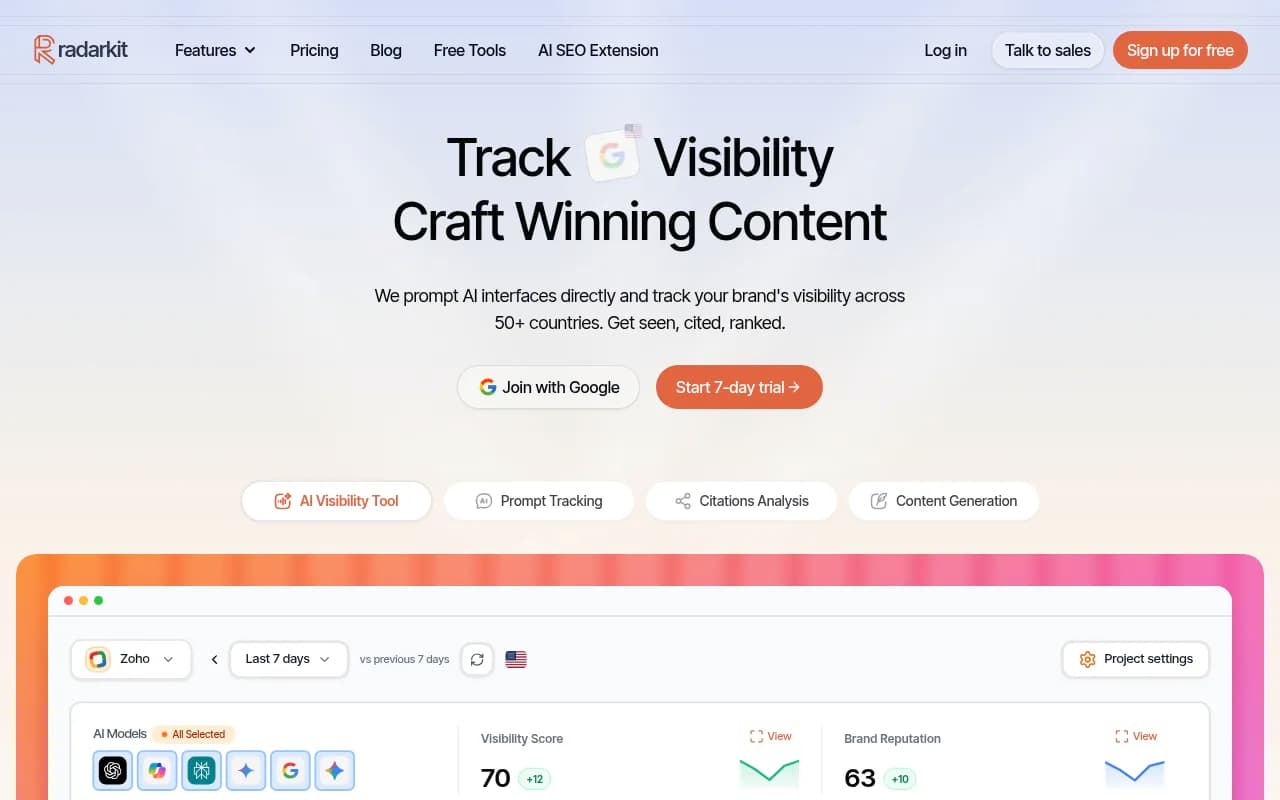
General AI visibility trackers increasingly let you pick a country, state or city. RadarKit lists ChatGPT, AI Mode, AI Overviews, Copilot, Perplexity and Gemini, with plans at $29, $79 and $139 per month. Its video description says dedicated state and city-level tracking sits under Enterprise, and I couldn't verify current pricing.
For franchises that also want to see what to fix, Promptwatch tracks the real interfaces of ChatGPT, AI Overviews, AI Mode, Gemini, Perplexity and Copilot. It has country tracking on every paid plan and state/city tracking from the Business plan, and it adds crawler logs and page-level citation data so you can see whether AI is even reading your location pages. Confirm the current tiers at promptwatch.com/pricing.

Tool comparison for franchise use
| Tool | Approach | Location granularity | Coverage notes |
|---|---|---|---|
| Local Falcon | Grid sampling | Points across a service area | Google AI Overviews, AI Mode, Gemini, ChatGPT |
| Social Places | Multi-location dashboard | By location, prompt, assistant | ChatGPT and Gemini only |
| SOCi | Local marketing suite | Per location | Unverified, page timed out |
| RadarKit | Prompt tracker | City-level on Enterprise | Six AI platforms listed |
| Promptwatch | Visibility platform with optimization | Country on all paid plans, state/city from Business | Real UI tracking, crawler logs, content tools |
| Peec AI | Prompt tracker | Check current plans | Multi-language tracking |

Pricing and location features change quickly, and I haven't verified current plans for most of these. Ask each vendor three questions: can I set a city or zip per prompt, how many prompts per location do I get, and do you track the assistants my customers use?
If you want to compare more options, the GEO software directory at bestgeosoftware.com lists a wider set of tools.
What to fix when a location disappears
Tracking is useless if nothing changes afterward. Here's where I'd look, in order.
Give every location its own real page
Promptwatch Data for Sep 28 to Oct 4, 2026 found that product pages account for 22.4% of ChatGPT citations and landing pages 16.8%. So roughly 39% of citations go to pages describing what a company sells. For branded prompts, landing pages rise to 22.8% and reviews reach 5.6%, more than three times their share across all prompts.
The report doesn't break out franchises, so this part is my inference: a unique page per location with address, services, hours, staff and local FAQs is probably your best shot at being cited for "near me" style prompts. A single store-locator widget that renders client-side gives AI very little to read.
Write titles the way ChatGPT searches
Promptwatch's query fanout data shows average query length falling from about 117 characters in early December to roughly 53 characters in April 2026. ChatGPT's searches look more like short keyword queries now. Put the service and city first in titles and H2s, such as "Emergency plumbing in Phoenix", instead of burying the city in a long sentence.
Keep listings and reviews consistent
AI systems pull from directories, review sites and maps. Mismatched hours or old addresses across a franchise network produce wrong answers, or no answer. Audit name, address and phone data per location, and respond to reviews. This is the unglamorous part, and it usually pays off first.
Check that AI can crawl the pages
If location pages sit behind scripts, login walls or robots rules, no amount of copy editing helps. Look at your crawler logs, or run a free AI crawler check, before rewriting anything.
Watch who beats you locally
In many cities the winners are directories and aggregators, not competing franchises. Promptwatch Data's travel report shows booking and search sites earning more than half of ChatGPT citations in that category, and its automotive report shows marketplaces like Autotrader and Cars.com outranking every car brand. If aggregators dominate your category, getting listed or reviewed there may beat publishing more of your own pages.
Setting up reporting that franchisees will read
A 300-row export won't get used. A few things that do:
- A single appearance rate per location, with a traffic-light threshold.
- A short list of the three locations that dropped most since last month.
- The top competitor and top cited source for each weak location.
- A monthly cadence, with weekly checks only on locations under active repair.
Keep the national brand view next to the local one. If the brand is strong but a region is weak, that's a rollout or listings issue. If both are weak, it's a content and authority issue.
Common mistakes
Testing only from headquarters is the most frequent one. The second is trusting a single run. The third is tracking only city names and ignoring suburbs and neighborhood phrasing, which is how people really ask. And the fourth is picking a tool that covers two assistants when your customers use five.
Where to start
Pick five locations: your best, your worst and three in the middle. Write eight prompts each, run them by hand for two weeks, and log mentions, citations and recommendations separately. You'll know quickly whether the gap is worth paying to monitor, and which of the fixes above applies. If you do move to a tool, choose one that lets you set location per prompt and tells you which pages got cited, not just whether your name appeared.