Key takeaways
- SEO is not dead, but the version of it that relied on keyword stuffing, thin content, and link volume is gone
- Zero-click searches and AI Overviews are reducing raw traffic for many sites, but the visitors who do click tend to have higher intent
- Reddit's rise in Google's SERPs is real, but it follows the same parasite SEO cycle that's played out on every platform before it
- AI search engines (ChatGPT, Perplexity, Gemini) are a separate visibility channel that requires its own strategy -- Generative Engine Optimization (GEO)
- The hardest problem in SEO right now isn't ranking -- it's measurement, because clicks no longer tell the full story
Every few years, someone declares SEO dead. Usually it's timed to a Google algorithm update, a new platform eating into search traffic, or a wave of AI hype. In 2026, the "SEO is dead" argument has more ammunition than ever: AI Overviews are answering questions before users click anything, ChatGPT is handling queries that used to go to Google, Reddit is somehow everywhere in the SERPs, and HubSpot lost a reported 80% of its organic traffic in a single year.
So is it dead? No. But the honest answer is more complicated than that.
What's actually happening to organic traffic
Let's start with what the data shows, not what the hot takes claim.
Google still processes somewhere around 8.5 billion searches per day. That number hasn't collapsed. What has changed is what happens after those searches. AI Overviews now appear for a significant portion of informational queries, and when they do, click-through rates drop -- sometimes sharply. A study by SE Ranking found that AI Overviews reduced clicks on organic results by around 34% for queries where they appeared.
Zero-click searches aren't new (featured snippets have been doing this for years), but AI Overviews are more comprehensive, more conversational, and harder to "optimize around" than a featured snippet box.
At the same time, AI-native search engines are growing fast. Perplexity reportedly crossed 100 million monthly active users in early 2026. ChatGPT's search feature is being used by hundreds of millions of people. These aren't fringe tools anymore -- they're where a meaningful chunk of your audience is now starting their research.
So traffic is getting redistributed, not destroyed. The question is whether you're positioned to capture it across the new channels.
The Reddit problem (and what it tells us about SEO cycles)
One of the more interesting developments of the past 18 months is Reddit's dominance in Google's search results. Search for almost any product review, software comparison, or "best X for Y" query and you'll find Reddit threads near the top.
Barry Schwartz, who covers Google more closely than almost anyone through Search Engine Roundtable, made an interesting point in a late 2025 discussion: Reddit's rise follows the same pattern as every other platform that briefly became an SEO goldmine. A platform gains trust signals, marketers flood it with optimized content, quality degrades, and eventually Google adjusts.
Reddit is already showing signs of this. Low-moderation communities are filling up with AI-generated posts. Automation is creeping in. The question isn't whether Reddit will remain an SEO powerhouse -- it's when the cycle completes.
What this means practically: Reddit threads are worth monitoring and contributing to authentically, because they influence both Google rankings and AI model responses (more on that in a moment). But building your strategy around Reddit as a traffic channel is a short-term play.
YouTube and video search
YouTube is increasingly functioning as a search engine in its own right, and it's also a major source for AI model citations. When ChatGPT or Perplexity answers a question about a complex topic, they often pull from video transcripts, not just text articles.
This matters for SEO in a way that's underappreciated. If you're producing video content with clear, well-structured transcripts, you're creating a second surface for AI citation. The YouTube video from Barry Schwartz and David Quaid discussing SEO in 2026 is a good example of how practitioners are using video to establish authority in a way that feeds multiple discovery channels simultaneously.
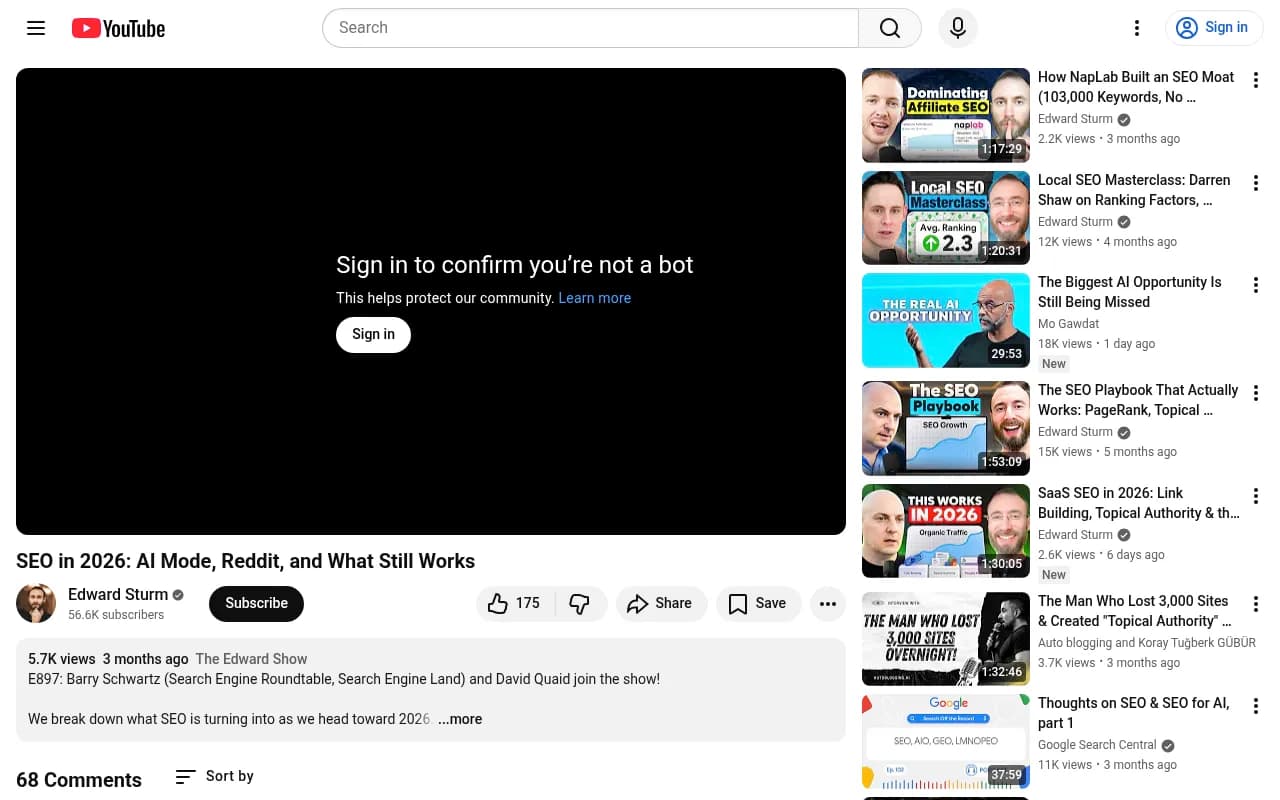
The practical takeaway: don't treat video as separate from your SEO strategy. Transcripts, chapters, and structured descriptions all feed into how AI models understand and cite your content.
AI search is a different channel, not a replacement
Here's where a lot of the "SEO is dead" discourse goes wrong. People treat AI search as a replacement for Google. It isn't -- at least not yet, and not for most audiences. It's an additional channel with different mechanics.
When someone searches Google, they're often looking for a list of options. When someone asks ChatGPT or Perplexity a question, they want a direct answer with a recommendation. The intent is different, the format of the response is different, and the way your brand needs to appear is different.
This is what Generative Engine Optimization (GEO) is about. Instead of optimizing for a ranking position, you're optimizing to be cited as a source in an AI-generated answer. The signals that matter include:
- Whether your content directly answers the kinds of questions people ask AI models
- Whether your brand appears in the sources AI models have been trained on or regularly crawl
- Whether third-party sources (Reddit threads, review sites, industry publications) mention you positively
- Whether your site structure makes it easy for AI crawlers to understand what you do
Tools like Promptwatch are built specifically for this layer -- tracking where your brand appears (or doesn't) across ChatGPT, Perplexity, Claude, Gemini, and other AI engines, and helping you identify the content gaps that explain why competitors are getting cited and you aren't.

What still works in 2026
Despite everything changing, some fundamentals have held up. Barry Schwartz's point from that late 2025 discussion is worth repeating: "Most AI optimization still depends on traditional search discovery and ranking." The AI models that generate responses are largely trained on and influenced by content that ranks well in traditional search. So ignoring Google in favor of "AI optimization" is a false choice.
Here's what's working:
Bottom-of-funnel content
High-intent queries -- comparisons, pricing pages, "X vs Y" articles, "best X for [specific use case]" -- are still driving conversions. These are the queries where users are close to a decision and want specific information. AI Overviews are less likely to fully satisfy these queries, so clicks still happen.
Topical authority (done properly)
HubSpot's traffic collapse is often cited as evidence that topical authority is dead. The more accurate read is that HubSpot's approach to topical authority -- publishing enormous volumes of thin, keyword-targeted content -- stopped working. Genuine depth on a specific subject area still matters. The difference is that "depth" now means actually answering the question better than anyone else, not just covering more keywords.
Technical fundamentals
Page speed, crawlability, structured data, and clean site architecture still matter. They matter for Google, and they matter for AI crawlers. If AI bots can't efficiently read your site, you won't get cited. This is one area where traditional SEO and GEO are almost identical.
Links (differently)
Links haven't stopped mattering, but the relationship is more nuanced. Google has gotten better at ignoring low-quality links rather than penalizing them, which means buying links can feel safe until it suddenly isn't. Earned links from relevant, authoritative sources still carry real weight -- both for Google rankings and for the third-party credibility signals that AI models use.
E-E-A-T signals
Experience, Expertise, Authoritativeness, Trustworthiness. Google has been pushing this framework for years, and it maps almost perfectly onto what AI models look for when deciding which sources to cite. Author credentials, original research, first-hand experience, and brand mentions across the web all feed into this.
The measurement problem is the real crisis
Here's the thing that doesn't get enough attention: the hardest part of SEO in 2026 isn't ranking. It's knowing whether your efforts are working.
When AI Overviews answer a question using your content, you might not get a click -- but your brand was still seen. When someone asks ChatGPT about the best tool in your category and your brand gets mentioned, that's visibility with real business value. None of this shows up in Google Analytics.
Traditional SEO metrics (organic sessions, keyword rankings) are increasingly incomplete pictures. You need to layer in:
- AI citation tracking (which AI models mention you, for which queries)
- Share of voice in AI responses vs competitors
- Traffic from AI referrals (Perplexity, ChatGPT, etc. do send some traffic)
- Brand search volume as a proxy for awareness
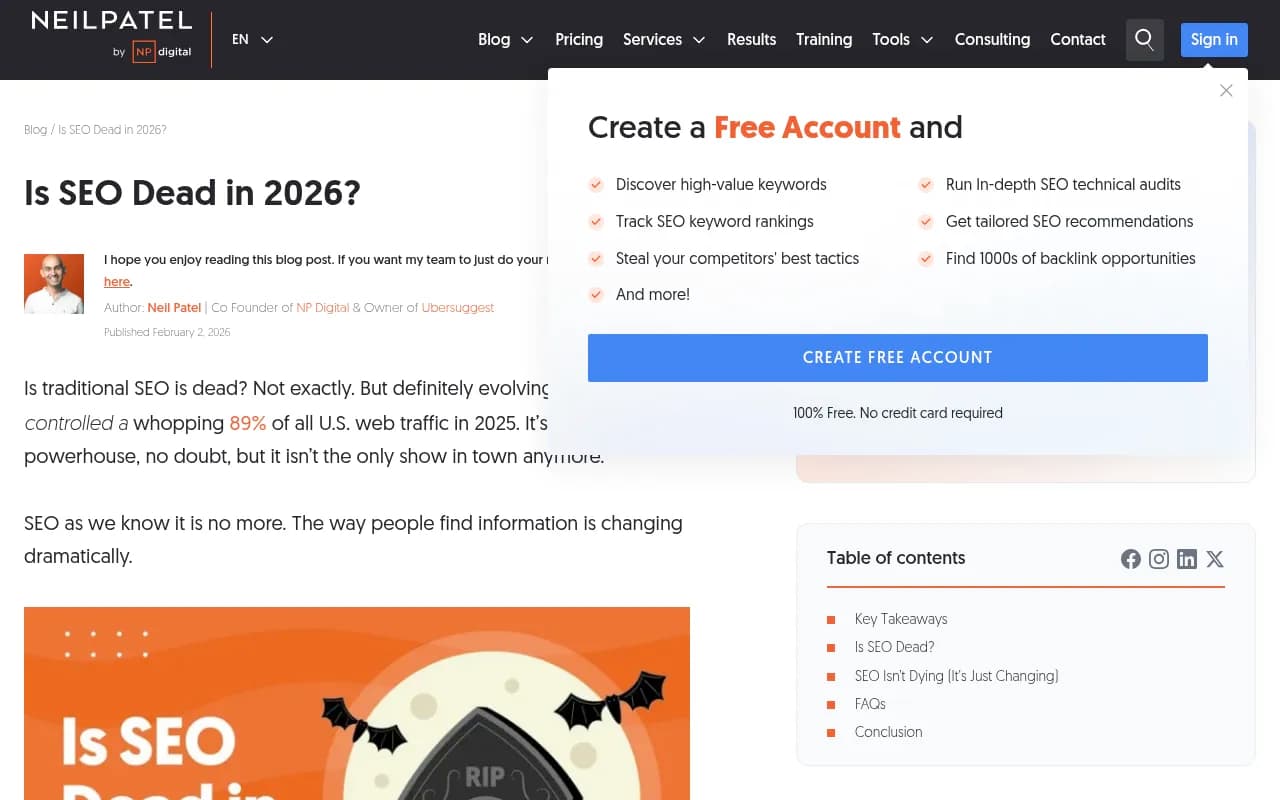
Neil Patel put it well in a recent post: "The death of SEO was just the death of low-intent clicks." The visitors who do click through in 2026 tend to be further along in their decision-making. Fewer sessions, but potentially more valuable ones.
Tools that help you navigate this
The tooling landscape has split into two camps: traditional SEO platforms that are adding AI visibility features, and purpose-built GEO platforms that started from scratch.
| Tool | Traditional SEO | AI visibility | Content generation | Best for |
|---|---|---|---|---|
| Semrush | Strong | Basic (fixed prompts) | Yes | All-in-one traditional SEO |
| Ahrefs | Strong | Limited (Brand Radar) | No | Backlink analysis |
| Promptwatch | No | Full (10 AI models) | Yes | AI search visibility + GEO |
| SE Ranking | Strong | Growing | Limited | Mid-market SEO teams |
| Surfer SEO | Content focus | No | Yes | Content optimization |
| Keyword.com | Rank tracking | AI Mode tracking | No | Rank monitoring |
For tracking where you stand in AI search specifically, Promptwatch goes further than most -- it doesn't just show you where you're invisible, it shows you the specific prompts competitors are winning and helps you create content to close those gaps. That's the difference between a monitoring dashboard and an optimization tool.
For traditional SEO fundamentals, Semrush and Ahrefs are still the workhorses. Neither is going away.
What to actually do right now
If you're trying to figure out where to put your energy, here's a practical framework:
-
Audit your current AI visibility. Search for the questions your customers ask in ChatGPT, Perplexity, and Google AI Mode. Does your brand appear? Do competitors? This tells you where the gap is.
-
Prioritize bottom-of-funnel content. If you're going to create new content, focus on high-intent queries where users are making decisions. These still drive clicks and conversions.
-
Build content that AI models want to cite. This means direct answers to specific questions, structured clearly, from a source with credible signals. Think FAQ sections, comparison tables, original data, and expert perspectives.
-
Don't abandon traditional SEO. Your Google rankings still influence which content AI models discover and trust. The two strategies reinforce each other.
-
Fix your measurement. Add AI referral traffic tracking, monitor brand mentions in AI responses, and stop treating organic sessions as the only metric that matters.
-
Contribute authentically to Reddit and YouTube. Not as an SEO play, but because these platforms directly influence what AI models say about your industry.
SEO in 2026 is harder to measure, harder to explain to stakeholders, and requires more channels than it used to. But the underlying goal -- being visible when your audience is looking for what you offer -- hasn't changed. The surfaces have.