Key takeaways
- Page-level AI citation data shows you which specific URLs are being cited by ChatGPT, Perplexity, Google AI Overviews, and other models -- not just your domain overall.
- Cited pages earn 35% more organic clicks and 91% more paid clicks than non-cited competitors, making citation data one of the highest-signal inputs for content prioritization.
- 44.2% of AI citations are extracted from the first 30% of a page, and AI-cited content is 25.7% fresher on average -- both facts that should directly shape your editorial calendar.
- Most content teams are still planning around keyword rankings. The teams pulling ahead are planning around citation gaps: prompts where competitors appear and they don't.
- Tools like Promptwatch give you page-level citation tracking, answer gap analysis, and built-in content generation -- so you can close those gaps systematically instead of guessing.
Why your content calendar needs a new input signal
Most content calendars are built on the same three inputs: keyword search volume, competitive rankings, and gut instinct about what the audience wants. That worked fine when Google's ten blue links were the end of the story.
They're not anymore.
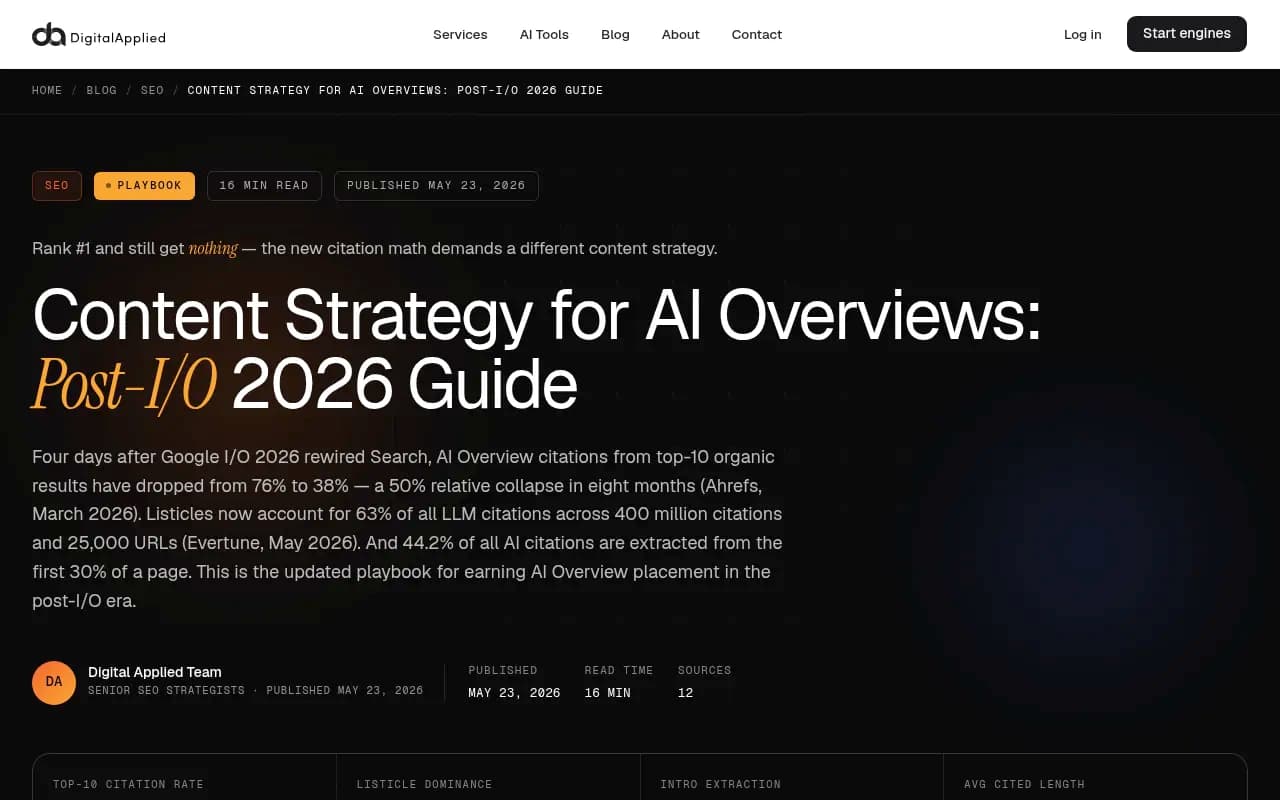
AI Overviews now appear in roughly 48% of queries, up from 31% in early 2025. Google I/O 2026 confirmed AI Mode has crossed 1 billion monthly active users. And here's the uncomfortable number: top-10 organic results now account for only 38% of AI Overview citations, down from 76% in July 2025 (Ahrefs, March 2026). You can rank first and still be completely invisible in the AI response that sits 1,674 pixels above your blue link.
The implication for content planning is direct. If you're scheduling articles based on what ranks, you're optimizing for a metric that's increasingly disconnected from where attention actually goes. Page-level AI citation data is the missing signal -- it tells you which of your pages AI models actually trust, which competitor pages are getting cited instead of yours, and exactly where the gaps are.
This guide walks through how to collect that data, interpret it, and turn it into a content calendar that actually moves the needle in 2026.
Understanding what page-level citation data actually tells you
There's a difference between knowing your brand gets mentioned in AI responses and knowing which specific pages are being cited, for which prompts, and by which models. The first is brand monitoring. The second is actionable editorial intelligence.
Page-level citation data answers questions like:
- Which of my URLs is ChatGPT citing when someone asks about [topic]?
- Which pages are cited by Perplexity but not by Google AI Overviews?
- Which competitor pages are getting cited for prompts where I have no citation at all?
- How often is each page cited, and is that frequency trending up or down?
This is fundamentally different from traditional rank tracking. A page can rank #2 organically and never appear in an AI citation. Another page buried on page two might get cited constantly because it answers a specific question clearly and completely.
The Evertune analysis of 400 million citations found that listicles account for 63% of all LLM citations. Wix's extraction-position data shows 44.2% of citations come from the first 30% of a page. These aren't abstract content strategy tips -- they're signals about which page structures and formats AI models prefer to extract from. Page-level citation data lets you see whether your own pages match those patterns, or whether you're leaving citations on the table because of how content is structured.
Step 1: Audit your current citation footprint
Before you can prioritize anything, you need a baseline. The audit has two parts: what's being cited, and what's not.
Map your cited pages
Pull a report of every page on your site that's been cited by at least one AI model in the last 90 days. For each page, record:
- Which AI models cite it (ChatGPT, Perplexity, Google AI Overviews, Claude, Gemini, etc.)
- Which prompts trigger those citations
- How frequently it's cited (citation count or citation rate)
- Whether citation frequency is trending up, flat, or declining
This gives you your "citation winners" -- the pages already doing work in AI search. These are your anchors. They tell you what's working structurally and topically.
Find your citation gaps
The more valuable half of the audit is the gap analysis. These are prompts where competitors appear in AI responses and you don't. This is where content calendar opportunities live.
For each gap prompt, note:
- Which competitor page is being cited
- What that page covers that yours doesn't (or whether you have no page at all)
- The estimated prompt volume (how often people are asking this)
Promptwatch has a built-in Answer Gap Analysis that surfaces exactly this -- prompts where competitors are visible and you're not, with the specific content gaps your site is missing. It's the fastest way to build this list without manually querying every AI model yourself.

Step 2: Score your gaps by priority
Not every citation gap is worth chasing. You need a scoring system that helps you decide which gaps to address first, second, and never.
A simple scoring framework looks like this:
| Factor | What to measure | Why it matters |
|---|---|---|
| Prompt volume | How often is this query asked across AI models? | High-volume gaps have more upside |
| Competitor citation strength | Is one competitor dominating, or is it spread? | Concentrated gaps are harder to crack |
| Your existing content | Do you have a page on this topic at all? | Refresh vs. create decisions |
| Topical authority | Is this adjacent to your strongest cited pages? | Easier to win near existing authority |
| Business value | Does this prompt relate to a product/service you sell? | Revenue relevance matters |
Score each gap on these dimensions and you'll quickly see which ones deserve slots in your next sprint versus which ones are nice-to-haves for Q4.
Prompt volume estimates and difficulty scores are available in platforms like Promptwatch, which also shows query fan-outs -- how a single prompt branches into sub-queries. That fan-out data is useful for planning content clusters rather than one-off articles.
Step 3: Translate citation data into calendar decisions
This is where the data becomes editorial decisions. There are three types of actions your citation audit should produce:
Create new pages for high-volume gap prompts
If you have no page covering a prompt where a competitor is consistently cited, that's a creation task. The prompt itself often tells you the format: "best X for Y" prompts tend to favor listicles (which, per Evertune's data, account for 63% of LLM citations). "How does X work" prompts tend to favor structured explainers with clear subheadings. "What is X" prompts often favor concise definitions followed by supporting detail.
Schedule these as new articles in your calendar, tagged with the specific prompt they're targeting and the AI models you expect to earn citations from.
Refresh existing pages that are losing citation momentum
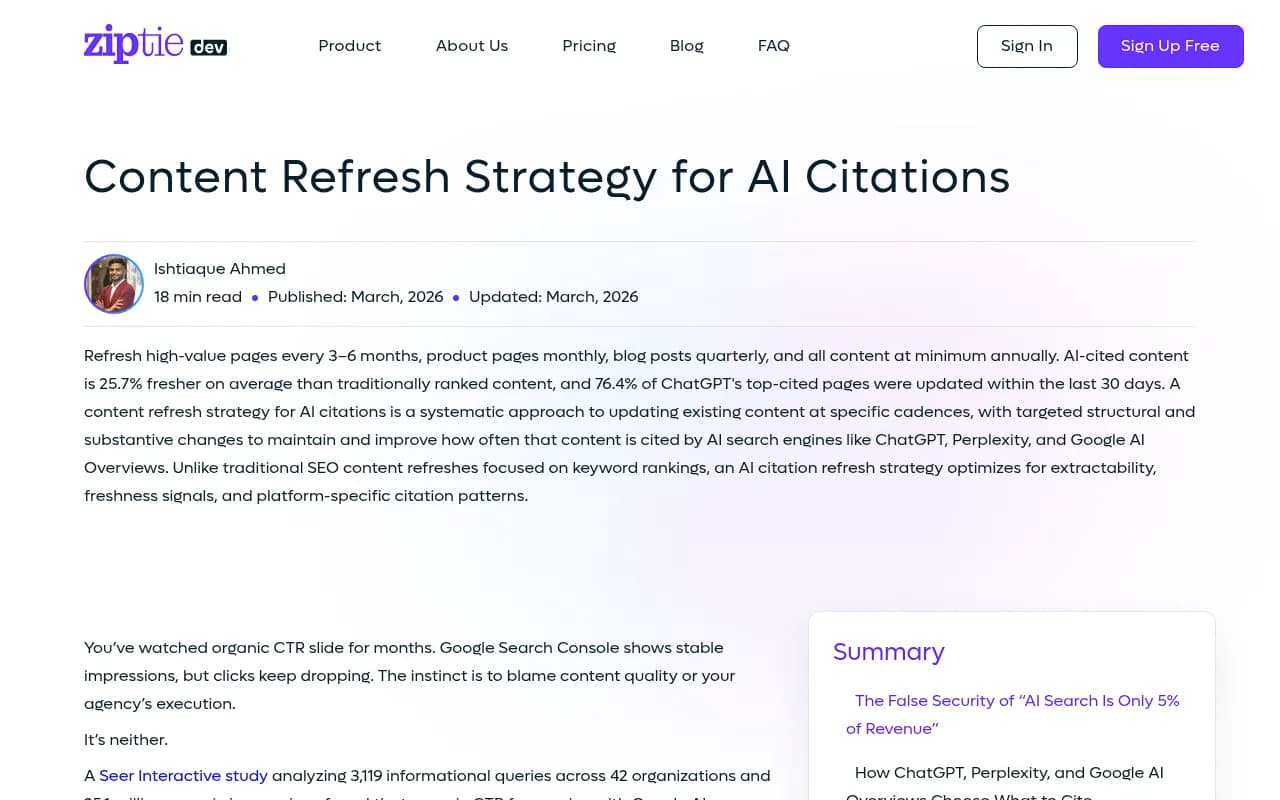
If a page was cited frequently six months ago and citation frequency has dropped, that's a refresh task. The ZipTie.dev research on content freshness is relevant here: AI-cited content is 25.7% fresher on average than traditionally ranked content, and 76.4% of ChatGPT's top-cited pages were updated within the last 30 days.
That's a meaningful signal. A page that was accurate and well-structured a year ago may be losing citations simply because it hasn't been touched. Build a refresh cadence into your calendar:
- Product pages: monthly
- High-value blog posts and guides: every 3-6 months
- All other content: at minimum annually
Restructure pages that rank but don't get cited
This is the most counterintuitive category. These are pages that perform well organically but never appear in AI citations. The issue is usually structural, not topical.
Common problems:
- The answer to the target question is buried in the middle of the page (remember: 44.2% of citations come from the first 30%)
- The page doesn't have clear subheadings that match how the prompt is phrased
- The content is written as flowing prose when the AI model is looking for a list or a direct answer
- The page is too long without a clear extractable summary near the top
Restructuring tasks are lower effort than creation tasks but can have immediate citation impact. Prioritize these for pages that already have strong organic traffic -- they're already trusted by Google, and a structural fix may be all it takes to get cited.
Step 4: Build the calendar with citation goals, not just traffic goals
A content calendar built on citation data looks different from a traditional editorial calendar. Each item should have:
- The target prompt (the specific question you're trying to get cited for)
- The target AI models (which platforms matter most for your audience)
- The action type (create, refresh, or restructure)
- The citation baseline (current citation count, if any)
- A review date (when you'll check whether the citation count has moved)
This last point matters more than most teams realize. Content for AI citations doesn't always show results in two weeks. AI models crawl and re-index content at their own cadence. Some pages start getting cited within days of a refresh; others take 6-8 weeks. Building review dates into your calendar means you're tracking the loop, not just publishing and hoping.
Tools that show page-level citation tracking -- which pages are being cited, how often, and by which models -- make this review process concrete rather than anecdotal. Promptwatch's page-level tracking does this, and its AI crawler logs show you when AI crawlers from ChatGPT, Claude, Perplexity, and others are actually visiting your pages, which helps you understand the lag between publishing and citation.
Step 5: Use citation data to decide where to publish, not just what to publish
One thing most content calendars completely ignore: where content lives affects whether AI models can cite it.
The research is clear that AI models don't only cite brand-owned content. They cite Reddit threads, YouTube videos, third-party review sites, and industry publications. If your brand is absent from those sources, you're missing citation opportunities that no amount of on-site content will fix.
Page-level citation data can show you which external sources AI models are pulling from for your target prompts. If Perplexity consistently cites a particular subreddit when answering questions in your category, that's a distribution signal. If Google AI Overviews consistently cite a specific trade publication, that's a PR and guest content signal.
Build these distribution decisions into your calendar alongside your owned content. A guest post on a frequently-cited domain may generate more AI citations than five new articles on your own site.
Choosing the right tools for citation-driven content planning
The tooling landscape for AI citation tracking has expanded significantly in 2026. Here's a practical breakdown of the main options and what they're actually suited for:
| Tool | Citation tracking depth | Content gap analysis | Content generation | Best for |
|---|---|---|---|---|
| Promptwatch | Page-level, 10 models | Yes (Answer Gap Analysis) | Yes (AI writing agent) | Full action loop: find gaps, create content, track results |
| Profound | Brand + page level | Limited | No | Enterprise brand monitoring |
| Otterly.AI | Brand-level | No | No | Basic monitoring on a budget |
| Peec.ai | Brand-level | No | No | Multi-language monitoring |
| AthenaHQ | Brand + page level | Limited | No | Monitoring-focused teams |
| Evertune | Enterprise citation analysis | No | No | Fortune 500 research |
| MarketMuse | Topic-level | Partial | Yes | Content brief creation |
The core distinction is between monitoring tools and optimization tools. Most platforms will tell you that you're not being cited. Fewer will tell you why, and fewer still will help you do something about it.



For teams that want to close the loop between citation data and content production, the workflow matters as much as the data. Knowing you have a gap is step one. Generating content that's actually structured to earn citations -- with the right format, the right extractable sections, the right freshness signals -- is step two. Tracking whether that content starts getting cited is step three. Most tools only do step one.
Common mistakes teams make when building citation-driven calendars
A few patterns that consistently undermine this approach:
Targeting prompts that are too broad. "Best CRM software" is a high-volume prompt, but it's also one where established players have enormous citation authority. Narrow prompts -- "best CRM for freelance consultants" or "CRM with the best Slack integration" -- are often easier to win and still drive meaningful traffic.
Ignoring the freshness requirement. Publishing a great article and then leaving it untouched for 18 months is a citation death sentence. Build refresh tasks into your calendar from day one, not as an afterthought.
Optimizing only for one AI model. ChatGPT, Perplexity, and Google AI Overviews have different citation preferences. A page that gets cited by Perplexity may not get cited by Google AI Overviews, and vice versa. If your audience uses multiple AI models (and they do), track citation performance across all of them.
Treating citation data as a one-time audit. The citation landscape shifts constantly. New competitors publish content, AI models update their training data, and prompt volumes change. A monthly review of your citation footprint is the minimum cadence for teams that want to stay ahead.
Skipping the distribution layer. On-site content alone won't win every prompt. If the AI models in your category consistently cite external sources, your calendar needs to include off-site content too.
Putting it together: a practical workflow
Here's the workflow in its simplest form:
- Run a citation audit to find your current cited pages and your top citation gaps
- Score the gaps by prompt volume, business value, and your existing content coverage
- Assign each gap to a calendar slot as a create, refresh, or restructure task
- Write content that puts the answer in the first 30% of the page, uses clear subheadings, and matches the format AI models prefer for that prompt type
- Set a review date 4-8 weeks out to check whether citation frequency has moved
- Repeat monthly
The teams winning in AI search right now aren't the ones with the biggest content budgets. They're the ones with the clearest feedback loop between what AI models are citing and what they publish next. Page-level citation data is that feedback loop. Build it into your calendar and you're not guessing anymore -- you're optimizing.