Key takeaways
- No Google or Promptwatch data isolates FAQ sections or FAQPage schema as a cause of AI Overviews citations. Treat FAQ advice as practitioner opinion, not proof.
- FAQ content works best as a component of product pages, landing pages and how-tos, not as a standalone page type.
- The FAQ rich result in the SERP is gone for almost every site. If that was your reason for adding FAQ schema, it is dead weight.
- Self-contained, specific answers to real customer questions are worth keeping. Padded, keyword-stuffed Q&A blocks are not.
- Measure whether your pages get cited instead of assuming. Tracking tools exist for exactly that.
What the evidence actually says
Search for advice on ranking in AI Overviews and you will find FAQ sections recommended almost everywhere. Seobility's guide (updated September 2026) says FAQ sections at the end of a page are a great way to concisely answer common questions. SegMetrics says AI Overviews "pull from FAQ content frequently." A Reddit thread on the topic boils it down to three rules: answer the main question in the first two or three sentences, use headings that match real questions, and add direct Q&A blocks.
I think most of that advice is reasonable. But look closely at where it comes from. These are practitioner recommendations. None of them comes with a dataset showing that adding an FAQ block makes Google cite you more often.
Google's own guidance is more cautious. In its May 2025 Search Central post on succeeding in AI search, Google asks for unique, non-commodity content, good page experience, and making sure Googlebot can reach your pages. A page must return HTTP 200 and have indexable content to be eligible. Structured data has to match the visible content. The post never recommends FAQ sections or FAQ schema. Its line is that the technical requirements for Search "cover you for search generally, including AI formats."
So the honest summary is this: FAQs are a sensible way to structure content that AI systems can extract, but nobody has publicly shown they are a ranking lever.
What the citation data shows about formats
Promptwatch Data tracks which content types Google AI Overviews cite. In its AI Overviews citation types report for July 2026, the breakdown looked like this:
| Content type | Share of AI Overviews citations (July 2026) |
|---|---|
| Listicle | 18.0% |
| Product page | 16.3% |
| How-to | 15.1% |
| News article | 13.5% |
| Video | 5.9% |
| Social post | 5.1% |
| Landing page | 4.7% |
| Comparison | 3.6% |
FAQ pages do not appear as their own category. That matters. If a standalone FAQ page were a top-tier cited format, it would likely show up here. Instead, the formats that win are product pages (which overtook listicles on July 28 and ended the month at 17.9% versus 16.2%), how-tos holding near 15%, and video climbing from about 2.7% in January to over 6% by late July.
The practical reading: FAQs are not a format to build a strategy around. They are a component that can live inside the formats AI Overviews already cite. A product page with a tight Q&A block about sizing, compatibility or returns is a better bet than a stand-alone "FAQ" URL.
What works
Answering real questions directly
The part of the FAQ advice that holds up is the answer-first structure. AI systems extract passages, and a passage that answers a question in two clear sentences is easy to lift. A paragraph that circles for 200 words before getting to the point is not.
Good FAQ answers share a few traits:
- They start with the answer, then add context.
- They make sense when read alone, without the rest of the page.
- They name the product, plan or condition they apply to instead of saying "it" or "this."
- They contain a specific fact such as a price, limit, timeframe or requirement.
Frase calls the same pattern a self-contained, definitional answer and flags vague or incomplete answers as the most common mistake. That matches what I see in practice.
Using questions your customers really ask
SegMetrics suggests building FAQs from real customer questions. This is the best single tip in the research. Pull them from support tickets, sales calls, on-site search, Search Console queries and People Also Ask. An invented question that nobody types is filler. A question that appears forty times in your inbox is content.
AI engines also fan one prompt out into several searches behind the scenes. Questions phrased the way people actually talk have a better chance of matching those sub-queries than corporate rewrites.
Placing FAQs on pages that already earn citations
Because product pages, how-tos and landing pages are the formats cited, that is where FAQs belong. Add three to six Q&As to a product page covering the objections a buyer has. Add a short Q&A to the bottom of a how-to covering the edge cases. Promptwatch's own advice in the July report is to give product pages structured specs, pricing and availability, and a Q&A block is a natural home for the leftover details.
Keeping the basics healthy
None of this matters if the page is not eligible. Check that Googlebot is not blocked, the page returns a 200, the content is indexable, and your snippet controls (nosnippet, data-nosnippet, max-snippet, noindex) are not accidentally suppressing the very text you want shown. A crawler such as Screaming Frog is a quick way to catch these.
What is dead weight
Chasing the FAQ rich result
This is the clearest dead end. Google's documentation update of September 14, 2023 restricted the FAQ rich result to "well-known, authoritative government and health websites." For everyone else, the accordion that used to show under your blue link is gone. One third-party post claims a further 2026 change removed even those sites, but I could not confirm it, so check Google's FAQPage documentation before you rely on either version.
If you added FAQPage schema purely to win that SERP real estate, it is not coming back for you.
Believing the big schema multipliers
Frase claims FAQPage-marked pages are "3.2x more likely to appear in Google AI Overviews," citing a secondary source. I could not verify that figure, and no first-party data supports it. It may be true for some slice of the web. It may also be correlation, since sites that bother with schema tend to be better maintained overall. Do not budget a project around a number you cannot trace.
That does not make schema useless. FAQPage markup is cheap, harmless when it matches the visible content, and may help machines parse the page. Just do not expect it to rescue weak content.
A generic FAQ block on every page
Copying the same five questions ("What is your return policy?" "How do I contact support?") across 300 URLs adds nothing. Duplicate Q&A is noise to a reader and to an extraction system. Google also pushes for unique, non-commodity content, and a boilerplate block is the opposite.
Questions written for keywords instead of people
Q&A like "What is the best SEO agency for SEO services near me?" reads as stuffed. If you would not say it out loud, cut it.
Forum-style Q&A as a ChatGPT strategy
This one is more about where your questions live. Promptwatch's social media citations report for Sep 28 to Oct 4, 2026 found that ChatGPT now gets just 0.46% of its citations from social platforms, with Reddit falling from 5.19% to 0.09%. AI Overviews is different: social platforms make up 12.2% of its citations, with YouTube at 4.28%, Facebook 2.38% and Reddit 2.15%. So answering questions on Reddit is still a small AI Overviews play, but it is no longer a route into ChatGPT. Your own site's Q&A matters more.
A practical FAQ checklist
- Collect 10 to 20 real questions from support, sales and Search Console.
- Keep the ones tied to the page's topic and drop the rest.
- Write each answer in 40 to 80 words, answer first.
- Make every answer stand alone, naming the product or condition.
- Place the block on a product page, landing page or how-to, not on a thin standalone URL.
- Add FAQPage schema only if it mirrors the visible text exactly.
- Review quarterly. Remove questions that have stopped being asked and refresh outdated numbers.
Do you need to rank first to be cited?
SEOcrawl says AI Overviews frequently cite pages from positions 4 to 20 and beyond. I could not verify that, so take it as directional. It does fit what many SEOs see: you do not always need the top organic spot, but a page with no organic visibility at all rarely shows up. Good FAQ content will not fix a page Google does not rank anywhere.
Measuring whether it worked
The weakest part of most FAQ advice is that nobody checks the result. Pick ten pages, add or rewrite FAQ sections on five, and leave five alone. Then watch citations for a couple of months.
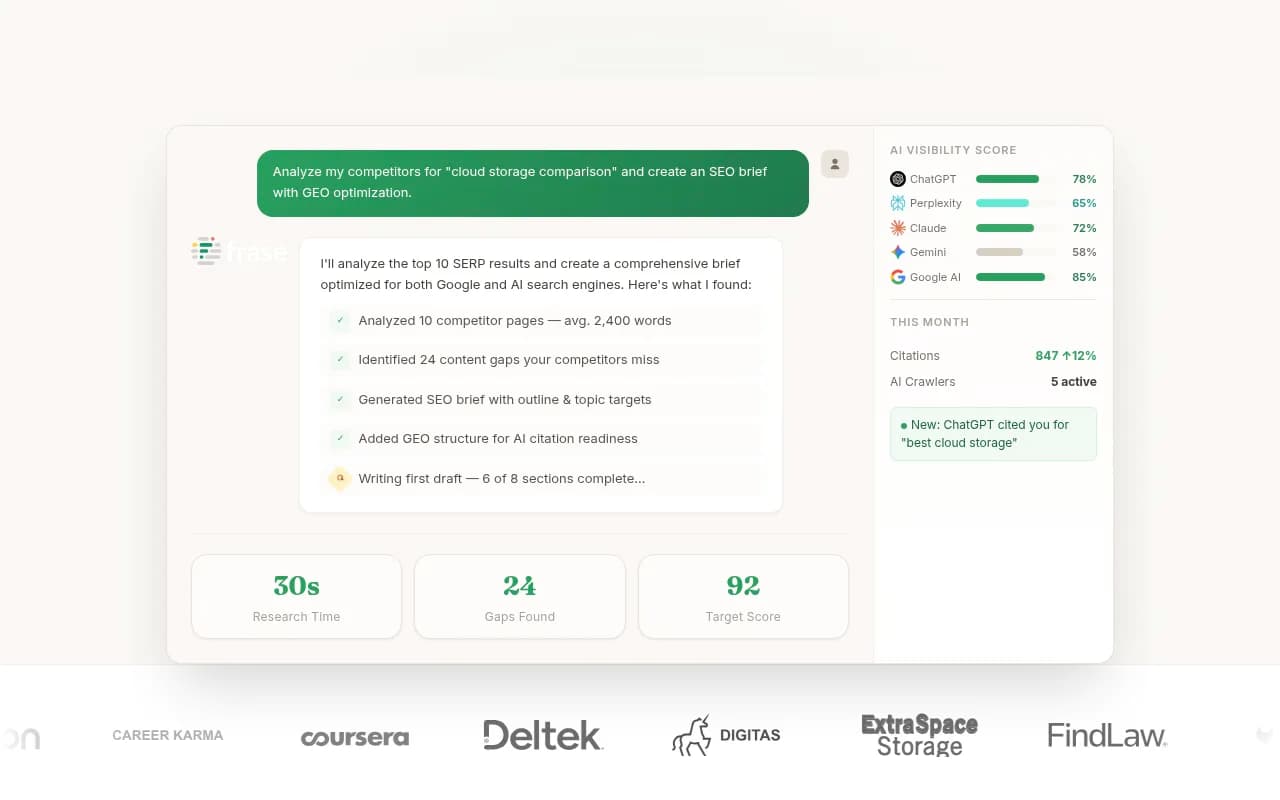
Tracking tools can do the watching. Promptwatch monitors Google AI Overviews and other AI engines in their real interfaces, shows which of your pages get cited, and its page-level data lets you compare pages before and after a change.

Other options in the same space include Profound, Otterly.AI and Peec AI for prompt monitoring, and Frase if you want FAQ drafting tied to content briefs.



| Need | Tool type | Examples |
|---|---|---|
| Track citations in AI Overviews | AI visibility tracker | Promptwatch, Profound, Otterly.AI |
| Draft and optimize Q&A content | Content platform | Frase, Surfer SEO |
| Check crawlability and indexability | Technical crawler | Screaming Frog, Sitebulb |
For a wider list of options, the GEO software directory at bestgeosoftware.com is a good place to compare.
Bottom line
Keep FAQ sections, but demote them from strategy to tactic. Write them from real questions, answer in the first sentence, put them on pages in formats that AI Overviews already cite, and drop anything that exists only to chase the dead rich result or a multiplier nobody can source. Then test on a small set of pages and let the citation data decide.