Key takeaways
- Pick the category before the vendor. SerpApi, SearchApi and DataForSEO return a search engine's results page as JSON. Tavily returns ranked results plus page content, shaped for LLMs.
- Price per 1,000 searches ranges from about $0.60 (DataForSEO, queued) to $15 (SerpApi Developer). Tavily pay-as-you-go is $8 per 1,000 basic credits.
- Platform risk is real in 2026. Google sued SerpApi in December 2025, Microsoft retired the Bing Search API in August 2025, and Nebius announced a deal to acquire Tavily in February 2026.
- If your pipeline needs full page text, a link-only SERP API will cost you more in the end, because you must build the fetch and parse layer yourself.
- Run 200 to 500 of your own real queries through two finalists before you commit. Vendor benchmarks, including the ones quoted below, are written by vendors.
Start with the job, not the vendor
Most "which search API" threads compare tools that do different things. That is how people end up paying $15 per 1,000 for something an agent could have gotten for less, or feeding an LLM a list of blue links and wondering why answers are thin.
There are two jobs here.
The first is reproducing a search engine results page. You want what a person in Lyon or Dallas would see on Google: organic results, People Also Ask, local packs, ads, AI Overviews. Rank trackers, SEO tools and AI visibility products need this. SerpApi, SearchApi and DataForSEO live in this lane.
The second is grounding an AI agent or RAG pipeline. You want relevant pages and their text, cheaply and fast, with little post-processing. Tavily lives here, alongside Exa, Brave and Firecrawl.
The fastCRW comparison of Tavily and Serper frames it well: picking by use case beats picking by price. I agree, with one caveat. Once you know the lane, price and billing rules decide a lot, so that is where most of this guide goes.
The four at a glance
| SerpApi | SearchApi | DataForSEO | Tavily | |
|---|---|---|---|---|
| Category | SERP scraper | SERP scraper | SERP data for SEO software | AI-native search and extraction |
| Entry price | $75/mo for 5,000 searches ($15 per 1,000) | $40/mo for 10,000 ($4 per 1,000) | From $0.0006 per SERP ($0.60 per 1,000) | $0.008 per credit ($8 per 1,000 basic) |
| Price near $100/mo | $15 per 1,000 | $3 per 1,000 (Production, $100 for 35,000) | Pay per task, no plan | $30/mo for 4,000 credits, or PAYG |
| Free tier | 250 searches/mo | 100 requests | Free Sandbox with production-shaped responses | 1,000 credits/mo |
| Returns | Structured SERP JSON, many engines and product endpoints | Structured SERP JSON, own AI Overview endpoint | Regular, Advanced and HTML SERP functions, 7 engines | Ranked results, optional answer and raw content |
| Speed | Medium; SerpApi publishes about 9 s average on Google over 30 days | "Seconds", faster option with parallel threads | Live about 6 s; queued about 5 min average | Low latency, depth controls |
| Legal posture | Defendant in Google DMCA suit | Contractual legal protection (Production and up) | Not a Google scraper dispute that I found | Not a Google scraper |
| MCP | No official | Not confirmed | Not confirmed | Official |
A note on sources. Prices come from the vendors' own pricing pages, and the SerpApi alternatives figures come from a page published by a competitor (String), which says plainly that it did not test the other APIs. Confirm numbers on the day you buy.
SerpApi: the broad, expensive incumbent
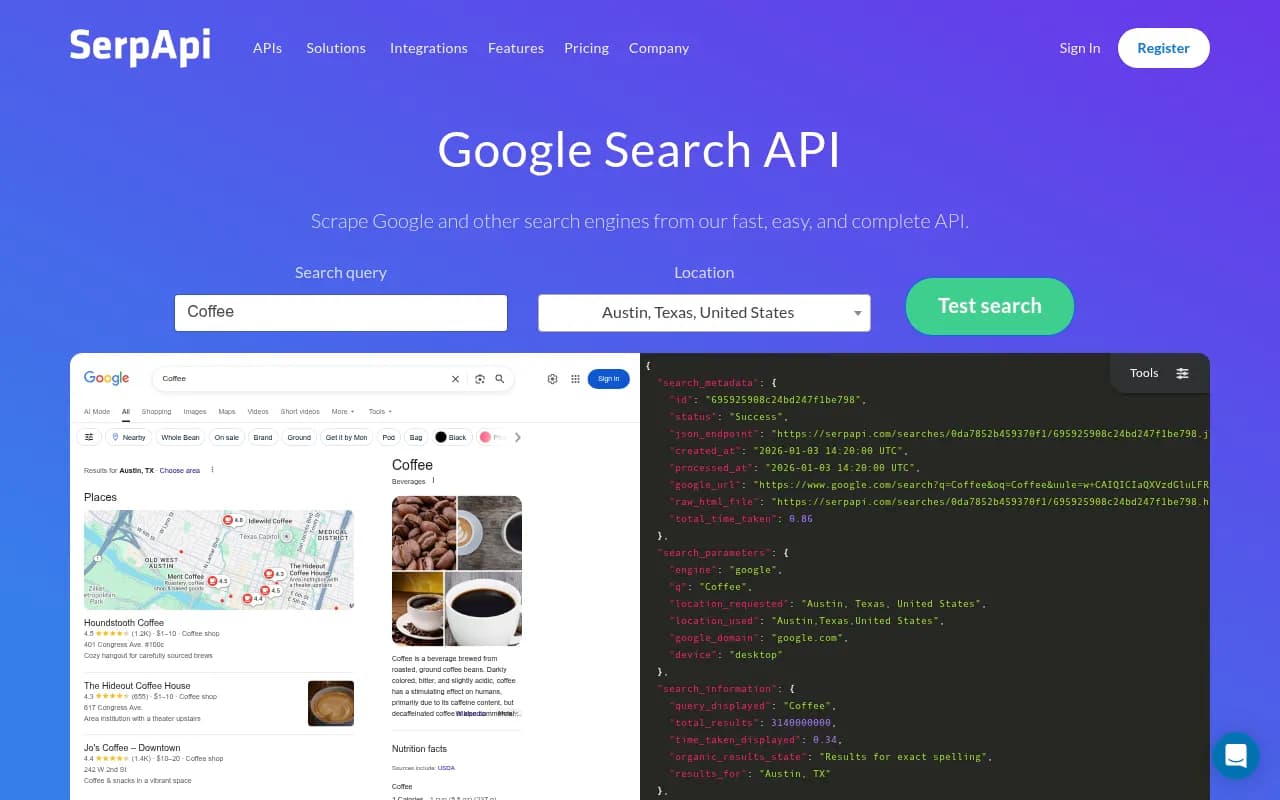
SerpApi has the widest catalog. Beyond Google Search, Light, Maps, Shopping, AI Mode and AI Overview, it covers Flights, Hotels, Trends, Scholar, Lens, Bing, Amazon, eBay and a long list of retail and social sites. If you need Google Flights or Scholar data, that breadth is the reason to stay.
The cost is the obvious drawback. The Developer plan is 5,000 searches for $75, so $15 per 1,000. Firecrawl calls that 10 to 50 times the price of focused alternatives, which is a vendor pitch but not a wild exaggeration next to $1 to $3 per 1,000 elsewhere.
A few other things to know before you sign:
- Plans carry hourly caps. Developer allows 1,000 searches an hour.
- Repeat queries are cached for one hour, and cached copies are free unless you set
no_cache. Good for cost, awkward if you track rankings and expect fresh data every call. - AI Overviews sometimes need a second request. When the overview is not in the first response, you get a
page_tokenthat expires within a minute and call the AI Overview API with it. - SerpApi's own metrics page showed 93.658% average success and 9.06 s average response time over the prior 30 days when String read it in October.
The legal question
Google sued SerpApi on December 19, 2025 in the Northern District of California, with a DMCA section 1201 anti-circumvention claim about its SearchGuard protection. The complaint says SerpApi's automated requests grew by as much as 25,000% over two years. SerpApi filed a motion to dismiss and argues it is in the right.
One Reddit snippet claims the motion was since granted. I could not verify that, and the docket also lists an amended complaint. Check the CourtListener docket yourself before you rely on either outcome.
Practically: this does not make SerpApi unusable today. It does mean any Google-scraper vendor is a dependency you should plan an exit from. Keep your integration thin, store raw responses, and avoid vendor-specific parameters in business logic.
SearchApi: SerpApi's breadth at a lower price
SearchApi covers much of the same ground at lower per-search prices, and it has the most useful contract language of the group.
| Plan | Monthly | Searches | Per 1,000 |
|---|---|---|---|
| Developer | $40 | 10,000 | $4 |
| Production | $100 | 35,000 | $3 |
| BigData | $250 | 100,000 | $2.50 |
| Scale | $500 | 250,000 | $2 |
| Octo 500K | $900 | 500,000 | $1.80 |
| Octo 5M | $5,000 | 5M | $1 |
What I like: only successful (200) responses are billed, there is a 99.9% SLA on all plans, and the Production plan and above include a Legal Protection Guarantee covering up to $2M. SearchApi says it takes legal responsibility for how it collects and parses public search results. It does not cover how you use the data, so read it as protection against the collection side, not a license to do anything.
What to watch: you can use only 20% of your plan's credits per hour. If your workload is bursty, say a nightly job that fires 20,000 queries in ten minutes, that cap will bite. Do the arithmetic against your peak, not your monthly average.
It has its own AI Overview endpoint and a free tier of 100 requests with no card, enough to test parser output on your own queries.
DataForSEO: cheapest at scale, if you can wait
DataForSEO is built for people who ship SEO software. Google organic SERPs start at $0.0006 per SERP of 10 results, which is $0.60 per 1,000. Pricing is per task and varies by processing mode. String's comparison lists $0.60 queued, $1.20 priority and $2.00 live, so verify on DataForSEO's endpoint pricing page which mode your quote applies to.
Two modes matter:
- Standard (queued): cheaper, results posted to your endpoint or fetched later. Average around 5 minutes, with a 45-minute target.
- Live: one request, answer in about 6 seconds on average, at a higher price.
The coverage is the strongest part. Seven engines (Google, Bing, YouTube, Yahoo, Baidu, Naver, Seznam) share one URL pattern, and Google alone has 17 search types including Organic, AI Mode, Maps, Local Finder, News, Images, Jobs and Autocomplete. The Advanced function returns the whole SERP as structured JSON with rank_group and rank_absolute per item, and when Google shows an AI Overview you get an ai_overview item with generated text and cited sources.
The pricing gotchas are real. A search operator multiplies the price by 5, and an AI Overview adds one base price, so the sticker number moves with your parameters. Model your actual request mix. There is a free Sandbox (swap api.dataforseo.com for sandbox.dataforseo.com) so you can test response structure without spending anything.
Skip it for user-facing, sub-second synchronous features. It is a poor fit for an agent loop that needs an answer inside a chat turn, and the queue mechanics take a day to learn.
Tavily: search shaped for agents
Tavily returns ranked results, optional LLM-synthesized answers, and content extraction in one API. It supports search depth modes (basic, advanced, fast, ultra-fast), include_domains and exclude_domains, country targeting, include_raw_content on search, a batch /extract endpoint (up to 20 URLs), and an async /research endpoint. There is an official MCP server and wide framework support.
Pricing:
- Free Researcher plan: 1,000 credits a month, no card.
- Pay as you go: $0.008 per credit. A basic search is 1 credit, advanced is 2, per the fastCRW matrix. Confirm in Tavily's docs.
- Project plan: $30 a month for 4,000 credits.
- Enterprise: custom, with SLAs.
When credits run out, requests stop until the reset on the 1st or an upgrade. That is fine for a prototype and a nasty surprise for production, so set alerts.
Two cautions. First, Tavily's pricing page claims it ranks first in its own Company Search Benchmark. That is a vendor claim. Second, Nebius announced an agreement to acquire Tavily on February 10, 2026. I could not confirm the closing status, and consolidation can shift roadmaps and pricing. Not a reason to avoid it, but a reason not to hard-code it into forty services.
Tavily is not a SERP replacement. You will not get People Also Ask, local packs, or position data that matches what a user saw. If you try to build a rank tracker on it, you will be unhappy.
What it really costs: a worked example
Take 100,000 searches a month.
| Provider | Rough monthly cost | Notes |
|---|---|---|
| SerpApi | Well above $1,000 at Developer's $15 per 1,000 rate; check higher plans | Caching can lower your billed count |
| SearchApi | About $250 (BigData, 100,000 searches) | 20% hourly credit cap |
| DataForSEO | About $60 queued, more for live or parameters that multiply price | Latency trade-off |
| Tavily | About $800 at $8 per 1,000 basic credits | Includes extraction options |
The gap matters at 100,000 and barely at 1,000. At small scale, pick on fit and developer time. At large scale, price per 1,000 dominates the decision, as long as billing rules (failed requests, caching, multipliers) do not erase the headline number.
Billing rules deserve a second look. SerpApi and SearchApi both state they bill only successful searches. DataForSEO bills per task with parameter multipliers. For Tavily the cost depends on request type and depth. Ask each vendor what a failed, empty or timeout response costs.
One more data point about agent traffic
If you are choosing for an agent, it helps to know what agent queries look like. Promptwatch Data's ChatGPT query fanouts report covers daily data from December 2025 to April 2026. Average web searches per ChatGPT response fell from 2.15 in early December to about 1.84 by early March, and average query length dropped from about 117 characters to the high 80s, then about 53 characters once fanouts returned in April at 1.0 per response.
My inference, not the report's: agent search calls are short, keyword-style queries, so cost and latency per query matter more than exotic query-syntax support. That favors fast, cheap retrieval for agents and queued, bulk pricing for SEO jobs.
Decision flow
- Do you need the exact Google or Bing results page, with positions, local packs and AI Overviews? Choose a SERP API. Go to step 2. Otherwise go to step 5.
- Can results arrive in minutes, in bulk? DataForSEO queued mode is the cost winner.
- Do you need sub-second or near-real-time responses at moderate cost, with contractual legal cover? SearchApi is the first shortlist item.
- Do you need Flights, Hotels, Scholar, Jobs or a very wide engine catalog, and $15 per 1,000 fits? SerpApi.
- Is this an agent or RAG pipeline that wants clean page text? Tavily, or compare with Exa, Brave and Firecrawl.
- Want to avoid dependence on Google and Bing entirely? Look at Brave's independent index, at $5 per 1,000.
A short note on the others. Brave is priced at $5 per 1,000 requests with its own index of over 40 billion pages, according to Brave, which obviously has an interest. Exa starts at about $7 per 1,000 for search with contents. Serper is about $1 per 1,000 for Google JSON, with a one-time 2,500 query allowance and limited public documentation. Firecrawl bundles search and scrape for markdown. For a fuller category view, the GEO and AI search directories at bestgeosoftware.com and ai-rank-tools.com list products built on top of these data sources.
Mistakes I see repeatedly
- Buying a cheap link-only SERP API, then discovering you need page text. Add the cost of a scraper and parser and the saving disappears.
- Treating the free tier as the price. SerpApi gives 250 a month, Tavily 1,000 credits, Serper a one-time 2,500, SearchApi 100 total. They are not comparable.
- Ignoring result volatility. String reported that Google's top results changed order on 50 of 56 queries between two calls 31 minutes apart, and that 55 of 56 pages had fewer than 10 organic results. That is a vendor test on 58 questions, so treat it as a hint, but it does mean your tests need repeated runs, not one snapshot.
- Skipping an abstraction layer. With Google litigation and Tavily's ownership change both in the news, wrap your search calls behind your own interface.
- Forgetting caching rules. SerpApi's free one-hour cache can corrupt rank-tracking data.
A fair evaluation protocol
- Collect 200 to 500 real queries from logs, split across locations and devices.
- Run each query through two finalists, twice, 30 minutes apart.
- Record success rate, p50 and p95 latency, fields you need present, and billed units.
- For agents, measure answer quality downstream, not just link overlap.
- Compute cost at your peak hour, not your monthly average, to catch rate caps like SearchApi's 20% rule.
Building AI visibility products on top
A common reason teams buy these APIs in 2026 is tracking how brands show up in AI answers. If your goal is monitoring rather than building, buying a finished platform often beats stitching APIs together. Tools like Promptwatch track brand visibility across ChatGPT, Gemini, Perplexity and Google AI Overviews from the real interfaces, and go on to help fix gaps with content and crawler data. If you are building your own tracker, a SERP API with AI Overview support is the starting point.

Verdict
- Bulk SEO jobs where waiting is fine: DataForSEO.
- Production SERP data with legal cover and moderate price: SearchApi.
- Widest product catalog, price secondary: SerpApi.
- Agents and RAG that need text, MCP and depth control: Tavily, with an exit plan.
None of these is a permanent choice. Keep your integration thin, run your own numbers, and re-check pricing pages before you sign.
For more tools in this space, browse the directory at surferstack.com.