SerpApi Review 2026
SerpApi is a real-time search results API that handles proxies, CAPTCHAs and parsing for Google, Bing, Amazon, YouTube and 100+ other endpoints. Built for developers, SEO teams and AI builders who need clean JSON, with a free tier and plans from $25/month.
Key takeaways
- SerpApi turns Google and dozens of other engines into clean JSON. You send a query and a location, and it handles proxies, browsers and CAPTCHAs.
- Coverage is the real draw: Google Search, Maps, Shopping, Flights, Hotels, Scholar, AI Mode and AI Overview, plus Amazon, Walmart, Bing, YouTube, Yelp and more.
- Pricing is simple but gets expensive at low volume: $25/month for 1,000 searches, dropping to roughly $3.75 per 1,000 at the 1M tier. There is a free plan with 250 searches.
- It is a data pipe, not an optimization product. For GEO and AI visibility work it lacks content gap analysis, content generation, AI crawler logs and AI traffic attribution that Promptwatch offers.
- Business risk to weigh: Google LLC v. SerpApi, LLC is an active lawsuit in the Northern District of California, and the outcome is unknown.
SerpApi is a search results API that scrapes Google and other engines in real time and returns structured JSON. The company has been around for years and has become the default answer to a developer question: how do I get search results without building and maintaining a scraping stack? Each request runs in a full browser, routes through a proxy near the requested location, solves any CAPTCHA, and parses the page into fields like organic results, knowledge graph, local results, related questions and AI Overviews.
The audience is mostly engineers and data teams. SEO tool vendors, price-monitoring startups, AI product teams feeding search context into LLMs, and in-house analysts all use it. The logo wall on the site includes Nvidia, Shopify, Perplexity, Adobe, Samsung, Ahrefs, Salesforce and Thomson Reuters. I would treat that as marketing, but the mix of customers does match what the product is good at: reliable, high-volume SERP data.
Key features
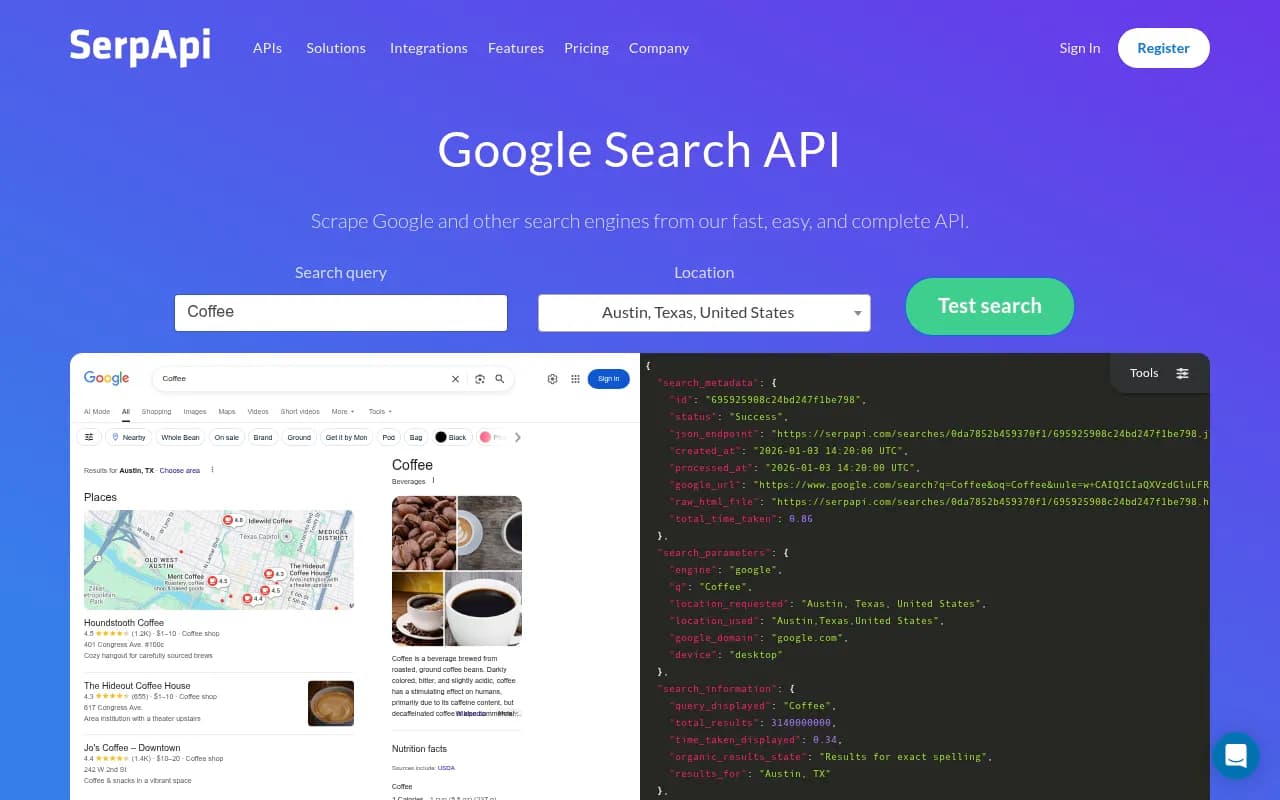
Google Search API and its variants. This is the flagship. A single call returns organic results, ads, knowledge graph, local pack, People Also Ask (related questions), perspectives, shopping results and AI Overview blocks, all in labeled JSON. The sample output on the site for the query Coffee in Austin includes GPS coordinates for local results, parsed ratings and review counts, and AI Overview text blocks with reference indexes. There are also Light versions of several endpoints (Google Light, Images Light, News Light, Videos Light, Shopping Light) for faster, leaner responses.
- Pagination is handled through serpapi_pagination links, so you can walk pages without constructing URLs yourself.
- Raw HTML and JSON files are stored per search, which helps debugging when Google changes a layout.
- Output can be JSON or Markdown, the latter being handy when you feed results straight into an LLM.
Breadth of engines. The API list is long. Beyond web search you get Google Maps (with Reviews, Photos, Posts and Directions), Google Flights and Hotels (including price calendars and reviews), Google Scholar and Patents, Google Trends, Google Finance, Google Jobs, Google Lens and reverse image. Then come Bing (with Copilot), DuckDuckGo, Yahoo, Baidu, Yandex, Naver, plus retail and review sources: Amazon, Walmart, eBay, Home Depot, Target, Yelp, Tripadvisor, Booking.com, Airbnb, Zillow, Glassdoor, OpenTable. Social and video endpoints cover YouTube (including video transcripts), Instagram, TikTok Discover, Pinterest, Facebook Marketplace and the Meta Ad Library. Competitors usually cover Google and Bing well and thin out quickly after that.
AI search endpoints. SerpApi offers a Google AI Mode API, Google AI Overview API, Bing Copilot API, Brave AI Mode, Duck AI, Naver AI Mode and a Google Gemini endpoint. Recent release notes mention clickable follow-up questions in AI Overviews and geo-targeting for Copilot. This makes SerpApi a useful raw data source for people building their own AI visibility experiments.
Accurate locations. The location parameter uses Google's own encrypted geolocation params and a proxy near the target place. A separate locations endpoint lists valid values. For local SEO checks this matters more than it sounds, since results for the same query shift block by block in a city.
Speed options. Ludicrous Speed and Ludicrous Speed Max trade cost for lower latency, and Pixel Position returns where each result sits on the rendered page. The X-Ray tool in the playground overlays JSON paths on the actual page, which is the nicest developer-experience touch in the product. You click an element and see which field it maps to.
Privacy and compliance. ZeroTrace Mode means SerpApi stores no search parameters, files or data after a search completes. The company lists SOC 2 Type II, SOC 3, ISO 27001 and ISO 27701 certifications, and a stated SLA of 99.95% on all plans, with premium support quoted up to 99.97%. For procurement reviews at larger companies that paperwork often decides the purchase.
U.S. Legal Shield. SerpApi assumes liability for the lawful collection of public search data, with up to $2 million in coverage. It is included from the Production plan up, per the pricing FAQ. It does not cover what you do with the data. Note that the pricing table scraped from the site shows blank columns for this feature, so confirm the current terms before relying on it.
Team management and JSON Restrictor. Team management handles multiple users on an account. The JSON Restrictor trims responses to only the fields you need, which cuts payload size on large SERPs.
Who is it for
The best fit is a developer or data team that needs search data as an input to something else. Think of an SEO SaaS company pulling rankings for thousands of keywords daily, an e-commerce team tracking Google Shopping and Amazon prices across stores, or an AI startup that grounds LLM answers in fresh search results. A travel startup comparing Google Flights and Hotels data is another natural user. Teams of two to fifty engineers with a clear volume forecast get the most from the tiered plans.
It also suits agencies with a technical bent who build custom reporting in Google Sheets or Looker and want raw SERP features, such as local packs and People Also Ask, rather than a packaged rank tracker. Researchers in academic and legal fields can use the Scholar and Case Law endpoints.
Who should skip it? Non-technical marketers who want dashboards will find nothing here, because there is no UI beyond the playground. Teams who need to improve how their brand shows up in ChatGPT, Gemini or Perplexity also need more than a data feed, since SerpApi tells you what the page looked like and nothing about what to change. And anyone who cannot tolerate legal uncertainty around a Google-facing vendor should read the lawsuit section below first.
Integrations and ecosystem
Official libraries cover Ruby, Python, JavaScript, Go, PHP, Java, Rust, .NET, Swift, C++ and a CLI, plus cURL examples and a Google Sheets option. There is also an MCP listing, which suits agent builders who want to hand a model a search tool. The REST design is plain: a GET request with an api_key, engine, q and location returns JSON.
There is no native connector marketplace of the Zapier kind, so no-code users will need Google Sheets or their own glue. Export is whatever you build, since the API returns JSON or Markdown and stores each result at a JSON endpoint for later retrieval. Development is unusually transparent. Release notes log several entries per day (the latest at the time of writing run to November 2, 2026), and each change links to an issue in the public serpapi/public-roadmap repository on GitHub. Recent additions include a TikTok Trends API, Facebook Ads Library API, Google Translate API and Google Books API.
That cadence has a flip side. The same release notes show recurring fixes: /goto links leaking into organic results, Google Lens slowdowns and failed searches, empty Google Images results, and intermittent Amazon and Walmart errors. This is the normal upkeep burden of scraping, and it is exactly what you are paying SerpApi to absorb. Still, expect occasional bad days.
Pricing and value
Pricing is month-to-month, cancel anytime, and based on successful searches. Cached, errored and failed searches are not counted, and a response with 100 results costs the same as one with none: one credit.
- Free: $0, 250 searches/month, 50 per hour throughput.
- Starter: $25/month, 1,000 searches, 200 per hour.
- Developer: $75/month, 5,000 searches, 1,000 per hour.
- Production: $150/month, 15,000 searches, 3,000 per hour, includes U.S. Legal Shield.
- Big Data: $275/month, 30,000 searches, 6,000 per hour.
- Searcher: $725/month, 100,000 searches. Volume: $1,475 for 250,000. Infrastructure: $2,750 for 500,000.
- Cloud tiers: from $3,750/month for 1M searches, scaling in 1M steps (for example $21,125 for 10M).
- Enterprise: custom volume, throughput and compliance terms via contact.
Hourly throughput is 20% of plan volume under 1M searches a month. There is a refund within 7 days unless you used more than 20% of the searches.
The per-search math tells the story. Starter works out to $25 per 1,000 searches, Big Data to about $9.17, Searcher $7.25, and the 1M tier $3.75. Compare Value SERP from Traject Data, which advertises $2.50 per 1,000 requests pay-as-you-go with no commitment, plus annual plans at discounted rates. For a straight Google results feed at volume, cheaper options exist. SerpApi's case rests on endpoint breadth, parsing quality, compliance certificates and the indemnity. If you only need basic Google organic results, you may overpay. If you need Maps, Shopping, Flights and AI Overviews from one vendor, the premium is easier to justify.
Strengths and limitations
What it does well
- Parsing depth. The JSON for a single Google query exposes local results, immersive products, AI Overview text blocks and references, and refinement filters as separate typed objects.
- Endpoint breadth across search, maps, shopping, travel, jobs and social sources.
- Developer experience: the playground, X-Ray overlay, public roadmap and ten-plus language libraries.
- Security paperwork: SOC 2 Type II, ISO 27001 and 27701, ZeroTrace Mode and a published SLA.
- Pay only for successful searches.
Where it falls short
- Cost per search is high at the low tiers, and there is no true pay-as-you-go option on the pricing page.
- Legal exposure. Google LLC v. SerpApi, LLC (N.D. Cal., docket 4:25-cv-10826) is ongoing. Google alleges that SerpApi circumvents bot protections with residential proxies, browser automation and CAPTCHA solving, and claims terms-of-service violations and copyright infringement. SerpApi disputes this and has said it is moving to dismiss. I cannot tell you how it ends, and a ruling against the company could disrupt service or pricing. Keep a fallback vendor in mind for anything business-critical.
- Scraping fragility. Release notes show regular fixes for Google Lens, Images, Amazon and Walmart.
Compared with Promptwatch for AI search work
SerpApi lists AI SEO (GEO) as a use case, and its AI Mode and AI Overview endpoints return useful data. But it is a raw data source. You write the code, store the results, build the dashboards and decide what to do. Promptwatch is a different kind of product. It lacks nothing on the monitoring side, and then goes on to do the work:
- No content gap analysis or answer gap reports.
- No content generation or CMS publishing to WordPress, Webflow or Framer, and no Content Refresh for existing pages.
- No IP-verified AI crawler logs or crawl-to-citation tracking.
- No AI traffic attribution or visitor analytics, and no Search Console or Bing data next to AI data.
- No Brand Narrative, Fact Check, Visibility Score or Share of Voice metrics, and no sentiment scoring.
- No Reddit, YouTube, LinkedIn or Instagram citation reports, and no AI Shopping or Ads Radar.
- No prompt volumes and difficulty scoring, no Action Board, no Agent Chat.
To be fair, SerpApi does not claim to be a GEO platform, and for engineers who want to build their own pipeline it is a fine ingredient. For a directory of tools in that category, the GEO software directory at bestgeosoftware.com is a good place to compare options.
Bottom line
SerpApi is a well-run, broad SERP API that earns its place for teams that need structured search data from many engines with enterprise-friendly compliance. Buy it if you are building a product on top of search results and value parsing quality and endpoint coverage over lowest price. Skip it if you only need cheap Google organic data, or if the lawsuit makes you uneasy about single-vendor dependence.
If your goal is not data but outcomes in AI search, meaning being mentioned and cited in ChatGPT, Gemini, Perplexity and Google AI Overviews, Promptwatch is the stronger choice because it monitors, explains, fixes and measures in one loop. It has a 7-day free trial and a free AI visibility report at promptwatch.com/ai-visibility-report.

Best use case in one sentence: feeding reliable, parsed Google and multi-engine results into your own product, pipeline or LLM.
Tags:
Frequently asked questions
What is SerpApi?
How much does SerpApi cost?
Which search engines and sites does SerpApi support?
Is SerpApi legal to use?
Is SerpApi a GEO or AI visibility tool?
Does SerpApi have a free plan?
Similar and alternative tools to SerpApi