Key takeaways
- Hall AI, LLMrefs, and Trakkr.ai are all lightweight, affordable options for tracking how AI models mention your brand -- each with a distinct focus area
- LLMrefs is the most feature-complete of the three, with share-of-voice metrics, citation tracking, and keyword-driven prompt generation
- Hall AI leans into sentiment analysis and tone monitoring, making it useful if you care about how AI talks about your brand, not just whether it does
- Trakkr.ai is the most stripped-down option -- fast to set up, easy to read, but limited in depth
- All three are monitoring-first tools; none of them help you act on what you find. If you need content gap analysis or built-in optimization, you'll need to look at more complete platforms
The AI search visibility space has exploded. Two years ago, tracking your brand in ChatGPT felt like a novelty. Now it's a line item in marketing budgets, and there are dozens of tools competing for that budget.
Most of the coverage goes to the bigger platforms -- Profound, AthenaHQ, Semrush's AI toolkit. But a lot of teams, especially smaller ones, aren't ready to commit to enterprise pricing or complex onboarding. They want something lightweight: set it up, see where you stand, move on.
Hall AI, LLMrefs, and Trakkr.ai all occupy that space. They're accessible, relatively affordable, and focused on the basics. This guide breaks down how they compare, where each one earns its keep, and where each one runs out of road.
What "lightweight" actually means here
Before getting into the tools, it's worth being clear about what lightweight means in this context -- because it's not just about price.
A lightweight AI visibility tracker typically:
- Covers a handful of AI models (ChatGPT, Perplexity, Claude, maybe Gemini)
- Tracks a limited number of prompts per month
- Shows you brand mentions, citation counts, and basic share-of-voice
- Has a simple dashboard you can read without training
- Doesn't include content generation, crawler logs, traffic attribution, or deep competitive intelligence
That's a reasonable starting point for a lot of teams. The tradeoff is that you get visibility into the problem but not much help solving it. Keep that in mind as we go through each tool.
Hall AI
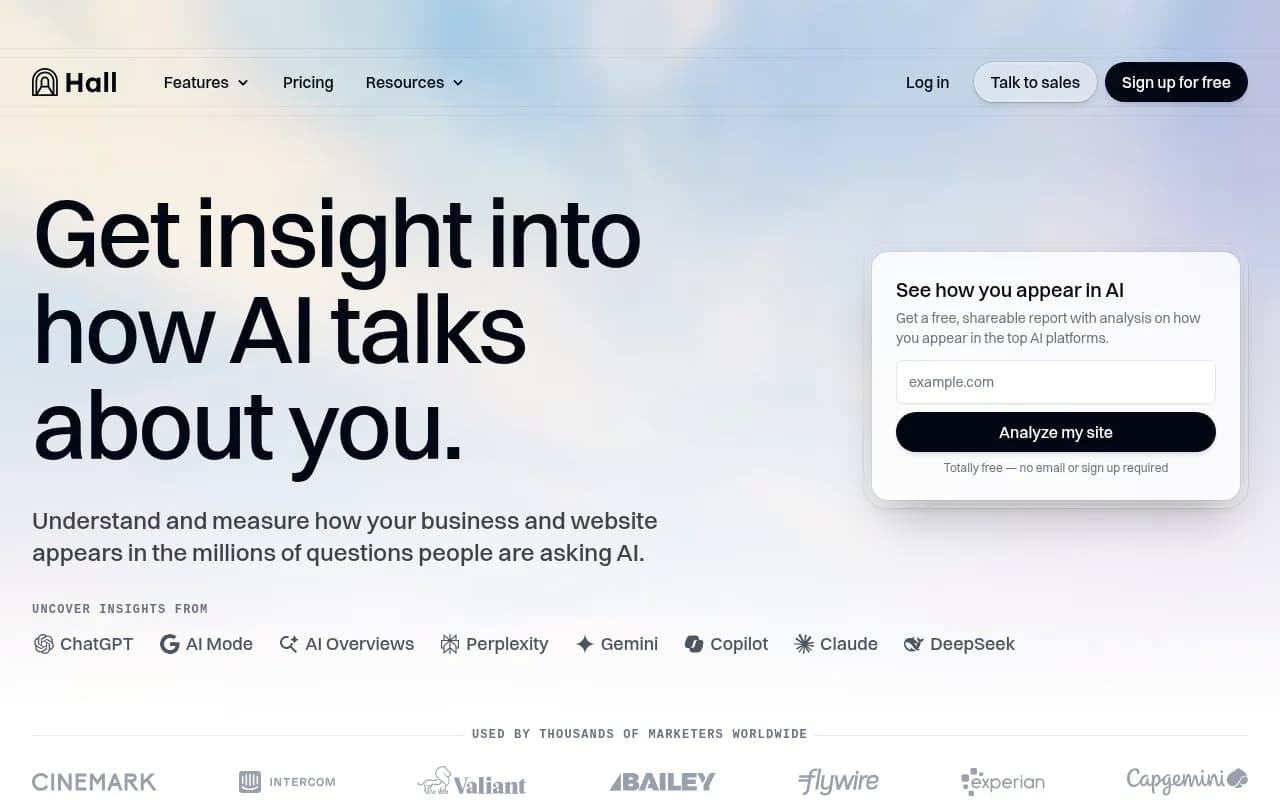
Hall AI (usehall.com) positions itself around sentiment and tone monitoring. The core question it answers is: when AI models mention your brand, what are they actually saying about you? Are you described as a market leader, a budget option, a risky choice? Hall tracks the language, not just the presence.
That's a genuinely useful angle. Most visibility trackers reduce everything to a binary -- cited or not cited. Hall adds a qualitative layer that matters for brand teams, PR managers, and anyone who's ever cringed at how an AI described their product.
What Hall AI does well
The sentiment tracking is the standout feature. Hall monitors tone across responses and flags when the framing around your brand shifts -- useful for catching early signs of reputation drift in AI outputs.
It also covers the major models: ChatGPT, Claude, Perplexity, and Gemini are all in scope. Setup is straightforward, and the dashboard is clean enough that you don't need to spend an afternoon learning the interface.
Where Hall AI falls short
The prompt library is limited. You're working with a relatively small set of queries, which means you might be missing visibility in categories or use cases you haven't explicitly configured. There's no automatic prompt generation based on your keywords -- you're largely defining the scope yourself.
There's also no content optimization layer. Hall will tell you that an AI is describing your brand in lukewarm terms, but it won't tell you what content to publish to change that. You get the diagnosis without the treatment plan.
Pricing is on the affordable end, which fits the lightweight positioning, but the feature ceiling is low. Teams that grow into more sophisticated needs will likely outgrow Hall fairly quickly.
LLMrefs
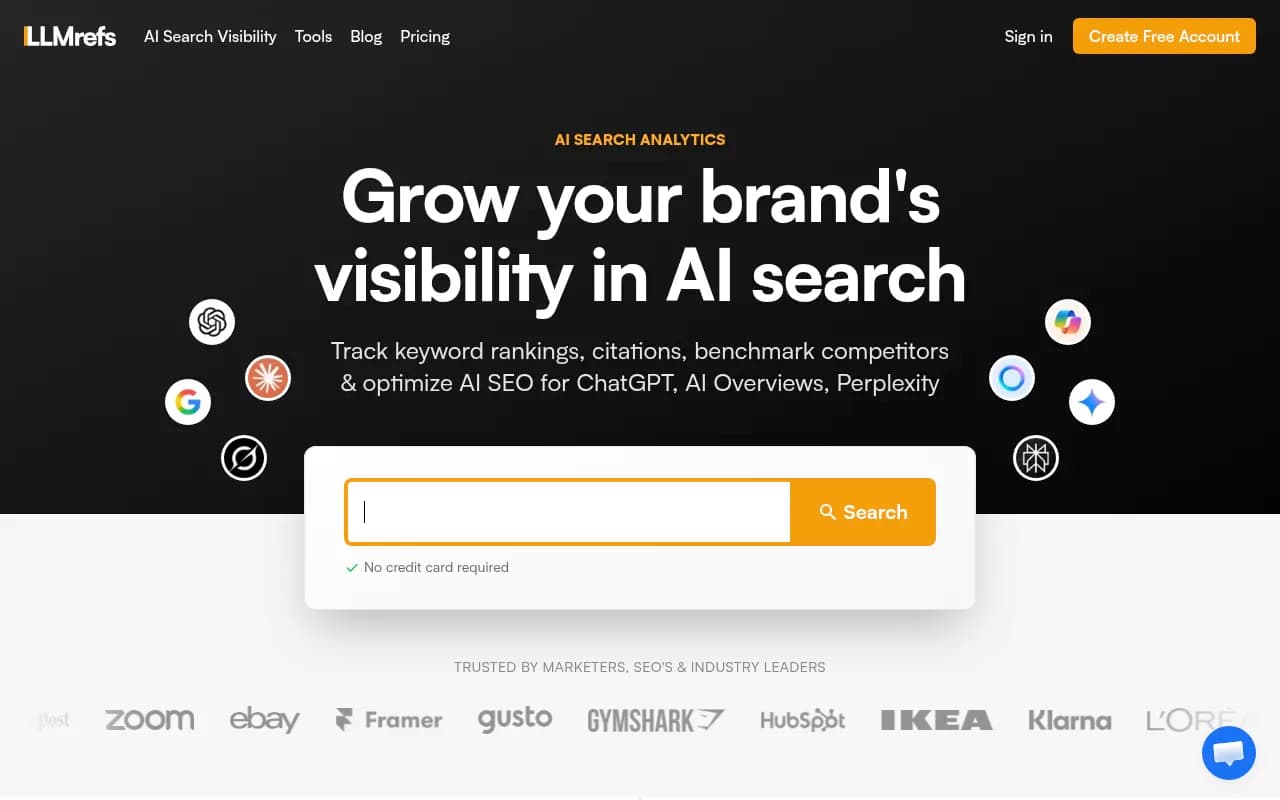
LLMrefs takes a more keyword-centric approach. Rather than asking you to manually define every prompt, it starts from the keywords you already track and generates conversational prompts around them automatically. That's a meaningfully different workflow -- it connects AI visibility to the SEO work you're already doing instead of treating it as a separate silo.
The platform covers ChatGPT, Google AI Overviews, Perplexity, and Gemini. It tracks share of voice, citation counts, and brand mention frequency across those models.
LLMrefs' dashboard showing share-of-voice and citation metrics across AI search engines
What LLMrefs does well
The keyword-to-prompt pipeline is the best feature here. It reduces the manual work of figuring out which prompts to track and makes the data more statistically reliable by generating multiple prompt variations per keyword rather than relying on a single fragile query.
Share-of-voice metrics are well-implemented. You can see how often your brand appears relative to competitors across a given topic area, which gives you a competitive benchmark rather than just an absolute number.
For SEO teams specifically, LLMrefs feels familiar. The mental model maps reasonably well onto traditional rank tracking -- keywords in, visibility data out -- which lowers the learning curve.
Where LLMrefs falls short
Weekly refresh cycles are a real limitation. If you're trying to react to something happening in your space, waiting seven days for updated data is frustrating. Some competitors refresh daily or even in near-real-time.
The dataset is also smaller than enterprise platforms. That means the share-of-voice numbers are directionally useful but shouldn't be treated as precise measurements. For trend-spotting and rough competitive benchmarking, it works. For board-level reporting, you'd want more data behind it.
Like Hall AI, there's no content generation or optimization tooling. LLMrefs is a monitoring dashboard. It shows you where you stand; it doesn't help you improve.
Trakkr.ai
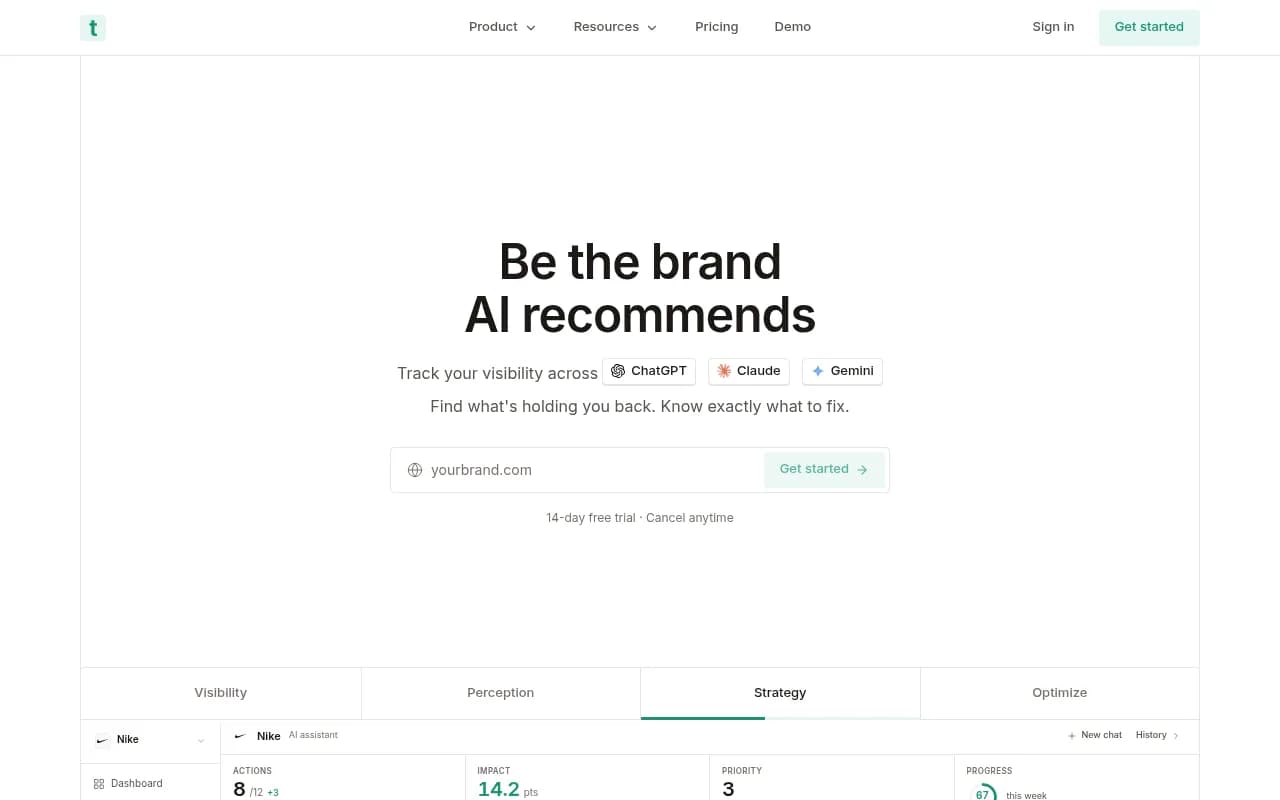
Trakkr.ai is the most minimal of the three. It tracks brand visibility across ChatGPT, Claude, Perplexity, and a few other models, and presents the data in a simple, readable format. The pitch is speed and simplicity: get set up in minutes, see your numbers, check back regularly.
What Trakkr.ai does well
The onboarding is genuinely fast. If you've spent time fighting through complex platform setups, Trakkr's simplicity is refreshing. You enter your brand, define a few prompts, and you're tracking within the hour.
The interface is clean and doesn't overwhelm you with metrics you don't understand yet. For someone just starting to think about AI visibility -- a founder, a small marketing team, someone who wants a quick read on the situation -- Trakkr is a reasonable first step.
Where Trakkr.ai falls short
Trakkr is thin on depth. There's limited competitive benchmarking, no sentiment analysis, no keyword-driven prompt generation, and no content tooling. You get a basic presence/absence signal across a handful of models.
The refresh frequency and prompt limits are also restrictive at lower tiers. If you're tracking more than a handful of queries, you'll hit ceilings quickly.
Trakkr works as a starting point or a sanity check. It's harder to justify as a primary tool once your AI visibility program matures beyond the "are we showing up at all?" question.
Side-by-side comparison
| Feature | Hall AI | LLMrefs | Trakkr.ai |
|---|---|---|---|
| AI models covered | ChatGPT, Claude, Perplexity, Gemini | ChatGPT, Perplexity, Google AI Overviews, Gemini | ChatGPT, Claude, Perplexity + others |
| Sentiment / tone tracking | Yes (core feature) | Limited | No |
| Share-of-voice metrics | Basic | Yes | Basic |
| Citation tracking | Yes | Yes | Yes |
| Keyword-driven prompt generation | No | Yes | No |
| Competitor benchmarking | Limited | Yes | Limited |
| Content optimization / generation | No | No | No |
| Crawler log access | No | No | No |
| Refresh frequency | Not specified | Weekly | Not specified |
| Best for | Brand/PR teams focused on tone | SEO teams tracking keyword-level visibility | Teams wanting a quick, low-effort setup |
| Pricing tier | Affordable | Affordable (startup-friendly) | Affordable |
Which one should you pick?
The honest answer depends on what question you're trying to answer.
If you're a brand or PR team and you want to know how AI models are framing your company -- the language, the associations, the sentiment -- Hall AI is the most purpose-built option for that.
If you're an SEO team and you want AI visibility data that connects to your existing keyword work, LLMrefs is the better fit. The keyword-to-prompt pipeline makes it feel like a natural extension of rank tracking rather than a completely separate workflow.
If you just want to check whether your brand is showing up in AI answers and you don't want to spend more than an hour on setup, Trakkr.ai gets you there fastest.
That said, all three tools share the same fundamental limitation: they're monitoring dashboards. They show you the problem. They don't help you fix it.
The gap these tools don't fill
This is worth saying plainly. If you track your AI visibility with any of these tools and discover you're invisible for a set of important prompts, none of them will tell you what content to create, which topics to cover, or how to structure your pages to get cited.
That's a significant gap. Knowing you have a problem and knowing how to solve it are different things.
Teams that want to close that loop -- find gaps, create content, track improvement -- typically end up moving to a more complete platform. Promptwatch is one example: it combines visibility tracking with answer gap analysis and a built-in AI writing agent that generates content specifically designed to get cited by AI models. The distinction is that it's built around the optimization cycle, not just the monitoring step.

That's not a knock on Hall AI, LLMrefs, or Trakkr.ai. They serve a real purpose, especially for teams that are earlier in their AI visibility journey or working with tighter budgets. But it's worth knowing the ceiling before you commit.
Other lightweight options worth considering
If none of the three main tools feel quite right, a few others occupy similar territory:

Otterly.AI is frequently mentioned alongside LLMrefs as an accessible entry point. It covers the major models and has a clean interface, though like the others, it's primarily a monitoring tool.

Peec AI is worth a look if you need multi-language tracking -- it handles non-English markets better than most tools at this price point.
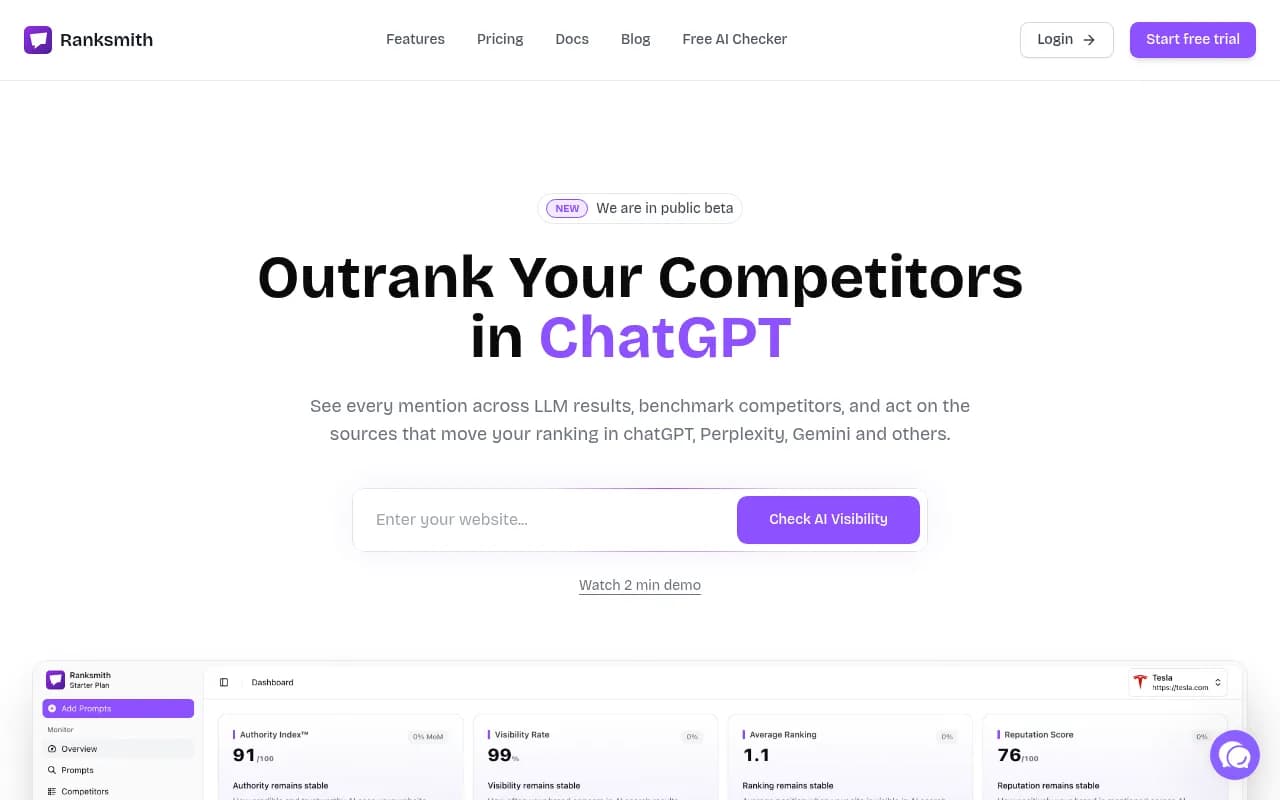
Ranksmith sits slightly above the lightweight tier but offers more actionable insight than pure monitoring tools, which makes it a reasonable step up if you find yourself wanting more than Hall, LLMrefs, or Trakkr can provide.
The bottom line
Hall AI, LLMrefs, and Trakkr.ai are all legitimate tools for teams that want a low-friction way to start tracking AI brand visibility. LLMrefs has the most depth of the three, Hall AI has the most distinctive angle with sentiment tracking, and Trakkr.ai has the lowest barrier to entry.
None of them are the last tool you'll ever need. The AI search visibility space is moving fast, and the teams that treat monitoring as the beginning of the process -- not the end -- are the ones that will actually improve their position. Pick the tool that fits where you are now, but keep an eye on what you'll need when "are we showing up?" stops being the only question that matters.