Key takeaways
- These four platforms sit in very different categories: Botify and seoClarity are enterprise technical SEO platforms that have added AI visibility features, while Goodie AI and Promptwatch are purpose-built for AI search optimization.
- If your priority is crawl budget, log file analysis, and site architecture at scale, Botify is the strongest technical SEO option -- but its AI visibility features are still maturing.
- seoClarity is the most complete traditional SEO platform of the four, with solid AI Overviews tracking, but it doesn't close the loop from monitoring to content creation.
- Promptwatch is the only platform here that covers the full cycle: find gaps, generate content, and track results -- including crawler logs, ChatGPT Shopping, Reddit insights, and page-level citation tracking.
- Goodie AI is a lightweight entry point for AI brand monitoring, useful for smaller teams but limited in depth compared to the others.
The question used to be simple: which SEO platform gives me the best keyword data? In 2026, it's more complicated. AI search engines -- ChatGPT, Perplexity, Google AI Mode, Gemini -- are now answering millions of queries that never click through to a search results page. Your brand either shows up in those answers or it doesn't, and traditional SEO tools weren't built to tell you which.
So now you're evaluating platforms that claim to do both: technical SEO and AI visibility. This guide focuses on four of them -- Goodie AI, Promptwatch, Botify, and seoClarity -- because they represent genuinely different approaches to that problem. Two come from the technical SEO world and have bolted on AI features. Two were built specifically for the AI search era. The gap between those philosophies matters more than any feature checklist.
Let's get into it.
What "combining technical SEO with AI visibility" actually means
Before comparing tools, it's worth being precise about what we're measuring. "Technical SEO" covers crawlability, indexation, site speed, structured data, log file analysis, and the infrastructure that helps search engines discover and render your content. "AI visibility" covers whether AI models cite your brand, which pages they reference, how often you appear in AI-generated answers, and what you can do to improve that.
These two things are related but not the same. A technically perfect site can still be invisible in AI search if it doesn't have the right content. And a site with great AI-optimized content can still underperform if crawlers can't access it properly.
The ideal platform would handle both. In practice, most tools do one well and the other adequately -- or not at all.
Goodie AI
Goodie AI is a monitoring-focused platform built specifically for AI search visibility. It tracks how your brand appears across ChatGPT, Perplexity, Gemini, and other AI engines, giving you sentiment analysis, share of voice data, and competitor comparisons.
What it does well: the interface is clean, setup is fast, and the brand monitoring data is genuinely useful for teams that are just starting to think about AI visibility. If you're a marketing manager who wants to know "does ChatGPT mention us when someone asks about our category?" Goodie gives you that answer without much friction.
What it doesn't do: technical SEO. There's no crawler, no log file analysis, no structured data auditing, no crawl budget optimization. Goodie is a monitoring tool, not an optimization platform. You can see where you're invisible, but the platform doesn't help you fix it. There's also no content generation, no prompt volume data, and no page-level citation tracking.
For small teams or brands new to AI visibility, Goodie is a reasonable starting point. For anyone who needs to actually move the needle, it runs out of depth quickly.
Botify
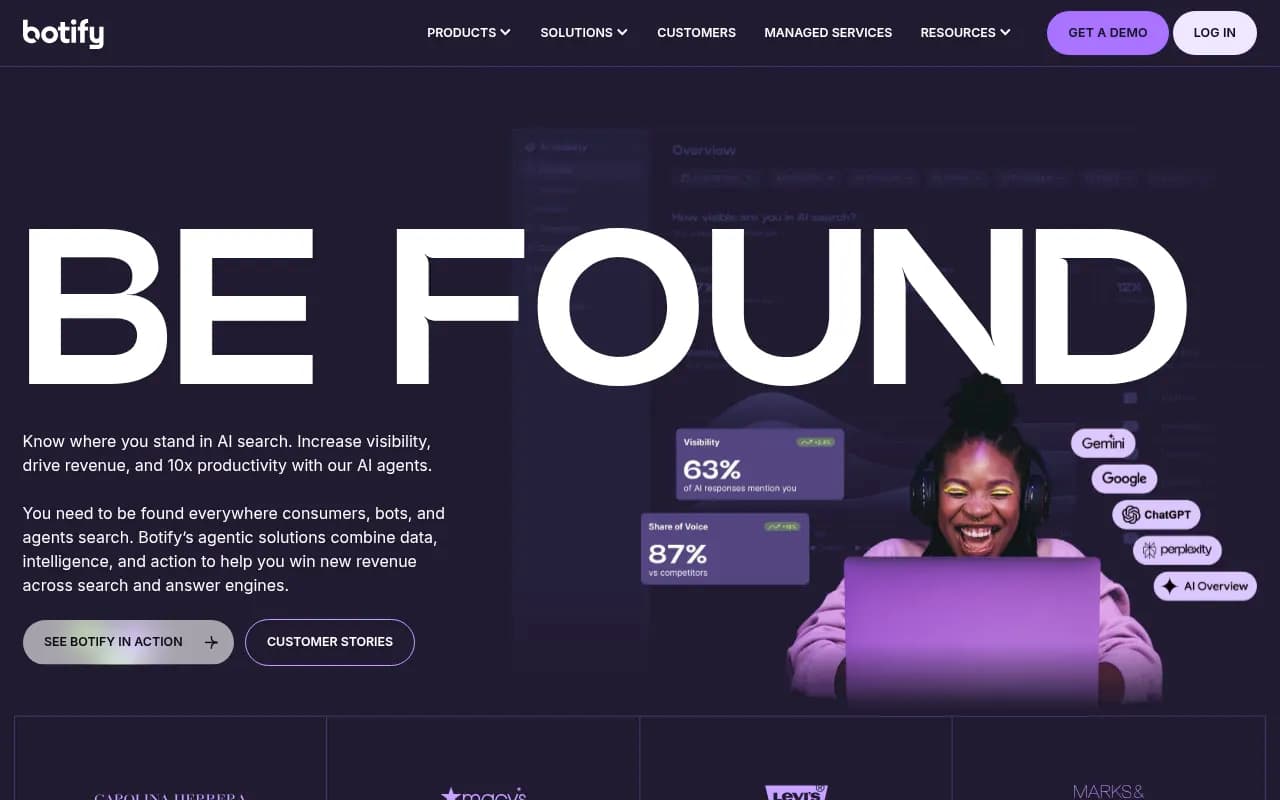
Botify is the most technically sophisticated platform in this comparison. It was built for enterprise SEO teams managing sites with hundreds of thousands or millions of pages -- think large e-commerce retailers, media publishers, and global brands where crawl budget is a real constraint.
Its core strength is log file analysis. Botify's LogAnalyzer shows you exactly which pages search engine crawlers are visiting, how often, and whether they're being indexed. Pair that with its crawler (SiteCrawler) and you get a detailed picture of how Google actually experiences your site versus how you think it does. For large sites, this is genuinely valuable -- it's the kind of data that can explain why pages that look fine in your CMS are being ignored by search engines.
In 2026, Botify has added AI visibility features, including tracking for AI Overviews and some AI search monitoring. But this is clearly an add-on to a platform built around traditional search infrastructure. The AI visibility data is useful, but it doesn't go deep: there's no prompt volume scoring, no content gap analysis against AI responses, no Reddit or YouTube citation tracking, and no content generation tools.
Botify also comes with enterprise pricing to match. It's not a tool you evaluate casually -- it's a platform you buy when you have a large site, a dedicated technical SEO team, and a budget to match.
If your primary pain is technical SEO at scale and you want some AI visibility data alongside it, Botify is worth evaluating. If AI search optimization is your main goal, it's the wrong starting point.
seoClarity
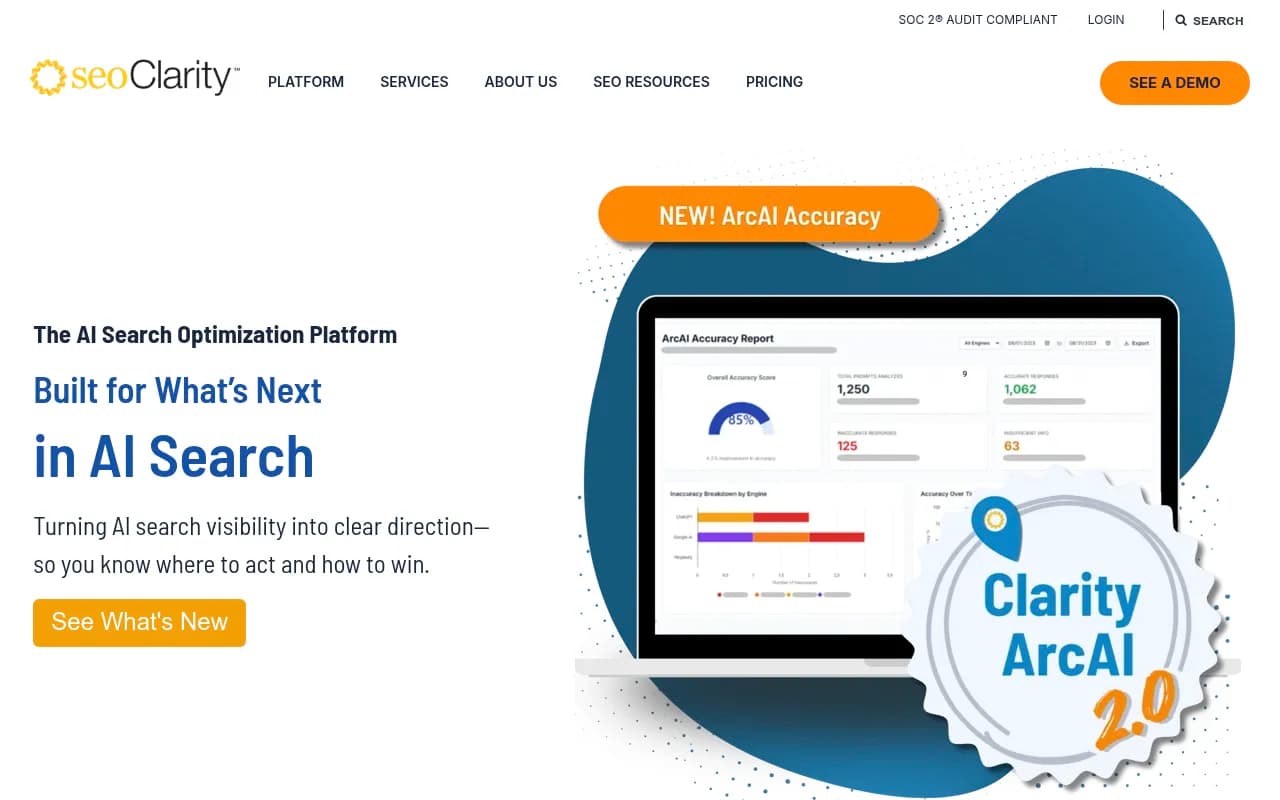
seoClarity sits somewhere between Botify's technical depth and a full-stack marketing platform. It's an enterprise SEO tool with strong keyword research, rank tracking, content optimization workflows, and site auditing -- and it has added meaningful AI visibility features over the past 18 months.
The AI Overviews tracking in seoClarity is one of the better implementations among traditional SEO platforms. You can see which of your pages appear in Google's AI Overviews, track changes over time, and get some content recommendations. It also covers a broader set of AI engines than most traditional SEO tools bother with.
Where seoClarity falls short for AI visibility specifically: it's still fundamentally a monitoring and reporting platform. You can see the data, but the path from "I'm not appearing in AI answers for this query" to "here's the content I need to create" is manual. There's no AI-native content generation tied to prompt data, no crawler log analysis for AI bots specifically, and no page-level citation tracking that shows which of your pages AI models are actually reading and citing.
For enterprise SEO teams that are already using seoClarity for traditional search and want to layer in AI visibility reporting, it's a reasonable choice. For teams where AI search optimization is the primary goal, it's a monitoring tool that stops short of helping you act.
Promptwatch
Promptwatch takes a different approach from all three platforms above. It was built from the ground up for AI search optimization -- not as an add-on to a traditional SEO platform, but as a dedicated system for understanding and improving how AI engines perceive your brand.

The core difference is what happens after you see the data. Promptwatch's Answer Gap Analysis shows you exactly which prompts competitors are visible for that you're not -- the specific questions AI models are answering where your content isn't being cited. That's useful. But then it goes further: Content Agents generate articles, comparisons, and briefs grounded in that prompt data, so you're creating content specifically designed to fill the gaps AI models are exposing.
On the technical side, Promptwatch's AI Crawler Logs show you real-time data on when ChatGPT, Claude, Perplexity, and other AI crawlers hit your pages, which pages they read, what errors they encounter, and how often they return. This is the AI equivalent of Botify's log file analysis -- and it's something most platforms in this space don't offer at all.
Other capabilities worth noting: page-level citation tracking (which specific pages are being cited, by which models, how often), ChatGPT Shopping tracking, Reddit and YouTube citation analysis, prompt volume and difficulty scoring, and traffic attribution that connects AI visibility to actual revenue. It monitors 10 AI models including ChatGPT, Perplexity, Google AI Mode, Claude, Gemini, Grok, DeepSeek, Copilot, Meta AI, and Mistral.
Promptwatch isn't a replacement for a dedicated technical SEO crawler like Botify or Screaming Frog for traditional crawl analysis. But for teams whose primary goal is AI search visibility -- understanding it, improving it, and proving it drives results -- it's the most complete platform in this comparison.
Pricing starts at $99/month (Essential: 1 site, 50 prompts, 5 articles) with a Professional tier at $249/month and Business at $579/month. A free trial is available.
Head-to-head comparison
| Goodie AI | Botify | seoClarity | Promptwatch | |
|---|---|---|---|---|
| AI brand monitoring | Yes | Partial | Yes | Yes |
| Prompt volume & difficulty | No | No | No | Yes |
| Content gap analysis | No | No | Limited | Yes |
| AI content generation | No | No | No | Yes |
| AI crawler logs | No | No | No | Yes |
| Page-level citation tracking | No | No | No | Yes |
| Technical SEO crawler | No | Yes (enterprise) | Yes | No |
| Log file analysis | No | Yes | Partial | AI bots only |
| Google AI Overviews tracking | Limited | Partial | Yes | Yes |
| ChatGPT Shopping tracking | No | No | No | Yes |
| Reddit/YouTube insights | No | No | No | Yes |
| Traffic attribution | No | Limited | Limited | Yes |
| Pricing (entry) | Low | Enterprise | Enterprise | $99/mo |
| Best for | Small teams, brand monitoring | Large-site technical SEO | Enterprise SEO + AI reporting | AI search optimization |
How to choose
The right platform depends on what problem you're actually trying to solve.
If your site has serious technical SEO issues -- crawl budget problems, indexation gaps, log file anomalies on a site with millions of pages -- Botify is the strongest tool for that job. Its AI visibility features are secondary, but they exist. Just know you're buying a technical SEO platform, not an AI search optimization platform.
If you're an enterprise SEO team already invested in a comprehensive platform and you want AI visibility reporting layered in, seoClarity is worth evaluating. It's solid on traditional SEO and has made genuine progress on AI Overviews tracking. The gap is that it stops at reporting -- you'll need to figure out the content response yourself.
If you're a smaller team or just starting to think about AI visibility, Goodie AI gives you a low-friction entry point. It won't help you fix anything, but it will tell you where you stand.
If AI search optimization is your primary goal -- not just monitoring, but actually improving your visibility in ChatGPT, Perplexity, and Google AI Mode -- Promptwatch is the most complete option. The combination of prompt tracking, content generation, AI crawler logs, and traffic attribution is something none of the other three platforms offer in one place.
One scenario worth calling out: some teams use Botify or seoClarity for traditional technical SEO and Promptwatch for AI visibility. These tools aren't necessarily competing -- they're solving different problems. If you have the budget and the team to run both, that's a legitimate setup.
A note on what's still missing across all four
No platform in this comparison fully solves the problem of proving ROI from AI search. Traffic attribution from AI engines is genuinely hard -- AI answers often don't generate clicks, and when they do, the referral data is inconsistent. Promptwatch gets closer than the others with its AI visitor analytics and revenue attribution, but this is an area where the whole category is still maturing.
Structured data optimization for AI engines is another gap. Traditional schema markup helps Google understand your content, but AI models don't consume structured data the same way. None of these platforms give you a clear playbook for structuring content so AI models are more likely to cite it -- though Promptwatch's content generation gets closer by grounding output in actual citation data.
The platforms that will win this space in the next 12-18 months are the ones that close the loop between what AI models are citing, why they're citing it, and what content changes actually move the needle. Right now, Promptwatch is the furthest along that path. Botify and seoClarity are strong in their lanes but haven't made AI optimization a core product priority. Goodie AI is useful but limited.
Pick the tool that matches where your team actually is -- and what problem you're actually trying to solve.