Key takeaways
- DeepSeek, Grok, and Mistral each serve distinct audiences -- ignoring any of them means missing real brand exposure opportunities in 2026.
- Grok's real-time X/Twitter integration makes it uniquely valuable for brands in news-sensitive or fast-moving industries.
- DeepSeek's open-source momentum has driven rapid adoption in Asia-Pacific and among cost-conscious developers worldwide.
- Mistral's European roots and privacy focus are attracting regulated industries that avoid US-based models.
- Tracking your brand across these three models requires different strategies than traditional SEO -- tools built for AI visibility monitoring can close that gap.
Most brand teams are still laser-focused on ChatGPT and Google AI Overviews. That's understandable -- those two capture the bulk of AI search traffic right now. But the conversation is spreading. DeepSeek crossed 100 million users faster than almost any app in history. Grok is embedded directly into X, where breaking news and brand conversations happen in real time. Mistral is quietly becoming the model of choice for European enterprises and privacy-conscious developers.
If your brand appears in ChatGPT but gets ignored by Grok when someone asks "what's the best [your category] tool?" -- that's a gap. And it's a gap that's growing as these models gain users.
This guide breaks down what each model actually is, who uses it, and what that means for your brand visibility strategy.
What makes these three models different from the mainstream
Before getting into the brand tracking angle, it's worth understanding what actually distinguishes DeepSeek, Grok, and Mistral from the ChatGPT/Claude/Gemini tier.
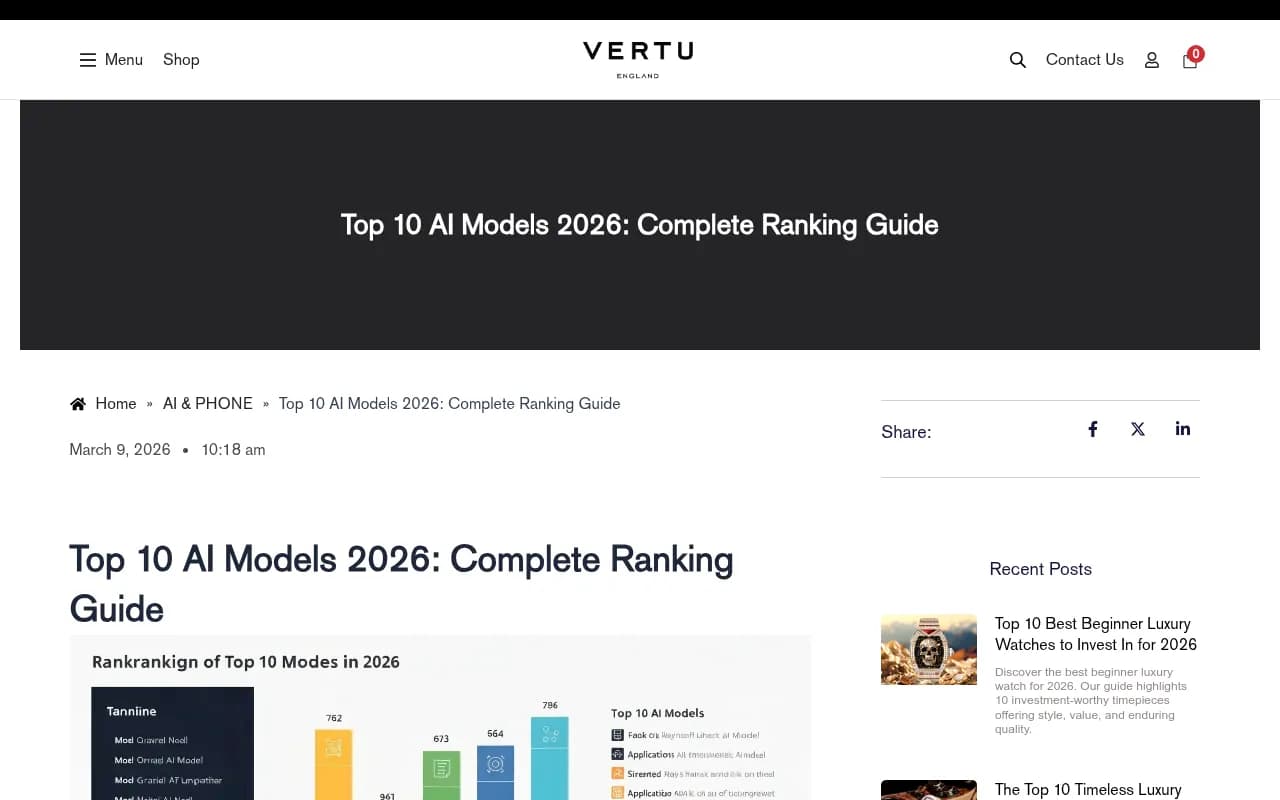
The ranking above shows where these models sit in the broader 2026 landscape. They're not at the top -- but they're not fringe players either. They occupy a middle tier that's growing fast and serving specific audiences that the top-tier models don't fully capture.
DeepSeek: the open-source disruptor
DeepSeek V3 and its reasoning variant R1 came out of China and immediately caused a stir in early 2025 when benchmarks showed it competing with GPT-4 class models at a fraction of the training cost. By 2026, DeepSeek has become the go-to open-source model for developers who want strong reasoning capabilities without paying OpenAI or Anthropic API rates.
The user base skews heavily toward:
- Developers and technical teams building AI-powered products
- Asia-Pacific markets where DeepSeek has strong brand recognition
- Cost-sensitive organizations running AI at scale
- Researchers who need a capable model they can self-host
For brands, this matters because DeepSeek's responses to product and service queries are increasingly influencing purchase decisions in these segments. If a developer asks DeepSeek "what's the best API monitoring tool for my stack?" and your brand isn't mentioned, you've lost that moment.
Grok: real-time, opinionated, and X-native
Grok 4 (xAI's current flagship) has one capability that no other major model matches: live access to X/Twitter data. When someone asks Grok about a brand, a product category, or an industry trend, it can pull in what people are actually saying right now -- not just what was in a training dataset from six months ago.
This creates a genuinely different dynamic for brand monitoring. Grok's answers about your brand are partly shaped by your X presence, your community's conversations, and how people are talking about you in real time. A brand with an active, positive X community will tend to appear more favorably in Grok responses than one that's dormant or has recent negative threads.
Grok's user base is concentrated among:
- X Premium subscribers (the platform's paying users)
- People who want real-time information rather than static knowledge
- Tech-forward audiences who followed Elon Musk's AI venture
- Users who want a less "filtered" AI personality
Mistral: Europe's answer to Big Tech AI
Mistral AI is a French company, and that origin matters more than you might expect. European data privacy regulations (GDPR, the EU AI Act) have made many enterprises -- especially in finance, healthcare, and government -- wary of sending sensitive queries to US-based AI providers. Mistral fills that gap.
Mistral's models (including Mistral Large and the open-weight variants) are available both as a hosted API and for self-deployment. The open-weight versions in particular have been adopted widely in enterprise settings where data sovereignty is non-negotiable.
The Mistral user base includes:
- European enterprises across regulated industries
- Developers who want a capable open-weight model they can run locally
- Organizations building AI products that need to comply with EU regulations
- Teams using the Le Chat interface as a ChatGPT alternative
For brands targeting European B2B audiences, Mistral visibility is increasingly relevant. A procurement manager in Germany asking Mistral about enterprise software vendors is a real scenario, and it's happening more often.
Why brand visibility differs across these models
Here's something that surprises most marketers when they first start thinking about AI visibility: the same question asked to different models can produce completely different brand recommendations.
Ask ChatGPT "what are the best project management tools for remote teams?" and you might get Asana, Monday.com, and Notion. Ask Grok the same question and it might surface different tools based on what's been trending on X. Ask DeepSeek and you might get a different mix based on its training data and the communities that shaped it.
This isn't a bug -- it's just how these models work. They're trained on different data, with different cutoffs, different weighting of sources, and different approaches to answering. The result is that brand visibility in AI search is not a single metric. It's a matrix of presence across multiple models, each with its own audience and its own logic.
A few specific ways this plays out:
Training data and citations: Each model has different source preferences. Mistral may weight European publications and technical documentation differently than ChatGPT. DeepSeek's training included significant Chinese-language content. Grok supplements its training with live X data. The content that gets your brand cited in one model may not be the content that works in another.
Recency: Grok has a significant advantage for anything time-sensitive. DeepSeek and Mistral have knowledge cutoffs that mean recent product launches, rebrands, or news may not be reflected in their responses. This cuts both ways -- negative press from last year might still show up, while a recent positive product review might not.
Tone and framing: Grok tends to be more opinionated and direct. Mistral's responses often feel more formal and structured. DeepSeek can be quite technical. The way your brand is described varies by model, and that framing matters for perception.
How to think about tracking your brand across all three
Traditional SEO rank tracking doesn't translate to AI visibility. You can't just check a position number. What you need to track is:
- Whether your brand is mentioned at all when relevant queries are asked
- How your brand is described when it is mentioned
- Which competitors are being recommended instead of you
- What sources the model is citing (and whether your content is among them)
This is where dedicated AI visibility tools become necessary. Manually prompting DeepSeek, Grok, and Mistral with dozens of queries every week isn't scalable, and it doesn't give you trend data over time.
Promptwatch monitors brand visibility across 10 AI models including DeepSeek, Grok, and Mistral -- and goes beyond just showing you where you appear. Its Answer Gap Analysis identifies which prompts your competitors are visible for that you're not, and a built-in content generation tool helps you create the articles and pages that are most likely to get cited.

For teams that want to start with something more focused, there are several other tools worth knowing about:



Here's a quick comparison of how these tools handle the three models in question:
| Tool | Tracks DeepSeek | Tracks Grok | Tracks Mistral | Content gap analysis | Content generation |
|---|---|---|---|---|---|
| Promptwatch | Yes | Yes | Yes | Yes | Yes |
| Otterly.AI | Partial | Partial | No | No | No |
| Peec AI | Yes | No | No | No | No |
| Rankshift | Yes | Yes | Partial | No | No |
| Profound | Yes | Yes | No | No | No |
The pattern here is consistent with what you see across the broader category: most tools track some models but not all three, and almost none help you do anything about the gaps they find.
Practical strategies for each model
Getting cited by DeepSeek
DeepSeek's training data heavily favors technical documentation, developer communities (GitHub, Stack Overflow, Hacker News), and structured reference content. If your brand is in a technical category, the highest-leverage move is:
- Publishing detailed technical documentation and integration guides
- Contributing to or being discussed in developer forums
- Creating comparison content that positions your product against alternatives (DeepSeek tends to cite these)
- Getting mentioned in technical newsletters and publications that were likely included in training data
For non-technical brands, the path is harder -- DeepSeek's general knowledge about consumer brands is less developed than ChatGPT's. But that also means there's less competition for visibility in your category.
Getting cited by Grok
Grok is the most dynamic of the three because its real-time X integration means your visibility can change week to week based on what's happening on the platform.
Practical moves:
- Maintain an active X presence with substantive posts (not just promotional content)
- Engage with conversations in your industry on X -- Grok picks up on what's being discussed
- When you launch something new, create X threads that explain it clearly (these can surface in Grok responses)
- Monitor what's being said about your brand on X, because Grok may be surfacing that content in responses about you
One thing worth knowing: Grok can be quite direct about negative sentiment. If there's a thread of complaints about your product on X, Grok might include that context when someone asks about your brand. Traditional reputation management matters here in a way it doesn't for models with static training data.
Getting cited by Mistral
Mistral's citation patterns favor structured, authoritative content -- think industry reports, detailed how-to guides, and content published on established European or international publications. The model also tends to be more conservative in its recommendations, often citing well-known brands over newer entrants.
For brands targeting European markets:
- Publish content on European industry publications and news sites
- Create detailed, well-structured guides that answer specific professional questions
- Get coverage in French, German, and other European language publications (Mistral handles multilingual content well)
- Consider whether your website content is available in European languages -- this can affect how Mistral represents your brand in non-English queries
The monitoring setup worth building
If you're serious about tracking across all three models, here's a practical monitoring setup:
Start with a set of 20-30 prompts that represent how your actual customers would search for solutions in your category. Include:
- Category-level queries ("best [category] tools for [use case]")
- Problem-based queries ("how do I solve [specific problem]")
- Comparison queries ("[your brand] vs [competitor]")
- Brand-specific queries ("[your brand] review" or "is [your brand] good for [use case]")
Run these prompts across DeepSeek, Grok, and Mistral at least monthly. Track not just whether you appear, but where in the response, how you're described, and who else is mentioned alongside you.
Tools like Promptwatch automate this entirely -- you set up your prompts once and get ongoing visibility scores, competitor comparisons, and alerts when something changes. The crawler logs feature is particularly useful for understanding whether DeepSeek and Mistral's crawlers are even visiting your site (they may not be, which is a separate problem to fix).
For teams that want to layer in additional monitoring, a few other tools are worth considering:
What the data tells us about emerging model adoption
The 2026 AI model landscape has consolidated somewhat at the top -- GPT-5.4, Claude Opus 4.6, and Gemini 3.1 are clearly the dominant general-purpose models by user count. But the "emerging" tier (DeepSeek at #7, Mistral at #8 in most rankings) is growing faster in specific segments than the headline numbers suggest.
DeepSeek's developer adoption is particularly notable. In communities where developers discuss AI tools, DeepSeek comes up constantly -- both as a model to use and as a benchmark for what's possible at low cost. That developer mindshare translates into real brand exposure for companies in the developer tools, infrastructure, and API space.
Grok's growth is tied directly to X's user base, which remains substantial despite the platform's turbulent few years. The integration is deep enough that many X users now default to Grok for quick questions rather than switching to a separate app.
Mistral's growth story is mostly enterprise and European. It doesn't have the consumer mindshare of the top models, but in B2B contexts -- especially procurement decisions in regulated European industries -- it's becoming a meaningful channel.
The bottom line
Most brand teams are underinvesting in AI visibility monitoring for the simple reason that it's new and the tools are still maturing. But the window for getting ahead of competitors is closing. Brands that establish strong citation patterns in DeepSeek, Grok, and Mistral now will have a structural advantage as these models grow.
The three models serve different audiences with different needs. Grok is where real-time brand reputation plays out. DeepSeek is where technical and developer audiences are making decisions. Mistral is where European enterprise buyers are increasingly turning for recommendations.
Tracking all three -- and actually doing something about the gaps you find -- is the work. The brands that treat AI visibility as a serious channel in 2026 will be the ones that don't have to scramble to catch up in 2027.