Key takeaways
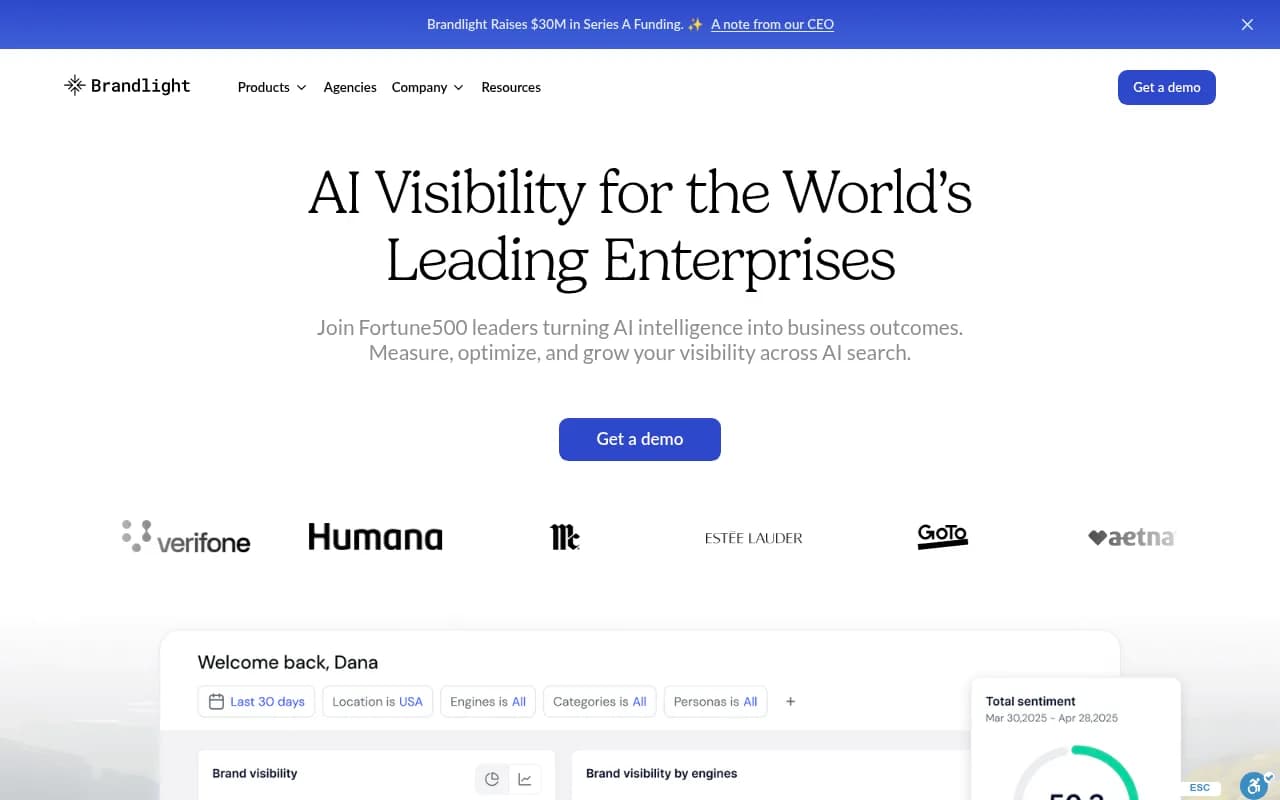
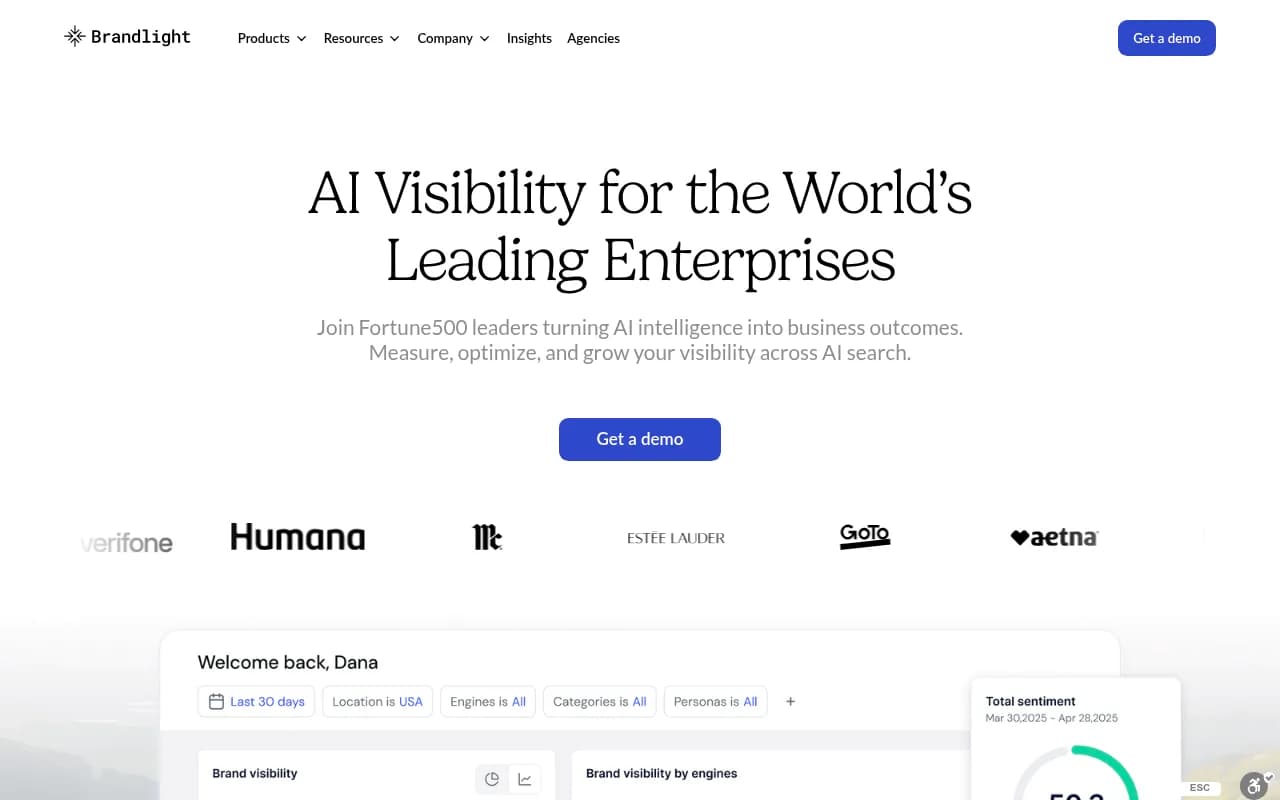
- Brandlight is an enterprise-only AI visibility platform covering ChatGPT, Google AI Overviews and AI Mode, Gemini, Perplexity, Copilot, and Claude, with five modules: Visibility & Insights, Content, Partnerships, Commerce, and Technical.
- Its strongest genuinely differentiated pieces are server-log AI crawler analysis, a dedicated AI advertising measurement module, and multi-brand/multi-region portfolio views. Few competitors have all three.
- The proof points are real but vendor-reported: a Kimberly-Clark case study claims 12 of 12 brands reached top-3 AI visibility across major LLMs, and G2 shows 4.8/5 from 194 reviews. Independent corroboration exists but is partial.
- There is no public pricing. Engagement starts with a paid 3-month pilot, and third-party estimates put enterprise contracts somewhere in the $4K–$15K/month range. If you need to compare on price, this isn't your tool.
- Watch the marketing claims. Brandlight's "#1 globally" homepage badge names no analyst or report, and its own "8 Best AI Visibility Tools" blog ranks itself first. The product is strong; the self-ranking is worth discounting.
What Brandlight actually is
Brandlight calls itself an "AI visibility platform for enterprise brands" and, more ambitiously, a marketing operating system for AI as a channel. Founded in October 2024 in Israel by Imri Marcus, Uri Gafni, and Didi Dvash, the company came out of stealth with a $5.75M seed in April 2025 and raised a $30M Series A in February 2026 led by Pelion Venture Partners. That's fast growth for a two-year-old company, and it shows in both the product's ambition and the aggressiveness of the marketing.
The platform organizes itself around a loop it calls See → Shape → Act → Transform, spanning owned, third-party, social, retail, paid, and what it brands "agentic-commerce" surfaces. In practice that breaks into five modules:
- Visibility & Insights — brand mentions, sentiment, citations, and competitive positioning inside AI answers, with a funnel-tagged query set (awareness → consideration → decision) built from licensed AI-panel data plus search signals.
- Content — a multi-agent generation workflow (strategist → writer → editor → validator) that enforces deterministic brand and legal rules and routes drafts to your CMS for human review. It does not auto-publish, which is the right call for regulated industries.
- Partnerships — assessments of which third-party publishers and review surfaces shape your AI answers, and prescriptive recommendations to fix or build those relationships.
- Commerce — tracking and optimization for AI shopping surfaces, including ChatGPT shopping results and agentic checkout flows.
- Technical — raw server-log analysis showing which AI crawlers reached your site, which were denied, and what they read.
That last module matters more than it sounds. Reading raw server logs to diagnose AI crawler access is something only Brandlight and Profound do well among the tools we've reviewed, and it answers the "why" question that most visibility dashboards skip. If your visibility score dropped, the Technical module can tell you whether GPTBot was hitting 403s before it ever happened.
What the platform genuinely does well
The query set comes to you
Most AI visibility tools put the prompt-selection burden on you: you guess which questions matter, type them in, and hope the tool tracks something representative. Brandlight builds the query set for you from licensed AI-panel data plus search signals, tags each prompt by funnel stage, and weights by buying intent. G2 reviewers specifically called this out. One wrote that instead of "checking random prompts," they now "analyze our AI visibility by the customer journey method." That's a real workflow difference, not a cosmetic one.
Prescriptive, explainable recommendations
Brandlight's recommendations are tied to specific source data: fix this page, create this content, partner with this publisher. Each one is explainable rather than a black-box score. For enterprise buyers, this matters because the recommendations have to survive review by people who didn't buy the tool. A senior SEO manager reviewer put it well: Brandlight "goes beyond the basic AEO/GEO data and tactics, it looks at overall brand visibility, sentiment and influencing factors for our brands in AI platforms."
The UI-vs-API problem, taken seriously
Here's something genuinely impressive from Brandlight's research lab: in June 2026 they ran 900 unbranded questions through both official APIs and the real consumer UIs of ChatGPT, Gemini, and Perplexity. The brand overlap between UI and API answers was only 6–12%, and the first-named brand matched in just 9–16% of pairs. ChatGPT's real UI read 3.5x more sources per answer than its API.
This is a real methodological problem in the industry. Many monitoring tools are built on API responses, and Brandlight's study suggests those numbers can diverge sharply from what actual users see. Promptwatch's data reaches the same conclusion from the other direction: its monitoring is built on real UI data precisely because user-facing answers, citations, and shopping recommendations differ from API outputs. Whatever tool you pick, ask the vendor whether their numbers come from the interface or the API. If they can't answer cleanly, discount everything they show you.
Why third-party sources matter so much
Brandlight claims roughly 85% of sources AI cites for category questions are third-party or social, not your own domain. That framing is what justifies the Partnerships module, and it's broadly consistent with what independent citation data shows. Promptwatch's June 2026 ChatGPT citation share data found that even the #1 most-cited domain (Reddit, at 3.71% of citations) holds under 4% of total share, with the citation landscape being a long tail of review sites, editorial, retailer pages, and forums rather than a winner-take-all game. A brand optimizing only its own website is optimizing a small fraction of what actually shapes AI answers.
The same data shows why monitoring needs to be continuous rather than a quarterly audit: Reddit's share of ChatGPT citations fell roughly 40% in a single month (6.11% to 3.71% between May and June 2026), while GitHub and Trustpilot shares rose slightly. Source influence shifts fast enough that last quarter's playbook may already be stale.
The proof points: real, but read them carefully
The Kimberly-Clark case
Brandlight's flagship proof point is Kimberly-Clark: 12 of 12 brands now ranking top-3 in their categories across major LLMs, based on monitoring over 600,000 queries. That's a strong result, and The Drum independently reported that an e-commerce assessment ranked Kimberly-Clark the top CPG in AI visibility. But note the caveat: the independent coverage corroborates K-C's AI visibility leadership without explicitly attributing it to Brandlight's tool. The claim is plausible, vendor-reported, and partially corroborated. Treat it as a strong signal, not a guarantee.
G2 reviews
G2 currently shows 4.8/5 from 194 reviews, with 96% five-star and nothing below three stars. A third-party aggregator's earlier snapshot showed 4.7/5 from only 19 verified reviews, which means review volume grew roughly tenfold during 2026. That's either impressive momentum or a well-executed review generation program, and honestly it's probably both. Enterprise vendors with 194 near-unanimous reviews this early are rare.
The praise themes are consistent: dashboards described as "very thorough and user-friendly," insights that "informed our GEO strategy & tactics" with results that were "clear, measurable," and genuine multi-brand support. One reviewer specifically sought "an enterprise-level platform that could manage multiple brands that operate in different markets" and found it delivered across content, brand, SEO, and paid media teams.
The criticism themes are just as consistent: no published pricing, implementation taking 30–90 days for full productivity, and an attribution module that was listed as "coming soon" for connecting AI visibility to revenue. Also worth knowing: Brandlight has essentially no presence on Capterra, TrustRadius, or Trustpilot. G2 is the only independent review source, which limits your ability to cross-check.
One interesting wrinkle: G2's own segment filters show Brandlight users split between small business (42), mid-market (110), and enterprise (36). Despite the "enterprise-only" positioning, most current reviewers are mid-market. Make of that what you will.
Pricing: the part nobody can verify
There is no public pricing page. /pricing and /plans return 404s. Brandlight's own FAQ describes pricing as "custom to scope" and the platform as enterprise-only, beginning with a paid 3-month pilot rather than a free trial. Third-party estimates put enterprise contracts in the $4K–$15K/month range depending on brand count, regions, and modules, with one aggregator listing an unverified "~$199/mo" entry point that we could not confirm and that contradicts the enterprise-only positioning.
For context, here's how the visible market prices:
| Tool | Public pricing | Model | Best fit |
|---|---|---|---|
| Brandlight | None (contact sales, paid 3-month pilot) | Enterprise platform + strategy team | Multi-brand Fortune 500 |
| Profound | $99–$399/mo self-serve | SaaS with enterprise tier | Enterprise with self-serve option |
| Ahrefs Brand Radar | $129–$449/mo base + $398–$699/mo add-on | Add-on to Ahrefs | Existing Ahrefs users |
| Semrush AI Toolkit | From $99/mo per domain | Add-on to Semrush | Existing Semrush users |
| Peec AI | $80–$205/mo | Self-serve SaaS | SMBs and agencies |
| Otterly.ai | From ~$29/mo | Self-serve SaaS | Small teams, basic tracking |
If your buying process requires comparing vendors on price, Brandlight has effectively opted out of that comparison. That's a deliberate enterprise strategy, but it means you'll be negotiating from zero public information.
Where the marketing outruns the evidence
This is the part a balanced review has to cover, because Brandlight's marketing is aggressive even by AI-visibility-industry standards.
The "#1 globally" claim. Brandlight's homepage claims to be the #1 platform in its category. An independent review by EchoWi found the claim names no analyst, no report, no date, and no link. When they asked a search engine to verify it, the AI cited Brandlight's own homepage as the source. That's circular, and it's the kind of claim that should make a careful buyer more skeptical, not less.
The self-ranking blog post. Brandlight's "8 Best AI Visibility Tools in 2026" comparison ranks itself first and Profound (a much larger competitor with roughly 6x the G2 review volume) seventh. It's written by Brandlight's own AI GTM Lead with no disclosure. Many vendors do this, and EchoWi says as much, but it's still worth discounting heavily when you encounter it.
The data discrepancy. Brandlight's blog claims 13 engines tracked, 100M+ AI answers analyzed, and ~98.5M+ sources indexed. Its own research hub, scraped directly, states different figures: 0.7B AI data points analyzed daily, 70M AI answers analyzed, and 56+ enterprise customers. These aren't necessarily contradictory (different metrics, different dates), but a vendor whose headline numbers don't reconcile across its own properties deserves a procurement question.
One amusing detail. EchoWi noticed brandlight.ai runs OpenAI's advertising pixel. A company selling AI ad measurement is buying AI ads. Not a scandal, just funny.
Who should buy Brandlight
Good fit:
- Multi-brand, multi-region enterprises (CPG, healthcare, financial services) that need portfolio-level rollup views few competitors offer
- Teams buying AI advertising who want it measured by the same system that measures organic AI visibility
- Organizations with procurement requirements where SOC 2 Type 2, closed-network processing, and deterministic brand/legal guardrails in content generation actually clear review
- Buyers who want a strategy team executing alongside the software, not just a dashboard
Poor fit:
- Anyone who needs to compare on price before a sales call
- Mid-market or SMB teams, despite what the G2 segment data suggests about actual usage
- Teams that only need basic answer tracking; cheaper alternatives with published pricing exist
- Brands whose primary market is China, since Brandlight has no Doubao or Qwen coverage
How Brandlight compares to the alternatives
| Dimension | Brandlight | Profound | Semrush AI Toolkit | Ahrefs Brand Radar |
|---|---|---|---|---|
| Positioning | Enterprise AI visibility OS | Enterprise AI visibility | Add-on to legacy SEO suite | Add-on to legacy SEO suite |
| Engine coverage | 7+ engines, adapted per market | Broad, all major engines | Broad but shallower AI-specific data | Broad but shallower AI-specific data |
| Server-log crawler analysis | Yes | Yes | No | No |
| AI ad measurement | Dedicated module | No | No | No |
| Content generation | Multi-agent with legal guardrails, human review | Autonomous optimization agents | General content tools | General content tools |
| Multi-brand portfolio | Core strength | Partial | Weak | Weak |
| Pricing transparency | None | $99–$399/mo self-serve | From $99/mo per domain | $398–$699/mo add-on |
| Review volume (G2) | 194 reviews, 4.8/5 | 1,128 reviews, 4.5/5 | Large existing base | Large existing base |
If you're evaluating the broader category, the GEO software directory at bestgeosoftware.com maintains a wider comparison set, and agentic tools that go beyond monitoring are catalogued at agenticseotools.com.
What to ask in a demo
If you do take the sales call, bring these questions:
-
Reconcile the data claims. Ask for current figures on engines tracked, answers analyzed, and sources indexed, and ask why the blog and research hub differ.
-
UI or API? Confirm their monitoring is built on real interface data, and ask them to show the methodology. Their own research lab argues API-based numbers are proxies, so hold them to that standard.
-
Attribution timeline. The module connecting AI visibility to revenue was "coming soon" in third-party reviews. Get a committed date and ask what it measures today.
-
Pilot scope and exit. The paid 3-month pilot is the entry point. Define success metrics before the pilot starts, and negotiate what happens if they're missed.
-
Crawler log access. If the Technical module is a key reason you're buying, confirm your CDN setup (Cloudflare, Akamai, Fastly, etc.) is supported for log ingestion.
The verdict
Brandlight is a real product with genuinely differentiated capabilities, aimed at a buyer most tools underserve: the multi-brand enterprise that needs to see and change its AI visibility across dozens of markets at once. The server-log crawler analysis, the AI ad measurement module, the legal-guardrailed content workflow, and the portfolio views are a coherent package, and the customer list (Kimberly-Clark, LG, The Hartford, Estée Lauder, Samsung, Aetna) is credible for a company this young.
The caveats are equally real. No public pricing means you can't comparison-shop. The marketing claims outrun the verifiable evidence in places, and the self-published rankings deserve the discount you'd give any vendor ranking itself first. The broader industry context warrants caution too: a July 2026 review of 45 GEO studies found no optimization technique with a demonstrated causal, stable, cross-platform effect on AI citations, so any vendor promising guaranteed movement in AI answers, Brandlight included, is selling ahead of the science.
If you're a Fortune 500 multi-brand operator with budget and a procurement process, Brandlight belongs on your shortlist alongside Profound. If you're anyone else, the enterprise-only posture and opaque pricing make it a poor fit, and the alternatives directory at surferstack.com will serve you better.