Key takeaways
- Most AI visibility metrics are proxies, not outcomes. Treating them like traditional SEO rankings will lead you astray.
- The metrics that matter most are citation share, sentiment, prompt coverage, and traffic attribution -- in that order.
- AI responses are inconsistent by design. Rand Fishkin's research found that AI tools give different answers to the same prompt across sessions, which means any single data point is noise. You need aggregated data over time.
- Connecting AI visibility to revenue requires a separate attribution layer -- crawler logs, GSC integration, or server-side tracking. Most teams skip this step.
- Tools like Promptwatch go beyond tracking to show you which content gaps are causing low visibility and help you fix them.
Why the old mental model doesn't work here
For years, SEO metrics had a clean logic: rank higher, get more clicks, drive more traffic. You could check a ranking, estimate CTR from position, and roughly predict what moving from position 5 to position 2 would do for your traffic. It wasn't perfect, but it was legible.
AI search breaks that model completely.
There's no stable "position 1." The same prompt can return 3 sources one time and 17 the next. Some responses include clickable links; others don't. Google's AI Overviews sometimes return links that trigger more Google searches rather than sending users to your site. OpenAI's responses vary in structure, length, and sourcing depending on factors you can't fully observe.
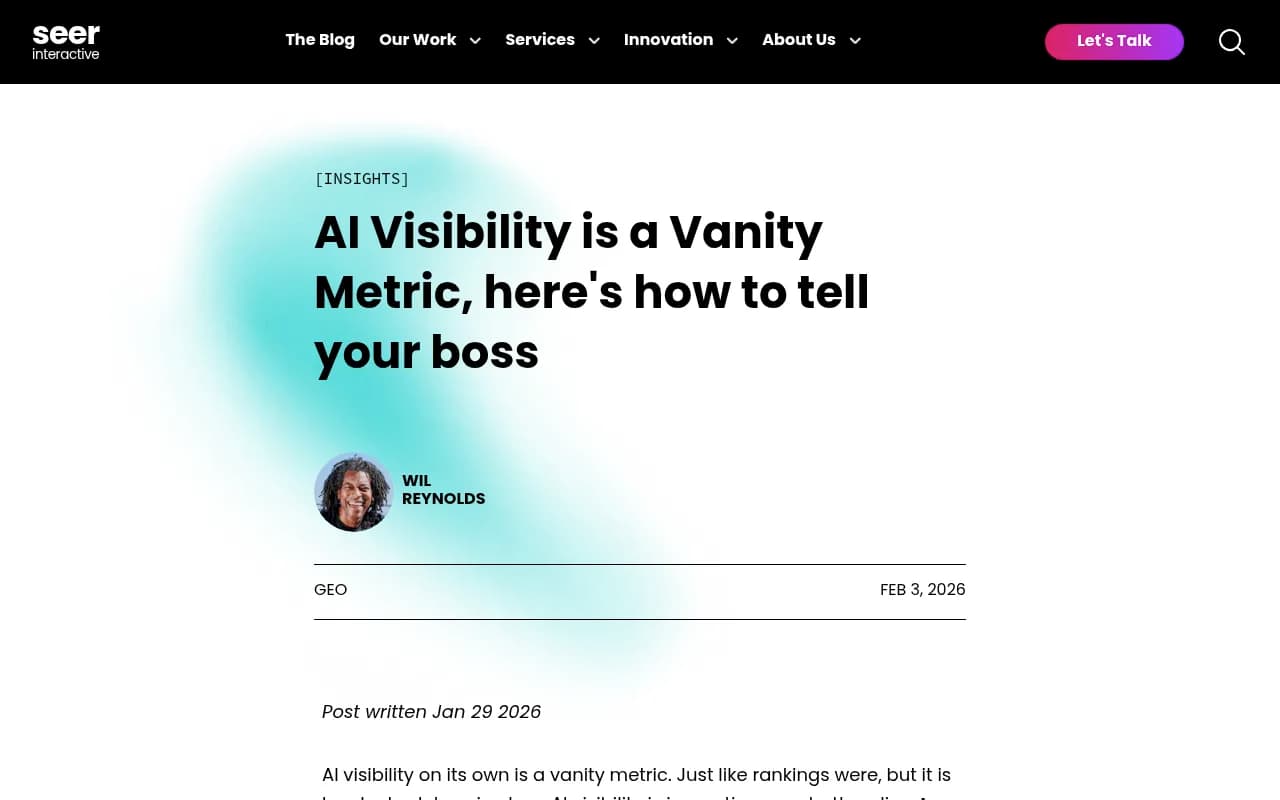
Wil Reynolds at Seer Interactive put it bluntly in early 2026: AI visibility on its own is a vanity metric. Not because the data is useless, but because a raw "you were mentioned 40 times this week" number tells you almost nothing without context -- which prompts, which models, what sentiment, and whether any of it drove actual behavior.
That said, the answer isn't to ignore AI visibility. It's to understand what each metric actually measures -- and what it doesn't.
The core metrics, explained honestly
Brand mention rate
This is the most basic metric: how often does your brand name appear in AI-generated responses to a set of tracked prompts?
It's useful as a baseline. If you're tracking 100 prompts relevant to your category and your brand appears in 12 of them, that's your mention rate. Track it over time and you'll see whether you're gaining or losing ground.
The catch: mention rate says nothing about context. Being mentioned as "a brand to avoid" counts the same as being mentioned as "the top choice." That's why you can't look at this number alone.
Citation share
Citations are different from mentions. A citation means the AI model linked to or explicitly credited your content as a source -- not just named your brand, but pointed to your website as the basis for its answer.
This is a stronger signal. It means AI models are treating your content as authoritative enough to reference directly. Citation share measures what percentage of total citations in your category go to your domain versus competitors.
Think of it like backlink share in traditional SEO, but for AI responses. If your category generates 500 citations across tracked prompts and 60 go to your site, you have a 12% citation share. That number is meaningful and actionable.
Share of voice (AI)
Share of voice in AI search measures how often your brand appears relative to competitors across a defined prompt set. If you and three competitors are all tracked across 200 prompts, and your brand appears in 80 of them while the next closest competitor appears in 110, you're at roughly 42% share of voice within that competitive set.
This metric is most useful for competitive benchmarking. It answers "are we winning or losing the AI visibility battle in our category?" rather than "are we visible at all?"

Sentiment and framing
How AI models describe your brand matters as much as whether they mention it. Sentiment analysis in this context isn't just positive/negative -- it's about framing. Is your brand described as a leader, a budget option, a niche tool, or an also-ran? Is it recommended proactively or only when users ask specifically about you?
Some platforms categorize this as "narrative control." The practical question is: when an AI model talks about your brand, does it say what you'd want it to say?
This is harder to track automatically because it requires reading actual AI responses, not just counting occurrences. But it's arguably the most important qualitative signal you have.
Prompt coverage
Prompt coverage measures how many of the relevant prompts in your category your brand appears in at all. This is distinct from mention rate -- it's about breadth rather than frequency.
If buyers in your category ask 500 different types of questions and your brand only shows up in responses to 40 of them, you have significant coverage gaps. Those gaps represent content your website is missing -- topics, comparisons, use cases, and questions that AI models want to answer but can't find on your site.
This is where visibility data becomes actionable. Identifying uncovered prompts tells you exactly what to write.

Metrics that sound useful but mislead
Raw AI referral traffic
You'll see "AI referral traffic" in Google Analytics -- sessions where the referrer is perplexity.ai, chatgpt.com, or similar. This number is real but incomplete.
The problem: most AI-influenced visits don't show up here. When someone asks ChatGPT about your product category, reads the response, then opens a new tab and searches your brand name directly, that visit shows up as direct or branded organic -- not AI referral. The actual influence of AI on your traffic is much larger than referral data suggests.
Use AI referral traffic as a floor, not a ceiling. It tells you the minimum impact, not the actual impact.
Position in AI responses
Some tools report "your brand appeared in position 3 of 7 sources." This sounds like a ranking, but it's not stable in the way SEO rankings are. The order of sources in AI responses varies across sessions, models, and even time of day. Treating position as a reliable metric will drive you crazy.
What matters more: were you included at all, and how were you described?
Visibility score (as a standalone number)
Many platforms roll up their data into a single "AI visibility score" -- a number between 0 and 100 or similar. These scores are useful for executive reporting and trend-spotting, but they're composite metrics built on proprietary formulas. Two platforms will give you different scores for the same brand because they weight things differently.
Use visibility scores for internal trend tracking. Don't compare your score across platforms or treat the absolute number as meaningful.
The attribution problem (and how to actually solve it)
Connecting AI visibility to revenue is the hardest part of this whole discipline, and most teams either skip it or do it wrong.
The core challenge: AI models don't always send trackable referral traffic. A user who discovers your brand through a ChatGPT recommendation might visit your site three days later via a branded Google search. Standard attribution models will credit Google, not ChatGPT.
There are a few approaches that actually work:
Crawler log analysis. AI crawlers (GPTBot, ClaudeBot, PerplexityBot, etc.) visit your website before they can cite it. If you can see which pages these crawlers are reading and how often, you get a leading indicator of what's likely to be cited. Platforms that provide real-time AI crawler logs give you this visibility -- you can see GPTBot hitting your new comparison page three days after you publish it, which tells you something useful before citation data even appears.
Branded search lift. When AI models recommend your brand, branded search volume tends to increase. If you publish new content targeting a specific prompt cluster and then see branded search volume rise in GSC over the following weeks, that's a reasonable signal that AI visibility is driving awareness.
Controlled content experiments. Publish a piece of content specifically targeting a gap in your prompt coverage. Track whether your citation share for those prompts improves over the next 4-6 weeks. This isn't perfect attribution, but it's the closest thing to a controlled test you can run.
Server-side tracking or GSC integration. Some platforms integrate with Google Search Console to correlate AI visibility changes with organic traffic changes. This is imperfect but better than nothing.
A practical framework for what to track
Here's how to think about metrics by their purpose:
| Metric | What it tells you | How often to check |
|---|---|---|
| Brand mention rate | Basic presence across tracked prompts | Weekly |
| Citation share | How authoritative AI models find your content | Weekly |
| Share of voice | Competitive positioning | Monthly |
| Sentiment / framing | How AI describes your brand | Monthly |
| Prompt coverage | Content gaps to fill | Monthly |
| AI crawler activity | Which pages AI bots are reading | Weekly |
| Branded search lift | Downstream impact of AI visibility | Monthly |
| AI referral traffic | Minimum direct traffic from AI | Weekly |
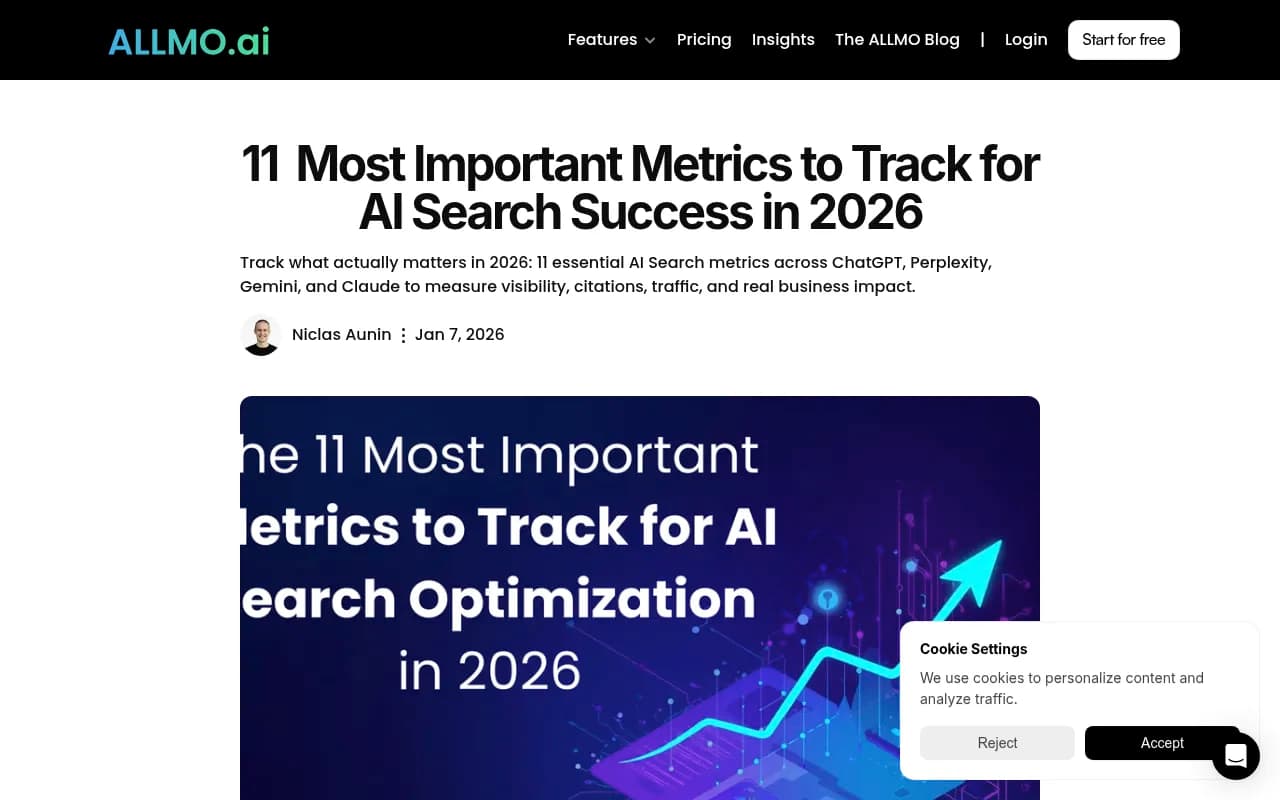
The key insight here is that different metrics operate on different timescales. Citation share and crawler activity can change within days of publishing new content. Share of voice and sentiment shift over weeks or months. Don't expect everything to move at the same pace.
Which models to track (and why they differ)
Not all AI models behave the same way, and your brand's visibility can vary significantly across them.
ChatGPT and Perplexity tend to be more citation-heavy -- they link to sources more often and more visibly. Google AI Overviews pulls heavily from content that already ranks well in traditional Google search. Claude tends to be more conservative with specific brand recommendations. Gemini's behavior varies depending on whether you're in AI Mode or standard search.
This means your citation share on Perplexity might be strong while your visibility in Google AI Overviews is weak, or vice versa. Tracking across multiple models isn't just thoroughness -- it tells you where your content strategy is working and where it isn't.
For most brands, prioritizing ChatGPT, Perplexity, and Google AI Overviews covers the majority of AI search volume. Adding Claude and Gemini gives you a fuller picture.



Tools worth knowing about
The market for AI visibility tracking has grown fast. Here's a quick orientation:
For comprehensive tracking and optimization: Platforms like Promptwatch track across 10+ AI models and go beyond monitoring to help you identify content gaps and generate content that's more likely to get cited. If you want to close the loop between visibility data and content action, this is the category to look at.
For focused monitoring: Tools like Profound, AthenaHQ, and Peec AI offer solid tracking dashboards. They're good for teams that primarily want to monitor and report rather than optimize.
For citation-specific tracking: LLM Clicks and LLMrefs focus specifically on tracking when and where AI models cite your content, which is useful if citation share is your primary metric.
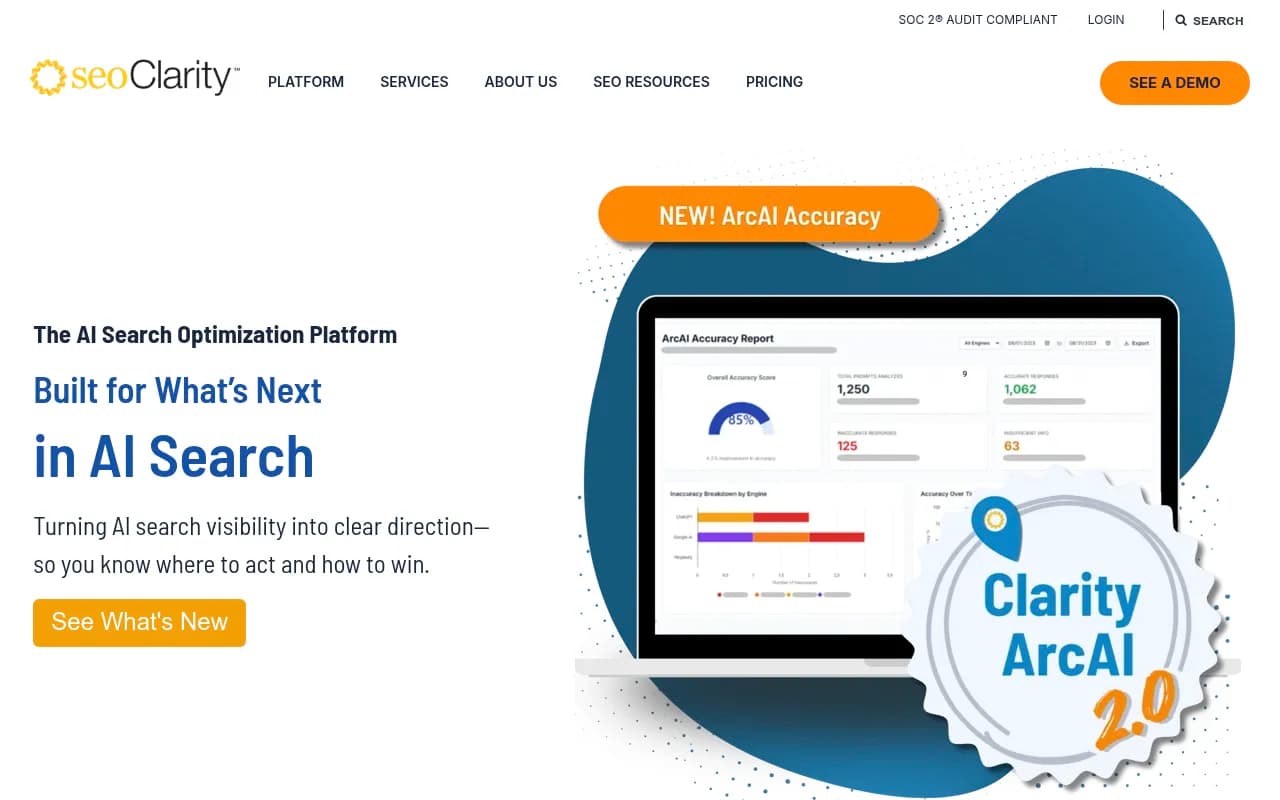
For enterprise teams: BrightEdge AI Catalyst and seoClarity integrate AI visibility tracking into broader enterprise SEO workflows, which makes sense if you're already using those platforms.
Turning metrics into action
Here's where most teams get stuck. They set up tracking, watch the numbers, and then... don't know what to do with them.
The metrics that matter most are the ones that point to specific actions:
- Low prompt coverage means you need to create content targeting the uncovered prompts. Not generic content -- specific articles, comparisons, and guides that directly answer the questions AI models are fielding.
- Low citation share despite decent mention rate usually means AI models know about you but don't trust your content enough to cite it. This often comes down to content depth, structure, and whether your pages directly answer the questions being asked.
- Negative or weak sentiment framing is harder to fix but usually traces back to how your content positions your brand. If AI models consistently describe you as "a cheaper alternative" when you want to be described as "the enterprise solution," your content isn't making that case clearly enough.
- Strong visibility on ChatGPT but weak on Google AI Overviews usually means your traditional SEO foundation needs work -- Google AI Overviews pulls heavily from pages that already rank well.
The practical cadence that works: weekly check on mention rate and crawler activity (to catch problems fast), monthly review of citation share and prompt coverage (to guide content strategy), quarterly look at sentiment and competitive share of voice (to assess whether the strategy is working).
The honest truth about where this is headed
AI search metrics are still maturing. The tools are getting better, but the fundamental challenge -- that AI responses are inconsistent, personalized, and not fully observable -- isn't going away. Rand Fishkin's research on answer inconsistency is a real constraint, not a temporary bug.
What this means practically: treat AI visibility data as directional, not definitive. A trend over 8 weeks is meaningful. A single data point is noise. Build your reporting around patterns, not snapshots.
The teams that will do well here are the ones who use visibility data to inform content decisions, then measure whether those content decisions actually moved the needle. That loop -- track gaps, create content, verify improvement -- is more valuable than any single metric score.
The metrics aren't the goal. The goal is being the brand that AI models recommend when your potential customers are asking the questions that matter most to your business.