Key takeaways
- Bluefish AI has real strengths: an unusually broad suite (monitoring, activation, measurement, commerce), Amazon Rufus coverage almost nobody else offers, and a genuinely differentiated AI Accuracy / Brand Vault capability launched in May 2026.
- The pricing is entirely quote-based. Independent estimates put contracts at $150K to $500K+ per year plus implementation, with no trial, no self-serve path, and a 4-6 week onboarding process.
- There is almost no first-hand public record of using it: zero G2 reviews of the actual AI product, and no meaningful TrustRadius or Gartner Peer Insights presence.
- Reported technical gaps include domain-level-only citation tracking (no page-level data), no prompt volume dataset, no content generation pipeline, no public API or docs, and no GA4-style conversion attribution.
- SOC 2 certification was still in progress as of May 2026, which matters if you are in a regulated industry.
What Bluefish AI actually is
Bluefish AI is a New York-based enterprise "agentic marketing platform" that monitors, optimizes, and measures how brands appear across AI channels: ChatGPT, Google AI, Claude, Perplexity, and, unusually, Amazon Rufus. It launched in 2024, founded by Alex Sherman (PromoteIQ, acquired by Microsoft) and Andrei Dunca (LiveRail, acquired by Facebook). It has raised $68M, including a $43M Series B in April 2026 co-led by Threshold Ventures and NEA, and names Adidas, American Express, Hearst, LVMH, and Ulta Beauty as customers.
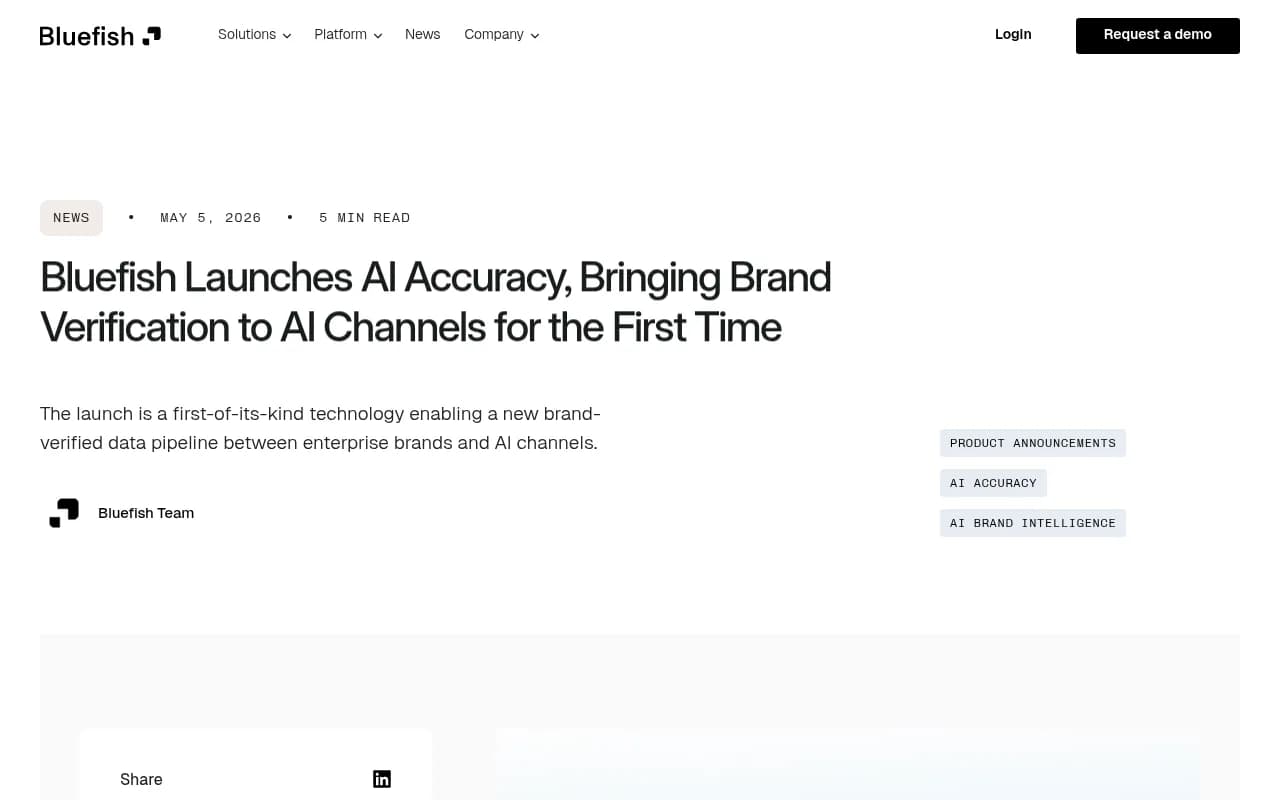
As of May 2026 the platform spans five modules: AI Monitoring, GEO Optimization, GEO Measurement, AI Commerce, and the new AI Accuracy. That last one is genuinely interesting. Brand Vault ingests your first-party content as a verified source of truth, extracts factual claims from AI responses, severity-scores discrepancies, and reports hallucinations to AI providers. For a brand managing hundreds of SKUs across markets where pricing and specs change constantly, that solves a real problem. Bluefish cites a March 2026 Rithum survey of 1,000+ US and UK shoppers finding that 58% lose trust in a brand when AI gets its product information wrong, and 16% abandon the purchase entirely.
So this is not a scam or vaporware. The named-customer list is strong evidence that someone large is paying. But the marketing story and the verifiable reality have gaps, and those gaps are what this review is about.
Limitation 1: The pricing is a black box, and the internet has started inventing numbers
Bluefish does not publish prices. There is no pricing page, no free tier, no trial, no self-serve signup. Every CTA routes to "Request a demo," and every plan goes through sales.
Independent estimates from OpenLens (June 2026) put contract value at $150K to $500K+ per year, plus $15K to $100K in implementation costs. Those are estimates, not vendor figures, but they are consistent with the Fortune 500 sales motion and the 4-6 week onboarding timeline multiple reviewers describe.
Here is where it gets strange. Because there is no official pricing, secondary sites have started publishing numbers that contradict each other completely:
| Source | Claimed Bluefish pricing | Consistent with reality? |
|---|---|---|
| Meev (July 2026, verified bluefishai.com/pricing returns 404) | Quote-only, six-figure estimates | Yes, matches primary source |
| PikaSEO | Starter $99/mo, Standard $249/mo | No, contradicts the 404 pricing page |
| Nick Lafferty / tryprofound network | Growth $299/mo, Business $799/mo | No, same problem |
| Dageno AI | "Custom quote, per-seat, enterprise" | Yes |
| Menra (July 2026) | "Publishes no pricing at all, sales-led" | Yes |
Some of these invented numbers look suspiciously like self-serve pricing from other tools in the category pasted onto Bluefish. I cannot prove intent, but the effect is bad either way: a buyer doing quick research will find a $99/month Bluefish plan on one page and a $500K enterprise contract on another. When a vendor's pricing narrative has degraded to the point where review sites are guessing, that is itself a limitation. Budget three to six weeks of procurement friction before you can even test the product.
Limitation 2: Almost nobody who uses it has written about it publicly
This is the most unusual fact about Bluefish for a company with $68M raised. Its G2 seller profile has zero reviews of the AI product. The reviews you will find under "Bluefish" on G2 belong to an unrelated open-source text editor. There is no meaningful TrustRadius or Gartner Peer Insights presence either.
Enterprise platforms with closed pilots often have thin public footprints, so this does not mean the claims are false. But it changes how you should evaluate. Reference calls with existing customers matter more than anything you can read, and a pilot should define its own success metrics up front rather than borrowing the marketing numbers. Ask specifically which modules are mature versus roadmap, and demand reference customers per module in production, not just for the suite as a whole.
Limitation 3: Citation tracking stops at the domain level
According to a May 2026 head-to-head comparison, Bluefish's citation analytics work at the domain level only. There is no individual URL breakdown. That means you can see that your brand was cited, and roughly how influential the cited domain was, but not which specific pages of yours earned citations and which did not.
For a content team, that is a big deal. Page-level citation data is what tells you which articles to update, which to replicate, and which to stop investing in. Without it, GEO optimization becomes guesswork at the page level.
There is a related measurement question worth asking. Bluefish's proprietary Impact Score and Influence Rank aggregate how closely cited content aligns with AI answer text. But the winnable inventory is small and engine-dependent: Promptwatch's data on average sources per response shows ChatGPT citing roughly 5 sources per web-search response, Google AI Overviews around 10, and Perplexity consistently near 10, while Microsoft Copilot has swung from under 2 to nearly 17 within weeks. Any influence metric needs to be interpreted against that small, volatile slot inventory, and it is worth asking Bluefish exactly how their scores normalize for it.
Limitation 4: No prompt volume data, and no disclosed methodology
Bluefish reportedly has no real user prompt volume dataset, and its prompt suggestion methodology is not publicly disclosed. Prompt sets are built jointly with Bluefish's professional services team rather than through a self-serve interface.
Why does this matter? Because without volume data, you cannot prioritize. "Are we visible for this prompt" is a much weaker question than "are we visible for a prompt thousands of people actually ask every month, and how hard is it to win." Tools that publish monthly prompt volumes and difficulty scores let you build a roadmap; a services-built prompt list gives you a list. If you are comparing platforms, prompt intelligence is one of the clearest dividing lines between trackers and decision-support tools.
Limitation 5: It tells you what to write but does not help you write, publish, or attribute
Three gaps that compound each other:
- No content pipeline. Bluefish produces content briefs, but there is no generation, optimization, or publishing workflow. You take the brief and do the work elsewhere.
- No conversion attribution. TryAnalyze's 30-day test flagged the missing GA4-style attribution layer as a "hard recommend" blocker: you can see visibility and favorability, but not what AI-driven visibility actually did to traffic and revenue.
- No CDN-level crawler-to-referral connection. Some competitors connect AI crawler activity to actual human referral traffic via CDN integrations (Cloudflare, Akamai, Fastly, AWS). Bluefish has no equivalent reported, so the "why" behind visibility shifts is harder to diagnose.
The result, as one reviewer put it, is a tool that runs in parallel to your existing stack rather than inside it. If you have already stitched GA4, Search Console, a CDP, and a CRM together, a parallel data lake usually means more reporting work for your ops team, not less.
Limitation 6: No public API, no docs, no MCP server, and gated exports
As of mid-2026, there is no public API, no MCP server, no documentation site, and no SDKs reported. Data export is reportedly gated to higher tiers, with basic CSV export and limited native BI integrations on lower plans.
For a Fortune 500 org with a data team, this might be survivable during a pilot. For everyone else, it means your data lives in Bluefish's house, on Bluefish's terms. Compare that with the direction of the rest of the market, where even mid-priced platforms ship REST APIs, Looker Studio connectors, and MCP servers that work with ChatGPT, Claude, and Cursor. There is a small irony here too: neither Bluefish nor some of its largest competitors serves an llms.txt file on their own site, which is an odd look for vendors selling AI-crawler-visibility expertise.
Limitation 7: SOC 2 is "in progress," not certified
As of the May 2026 comparison, Bluefish's SOC 2 audit was in progress rather than certified. The company has Google Workspace SSO and standard encryption, described as "SOC 2-aligned controls." Some alternative-comparison sites loosely imply SOC 2 compliance as an enterprise feature without confirming certification, so read those carefully.
If you are in pharma, financial services, insurance, or any regulated category, this is a procurement blocker or at minimum a delay. Competitors like Profound are SOC 2 Type II certified with HIPAA compliance, SAML/OIDC SSO, and RBAC. Given that Bluefish's own AI Accuracy pitch leans heavily on regulated industries, the compliance gap is worth pressing hard on in any evaluation.
Limitation 8: Claude and emerging-platform coverage is thin
Reviewers repeatedly flag Claude-side monitoring depth and emerging AI platforms as coverage gaps. Promptwatch's crawler data partially corroborates this: Claude's citation crawler grew from roughly 0.04% of tracked AI citation crawler traffic in mid-December 2025 to a peak of 1.73% in April 2026, a more than 100x increase in four months. So weak Claude coverage is a real gap, but a currently small one, roughly 1% of citation crawler traffic as of April 2026. The honest framing: it is a fast-growing channel you will eventually need, not the hole some competitors make it out to be today.
The broader concern is platform maturity. Bluefish launched in 2024 and splits engineering attention across five modules. A $68M company maintaining monitoring, GEO optimization, measurement, commerce, and accuracy is a different proposition from a single-focus competitor, and module depth will vary. Ask which modules have been in production with named customers for more than a year.
Limitation 9: It is structurally wrong for anyone below large enterprise
Multiple reviewers converge on this: Bluefish is complex to master, requires significant data expertise, and likely requires services spend on top of licensing. The closed pilot model prevents self-service evaluation entirely. Scrunch describes it as a "product-service hybrid" favoring customized deployment over standardized workflows.
If you are an agency, an SMB, or a small marketing team, this is not a tool you can try, and the reported contract sizes are not numbers you can hide in a quarterly budget. That is not a flaw in the product; it is a deliberate go-to-market choice. But most "Bluefish AI review" content buries it three paragraphs deep, so it belongs up front.
What Bluefish is genuinely good at
Fairness requires the other side:
- Breadth. Monitoring, activation, measurement, and commerce in one suite, where most of the category does monitoring only.
- AI Accuracy / Brand Vault. Brand-fact verification against a first-party source of truth, with hallucination reporting to AI providers, is a real differentiator.
- Amazon Rufus and agentic commerce coverage that almost no competitor offers.
- Blue-chip validation on both sides of the table: Adidas, Amex, Hearst, LVMH, and Ulta as customers; NEA, Threshold, Salesforce Ventures, Amex Ventures, and Bloomberg Beta as investors.
- Founders with two prior exits to Microsoft and Facebook, which explains the enterprise discipline.
If you are a Fortune 500 marketing org with procurement muscle, a regulated-industry accuracy problem, and heavy Amazon commerce exposure, Bluefish belongs on your shortlist. The question is whether it belongs there alone.
How the alternatives compare
For everyone else, the market has moved toward self-serve, transparent pricing, and deeper data access. A quick comparison of the most credible options:
| Platform | Published pricing | Page-level citations | Prompt volumes | Content pipeline | API / data access | Best for |
|---|---|---|---|---|---|---|
| Bluefish AI | No (quote-only, est. $150K-500K+/yr) | No, domain-level | No | Briefs only | Gated, no public API | Fortune 500, agentic commerce |
| Profound | Yes ($99 Starter, $399 Growth, custom enterprise) | Yes | Yes | Full brief-to-publish | CSV/JSON/API, BI integrations | Enterprise with self-serve option |
| Promptwatch | Yes ($95 Essential, $245 Professional, $579 Business) | Yes | Yes, with difficulty scores | Automated content agents with CMS publishing | REST API v2, MCP server, Looker Studio | Teams that want monitoring and execution |
| Otterly.AI | Yes (from $29/mo) | Partial | Limited | No | Limited | Budget-conscious small teams |
| AthenaHQ | Yes ($295/mo self-serve) | Yes | E-commerce focus | No | Yes | E-commerce brands |
| Peec AI | Mid-market | Yes | Yes | No | Yes | International brands (115+ languages) |
| Evertune | Yes (Pro from $800/mo) | Yes | Custom prompt sets | No | Yes | Statistical-rigor buyers |
A few notes on the table. Profound is the most direct enterprise rival, with $155M raised and SOC 2 Type II certification, though its own comparison content quotes slightly different Growth pricing across pages, so verify against the live pricing page. Otterly's weakness is a weekly refresh cadence and no competitive gap analysis. Peec AI is strong for multi-language coverage.
Promptwatch is worth a closer look if Bluefish's two biggest structural gaps, no execution layer and no attribution, are what killed it for you. It is the only platform in the 2026 comparison of 21 GEO platforms with a complete end-to-end stack: crawler logs that show when AI systems visit your pages and what they read, citation analytics down to individual pages plus Reddit and YouTube tracking, visitor analytics that connect AI visibility to actual traffic and conversions, and content agents that plan, write, and publish GEO-optimized content straight to Webflow, Framer, or WordPress. It starts at $95/month with a 7-day free trial, which is a category of evaluation Bluefish simply does not offer.


If you want a wider view of the category, the GEO software directory at bestgeosoftware.com covers the full landscape, and ai-rank-tools.com tracks the rank-monitoring specialists.
Questions to ask before you sign anything
If you do enter a Bluefish evaluation, treat the demo as an audit:
- Which modules are in production with named customers today, versus on the roadmap? Ask for references per module.
- Can you get citation data at the individual URL level? If not, how do they propose you optimize content?
- What is the prompt methodology, and is there any volume data behind prompt prioritization?
- What exactly can you export, on which tier, and is there an API or documentation?
- What is the SOC 2 certification date, in writing, and what happens contractually if it slips?
- How is AI-driven traffic attributed to conversions? Is there any GA4 or CDN-level integration?
- What does onboarding cost in services fees, and what is the 4-6 week timeline actually dependent on?
- Which AI platforms are covered today, and what is the commitment for adding new ones?
Define your own pilot success metrics before the pilot starts. With no public review footprint, the burden of proof is on the vendor, and a well-designed pilot is the only first-hand evidence you will get.
The verdict
Bluefish AI is a serious platform with a real point of view: that AI visibility is an enterprise-wide marketing problem spanning accuracy, commerce, and measurement, not just a prompt-tracking exercise. AI Accuracy and Brand Vault are legitimately novel, and the Amazon Rufus coverage is unmatched.
But the honest summary for most buyers in 2026 is this: you cannot check the pricing, you cannot check the reviews, you cannot check the API, you cannot check the compliance certification, and the citation data stops one level above where content decisions get made. Any one of those would be a caveat. All of them together mean the evaluation itself is the project.
If you are a Fortune 500 org with the budget and the procurement patience, run the pilot and ask the eight questions above. If you are anyone else, the self-serve end of the market has matured fast enough this year that there is no reason to wait three to six weeks for a quote to find out what an AI visibility platform can do for you.